


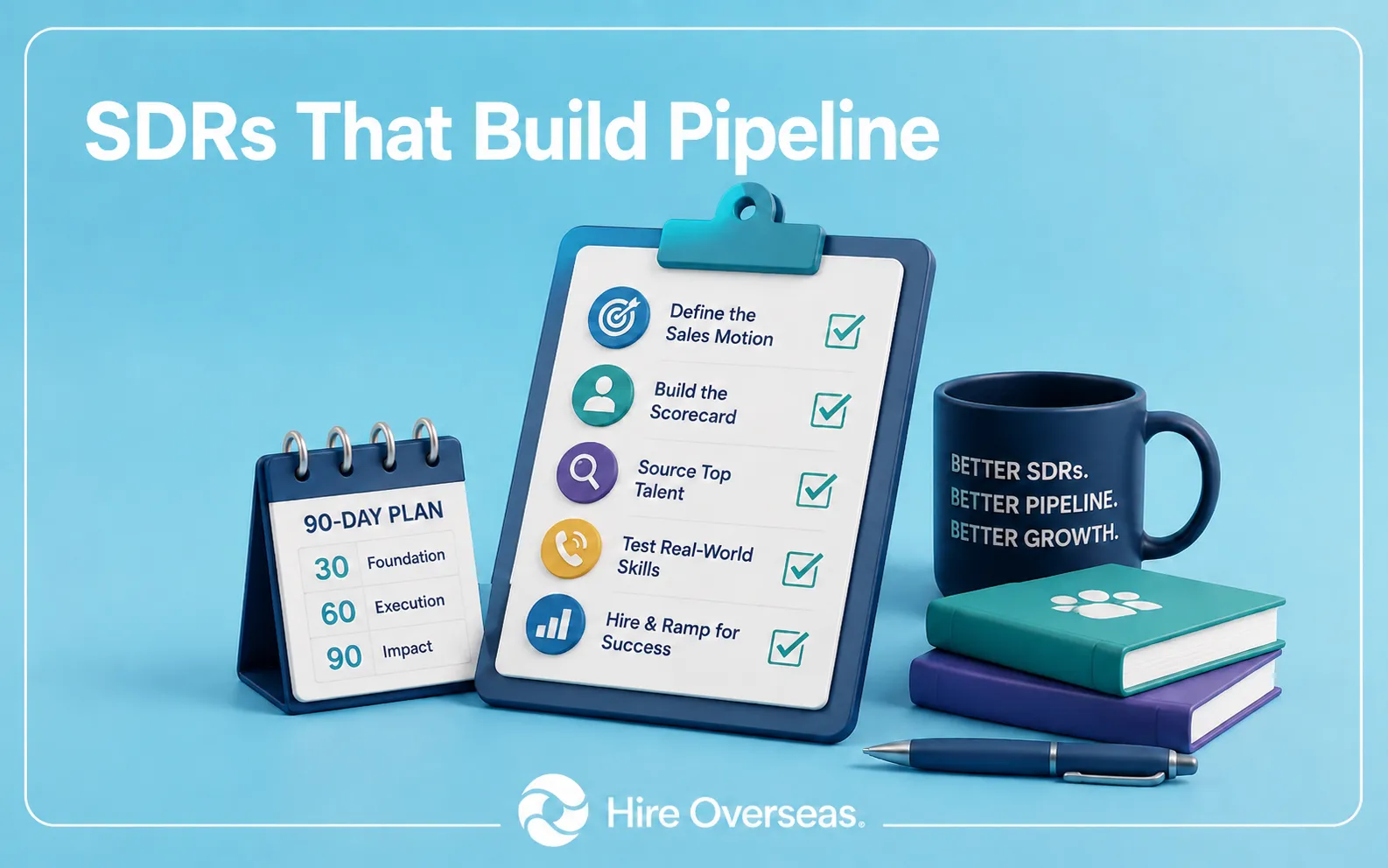
Hiring an SDR is easy to get wrong because most hiring processes test the wrong things.
A resume can tell you where someone worked. An interview can tell you whether they communicate well. Neither tells you whether that person can research the right prospect, earn attention on a cold call, handle an objection without sounding scripted, qualify an opportunity, and consistently do it again tomorrow.
At Hire Overseas, we hire and vet remote sales talent for companies building global teams. One pattern shows up repeatedly: the closer the hiring process gets to the actual SDR job, the easier it becomes to separate polished candidates from capable operators.
That means we do not evaluate SDRs on sales personality alone.
We look for evidence across the entire outbound workflow, including prospect research, written communication, cold calling, objection handling, qualification, CRM discipline, coachability, and consistency.
This guide breaks down how to hire SDRs using the same operational principles we apply when evaluating sales talent for Hire Overseas clients.
How to Hire an SDR: The Process We Recommend
To hire an SDR, first define the sales motion and performance expectations, then source enough candidates to compare meaningfully. Screen for proven outbound results, use scenario-based interviews, test cold calling and prospect research through live assessments, verify operational fit, and onboard the final hire against a structured 30-, 60-, and 90-day ramp plan.
Our process follows eight stages:
- Define the sales motion before defining the candidate.
- Build the SDR scorecard.
- Source enough candidates to create meaningful comparison.
- Screen for evidence of outbound ability.
- Run a structured SDR interview.
- Test the candidate through live sales simulations.
- Validate references, availability, and operational fit.
- Onboard against a structured ramp plan.
Each stage should remove a different type of hiring risk.
By the time someone receives an offer, you should know considerably more than whether they "seem good at sales."
Step 1: Define the Sales Motion Before Defining the SDR
This is where we would start with a client. Before sourcing candidates, we need to understand what the SDR will actually be responsible for.
An SDR selling a $500-per-month SaaS product to small businesses is not doing the same job as someone prospecting enterprise CFOs for a six-figure solution.
We clarify:
- Who is the ICP?
- Who does the SDR contact?
- Is the motion inbound, outbound, or both?
- Which channels will they use?
- What qualifies as a meeting?
- When does an SDR hand the opportunity to an AE?
- What is the average deal size?
- How long is the sales cycle?
- Which markets and time zones will they cover?
- What technology will they use every day?
This determines the profile we source.
Know Which SDR You Are Actually Hiring
We generally separate SDR requirements into several profiles.
- Outbound SDRs need stronger cold outreach, prospect research, objection handling, and resilience.
- Inbound SDRs need stronger qualification, responsiveness, discovery, and lead-routing discipline.
- AI-native SDRs need traditional prospecting ability plus fluency with modern research, enrichment, personalization, and automation workflows.
- SDR team leads need another layer entirely: coaching, QA, reporting, pipeline management, and accountability for team performance.
This distinction sounds obvious but is frequently skipped.
Companies sometimes start recruiting for "an SDR" before defining what that SDR will spend 80% of the week doing. The result is a candidate who may be competent but mismatched to the sales motion.
Step 2: Build the SDR Hiring Scorecard Before Reviewing Candidates
Once we understand the role, we define what evidence would make someone a strong hire.
At Hire Overseas, we prefer structured criteria because they reduce one of the biggest problems in sales hiring: overvaluing charisma. An SDR candidate should not move forward simply because the interviewer enjoyed talking to them.
A practical scorecard can include:
Not every category should carry equal weight.
- For a high-volume outbound role, cold calling and resilience may matter more.
- For an inbound SaaS SDR, discovery and qualification may deserve more weight.
- For an AI-native outbound role, we may place additional emphasis on prospect research, personalization, and the candidate's ability to work efficiently with automation.
The scorecard should follow the job. The job should not be redesigned around whichever candidate interviews best.
Step 3: Source Enough SDR Candidates to Recognize the Difference
One lesson we apply across remote hiring is simple: candidate volume improves hiring judgment. If you interview three people, the strongest of those three can easily look exceptional. That does not mean they are exceptional in the broader market.
For SDR hiring, we prefer building enough candidate volume to identify patterns in compensation expectations, experience, communication quality, tool exposure, sales environments, and actual outbound ability.
This becomes particularly powerful with remote SDR hiring because companies are no longer limited to candidates within commuting distance of an office.
We can source across markets such as:
- Philippines
- Latin America, including Colombia
- South Africa
- India
But we do not treat geography as the qualification.
The objective is to expand the talent pool while keeping the hiring bar high.
For example, the Philippines gives companies access to a mature remote-services workforce with extensive exposure to U.S. businesses, structured performance environments, and English-language customer communication.
Colombia can be particularly useful when U.S. working-hour overlap is a priority.
South Africa provides another strong English-language talent market.
The right market depends on the sales motion, working hours, budget, buyer geography, and experience required.
Because sourcing decisions often extend beyond SDRs into other outbound roles, this comparison of remote hiring versus offshore staffing models is worth reviewing before locking in a geographic strategy.
Step 4: Screen for Proof of Performance
This is where the SDR hiring process should start getting harder.
Sales candidates are usually better than the average applicant at interviews. That is part of the job. So we keep pushing for specifics.
If a candidate says:
"I consistently exceeded quota."
We want to know:
- What was your quota?
- What counted toward quota?
- What percentage did you achieve?
- How many meetings did you personally generate?
- Which channels produced them?
- What happened to those meetings after handoff?
- What did you do when performance dropped?
The deeper you go, the easier it becomes to distinguish direct experience from rehearsed interview language.
We Also Look for Operational Discipline
A strong SDR is not just someone who can talk.
Sales development involves repetitive execution.
Prospects need to be researched. Activities need to be logged. Follow-ups need to happen. CRM records need to remain accurate. Sequences need to be managed. Handoffs need context.
That is why we look for evidence of:
- consistent follow-up
- CRM hygiene
- preparation
- attention to detail
- time management
- process adherence
- responsiveness
The charismatic candidate who creates operational chaos is rarely the SDR you want to manage six months from now.
Step 5: Use a Structured SDR Interview
We recommend asking candidates the same core questions.
Otherwise, interviews become different conversations with different candidates, which makes objective comparison difficult.
SDR Interview Questions We Use to Test Prospecting Judgment
"Walk me through how you would research a new account."
Listen for more than the names of tools.
We want to understand how the candidate determines whether the account is worth pursuing.
"You have 100 accounts. How would you decide which 20 to contact first?"
This tests prioritization.
"Tell me about a prospect you decided wasn't worth pursuing."
This tests whether they understand that good prospecting includes knowing when not to sell.
Questions We Use to Test Performance Ownership
"What was your quota?"
Then ask:
"Where did you finish against it?"
Follow with:
"What caused the gap?"
The answer matters, but so does how they frame it.
Strong candidates can usually explain what was happening inside their funnel.
They know whether the problem was activity, connection rates, targeting, messaging, qualification, show rates, or another part of the process.
Questions We Use to Test Coachability
We don’t really work from a fixed list of questions here. Instead, we use a scenario-based evaluation approach.
We give the candidate a real scenario and let them respond.
Then we provide specific, direct feedback on their answer.
After that, we ask them to try again.
We pay close attention to the second attempt.
A candidate who can immediately incorporate feedback and adjust their thinking is often more valuable than someone who delivers a polished first answer but struggles to adapt.
Step 6: Run a Cold Call Role-Play Assessment
If the role involves cold calling, we want to hear the candidate cold call. Not talk about cold calling but actually do it.
This is one of the most useful ways to vet an SDR candidate because it compresses several important skills into a short exercise.
Before the assessment, give the candidate:
- your company or product information
- a target account
- the buyer persona
- enough preparation time to research the scenario
Then run the call. We typically evaluate five things.
1. The Opening
Can they earn another 20 seconds of attention?
We are not looking for a particular script. We are listening for confidence, clarity, relevance, and whether the opener sounds like an actual human conversation.
2. Discovery
Weak SDRs rush toward the pitch.
Stronger SDRs create enough relevance to ask a useful question.
We look at whether the candidate listens to the answer and changes direction accordingly.
3. Objection Handling
Introduce realistic resistance:
"Send me an email."
"We already use another provider."
"Not interested."
"We don't have the budget."
"I'm heading into another meeting."
We are not scoring candidates based on whether they magically overcome every objection.
We want to see whether they stay composed, listen, think, and respond naturally.
4. Call Control
A good SDR can move the conversation somewhere.
That might mean securing a meeting. It might mean identifying a better contact. Sometimes it means recognizing that the prospect is not qualified.
Good judgment matters more than forcing a calendar invite.
5. Coachability
After the first call, give the candidate feedback. Then run it again.
The difference between attempt one and attempt two is one of the strongest signals in the assessment.
Step 7: Add a Real Prospecting Exercise
Cold calling alone does not show us how the candidate thinks before the conversation.
So we recommend adding a short prospecting assignment.
Give the candidate a company that resembles your ICP and ask them to:
- Identify the most relevant contact.
- Explain why the account fits.
- Identify a plausible business problem.
- Write a short cold email.
- Create a cold call opener.
Now you can see the work behind the pitch.
- Did they research?
- Did they personalize intelligently or just insert the company name?
- Did they identify an actual business problem?
- Can they communicate value concisely?
This is much closer to the SDR's Tuesday afternoon than another hypothetical interview question. That is exactly what you want from an assessment.
Step 8: Set the SDR Ramp Period Before Day One
Hiring the right person is only half the process.
Companies can make a strong hire look weak by giving them an unstructured ramp.
The Bridge Group's 2025 SDR research puts average ramp time at approximately three months.
We use that as a useful benchmark, but not a universal rule.
Your ramp should reflect the complexity of your sales motion.
Days 1–30: Build Competency
The SDR should learn:
- product
- ICP
- buyer personas
- positioning
- qualification criteria
- CRM
- sales engagement platform
- outreach process
- objection handling
- AE handoff procedures
They should be listening to real calls, practicing messaging, researching accounts, and beginning supervised outreach.
Days 31–60: Build Consistency
Now we want repeatable execution.
The rep should increasingly own prospecting while managers review:
- call quality
- email quality
- activity
- meeting quality
- qualification accuracy
- CRM hygiene
- show rates
The objective is not simply "more activity."
We want to know whether the underlying process is becoming reliable.
Days 61–90: Build Toward Full Quota
By this stage, the SDR should be approaching normal production expectations.
But quota attainment alone does not tell the whole story.
If meetings are below target, inspect the funnel.
- Are they contacting enough prospects?
- Are prospects answering?
- Are conversations converting?
- Are meetings showing?
- Are those meetings actually becoming qualified opportunities?
That tells you what to coach. "Make more calls" usually does not.
Ramp structure matters just as much for other remote hires, and this practical system for onboarding technical talent without guesswork shows how the same staged-competency approach applies to engineering roles.
How We Think About SDR Quotas at Hire Overseas
We do not recommend copying another company's quota and assuming it will work for yours. Industry benchmarks give you a reference point. For example, Bridge Group's 2025 research found a global median of 10 Stage 0 held meetings per month, while average SDR ramp time was three months. But, quotas also need context. A rep prospecting small businesses for a relatively simple product should not necessarily carry the same meeting quota as an SDR targeting Fortune 500 executives for an enterprise solution.
Build quota backward from:
target pipeline → opportunity requirements → qualified meetings → conversion rates → required prospecting activity
This creates a quota tied to your economics rather than somebody else's sales dashboard.
If quota-setting reveals that your broader revenue infrastructure still relies on ad hoc outreach, this breakdown of how modern companies build predictable outbound pipelines covers the systems that turn SDR output into consistent revenue.
What We Have Learned From Hiring Remote SDRs
The biggest hiring lesson is not complicated: Do not hire SDRs based on how much they look like SDRs.
Hire based on evidence that they can perform the work.
We have seen candidates with polished resumes become considerably weaker once the role-play starts.
We have also seen less obvious candidates become much stronger when given an actual account, a prospect, and a problem to solve.
That is why our process is deliberately operational.
- We want to see candidates research.
- We want to hear them sell.
- We want to introduce objections.
- We want to give feedback and see what happens next.
- We want to understand their numbers.
- And we want to know whether they can operate consistently inside a process.
By the time a Hire Overseas client meets a vetted SDR candidate, much of the basic uncertainty should already have been removed. The client can spend more of the interview evaluating the things only they can judge: product fit, team chemistry, sales philosophy, and whether they want this person representing their company in the market.
This same evidence-based screening discipline extends across other client-facing roles, and this guide to hiring customer support talent shows how the same operational vetting principles apply outside of sales.
Direct SDR Hiring vs. Outsourcing Your SDR Function
There is an important distinction between hiring SDRs offshore and outsourcing sales development.
When you outsource the function, another provider may control much of the process, team, messaging, and day-to-day execution.
When you hire a dedicated remote SDR, the person becomes part of your sales organization.
Your team controls:
- messaging
- training
- ICP
- tools
- qualification
- coaching
- performance management
- sales culture
Hire Overseas sits on the hiring side of that equation.
We help companies find, vet, hire, and support dedicated global SDR talent while the company retains control of the sales function itself.
For businesses that already understand their sales motion and want to build internal capability, that distinction can be significant.
If you would rather delegate more of the sales development function itself, see our guide to outsourced SDR services to compare the two models.
If your broader ambition is to move past ad hoc contractor support altogether, this guide to building stable nearshore teams explains how founders structure full-time global hiring without losing day-to-day control.
The Best SDR Hiring Process Makes Performance Visible Before You Hire
The best SDR hiring process does not rely on resumes or interview chemistry. It tests the work itself: prospect research, cold outreach, objection handling, coachability, and consistent execution.
We have seen the same principle work across other outbound operations. Our clients at Wildcard built three offshore prospect research specialists through Hire Overseas for the cost of one U.S. hire, tripling ABM research capacity and cutting campaign preparation from three weeks to one. The difference was not simply lower-cost talent. The team was integrated into existing workflows, U.S. hours, AI tools, and clear playbooks.
Hire Overseas applies that requirements-driven approach to SDR hiring. We source across the Philippines, Latin America, and Africa, screen thousands of applicants, and advance fewer than 1% before matching vetted candidates directly with clients.
You keep control of your sales strategy, messaging, and team. We handle the recruiting, HR, international compliance, and replacement risk.
Ready to hire SDRs who fit your actual sales motion? Schedule a Free Discovery Call with a Global Hiring Expert at Hire Overseas.
SDR ramp and meeting benchmarks reference The Bridge Group's 2025 SDR research. Hire Overseas hiring methodology, screening criteria, market observations, and client outcomes are based on its recruiting process and placement experience.
