


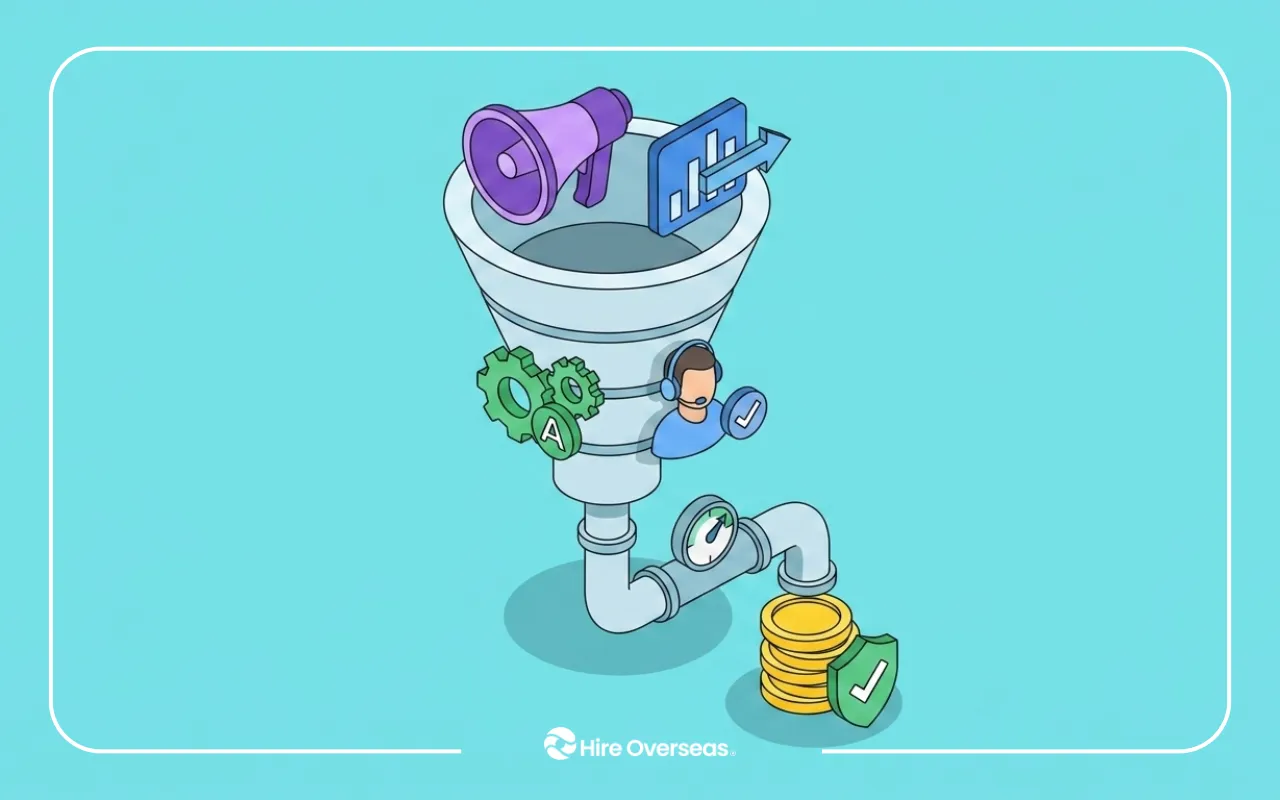
B2B lead generation is no longer just about cold emails or paid ads. Companies growing fastest today use structured systems that combine outbound outreach, intent data, automation, and human qualification to generate predictable pipeline opportunities. The challenge is not getting more leads but getting qualified buyers consistently. In this guide, you will learn how modern B2B lead generation services work, which providers and strategies perform best, conversion benchmarks across different models, and how businesses scale outbound operations more efficiently.
What Are B2B Lead Generation Services and Why Do They Matter?
B2B lead generation services help companies identify, attract, engage, qualify, and convert potential business customers into sales opportunities.
Instead of relying entirely on internal sales teams, businesses use external providers or dedicated outbound teams to create scalable lead generation systems.
These services commonly include:
- Prospect research
- Cold email outreach
- LinkedIn prospecting
- Appointment setting
- CRM management
- SDR support
- Lead qualification
- Intent-data targeting
- Multi-channel campaigns
- Sales automation workflows
The goal is not simply generating more leads.
The goal is generating qualified pipeline opportunities that sales teams can realistically close.
Today’s B2B buyers are more informed and harder to convert. Most decision-makers research vendors independently before speaking with sales teams. This means companies need consistent visibility throughout the buying journey.
Without structured b2b lead generation:
- Pipelines become unpredictable
- Customer acquisition costs rise
- Sales teams waste time on low-quality prospects
- Revenue forecasting weakens
- Growth becomes inconsistent
This is why modern businesses increasingly invest in lead generation services b2b providers offer to build scalable and repeatable revenue systems.
If you're deciding whether to outsource outbound prospecting or hire internally, this breakdown of how modern marketing recruitment agencies build scalable growth teams explains the cost, hiring speed, and operational tradeoffs growing B2B companies face today.
What Makes Modern B2B Lead Generation Different?
Traditional lead generation focused heavily on volume.
Modern b2b lead gen services focus on:
- Buyer intent
- Personalization
- Multi-channel outreach
- Qualified conversations
- Revenue attribution
- Pipeline efficiency
The strongest companies today optimize for pipeline quality, not just lead quantity.
The Modern B2B Lead Generation Process That Drives Qualified Pipeline
The best b2b lead generation services follow a structured process designed to consistently generate qualified pipeline opportunities instead of random leads. Each stage plays a critical role in improving conversion rates, reducing wasted outreach, and helping sales teams focus on buyers with real intent.
Step 1: Define the Ideal Customer Profile (ICP)
Strong lead generation starts with clear targeting. Before launching campaigns, companies identify exactly who they want to sell to.
This usually includes:
- Industry
- Company size
- Revenue range
- Buyer roles
- Geographic markets
- Pain points
- Technology stack
- Buying triggers
For example, a SaaS company selling HR software may target:
- U.S.-based companies
- 50–500 employees
- HR directors or COOs
- Businesses currently hiring rapidly
Without a clear ICP, outreach campaigns become inefficient because messaging feels too broad and conversion rates drop significantly.
Step 2: Build High-Quality Prospect Databases
Once the ICP is defined, lead generation teams build targeted prospect lists using lead generation software and data providers such as:
This step focuses on finding verified decision-makers who closely match the ideal buyer profile.
The goal is not collecting thousands of random contacts. The goal is building accurate, high-intent prospect databases that sales teams can realistically convert.
Top b2b lead gen service providers also enrich prospect data with:
- Company growth signals
- Hiring activity
- Funding announcements
- Technology usage
- Intent signals
This improves targeting precision and outreach timing.
If you want to see this applied to account-based outreach specifically, the Wildcard case study shows how they tripled their ABM research capacity for the cost of a single hire.
Step 3: Launch Personalized Outreach Campaigns
Modern b2b lead generation relies heavily on personalization because buyers receive hundreds of generic sales messages every week.
Strong outreach campaigns commonly include:
- Cold email sequences
- LinkedIn engagement
- Personalized Loom videos
- Industry-specific messaging
- Case-study-driven outreach
- Follow-up touchpoints across multiple channels
Instead of using generic templates, the best lead generation services for b2b companies tailor messaging around:
- Specific business pain points
- Industry trends
- Buyer goals
- Operational challenges
This makes outreach feel relevant instead of automated.
Step 4: Qualify Leads Before Sales Handoffs
Not every response becomes a qualified sales opportunity.
The best b2b lead generation services qualify prospects before handing them to sales teams. This prevents account executives from wasting time on low-quality meetings.
Leads are typically qualified based on:
- Budget
- Need
- Authority
- Timing
- Buying intent
For example:
- Is the company actively evaluating solutions?
- Does the buyer have decision-making authority?
- Is there a realistic implementation timeline?
This filtering process improves close rates and protects sales productivity.
Step 5: Book Qualified Sales Conversations
Once leads are qualified, they move into:
- Discovery calls
- Product demos
- Consultations
- Sales conversations
At this stage, the focus shifts from outreach volume to meeting quality.
The strongest b2b lead gen services optimize:
- Show rates
- Lead quality
- Sales acceptance rates
- Pipeline contribution
- Opportunity conversion
A booked meeting only matters if it has real buying potential.
Step 6: Continuously Optimize Campaign Performance
Lead generation is not a one-time setup. The best providers continuously improve campaigns using real performance data.
Top-performing teams constantly optimize:
- Email deliverability
- Messaging angles
- Prospect targeting
- Reply rates
- Meeting quality
- SDR workflows
- Channel performance
For example, if reply rates drop, teams may:
- Rewrite messaging
- Narrow targeting
- Improve personalization
- Rotate sending domains
- Adjust follow-up timing
The strongest b2b lead generation process is built around ongoing optimization, not static campaigns.
Ranked Comparison of the Best B2B Lead Generation Services
The B2B lead generation market has become more specialized. Some providers focus heavily on outbound cold outreach, while others specialize in intent-data targeting, content syndication, or SDR-driven pipeline generation.
The best fit depends on:
- Your sales cycle
- Average contract value (ACV)
- Internal sales resources
- Existing outbound infrastructure
- Budget and growth stage
Below is a ranked comparison of the best b2b lead generation services businesses commonly use today, including actual agencies, pricing ranges, strengths, limitations, and average conversion benchmarks.
Note: Pricing varies based on campaign scope, outbound volume, SDR headcount, regions targeted, and contract length. The estimates below reflect common market ranges.
1. Cognism-Powered Cold Outreach Agencies
Best for: Mid-market and enterprise outbound prospecting
Cognism-powered agencies focus on scalable outbound systems using verified B2B contact databases and SDR appointment-setting workflows.
Why Companies Use This Model
- Access to verified contact databases
- Better international targeting
- Faster SDR deployment
- Enterprise-grade outbound scalability
Main Limitation
These providers are often expensive for smaller businesses and work best when messaging, positioning, and offers are already strong.
2. Apollo-Powered Lead Generation Services
Best for: Startups and growth-stage outbound systems
Apollo-powered agencies use lean outbound infrastructure that combines prospect sourcing, sequencing, and CRM workflows into lower-cost outbound systems.
Why Companies Use This Model
- Lower setup costs
- Faster campaign launches
- Good for testing outbound channels
- Lean SDR operations
Main Limitation
Apollo-powered campaigns can suffer from deliverability issues if outbound infrastructure is not managed properly.
3. Intent-Data Lead Generation Providers
Best for: Enterprise pipeline acceleration
Intent-data platforms identify companies actively researching products or solutions, helping sales teams prioritize buyers with stronger purchase intent.
Why Companies Use This Model
- Higher-quality opportunities
- Better enterprise targeting
- Reduced outbound waste
- Strong account prioritization
Main Limitation
Intent-data systems are expensive and typically require mature CRM and outbound infrastructure to maximize ROI.
4. Content Syndication Lead Generation Companies
Best for: Top-of-funnel lead volume
Content syndication providers distribute gated content such as whitepapers, webinars, and reports to generate marketing-qualified leads (MQLs) at scale.
Why Companies Use This Model
- Fast lead generation volume
- Strong awareness campaigns
- Useful for long sales cycles
- Scalable top-of-funnel growth
Main Limitation
Content syndication often generates lower-intent leads that require extensive nurturing before becoming sales-ready.
5. Hybrid Outbound + Human SDR Models
Best for: Personalized outbound at scale
This model combines automated prospecting with human SDR qualification and multi-channel engagement. It is becoming one of the fastest-growing lead generation services b2b companies use because it balances automation with higher-quality conversations.
Why Companies Use This Model
- Better personalization
- Higher-quality meetings
- Stronger sales alignment
- Reduced wasted sales calls
Main Limitation
These systems require stronger operational management and campaign oversight.
Which B2B Lead Generation Model Performs Best?
There is no single “best” model for every business.
The strongest-performing companies usually combine:
- Intent-data targeting
- Personalized outbound
- AI-assisted prospecting
- Human SDR qualification
- CRM automation
- Multi-channel engagement
For example:
- Startups often begin with Apollo-powered outbound systems because of affordability and speed.
- Enterprise SaaS companies usually layer intent data with SDR qualification for higher-quality pipeline generation.
- Companies with longer sales cycles often combine content syndication with outbound follow-up campaigns.
The future of b2b lead generation is becoming less about mass outreach and more about building efficient revenue systems that consistently generate qualified opportunities.
Alternatives to Traditional B2B Lead Generation Agencies
Not every business wants or can afford large lead generation agency retainers. Many traditional b2b lead generation services charge thousands monthly for fully managed outbound campaigns, which may not make sense for startups, SMBs, or companies still building their outbound systems.
In many cases, businesses simply need:
- Consistent outbound execution
- Reliable prospect research
- Better CRM management
- Appointment follow-up support
- SDR operational assistance
- Scalable outbound workflows
This is why many growing businesses are exploring alternative lead generation models that focus on building scalable outbound infrastructure around existing sales systems instead of fully outsourcing everything.
Common Alternatives
Why Dedicated Outbound Support Teams Are Becoming More Popular
Many companies eventually realize that lead generation success is not only about launching campaigns. It also depends heavily on the operational systems supporting outbound execution every day.
As outbound systems become more advanced, businesses increasingly need ongoing support to maintain:
- Consistent prospecting workflows
- Faster lead follow-ups
- Better CRM accuracy
- Higher personalization quality
- SDR productivity
- Multi-channel outreach coordination
This is one of the biggest reasons dedicated outbound support teams are becoming more popular.
Instead of outsourcing everything to large agencies, companies are building flexible support structures around their existing lead generation process. This gives businesses more visibility, operational control, and scalability while keeping costs more manageable.
This model works especially well for companies already using platforms such as:
Instead of replacing existing workflows, dedicated support teams help businesses scale the operational side of outbound without rapidly increasing internal headcount.
For example:
- A startup may begin with one SDR and one lead research assistant to launch outbound affordably.
- A scaling SaaS company may add CRM and appointment-setting support to improve pipeline consistency.
- An agency may build a dedicated outbound support structure without aggressively expanding internal operations.
Providers like Hire Overseas support this by helping businesses build dedicated SDR, lead research, and outbound operations teams that integrate into existing sales workflows instead of replacing them entirely.
This approach works especially well for:
- Startups building outbound for the first time
- SMBs needing lower-cost SDR support
- Agencies managing outbound fulfillment for clients
- SaaS companies scaling prospecting operations
- Businesses wanting operational support without large agency retainers
As lead generation becomes more operationally intensive, many companies are realizing that sustainable pipeline growth often comes from building reliable outbound infrastructure, not just launching more campaigns.
Hire Overseas Insider: Best B2B Lead Generation Strategies According to Our Partners
After working with startups, SaaS companies, agencies, and scaling B2B teams, one pattern becomes very clear: the best lead generation strategy depends heavily on the company’s growth stage, outbound maturity, and operational capacity. According to many of the businesses we partner with, the strongest-performing lead generation systems are usually the ones aligned with the company’s current size, sales structure, and ability to execute consistently over time.
Startups and Early-Stage Businesses
Best strategy: Lean outbound + founder-led prospecting
For early-stage companies, speed and flexibility matter more than building massive outbound systems immediately.
Most startups first need to:
- Validate messaging
- Identify their ideal customer profile (ICP)
- Generate early pipeline
- Learn which channels convert best
According to many startup founders we work with, lean outbound systems often perform best early on because they allow faster iteration and lower upfront costs.
This usually includes:
- Cold email outreach
- LinkedIn prospecting
- Founder-led sales
- Apollo-powered outbound systems
- Lightweight CRM workflows
At this stage, many businesses also benefit from operational support around:
- Prospect research
- CRM organization
- Follow-up coordination
- Appointment scheduling
This helps founders spend more time selling and less time managing outbound admin work.
Why This Strategy Often Works Best
- Lower operational costs
- Faster outbound testing
- Easier messaging adjustments
- Faster feedback loops
- More flexible scaling
SMBs and Scaling B2B Companies
Best strategy: Multi-channel outbound + dedicated SDR support
As businesses grow, outbound systems become more operationally demanding.
This is usually where companies begin experiencing:
- SDR bandwidth limitations
- Follow-up inconsistency
- CRM disorganization
- Lower personalization quality
- Slower outbound execution
According to many scaling B2B teams we partner with, this is often the stage where operational support creates the biggest impact.
Businesses commonly combine:
- Cold email campaigns
- LinkedIn outreach
- Personalized Loom videos
- Appointment setters
- SDR qualification workflows
- CRM management support
Many companies at this stage also begin building dedicated outbound support teams to improve:
- Prospecting consistency
- CRM hygiene
- SDR productivity
- Lead qualification
- Follow-up management
This is also one of the most common stages where businesses partner with Hire Overseas to support SDR operations, lead research, appointment coordination, and outbound workflow management.
Why This Strategy Often Works Best
- Improves pipeline consistency
- Reduces operational bottlenecks
- Creates more selling time for SDRs
- Supports gradual outbound scaling
- More cost-efficient than large agency retainers
Mid-Market SaaS and B2B Companies
Best strategy: Intent-data targeting + multi-channel SDR outreach
Mid-market companies usually already have outbound systems in place. The challenge now becomes improving lead quality and increasing sales efficiency.
Many businesses at this stage begin layering:
- Intent-data platforms
- SDR qualification
- CRM automation
- Multi-channel outreach
- Account-based prospecting
Popular platforms include:
- 6sense
- Bombora
- ZoomInfo Intent
- Demandbase
According to several B2B companies we’ve worked with, intent-data targeting often helps reduce outbound waste because SDR teams focus more heavily on accounts already showing buying signals.
This typically improves:
- Meeting quality
- Pipeline velocity
- SDR efficiency
- Conversion rates
Why This Strategy Often Works Best
- Better targeting precision
- Reduced outbound waste
- Higher-quality opportunities
- Faster sales cycles
- Stronger sales alignment
Enterprise B2B Organizations
Best strategy: ABM + intent data + content syndication
Enterprise organizations usually manage:
- Longer sales cycles
- Multiple stakeholders
- Complex buying committees
- Large pipeline targets
This requires more advanced lead generation infrastructure and stronger coordination between sales and marketing teams.
Enterprise teams commonly combine:
- Account-based marketing (ABM)
- Intent-data targeting
- Content syndication
- SDR qualification
- Multi-channel engagement
- Revenue operations support
Popular providers and platforms include:
- Demandbase
- 6sense
- NetLine
- INFUSE
- Madison Logic
According to enterprise-focused teams we’ve observed, successful outbound execution at this level depends heavily on operational consistency and cross-functional coordination, not just lead volume.
Why This Strategy Often Works Best
- Better enterprise targeting
- Stronger sales and marketing alignment
- Higher pipeline visibility
- Scalable demand generation
- Better buying committee engagement
What High-Performing B2B Teams Consistently Have in Common:
Across businesses of different sizes, the strongest-performing outbound systems usually share several common traits:
- Clear ICP targeting
- Consistent follow-up systems
- Personalized outreach
- Reliable SDR support
- Strong CRM organization
- Operational consistency behind campaigns
According to many businesses we partner with, the biggest difference is often not the tools themselves but how well the outbound process is supported operationally over time.
Companies that build repeatable outbound infrastructure tend to generate more predictable pipeline growth compared to businesses relying only on one-off campaigns or volume-driven outreach.
You Do Not Need a Large Agency Retainer to Build a Strong B2B Pipeline
One of the biggest misconceptions in B2B lead generation is that scaling outbound always requires expensive agencies, massive SDR teams, or complex enterprise software from day one.
But according to many businesses we partner with, that is rarely how sustainable outbound growth actually starts.
Many companies first succeed by building lean, operationally efficient systems around:
- Consistent prospecting
- Reliable follow-ups
- Strong CRM organization
- SDR support
- Better outbound coordination
This is why alternative lead generation models are becoming more popular, especially among startups, SMBs, agencies, and scaling SaaS companies.
Instead of fully outsourcing pipeline generation, many businesses are now building dedicated outbound support structures that give them:
- More operational control
- Lower long-term costs
- Greater flexibility
- Easier scaling over time
For companies already running outbound campaigns or using platforms like Apollo, HubSpot, Cognism, or LinkedIn Sales Navigator, dedicated SDR and operational support often becomes a more scalable long-term solution than relying entirely on large agency retainers.
Hire Overseas supports businesses building this type of outbound infrastructure through dedicated SDR staffing, lead research support, CRM management, appointment-setting support, and outbound operations assistance designed to integrate into existing workflows.
If you are exploring alternatives to traditional lead generation agencies or looking for a more scalable outbound support structure, book a strategy call today.
