


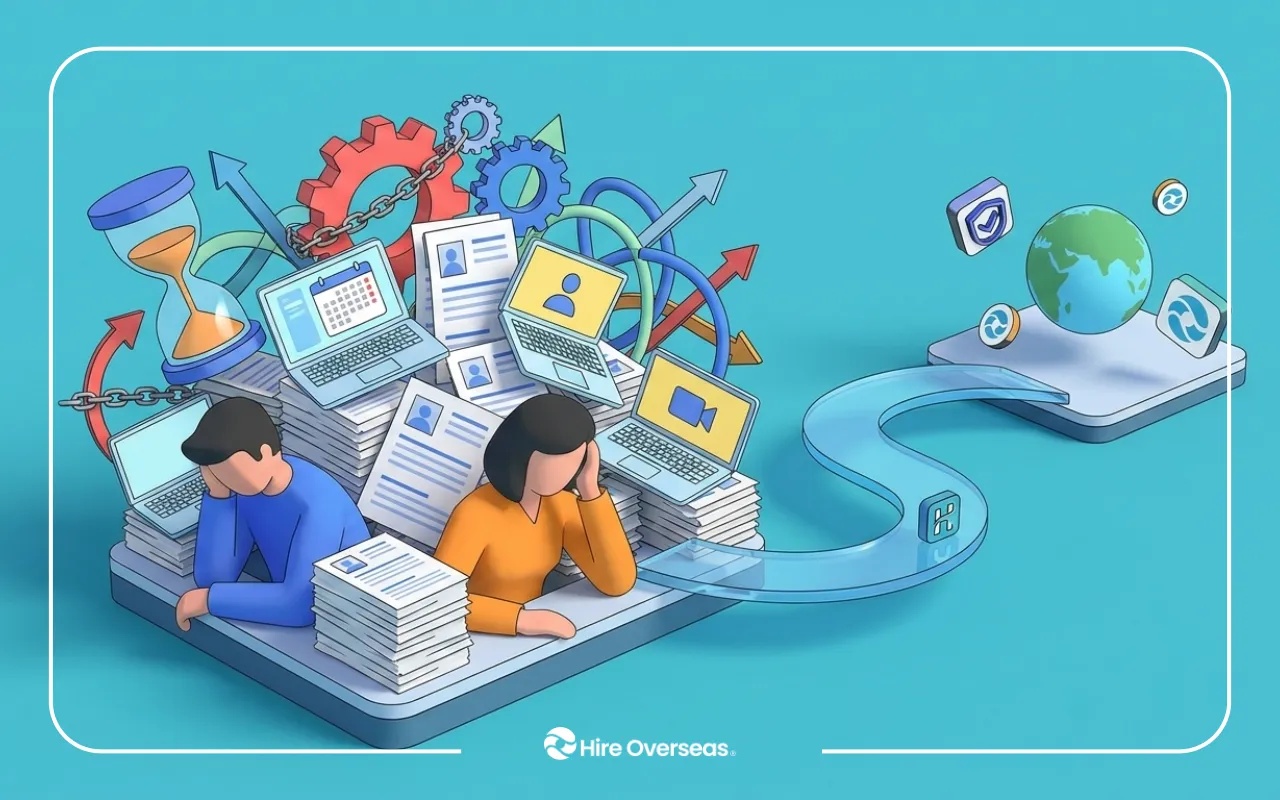
Many companies came to Hire Overseas after recruiting started consuming too much leadership bandwidth internally.
At first, founders and operational leaders were able to manage hiring themselves. But as the business grew, recruiting became increasingly time-consuming. Leaders found themselves reviewing resumes, coordinating interviews, following up with candidates, and managing hiring pipelines alongside their actual operational responsibilities.
For many growing companies, this was the point where recruiting stopped being an occasional task and became a full operational function requiring dedicated support.
When Hiring Bottlenecks Started Slowing Growth
Another common pattern we saw was hiring delays starting to impact operational performance across the business.
Many companies did not initially outsource recruiting because they lacked applicants. The problem was that internal hiring processes could no longer keep up with the company’s growth.
Open roles stayed unfilled longer, internal teams became overloaded, and recruiting pipelines struggled to maintain consistency as hiring demand increased.
At that point, recruiting delays stopped being an HR problem and became a business growth problem.
Open Roles Stayed Unfilled for Too Long
One of the clearest signs companies needed outsourced recruiting support was extended hiring timelines.
Critical positions often remained open for:
- several months
- multiple hiring cycles
- repeated interview rounds without progress
This created operational strain across the business, especially in:
- customer-facing teams
- operations departments
- technical roles
- leadership positions
In many cases, companies partnered with Hire Overseas after realizing slow hiring was already affecting delivery capacity and internal execution speed.
Internal Teams Became Overloaded While Waiting for New Hires
As hiring slowed down, existing teams usually absorbed the additional workload.
This often led to:
- employee burnout
- slower project execution
- operational bottlenecks
- reduced customer responsiveness
- hiring fatigue across managers and HR teams
Instead of continuously redistributing work internally, companies began outsourcing recruiting to maintain hiring momentum while allowing internal teams to focus on core operations.
Recruiting Pipelines Couldn’t Keep Up With Growth
Many growing businesses reached a point where recruiting became too inconsistent to manage informally.
Hiring pipelines often lacked:
- continuous sourcing
- candidate follow-up consistency
- structured screening workflows
- recruiting coordination capacity
This became especially common for companies hiring across multiple departments simultaneously.
To solve this, companies started using outsourced recruiting support to create:
- ongoing candidate pipelines
- more structured hiring workflows
- dedicated sourcing support
- consistent recruiting execution across open roles
Specialized Roles Became Increasingly Difficult to Fill
Another common trigger for outsourcing recruiting was difficulty sourcing specialized talent.
This included:
- technical hires
- operational leadership roles
- healthcare positions
- AI and automation-related roles
- offshore operational support positions
Many internal teams simply lacked the time, sourcing infrastructure, or recruiting specialization required to fill these roles efficiently.
Partnering with external recruiting support helped companies expand sourcing reach and reduce hiring delays for hard-to-fill positions.
If your hiring bottlenecks involve offshore operational support, this breakdown of outsourcing to the Philippines explains which roles companies scale fastest overseas, typical labor cost ranges, and why many SMBs use offshore teams to reduce recruiting pressure while maintaining operational continuity.
When Recruiting Became Operational Infrastructure
One of the biggest shifts we noticed among growing companies was how they started viewing recruiting itself.
At first, hiring was treated as an occasional responsibility handled internally when needed.
But as headcount grew, recruiting became operationally complex. Companies were no longer just filling roles. They were managing:
- sourcing pipelines
- candidate experience
- interview coordination
- hiring workflows
- recruiting timelines across multiple departments
At that stage, recruiting stopped functioning like a side responsibility and started functioning like operational infrastructure.
Another shift many companies experienced was the growing complexity of modern recruiting workflows. As hiring became more technology-driven through Applicant Tracking System platforms, sourcing automation, async screening, and AI-assisted recruiting tools, companies increasingly needed dedicated recruiting support capable of operating inside more structured hiring systems.
Hiring Required Continuous Pipeline Management
Many companies initially approached recruiting reactively.
A role would open, a job post would go live, and the hiring process would start from scratch.
Over time, this became increasingly inefficient, especially for businesses hiring regularly.
Companies that outsourced recruiting often needed:
- continuous sourcing pipelines
- proactive outreach
- ongoing candidate flow
- structured recruiting coordination
Instead of restarting the hiring process every time a role opened, outsourced recruiting created more consistent hiring momentum.
Recruiting Workflows Became Too Complex to Manage Informally
As hiring volume increased, recruiting workflows became harder to manage without dedicated structure.
Internal teams often struggled to consistently handle:
- candidate communication
- interview scheduling
- follow-ups
- application tracking
- hiring coordination across departments
This usually created:
- delayed responses
- inconsistent candidate experience
- interview bottlenecks
- slower hiring decisions
Many companies partnered with outsourced recruiting teams after realizing their hiring workflows had outgrown informal internal management.
Recruiting Needed Dedicated Ownership
Another pattern we consistently saw was unclear ownership across recruiting operations.
In many companies, recruiting responsibilities were spread across:
- founders
- HR teams
- operations managers
- department leaders
This created fragmented hiring processes and inconsistent recruiting execution.
Outsourced recruiting gave companies:
- dedicated sourcing support
- recruiting coordination ownership
- structured hiring workflows
- consistent pipeline management
For many SMBs and mid-market companies, this became the bridge between informal hiring and building a fully internal talent acquisition department.
Companies Needed Hiring Infrastructure, Not Just More Recruiters
One of the biggest misconceptions about outsourced recruiting is that companies simply need “more recruiters.”
In reality, most growing businesses needed:
- better hiring systems
- more structured recruiting workflows
- scalable sourcing processes
- operational recruiting support
The issue was rarely just candidate volume.
It was the lack of operational infrastructure supporting the hiring process itself.
This is why outsourced end-to-end recruitment became increasingly attractive for companies trying to scale hiring without immediately building large internal talent acquisition (TA) teams.
Once recruiting starts functioning like operational infrastructure instead of occasional hiring support, this recruitment process outsourcing guide explains how companies build scalable sourcing systems, structured hiring workflows, and dedicated recruiting operations without immediately expanding internal TA headcount.
When Recruiting Costs Stopped Scaling Efficiently
Another common reason companies outsourced recruiting was cost inefficiency inside their existing hiring process.
In many cases, the issue was not that recruiting was “too expensive.”
It was that the company was spending heavily on hiring while still struggling with:
- delayed hires
- inconsistent recruiting pipelines
- overloaded internal teams
- repeated agency fees
- operational slowdowns caused by unfilled roles
At that point, many companies realized the problem was not just recruiting cost. It was recruiting structure.
When Agency Fees Started Compounding Across Multiple Hires
Many companies initially relied on contingency recruiting firms for occasional hiring support.
But as hiring volume increased, agency fees became difficult to sustain operationally.
Typical contingency recruiting fees ranged from:
- 15%–30% of first-year salary per hire
For example:
- a $90,000 hire at a 25% fee = $22,500 placement cost
- several hires per quarter quickly created significant recruiting spend
This became especially noticeable for companies scaling across multiple departments simultaneously.
In many cases, companies started outsourcing recruiting differently after realizing they needed ongoing hiring infrastructure rather than repeated placement fees.
When Internal Recruiting Costs Increased Faster Than Hiring Efficiency
Some companies attempted to solve recruiting bottlenecks by building internal talent acquisition teams.
But internal recruiting operations often introduced additional overhead such as:
- recruiter salaries
- sourcing platforms
- LinkedIn Recruiter licenses
- onboarding costs
- management overhead
- recruiting coordination support
For many SMBs and mid-market businesses, this created growing operational costs before recruiting workflows were fully optimized.
At that point, outsourcing recruiting started making more sense operationally than rapidly expanding internal TA headcount.
If internal recruiting costs are growing faster than hiring efficiency, this guide to outsourcing employees breaks down which business functions companies commonly offshore first, how dedicated staffing models work, and where outsourced teams typically reduce operational overhead most effectively.
When Hiring Delays Became More Expensive Than Recruiting Support
One of the biggest cost realizations companies faced was that hiring delays often created larger business costs than recruiting itself.
Open roles frequently led to:
- slower execution
- employee burnout
- delayed customer delivery
- operational bottlenecks
- missed revenue opportunities
In many cases, the cost of leaving positions unfilled became more damaging than investing in dedicated recruiting support.
This was especially true for:
- operational roles
- technical positions
- customer-facing teams
- revenue-generating departments
When Companies Needed More Predictable Recruiting Costs
Another reason companies outsourced recruiting was cost predictability.
Traditional agency recruiting often created inconsistent hiring expenses depending on:
- hiring volume
- salary levels
- placement frequency
Dedicated outsourced recruiting support created more predictable operational structures instead.
Typical offshore recruiting support costs ranged from:
- recruiting coordinators: $1,200–$2,500/month
- recruiters and sourcers: $2,000–$4,000/month
For companies hiring continuously, this often provided:
- dedicated recruiting capacity
- ongoing pipeline support
- lower overhead per hire over time
- more scalable recruiting operations as the business grew
This is usually when companies stopped viewing outsourced recruiting as temporary hiring help and started treating it as long-term operational infrastructure.
Growth Insight: Why Outsourced Recruiting Worked Better For Our Partners
One pattern became clear after companies outsourced recruiting successfully:
The businesses that benefited most were not simply trying to fill open roles faster.
They were building more scalable hiring operations.
Over time, many companies realized the biggest advantage of outsourced recruiting was not just external sourcing support. It was creating more consistency, structure, and operational continuity across hiring itself.
It Was Integrated Into Operations
Companies often struggled with outsourced recruiting when it operated completely outside the business.
The strongest hiring outcomes usually happened when recruiting support became integrated into:
- internal workflows
- hiring communication
- operational priorities
- department planning
This created:
- faster hiring coordination
- better candidate experience
- more aligned recruiting execution
- clearer hiring visibility across teams
For many growing businesses, outsourced recruiting became most effective when it functioned like embedded operational support instead of a disconnected vendor relationship.
Dedicated Recruiting Support Created More Consistent Hiring
Another common lesson companies learned was that consistency mattered more than occasional hiring bursts.
Dedicated recruiting support helped companies maintain:
- continuous candidate pipelines
- ongoing sourcing activity
- structured hiring workflows
- more stable recruiting execution during growth periods
This reduced the stop-and-start hiring patterns many SMBs struggled with internally.
It Improved Hiring Efficiency
As hiring needs became more specialized, many companies realized general recruiting support was no longer enough.
Businesses increasingly needed recruiters capable of supporting:
- technical hiring
- healthcare recruitment
- operational leadership searches
- offshore staffing initiatives
- AI and automation-related roles
This is one reason many companies shifted toward outsourced recruiting partners with dedicated sourcing and specialization capabilities instead of relying solely on general staffing agencies.
Companies scaling operational support teams often pair outsourced recruiting with outsourced administrative services to reduce internal coordination workload, improve execution speed, and free leadership teams from repetitive operational tasks that slow growth.
Recruiting Performed Better as a Scalability Function
One of the biggest patterns we observed was that companies scaling successfully no longer treated recruiting as occasional administrative work.
They treated it as a core operational function tied directly to:
- growth capacity
- execution speed
- leadership efficiency
- operational scalability across teams
That shift is often when outsourced recruiting stops being temporary hiring support and starts becoming long-term hiring infrastructure.
The Most Scalable Companies Are Rebuilding How Hiring Works
One of the biggest patterns we observed after working with growing companies is this:
The businesses scaling hiring successfully were not simply hiring faster. They were rebuilding how recruiting operated internally.
As companies grow, recruiting becomes too operationally important to manage reactively. Hiring delays start affecting execution speed, leadership bandwidth, customer delivery, and team performance across the business.
That is why more companies are moving toward outsourced recruiting models that provide:
- dedicated hiring support
- structured recruiting workflows
- scalable sourcing capacity
- operational continuity across hiring
For many growing businesses, outsourcing recruiting was no longer just about filling open roles.
It became a decision about building a recruiting operation capable of scaling with the company itself.
Book a demo to discover what changes when recruiting stops slowing down the rest of the business.