


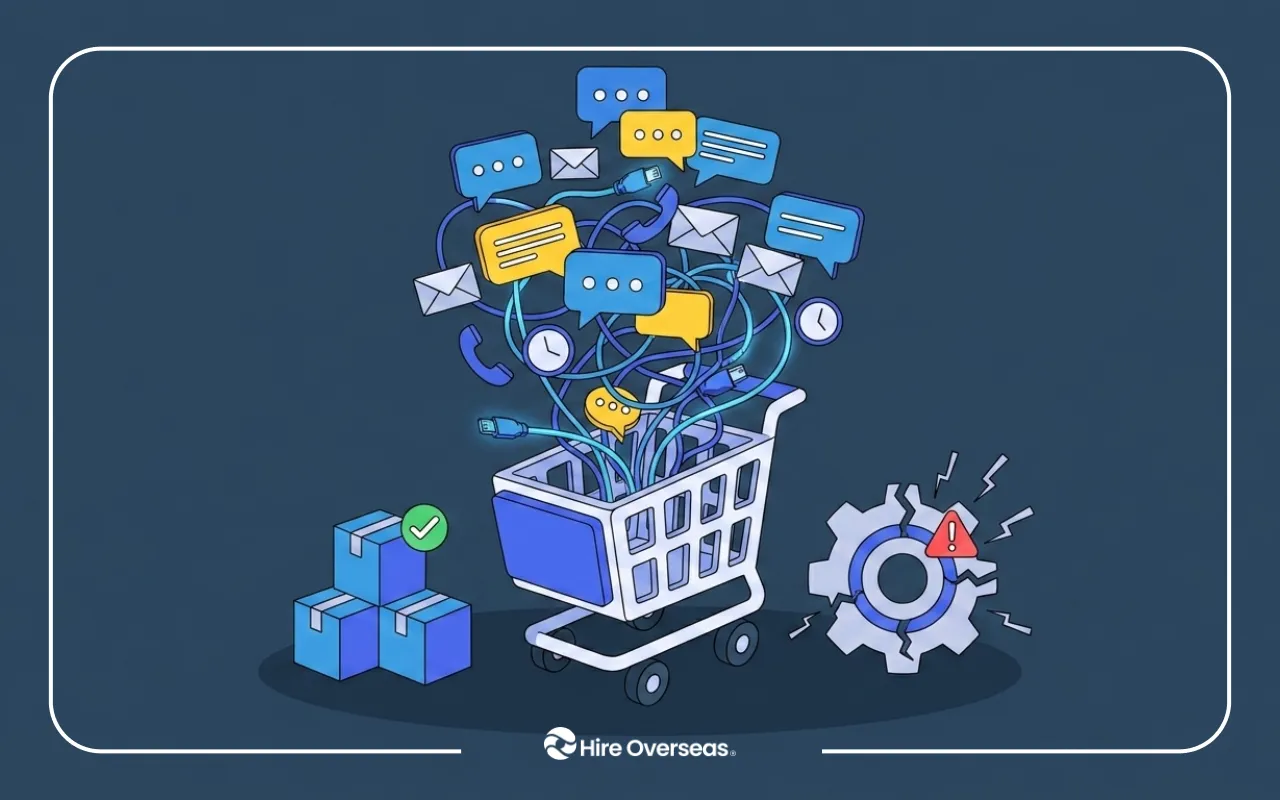
Most ecommerce brands do not think seriously about customer service outsourcing until support complexity starts affecting operations directly.
At first, support feels manageable internally. Founders answer emails themselves, small teams handle Shopify inboxes, and customer communication remains relatively straightforward. But as order volume grows, ecommerce support usually becomes far more operationally complex than many businesses initially expect.
At Hire Overseas, we’ve consistently seen that the brands scaling ecommerce customer service successfully are rarely the ones simply adding more agents reactively. They are usually the companies building structured support systems capable of handling fulfillment coordination, refunds, live chat, logistics communication, and customer retention simultaneously. Over time, ecommerce customer service outsourcing stops being just about reducing ticket backlog. It becomes about building operational infrastructure capable of supporting long-term customer experience at scale.
1. When Ecommerce Support Stops Being “Just Customer Service”
In the early stages of an ecommerce business, customer support usually feels relatively manageable.
Most founders or small internal teams handle basic order questions, shipping inquiries, product clarification, and occasional refund requests themselves. At that stage, ticket volume remains low enough that support still feels like a simple customer communication function rather than a major operational responsibility. But as ecommerce brands scale, support complexity usually grows much faster than most companies initially expect.
What many ecommerce brands eventually learn is that customer support starts changing operationally in very specific stages as order volume, fulfillment complexity, and customer expectations continue increasing.
First, Support Starts Coordinating Across Multiple Operational Systems
One of the first major shifts usually happens when support teams stop managing conversations alone and start coordinating directly with the operational systems behind the customer experience. As order volume increases, customer support gradually becomes tied to multiple operational systems simultaneously. At first, many ecommerce brands assume support complexity simply means handling more tickets.
But over time, support teams usually become responsible for coordinating across:
- fulfillment providers
- warehouse operations
- shipping carriers
- subscription systems
- returns management
- inventory visibility
- payment disputes
This is often the point where ecommerce customer service outsourcing starts becoming operationally important rather than simply administrative.
Customer support stops functioning like isolated customer communication. It becomes operational coordination.
At Hire Overseas, we’ve consistently seen ecommerce customer service outsourcing become significantly more valuable once brands realize support agents are no longer simply answering tickets. They are managing customer expectations across increasingly complex workflows tied directly to fulfillment, logistics, and retention.
Then, Customer Experience Starts Affecting Operational Stability Directly
Another major shift many ecommerce businesses experience is realizing customer support problems rarely stay isolated inside support itself.
At first, delayed responses or unresolved tickets may seem like isolated customer service issues.
But as order volume grows, support quality usually starts affecting much larger parts of the business operationally.
Delayed responses, unresolved shipping issues, inconsistent refund handling, and slow escalation management often begin impacting:
- customer retention
- repeat purchases
- review quality
- chargeback rates
- operational efficiency
This becomes especially noticeable once brands start scaling aggressively across multiple sales channels.
We’ve consistently seen ecommerce brands realize that support breakdowns often create operational strain long before leadership notices direct revenue impact. Negative customer experiences gradually start increasing refund pressure, overwhelming internal teams, and slowing fulfillment coordination across the business itself.
In many cases, ecommerce customer service outsourcing becomes necessary not because businesses lack support agents, but because customer communication itself has become operationally critical to maintaining growth stability.
For brands at this inflection point, this breakdown of when businesses should outsource fulfillment and logistics operations explains how companies structure backend coordination across warehouses, carriers, and inventory systems before support strain reaches customers directly.
2. Increasing Order Volume Usually Requires Scaling Support Systems Earlier Than Expected
One of the most common operational patterns we’ve observed at Hire Overseas is that ecommerce brands usually underestimate how quickly support complexity scales alongside order volume.
At first, many businesses assume scaling support simply means handling more tickets.
But as ecommerce operations grow, customer support gradually becomes tied to fulfillment coordination, logistics communication, refunds, subscription management, and omnichannel customer communication simultaneously.
This is often where support systems start falling behind much earlier than leadership initially expects.
Many ecommerce brands do not realize support infrastructure needs to scale proactively until operational pressure has already started affecting customer experience internally.
WISMO Tickets Often Become One of the Earliest Signals of Operational Strain
For many ecommerce businesses, “Where Is My Order?” tickets are often the first sign that support systems are no longer scaling efficiently alongside fulfillment operations.
At first, occasional shipping inquiries remain manageable.
But as order volume increases, support teams gradually become responsible for:
- delayed shipping concerns
- tracking discrepancies
- fulfillment escalations
- inventory confusion
- delivery coordination
- refund requests tied to logistics issues
What many ecommerce brands eventually realize is that these tickets are rarely just customer service conversations.
They are operational coordination problems tied directly to fulfillment visibility, logistics communication, and order management systems.
At Hire Overseas, our partners share that seeing WISMO tickets becomes one of the first indicators that their ecommerce support workflows are no longer scaling efficiently alongside fulfillment operations.
This is one reason outsourcing ecommerce order support becomes increasingly important as brands scale fulfillment operations across multiple systems, warehouses, and carriers simultaneously.
Internal Teams Gradually Start Becoming Ad Hoc Support Extensions
Before many brands formally outsource ecommerce customer service, internal teams usually absorb the operational pressure themselves.
Founders answer support late at night.
Operations teams step into escalations.
Marketing teams respond to social complaints.
Fulfillment teams repeatedly get pulled into customer communication.
At first, these adjustments may feel temporary or manageable internally.
But over time, ecommerce brands usually start experiencing operational drag across multiple departments simultaneously because customer support is no longer staying contained inside support workflows alone.
This often creates:
- slower internal execution
- inconsistent support quality
- delayed responses
- employee burnout
- fragmented communication across teams
Many businesses initially assume they simply need more support agents.
But in reality, they often need more scalable support systems capable of handling increasing operational complexity without continuously pulling internal teams into reactive customer escalations.
As order volume continues increasing, support complexity usually expands even further once customer communication starts spreading across multiple channels simultaneously.
Increasing Order Volume Usually Expands Support Channels Faster Than Teams Can Coordinate Them
As ecommerce businesses continue scaling, customer communication usually expands across:
- email support
- live chat
- social media messaging
- Shopify inboxes
- SMS support
- subscription platforms
At first, many ecommerce brands manage these channels informally through shared inboxes or small internal support teams.
But as support volume increases, customer communication often becomes fragmented very quickly.
Customers begin reaching out across multiple channels simultaneously while internal teams struggle to maintain visibility across conversations, escalations, and order history consistently.
Many of our ecommerce partners eventually experience ecommerce customer service outsourcing becoming operationally necessary once support starts spreading across multiple communication channels without structured workflows in place.
Without centralized systems and operational coordination, teams often struggle with:
- duplicated responses
- inconsistent customer information
- delayed escalations
- disconnected support history
- fragmented communication between departments
This is one reason outsourcing ecommerce live chat support and outsourcing ecommerce email support often becomes part of broader operational scaling rather than isolated staffing decisions alone.
For ecommerce brands scaling across multiple sales channels simultaneously, this guide on building scalable operations with Amazon FBA virtual assistants explains how sellers delegate order coordination, fulfillment tracking, and backend operational workflows before ticket backlog starts compounding internally.
3. Many Ecommerce Brands Eventually Realize Reactive Support Outsourcing Creates New Operational Problems
One of the biggest lessons many ecommerce brands eventually learn is that outsourcing customer support reactively often creates additional operational strain instead of immediate stability.
At Hire Overseas, we’ve consistently seen ecommerce customer service outsourcing perform best when brands scale support proactively before workflows, fulfillment coordination, and customer communication become highly reactive internally.
Over time, many ecommerce brands begin realizing that strong outsourced support systems usually depend just as much on operational readiness as staffing itself.
Outsourced Teams Cannot Instantly Fix Broken Internal Workflows
One of the biggest lessons many ecommerce brands eventually learn is that outsourced support teams cannot immediately stabilize workflows that were already disorganized internally.
Many growing ecommerce businesses initially operate through:
- undocumented SOPs
- inconsistent refund handling
- fragmented fulfillment communication
- unclear escalation ownership
- manually updated support processes
At first, these gaps may feel manageable internally because existing teams already understand the business context informally.
But once outsourced ecommerce customer service teams are introduced, operational inconsistencies usually become much more visible very quickly.
At Hire Overseas, we’ve consistently seen ecommerce customer service outsourcing perform significantly better once brands create clearer operational structure around escalation handling, fulfillment coordination, and communication expectations before scaling support further.
Strong outsourced support usually amplifies operational structure.
It rarely replaces the need for it.
Waiting Until Peak Season Makes Support Scaling Harder
Another major realization many ecommerce brands eventually have is that support outsourcing becomes much harder when implementation begins during peak operational pressure.
This often happens during:
- seasonal sales spikes
- product launches
- holiday promotions
- viral product growth
- rapid order expansion
At first, outsourcing feels like immediate operational relief.
But onboarding support teams while fulfillment systems, escalation workflows, and customer communication are already under heavy strain usually creates a far more difficult operational transition.
Many ecommerce brands eventually learn that the strongest support systems are usually built before operational pressure peaks, not after customer frustration and ticket backlog have already started compounding internally.
Prioritizing Resolution Quality Over Faster Replies Alone
One of the biggest operational shifts many ecommerce brands eventually experience is realizing that fast replies alone rarely create strong customer support systems.
At first, many businesses focus heavily on:
- lowering first-response times
- increasing ticket output
- reducing queue volume
- closing conversations quickly
But over time, brands usually realize customer experience depends far more on resolution quality than response speed alone.
At Hire Overseas, we’ve consistently seen the strongest ecommerce customer service outsourcing outcomes happen when support teams are trained around escalation accuracy, fulfillment coordination, retention-focused communication, and complete issue resolution. Because as ecommerce brands scale, support quality usually becomes far more operationally important than simply replying faster.
If operational friction keeps surfacing before your business has formally structured support ownership, this breakdown of how outsourced administrative services fix inefficiencies in growing businesses covers how to restructure workflows and clarify execution responsibility before customer-facing pressure compounds across departments.
4. The Best Ecommerce Support Agents Usually Understand Operations, Not Just Customer Service
One of the biggest realizations we’ve had at Hire Overseas after working closely with growing ecommerce brands is that the strongest support agents rarely come from traditional “customer service only” backgrounds. As ecommerce operations become more complex, high-performing support teams gradually start operating much closer to embedded operations coordinators. At scale, ecommerce customer service outsourcing requires far more than answering customer messages quickly.
Over time, we’ve seen that the support teams creating the best outcomes for ecommerce brands are usually the ones that understand how customer communication connects directly to fulfillment, logistics, retention, and operational execution across the business.
After supporting ecommerce brands through different stages of growth, we started noticing several consistent patterns across the support teams that scaled most successfully:
Ecommerce Support Hiring Performs Better When Candidates Already Understand Operational Pressure
One of the biggest recruiting patterns we’ve observed at Hire Overseas is that ecommerce support agents with previous exposure to operational environments usually ramp much faster than candidates coming from purely script-based support roles.
For example, some of the strongest candidates we’ve placed previously had backgrounds in:
- ecommerce operations coordination
- logistics communication
- Shopify store support
- fulfillment issue resolution
- subscription billing support
- high-volume live chat environments
These candidates often adapt faster because they already understand how ecommerce support connects directly to operational execution behind the scenes.
Instead of viewing tickets as isolated customer conversations, they naturally think in terms of:
- order flow
- escalation urgency
- fulfillment coordination
- customer retention impact
- operational resolution speed
At Hire Overseas, we’ve consistently found that this operational mindset often becomes more valuable long term than scripted customer service experience alone.
Strong Ecommerce Support Teams Usually Need Operational Training, Not Just Customer Service Training
Another major lesson we learned after supporting ecommerce brands is that high-performing outsourced ecommerce customer service teams usually require much deeper operational onboarding than many businesses initially expect.
The strongest ecommerce support agents are rarely successful because they simply answer quickly.
They usually perform best once they understand:
- Shopify workflows
- Gorgias systems
- fulfillment communication processes
- refund structures
- escalation routing
- retention priorities
- brand tone expectations
- logistics coordination
At Hire Overseas, we’ve consistently seen ecommerce support performance improve significantly when support onboarding includes operational workflow training rather than customer service scripting alone.
This becomes especially important once ecommerce brands start scaling:
- omnichannel communication
- fulfillment coordination
- returns management
- subscription support
- retention-focused support systems
The more operational visibility support teams have, the more independently and consistently they usually perform.
Embedded Support Teams Usually Resolve Problems Faster
Another major lesson we’ve learned after working with ecommerce customer service outsourcing teams is that support performance improves significantly once teams become embedded directly into operational workflows.
The strongest support teams usually develop familiarity with:
- Shopify admin systems
- fulfillment communication
- internal escalation paths
- refund approval structures
- retention policies
- operational response expectations
Over time, high-performing outsourced ecommerce customer service teams stop functioning like external vendors.
They begin operating like embedded operational infrastructure connected directly to customer experience and fulfillment execution.
We've learned that this create:
- faster resolutions
- more consistent customer communication
- fewer escalation delays
- better cross-functional coordination
- improved operational visibility
The difference becomes especially noticeable once ecommerce brands begin scaling order volume rapidly across multiple channels and support systems simultaneously.
Strong Support Teams Often Identify Operational Problems Earlier Than Leadership
One of the most overlooked lessons we’ve learned after working with ecommerce partners is that strong support teams often surface operational problems before leadership notices them internally.
Because support agents interact directly with customers every day, they usually identify recurring issues much earlier, including:
- shipping delays
- fulfillment bottlenecks
- inventory confusion
- refund friction
- broken workflows
- recurring customer complaints
High-performing ecommerce support teams improve operational visibility across the business itself, not just customer communication.
That is often the point where ecommerce customer service outsourcing stops functioning like temporary staffing support and starts becoming long-term operational infrastructure tied directly to customer experience, retention, and scalability.
For ecommerce brands ready to move beyond reactive ticket handling into embedded operational infrastructure, this guide on what virtual assistant outsourcing looks like at the startup and enterprise level explains how businesses identify the right moment to scale dedicated remote support roles before internal execution capacity starts limiting customer experience directly.
Build Ecommerce Support Systems Before Operational Pressure Reaches Customers
One of the biggest lessons growing ecommerce brands eventually learn is that customer support problems rarely stay contained inside support for very long.
At first, the warning signs feel manageable internally. Response times slow down, shipping complaints increase, and internal teams become increasingly reactive as ticket volume grows.
But over time, those issues usually start exposing much larger operational problems behind the scenes. Fulfillment coordination becomes inconsistent, customer communication starts fragmenting across channels, and operational pressure gradually becomes visible to customers directly.
That is why the strongest ecommerce brands eventually stop treating support like a simple ticket-handling function. They start building ecommerce support systems capable of scaling alongside fulfillment operations, logistics coordination, and customer experience itself.
At Hire Overseas, we’ve consistently seen that the ecommerce brands scaling support successfully are usually the ones building operational support infrastructure before customer frustration starts compounding publicly.
If your ecommerce support operation is starting to feel reactive, fragmented, or difficult to scale internally, this is usually the stage where the right outsourced ecommerce customer service team creates long-term operational stability.
Talk to us at Hire Overseas today about building an ecommerce support team designed to to scale alongside your fulfillment operations, customer experience standards, and long-term growth goals.
