


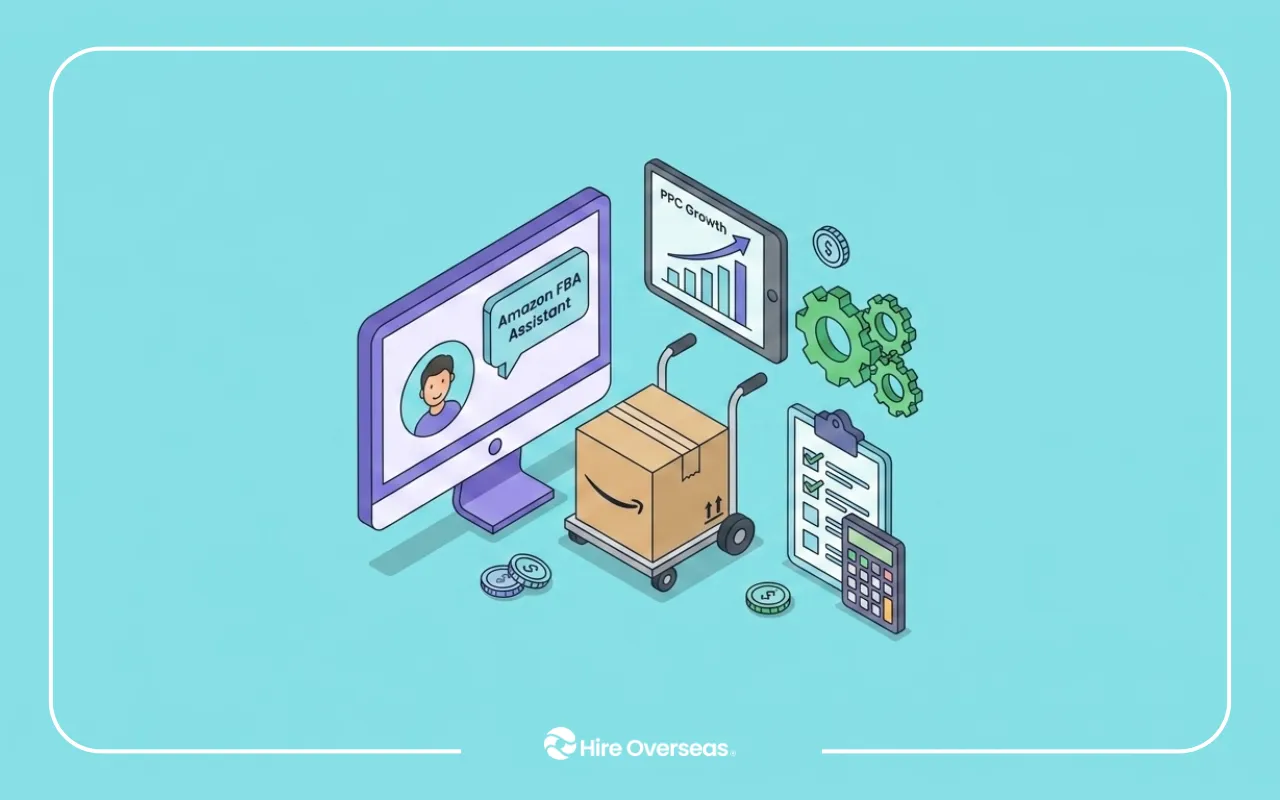
Running an Amazon FBA business becomes operationally complex faster than most sellers expect. Inventory management, listing updates, reimbursements, customer support, shipment tracking, and PPC reporting quickly consume time that should be spent on growth. This is why many sellers eventually hire an Amazon FBA virtual assistant. But successful hiring is not just about delegation. It is about building reliable operational support that helps your Amazon business scale efficiently without creating more operational chaos. At Hire Overseas, we’ve seen that the strongest Amazon sellers usually build structured support systems early instead of waiting until operations become overwhelming. Here’s the exact process we recommend for hiring an Amazon FBA VA successfully.
Step 1: Identify Which Amazon FBA Tasks Are Slowing Growth
One of the biggest mistakes sellers make when hiring an Amazon FBA virtual assistant is hiring too generally.
Many founders simply say: “I need help with Amazon.”
But strong Amazon FBA operations usually assign ownership around workflows instead of vague responsibilities.
Before hiring a virtual assistant for your Amazon FBA business, identify which operational bottlenecks consume the most time weekly and consistently pull you away from higher-value growth activities.
At Hire Overseas, we commonly see sellers needing support with:
- Inventory monitoring
- Shipment tracking
- Listing optimization support
- PPC reporting
- Reimbursement claims
- Customer support
- Supplier follow-ups
- Catalog management
- Product research assistance
- Review monitoring
As Amazon stores grow, these repetitive operational tasks usually compound quickly and begin creating execution bottlenecks across the business. One thing we’ve repeatedly seen is Amazon sellers waiting too long to delegate reimbursement claims. As order volume grows, many businesses quietly lose thousands in unrecovered FBA reimbursements simply because founders no longer have time to monitor discrepancies consistently.
If you want to see how this plays out in practice, the Golden Egg case study shows how their founder reclaimed 20+ hours weekly by delegating repetitive operational work before burnout set in.
What Strong Amazon Sellers Usually Do
The strongest Amazon FBA businesses usually delegate repetitive operational work first before founder overload starts affecting growth.
Founders often retain:
- Pricing strategy
- Supplier negotiations
- Product expansion
- Brand direction
while Amazon FBA VAs handle:
- Operational coordination
- Reporting workflows
- Admin-heavy execution
- Monitoring tasks
This creates far more scalable Amazon operations long term because founders can focus more on strategic growth instead of daily operational maintenance.
Hire Overseas Tip
One of the easiest ways to identify what to delegate is asking:
“What tasks repeat every week but do not require founder-level decision-making?”
Those workflows are usually the best starting point for hiring an Amazon FBA VA because they are often the tasks consuming the most time while creating the least strategic leverage for the founder.
If this is your first time bringing on remote support, this guide to hiring your first virtual assistant walks through the exact vetting steps to avoid the most common early mistakes.
Step 2: Create a Simple Amazon FBA Operations System Before Hiring
One of the biggest mistakes sellers make is hiring an Amazon FBA virtual assistant before organizing their workflows first.
At Hire Overseas, we’ve consistently seen Amazon FBA VAs perform significantly better when businesses create basic operational structure before onboarding support.
This does not mean building overly complex systems.
It usually means organizing:
- Recurring tasks
- Reporting expectations
- SOPs
- Workflow ownership
- Daily priorities
- Communication processes
before hiring begins.
Many Amazon sellers hire reactively after operations already become chaotic. But without clear systems, even highly skilled virtual assistants often struggle to operate efficiently.
What Strong Amazon Sellers Usually Prepare First
Before hiring a virtual assistant for Amazon FBA operations, strong sellers usually organize:
- Inventory management systems
- Listing update procedures
- Customer support processes
- Reimbursement tracking systems
- PPC reporting templates
- Supplier communication processes
This creates smoother onboarding, faster delegation, and significantly less operational confusion early.
Why This Matters
Many Amazon FBA virtual assistants fail not because they lack skill, but because:
- Processes are undocumented
- Expectations are unclear
- Reporting systems do not exist
- Workflows constantly change
- Founders manage reactively
At Hire Overseas, we’ve repeatedly seen that structured onboarding usually creates stronger long-term operational performance than aggressive micromanagement later.
Hire Overseas Tip
One of the best things Amazon sellers can do before hiring is record simple walkthrough videos for repetitive tasks.
For example:
- How reimbursements are filed
- How inventory is checked
- How listings are updated
- How PPC reports are reviewed
This allows Amazon FBA VAs to learn workflows faster while reducing repetitive founder explanations later.
If you're weighing whether to use a managed service or go direct, this breakdown of virtual assistant outsourcing covers the key structural differences — including how oversight and replacement guarantees work in practice.
Step 3: Vet Amazon FBA Virtual Assistants Using Real Operational Tasks
One of the biggest hiring mistakes Amazon sellers make is relying too heavily on resumes or interviews.
At Hire Overseas, we’ve consistently found that operational reliability is revealed much faster through small real-world tasks that reflect actual Amazon workflows.
Strong Amazon FBA virtual assistants should demonstrate:
- Attention to detail
- Communication clarity
- Workflow discipline
- Responsiveness
- Organizational ability
- Consistency
before onboarding fully.
Many candidates can speak confidently about Amazon experience, but operational performance usually becomes clear once they begin handling structured tasks under real working conditions.
What Strong Amazon Sellers Usually Test First
Instead of relying on generic interviews alone, strong sellers often assign:
- Inventory tracking exercises
- Reimbursement organization tasks
- Listing update simulations
- Spreadsheet organization tests
- Shipment monitoring workflows
- Customer support response drafts
These small tests quickly reveal whether a virtual assistant for Amazon FBA management can operate inside real business systems consistently.
What We’ve Learned at Hire Overseas
One pattern we consistently see is that strong Amazon FBA VAs usually communicate clearly before they become highly skilled operationally.
Reliable candidates often:
- Ask clarifying questions
- Follow instructions carefully
- Submit work on time
- Organize information properly
- Communicate proactively
even during small test assignments.
Meanwhile, weak candidates often show operational issues very early through:
- Delayed replies
- Incomplete work
- Poor organization
- Inconsistent communication
- Missed instructions
One pattern we’ve repeatedly seen is that highly organized candidates often outperform more “experienced” Amazon hires long term. Sellers frequently underestimate how much consistency, responsiveness, and workflow discipline affect Amazon operations daily.
Hire Overseas Tip
One of the best vetting methods is assigning a small paid operational test that mirrors actual workflows inside your Amazon FBA business.
For example:
- Updating inventory logs
- Organizing reimbursement cases
- Summarizing PPC performance reports
- Tracking shipment discrepancies
Small operational tasks often reveal more about long-term reliability than multiple interviews because they show how candidates actually execute inside operational environments.
Step 4: Build a Long-Term Amazon FBA Support Structure That Can Scale
Many sellers think hiring one Amazon FBA virtual assistant automatically solves operational problems.
In reality, the strongest Amazon businesses usually continue improving operational systems as the business grows.
At Hire Overseas, we’ve consistently seen that scalable Amazon FBA operations depend heavily on:
- Clear reporting systems
- Operational visibility
- Defined ownership
- Workflow documentation
- Communication structure
- Scalable delegation
not just additional manpower.
As product catalogs, order volume, suppliers, and customer inquiries grow, operational complexity compounds quickly. Without structure, founders often become the central bottleneck for every workflow inside the business. One thing we frequently see is sellers scaling ad spend aggressively while backend inventory coordination remains completely founder-managed. This often creates preventable stockouts, delayed replenishment decisions, and reactive operations as sales volume grows.
What Strong Amazon FBA Businesses Usually Do
As operations grow, high-performing Amazon sellers usually separate:
- Founder-level decisions
from: - Operational execution
This allows founders to spend more time on:
- Product expansion
- Supplier negotiations
- Brand growth
- PPC strategy
- Scaling opportunities
while Amazon FBA VAs support:
- Inventory coordination
- Listing maintenance
- Reimbursement tracking
- Reporting workflows
- Customer support operations
- Shipment monitoring
This creates much more scalable Amazon FBA operations long term because the founder is no longer buried in repetitive execution work daily.
What We’ve Personally Seen at Hire Overseas
One pattern we consistently see is this:
The strongest Amazon businesses usually build support systems before operational pressure becomes overwhelming.
Meanwhile, sellers who delay delegation often become:
- Operational bottlenecks
- Reactive managers
- Buried in repetitive tasks
- Slower at scaling new products
Over time, this limits growth significantly because operational complexity starts consuming the founder’s strategic capacity.
Hire Overseas Tip
As your Amazon FBA business grows, avoid building operations entirely around founder involvement.
Instead, gradually create:
- SOP libraries
- Dashboard reporting
- Escalation systems
- Weekly reviews
- Ownership tracking
This allows your Amazon FBA virtual assistant to operate more independently while giving you stronger visibility into the business without managing every workflow manually.
If you're building that structure for the first time, this remote employee onboarding guide covers the exact documentation and workflow handoff steps that reduce ramp-up time to under two weeks.
The Amazon Sellers Winning Long Term Usually Build Better Operations, Not Just Better Products
One of the biggest realities Amazon sellers eventually face is this:
Growth creates operational complexity faster than most founders expect.
Inventory issues, reimbursement tracking, listing maintenance, customer support, shipment coordination, and daily operational monitoring eventually begin competing directly with the founder’s ability to scale the business strategically.
This is where many Amazon sellers plateau.
Not because demand disappears, but because operations become too dependent on the founder managing everything manually.
The strongest Amazon FBA businesses usually scale differently.
They build structured support early through systems, workflows, and reliable Amazon FBA virtual assistants who help the business continue operating efficiently as complexity grows.
At Hire Overseas, we help Amazon sellers build scalable operational support structures designed for long-term growth, not just short-term delegation.
If your Amazon business is growing faster than your current operations can support efficiently, talk with Hire Overseas about building a stronger Amazon FBA support system today.
