



Key Summary
To rank in AI answer engines (AEO), build each page around one clear question, lead with a direct factual answer in the first sentence or two, add FAQ and Article schema, and earn mentions on the third-party sites those engines cite. The pages that win are the ones easiest for an AI to quote.
A modern playbook for Answer Engine Optimization in the era of AI-driven search.
Search is changing faster today than at any moment in the past 20 years. Traditional SEO still matters, but the way users discover information has changed. People now expect instant, synthesized answers—not long lists of blue links.This shift created a new discipline: Answer Engine Optimization (AEO).
AEO is the practice of making your brand the source that AI systems trust, reference, and cite inside tools like:
- ChatGPT
- Google AI Overviews / AI Mode
- Bing Copilot
- Perplexity
- OpenAI Search
The difference is simple:
- SEO helps your pages rank in search results.
- AEO helps your brand appear inside the answers users get from AI.
This playbook teaches you how to build a complete AEO system—one that makes your content visible, verifiable, and quotable across modern answer engines. You’ll learn how LLMs gather information, how they choose which sources to surface, and how to create content that AI tools consistently trust and elevate.
If there’s one principle to remember, it’s this:
“LLMs cite the clearest, most authoritative, and most widely supported content on the internet.”
Your job is to become that source.
STEP 1: Understand AEO vs SEO and What Actually Changed
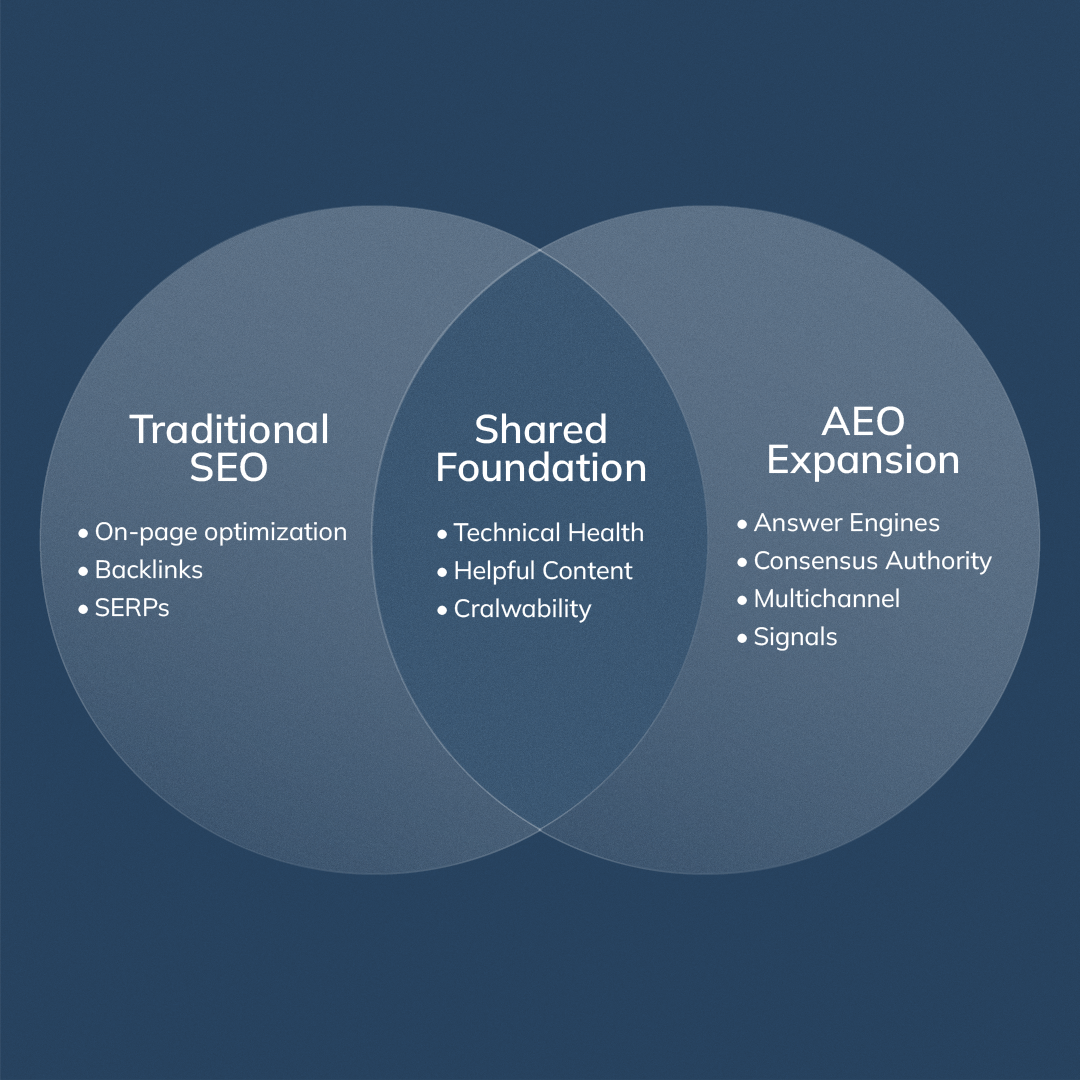
Before you optimize for AI engines, you need a clear picture of how AEO works and why it’s fundamentally different from traditional SEO. SEO is still your foundation, but AI search introduces new rules, new signals, and new surfaces where your brand must earn trust.
AEO is not a replacement for SEO.
AEO is an expansion of SEO for a world where answers matter more than rankings.
Here’s what changed:
LLMs pull from the entire internet, not just websites
Google, Bing, OpenAI, and Perplexity now compile answers from a broad mix of signals:
- Web pages
- News publishers
- Community platforms
- YouTube and podcast transcripts
- GitHub and technical documentation
- Reddit, StackOverflow, and Q&A forums
- PDFs, decks, research summaries
- Structured data and knowledge graphs
If your expertise only lives on your website, you will not appear in AI answers with consistency.
To rank in AI search, your content must exist across the places LLMs actually learn from.
LLMs prioritize “consensus authority,” not SERP position
Ranking #1 in Google does not guarantee visibility inside ChatGPT, Bing Copilot, or Perplexity.
Answer engines look for:
- High-authority sources
- Clear consensus across multiple platforms
- Consistent expert signals
- Entity clarity (Wikipedia, Wikidata, sameAs profiles)
- Reputable citations
- Cleanly structured answers
LLMs want agreement, proof, and authority—not clever SEO tricks.
LLMs reward clarity, structure, and verifiability
LLMs do not “read” your whole article. They extract chunks that look like answers.
They prefer content that is:
- Answer-first and skimmable
- Supported by citations or primary sources
- Easy to extract (tables, lists, definitions, frameworks)
- Structured with schema that matches visible text
- Consistent across multiple platforms
This is why AEO is less about long content and more about clean, authoritative answer blocks.
AI search introduced new visibility surfaces
You no longer compete only for SERP rankings. You now compete for placement inside:
- ChatGPT suggested answers
- Perplexity citations
- Bing Copilot sidebars
- Google AI Overviews
- AI-powered summaries in search results
- AI-driven snippets and “explainers”
- AI-driven product comparisons
- Multi-modal answer cards (text + video)
Visibility can now come from any content format anywhere your expertise appears.
AEO requires a system, not a tactic
You cannot “hack” your way into AI search. There are no shortcuts, no keyword stuffing, and no easy loopholes.
AEO works when you:
- Publish answer-first content
- Build authority across multiple platforms
- Strengthen entity clarity
- Earn citations from reputable sources
- Provide clean, verifiable structure
- Maintain a high-trust digital footprint
This is a long-game discipline that rewards brands who build real, public expertise.
Now that you understand how AEO diverges from traditional SEO, you’re ready for the most foundational part of this playbook: mapping where LLMs actually pull their information from.
That’s where STEP 2 begins.
STEP 2: Map Where LLMs Get Their Information (The LLM Source Map)
To optimize for AI search, you need to understand exactly where modern LLMs pull information from and how they decide which sources to trust. This is your foundation.
If you get this part wrong, every AEO decision you make downstream will be guesswork.
LLMs rely on two major layers:
- Training-time data → what the model “knows”
- Answer-time data → what the model “checks” live
AEO requires visibility across both. Below is the full breakdown.
a. Training-Time Sources (Model Knowledge)
These are the datasets used to train and fine-tune LLMs. They shape the model’s general understanding of topics, entities, and expertise.
Public Web + Licensed Publishers
Models learn heavily from large news outlets, reputable publishers, and content that has been vetted, licensed, or consistently referenced.
Examples include:
- International news organizations
- High-trust media
- Structured explainers from authoritative brands
Being cited by these ecosystems increases your chance of appearing in AI answers because LLMs use them as high-confidence references.
Common Crawl
A massive open dataset capturing billions of pages across the internet.
If your site is crawlable, indexable, and technically clean, it is already part of this dataset.
Community Knowledge Sources
LLMs use the collective intelligence from:
- StackOverflow
- Quora
- Niche forums and Q&A communities
These platforms help models detect consensus and real-world patterns.
Wikipedia + Wikidata (Entity Understanding)
Still one of the strongest signals for grounding brands, people, concepts, and categories.
If your brand’s entity information is unclear, LLMs struggle to understand or reference you properly.
GitHub + Code Repositories (Technical Domains)
Models learn frameworks, patterns, and explanations from public repos.
If you’re in SaaS, devtools, or technical B2B, GitHub is a core visibility layer.
b. Answer-Time Sources (Real-Time Grounding)
Answer engines don’t rely only on model memory. They check live sources to pull fresh, accurate, and up-to-date information.
Modern AI engines ground their answers with:
Google AI Overviews / AI Mode
Uses real-time crawlable pages that meet SEO fundamentals:
- Clear structure
- Helpful content
- Solid UX
- Accurate schema
Bing Copilot
Synthesizes answers from the Bing index and surfaces citations directly.
Perplexity
One of the most transparent engines, showing every source it uses in real time.
OpenAI Search (OAI-SearchBot)
OpenAI’s retrieval layer scans live web data to ground answers ChatGPT provides.
Multimodal Sources (Critical for AEO)
LLMs extract information from:
- YouTube transcripts
- Podcast transcripts
- Public PDFs
- Slide decks
- Datasets
If you are not publishing transcripts, you're invisible across huge segments of answer-time retrieval.
But knowing the list of sources is only half the picture. What truly matters for AEO is how LLMs rank these sources in terms of trust, consensus, and context. That’s where the LLM Data Ecosystem comes in.
The LLM Data Ecosystem (Ring Diagram Overview)
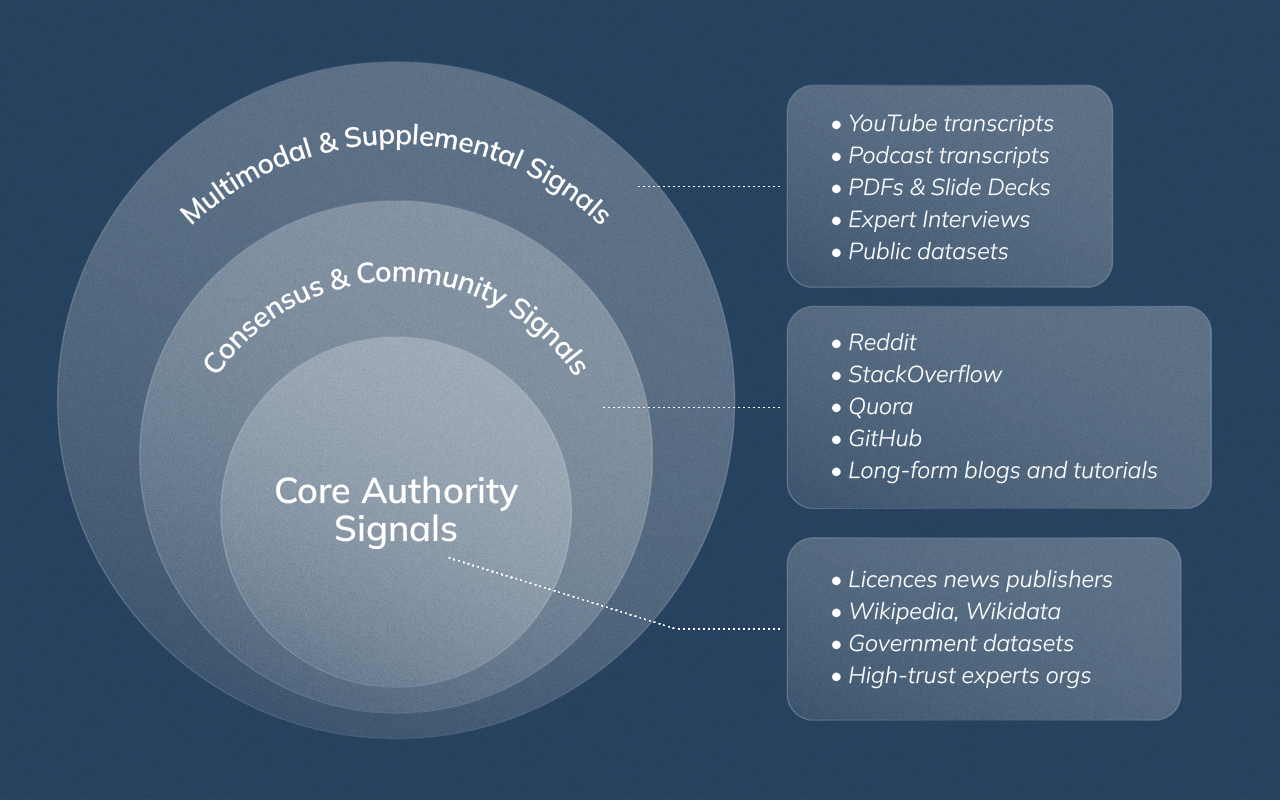
This mental model organizes LLM information sources into three concentric rings, each representing a different level of influence.
Think of it as three concentric rings:
Inner Ring: Core Authority Signals
These carry the highest trust weight.
They include:
- Licensed news publishers
- Wikipedia and Wikidata
- Government and official data
- High-trust expert organizations
LLMs use this layer to verify facts, resolve contradictions, and anchor authoritative statements.
Middle Ring: Consensus & Community Signals
This is where real-world conversations and technical insights live.
Examples:
- StackOverflow
- Quora
- GitHub
- Long-form blogs and tutorials
LLMs look for patterns and agreements across this layer. If multiple sources repeat your concepts or frameworks, LLMs treat them as consensus.
Outer Ring: Multimodal & Supplemental Signals
These enrich the model’s understanding of how humans talk, teach, and learn.
Examples:
- YouTube transcripts
- Podcast transcripts
- PDFs and slide decks
- Public research datasets
- Interviews and expert discussions
This ring is crucial for brand visibility in AI-generated answers because it surfaces fresh, specific, and niche insights.
Why This Matters for AEO
This ring model shows you exactly how to plan your AEO strategy:
- To earn trust → aim for inner-ring authority
- To build consensus → be active in the middle-ring communities
- To strengthen presence → publish multimodal assets across the outer ring
AEO is not about stuffing keywords into blogs. It’s about making your expertise visible across the entire LLM ecosystem.
If you need a quick-reference version of all these sources and rings, use Appendix A: The LLM Source Map while you plan your strategy.
With this mental model in place, you're ready for STEP 3: setting the technical and strategic foundations that help LLMs find, parse, and trust your content.
STEP 3: Set Your AEO Foundations and Guardrails
Before you expand across platforms or build advanced content, you need to establish the technical and strategic foundations that make AEO work. Without these fundamentals, LLMs can’t reliably find, parse, or trust your content—no matter how good it is.
This step is about strengthening the underlying system so every signal you publish becomes easier for AI engines to understand and cite.
Most brands skip this stage, and it’s why they never show up in ChatGPT, Perplexity, Bing Copilot, or Google AI Overviews.
a. Technical Fundamentals (Your AEO Base Layer)
These are the essentials LLMs still depend on. They ensure your content is accessible, structured, and machine-readable.
You need:
- Fast-loading, mobile-friendly pages
- Clean site architecture + strong internal linking
- Clear headers and answer-first formatting
- A fully updated XML sitemap
- No critical pages blocked in robots.txt
- Unique, high-quality content (no thin or mass-generated pages)
If these pieces aren’t solid, everything else in AEO becomes unstable.
b. AEO-Specific Technical Enhancements (Your LLM Clarity Layer)
These upgrades help AI systems extract answers, identify your entity, and trust your information.
Organization Schema (Entity Clarity)
Add structured data that defines:
- Your brand name
- Logo
- Website
- Social profiles (sameAs)
- Clean model-friendly description
This helps LLMs recognize you as a distinct, authoritative entity.
FAQPage / QAPage / HowTo Schema
LLMs prefer content that looks like structured answers.
Schema provides explicit question → answer formatting.
Answer-First Content Blocks
Use TL;DRs, short definitions, step-by-step lists, and tables. These are the easiest for AI engines to extract.
Bing IndexNow
Instantly notifies Bing (and partner engines) of new content and updates—speeding up answer-time visibility.
Allow Grounding Bots (Critical for AEO)
Your robots.txt should explicitly allow retrieval bots that power answer engines:
User-agent: OAI-SearchBot
Allow: /

User-agent: GPTBot
Allow: /

User-agent: ChatGPT-User
Allow: /
If grounding bots can’t crawl you, LLMs cannot cite you. Refer to Appendix B: Technical Templates and Robots.txt for LLMs to copy the exact patterns you need.
c. AEO Guardrails (What You Avoid at All Costs)
These practices damage trust, visibility, or both:
- Mass-produced AI content (“scaled content abuse”)
- Schema that does not match visible text
- Fake Reddit accounts or manipulated conversations
- Duplicate or thin pages created at scale
- Keyword dumping without clarity or structure
- Cloaked pages or deceptive markup
- Over-optimized SEO tricks that reduce readability
AEO rewards transparency, expertise, and machine-friendly clarity. It punishes shortcuts.
Why This Step Matters
If you don’t set these foundations:
- LLMs can’t identify your brand
- Crawlers can’t reliably parse your content
- Grounding bots skip your pages
- Your answers never become the “canonical chunks” AI systems pull from
- Competitors with cleaner signals outrank you everywhere
AEO is a compounding system. Strong foundations make every future asset more visible and more cite-worthy.
With the fundamentals in place, you’re ready for the step that determines whether AI actually uses your content: creating answer-first, LLM-friendly content designed for extraction and citation.
That’s STEP 4.
STEP 4: Build Answer Cards and Best-in-Class Content
Now that your foundations are in place, you’re ready for the part of AEO that has the biggest impact on visibility: creating content that LLMs can easily understand, extract, and quote.
AEO doesn’t reward long essays, keyword stuffing, or fluffy narratives.
It rewards precision, clarity, and structure.
Answer engines pull from content that is clean, skimmable, and verifiable.
Your goal in this step is to create the kind of content that becomes “copy-ready” for AI systems.
a. Lead Every Major Page With an Answer Card
An Answer Card is a compact, structured block placed at the top of every guide, playbook, or knowledge page.
It is the part LLMs are most likely to extract and cite.
Your Answer Card Should Include:
- Title
- Answer-first TL;DR (3–7 bullet points)
- Definitions of key terms
- A short step-by-step list
- Citation-ready links (preferably primary or original sources)
This creates a high-signal block that LLMs can use as a reliable reference.
Why It Works
LLMs don’t want to parse 2,000+ words.
They want:
- a clean structure
- direct answers
- factual clarity
- extractable chunks
- Answer Cards give them exactly that.
b. Write “LLM-Ready” Content, Not Traditional SEO Pages
Your content needs to feel like the most trustworthy, clear explanation of a topic on the internet.
Build pages that are:
- Answer-first, not story-first
- Visually structured, not text-heavy
- Evidence-based, not opinion-driven
- Cleanly formatted, not cluttered
- Well-cited, not vague
LLMs prioritize sources that reduce ambiguity. Your content needs to remove friction, not create it.
c. Use Structured Sections That AI Can Parse Instantly
Every authoritative page should contain:
- TL;DR summary — Short, clear, and written in plain language.
- Definitions block — LLMs love when complex concepts are simplified upfront.
- Step-by-step frameworks — LLMs index and cite procedural content.
- Tables and comparisons — These are easy for answer engines to extract and reuse.
- FAQs — These map closely to how users prompt AI systems.
- Visual frameworks (diagrams, charts, maps) — Even if the LLM can’t “see,” it can often parse labels, figure captions, and surrounding text.
- Cite Your Claims Like a Researcher — AEO rewards verifiability. This means:
- Cite primary sources whenever possible
- Use reputable references
- Link to your own original research
- Add expert quotes with names and credentials
LLMs surface content that appears grounded in real evidence, not speculation.
d. Add Expert Bios for E-E-A-T Reinforcement
Just like SEO, AEO benefits from strong expertise signals:
- Author name
- Credentials
- Experience
- Role
- Link to expert profile page
LLMs look for authority patterns, and expert attribution strengthens trust.
e. Make Every Page “Chunkable”
AEO is about producing content that’s easy to break into small, meaningful blocks.
Chunkable content includes:
- short paragraphs
- numbered lists
- bulleted summaries
- concise definitions
- repeatable frameworks
- modular sections with clear headings
You’re essentially creating building blocks for AI answers.
Why This Step Matters
Without answer-first content:
- LLMs can’t extract the right information
- Your page becomes a low-confidence source
- Competitors with clearer formatting outrank you
- You miss being quoted in ChatGPT, Bing, Perplexity, and Google AI Overviews
AEO visibility is driven by clarity, not cleverness. This step is what transforms your content from “helpful” to “LLM-friendly.”
With answer cards and structured content in place, you’re now ready for the next major piece of AEO: expanding your expertise across the platforms where LLMs learn and validate information.
That’s STEP 5.
STEP 5: Be Everywhere Your Audience Researches (Ethical Multichannel AEO)
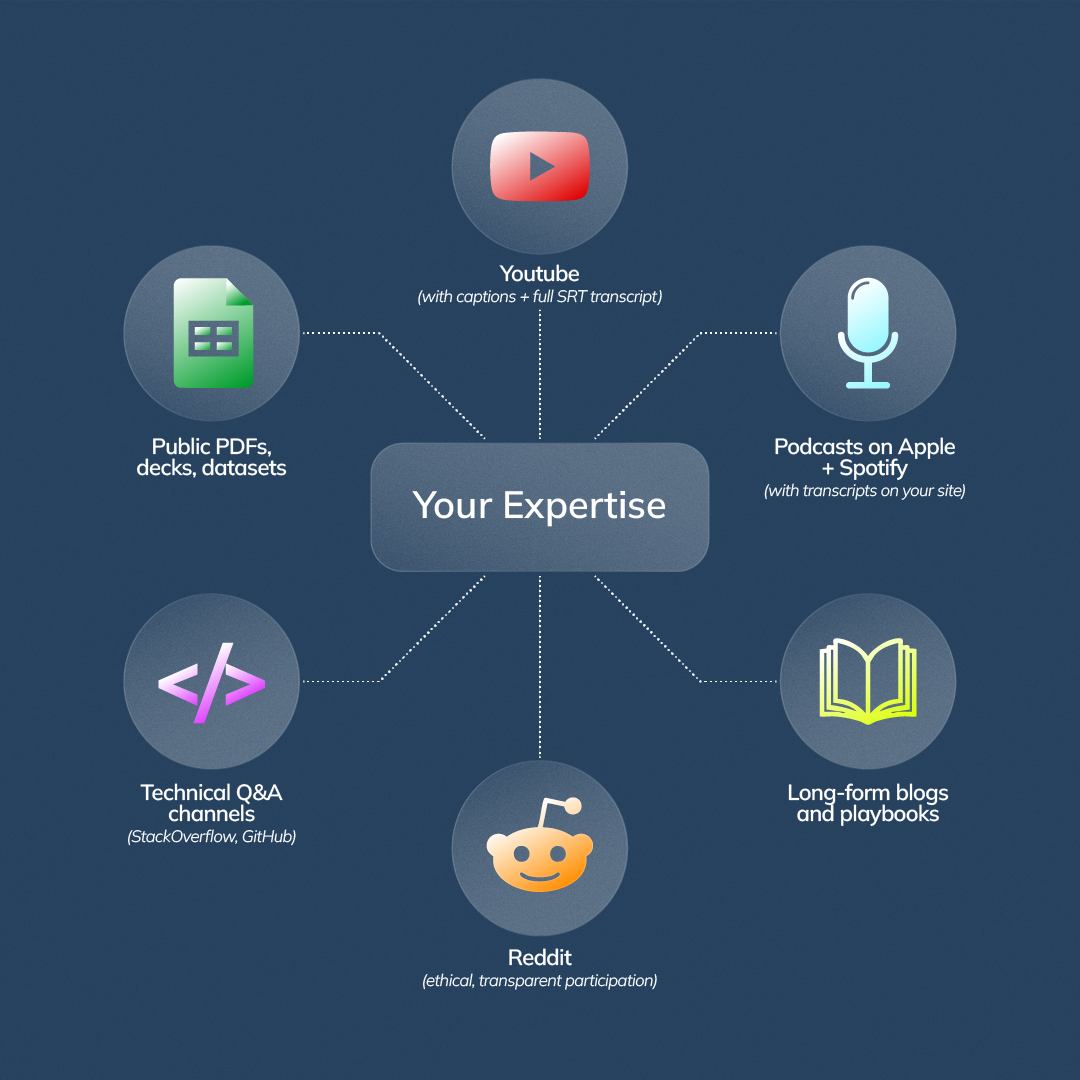
LLMs learn from everywhere: videos, podcasts, communities, forums, datasets, and transcripts—not just blog posts and landing pages. If your expertise exists on only one channel, AI engines will treat you as a partial signal, not a reliable source.
To win at AEO, you need a multichannel presence that mirrors where LLMs gather evidence.
This isn’t about being everywhere for marketing. It’s about being everywhere that LLMs look.
a. Publish Across the Channels LLMs Actively Mine
Modern answer engines extract knowledge from multiple formats. To appear consistently, your content must live where LLMs are already listening.
Priority Channels
- YouTube (with captions + full SRT transcript)
- Podcasts on Apple + Spotify (with transcripts on your site)
- Reddit (ethical, transparent participation)
- Long-form blogs and playbooks
- Technical Q&A channels (StackOverflow, GitHub)
- Public PDFs, decks, datasets
The wider your footprint across these surfaces, the stronger your signals in answer engines.
i. YouTube + Podcast Pipelines (High-Value Multimodal Signals)
LLMs extract meaning from video and audio through transcripts. These are extremely valuable because they capture:
- how experts explain concepts
- how terms are defined in practice
- how users describe real problems
- real-world conversational patterns
To maximize visibility:
- upload SRT files (not auto-generated captions only)
- embed full transcripts on your site
- summarize videos/podcasts into blog posts
- link related assets to each other
- YouTube + transcripts are now an AEO superpower.
ii. Reddit — But Ethical Only
Reddit is one of the strongest middle-ring consensus signals for LLMs. But it is also the easiest to get wrong.
Use this Ethical Reddit SOP:
- Identify 5–10 relevant subreddits
- Contribute value before ever linking (10:1 ratio)
- Disclose affiliation in flair/profile
- Never astroturf or manipulate
- Ask moderators before scheduling AMAs
- Publish an AMA recap or summary on your website
Reddit is not where you promote. It is where you demonstrate expertise.
LLMs reward transparency—not fakery.
iii. Datasets, Templates, Tools, and Frameworks
LLMs heavily favor content that is procedural, structured, or data-driven.
Examples that work extremely well:
- downloadable datasets (CSV, JSON)
- calculators or tools
- frameworks with clear steps
- code snippets and GitHub repos
- diagnostic checklists
- decision trees
AI engines treat these as high-quality reference points.
b. Participate in High-Trust Communities
LLMs look for consensus across expert communities.
Being visible in these ecosystems strengthens your middle-ring signals.
High-value communities include:
- Reddit (niche subs)
- StackOverflow
- GitHub
- Industry Slack groups
- Reviewer platforms (G2, Capterra, etc.)
- YouTube comments (expert replies)
- Presence here reinforces your authority far beyond SEO.
c. Create Publicly Accessible PDFs, Slides, and Playbooks
LLMs index documents attached to:
- Notion pages
- Google Drive (if public)
- SlideShare
- Dropbox public links
- Your website
These assets often contain your most structured insights, making them ideal for LLM extraction.
Why This Step Matters
- If your brand only exists on your website:
- LLMs see you as a weak signal
- You miss the majority of answer-time context
- AI systems rely on competitors with broader footprints
- Your authority appears incomplete
- You lose visibility in ChatGPT + Perplexity + Bing
Modern AEO is multichannel because LLMs are multichannel. To become a consistent citation source, your expertise needs to live across the surfaces LLMs learn from—ethically, transparently, and with clear, structured value.
With your multichannel presence established, you’re ready for the part of AEO that accelerates trust and authority: entity alignment, citations, and knowledge graph clarity.
That’s STEP 6.
STEP 6: Build Authority, Citations, and Entity Clarity
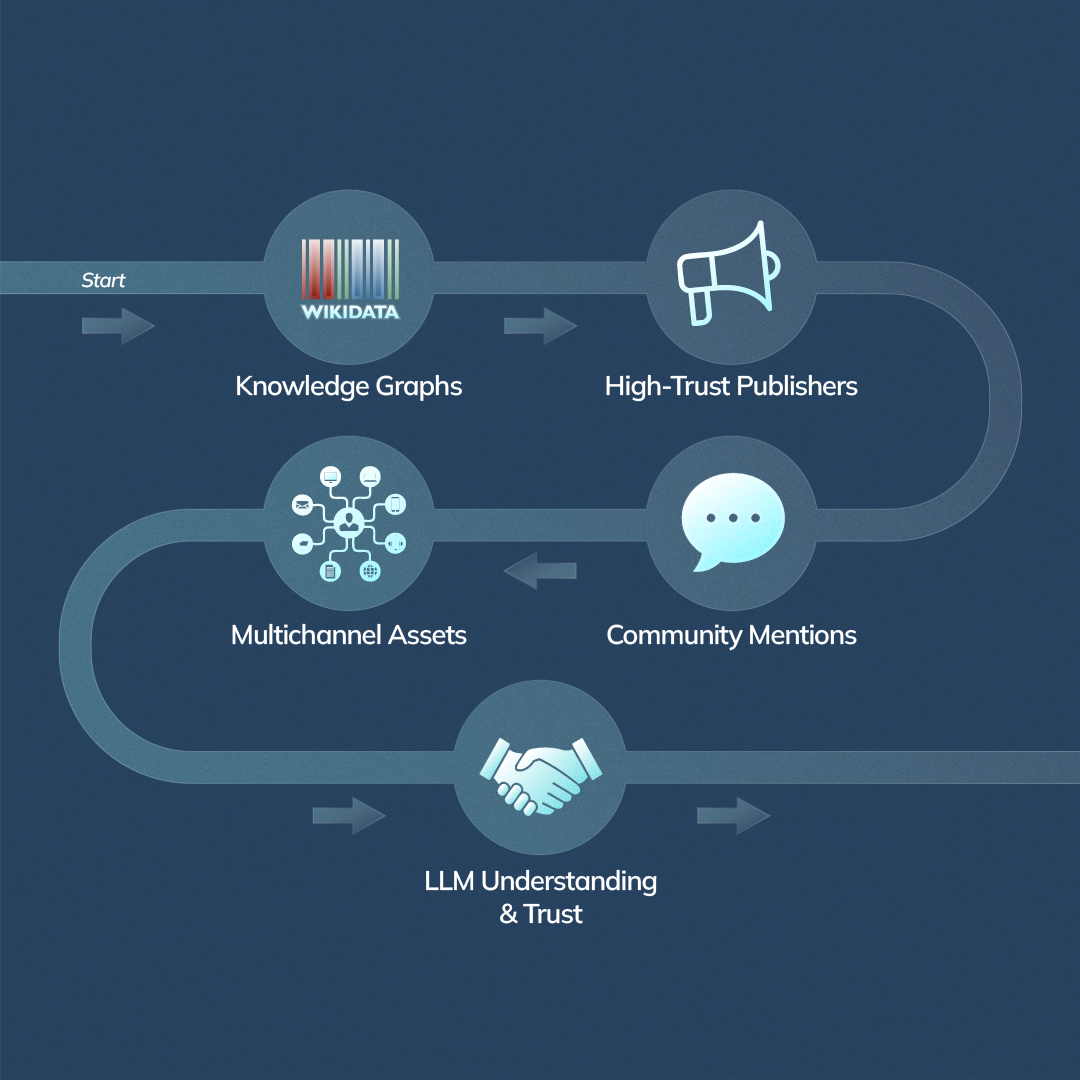
At this stage, you’ve built structured content and you’ve expanded across the channels LLMs rely on.
Now you need to strengthen the signals that make AI systems trust your content enough to cite it.
- In AEO, trust is earned through:
- entity clarity
- consistent brand identity
- reputable citations
- alignment with authoritative sources
- a clean footprint across the web
This step is about giving modern LLMs the confidence to select your content over competitors.
a. Strengthen Your Entity: The Core of AEO Authority
LLMs think in entities, not keywords. If your entity is unclear, ambiguous, or inconsistent, AI engines can’t reliably use your information—even if it’s excellent.
Make your entity unmistakable:
- Add Organization schema with all required fields
- Use consistent name, description, and messaging everywhere
- Include sameAs links to official social profiles
- Make sure your logo, brand name, and tagline match across properties
- Ensure your company is referenced on multiple reputable platforms
- LLMs need a unified identity to trust your expertise.
b. Align With Knowledge Graphs (High-Impact AEO Signal)
LLMs rely heavily on sources like:
- Wikipedia
- Wikidata
- schema.org data
- public reference directories
If your brand, product, or founder is notable, creating a Wikidata item is one of the most powerful AEO moves you can make.
Even if you’re not notable enough for Wikipedia, Wikidata often is accessible.
Why this matters:
Knowledge graph alignment helps LLMs:
- understand your brand as a distinct entity
- connect your content to your industry
- reduce ambiguity with similarly named companies
- verify your legitimacy through structured references
- This is foundational authority infrastructure.
c. Earn Citations From High-Trust Publishers (Inner-Ring Signals)
LLMs prioritize information supported by verified, reputable sources. This resembles “link building” in SEO—but the stakes are higher.
Target citations from:
- AP
- Financial Times
- Business Insider
- TechCrunch
- Forbes
- Industry-specific publishers
- Government sites
- Major research institutions
A single citation from a licensed or high-authority publisher can ripple across many answer engines.
How to pitch these outlets effectively:
- Provide data or benchmarks
- Offer expert commentary
- Release proprietary research
- Publish reports with real numbers
- Provide timely insights tied to industry trends
- LLMs treat verified citations as trust anchors.
d. Build Middle-Ring Consensus Signals (Community Validation)
You already started this in Step 5. Now you strengthen it.
LLMs care about consensus. If multiple sources repeat your terms, definitions, or frameworks, AI systems treat them as reliable truths.
Build consensus by:
- Sharing frameworks across communities
- Publishing consistent explanations on multiple channels
- Getting your terminology adopted in forums or discussions
- Being referenced by other experts or creators
- Encouraging organic citations (not forced or artificial)
- Consensus is one of the strongest AEO signals.
e. Maintain a Clean, High-Trust Digital Footprint
LLMs are highly sensitive to credibility. Any signal that suggests manipulation or low quality damages your AEO standing.
Avoid or clean up:
- Fake reviews
- Spammy backlinks
- Link farms
- Duplicate listings
- Social profiles with inconsistent branding
- Outdated descriptions
- Directories with mismatched data
Consistency builds trust. Inconsistency creates doubt.
f. Encourage Natural Citations From Other Experts
LLMs heavily reward content that is referenced by third parties—even small ones.
Examples of natural citations:
- A niche blog referencing your framework
- A creator summarizing your research
- A podcast quoting your explanation
- A developer using your code snippet
- A Reddit user citing your guide
- A professor referencing your methodology
These citations strengthen both middle- and outer-ring credibility.
Why This Step Matters
This is the step that turns your content into trusted evidence instead of “just another page on the internet.”
With strong entity clarity and authoritative citations:
- LLMs can verify your statements
- They treat your content as reliable
- Your frameworks build consensus
- Your brand becomes a distinct, high-trust entity
- Your content becomes a preferred source in answer engines
This is where AEO stops being content and becomes authority. With authority signals in place, you’re ready for a practical, fast-moving execution roadmap that ties everything together.
That’s STEP 7.
STEP 7: Launch Your 90-Day AEO Execution Roadmap
You now have the foundations, the content system, and the authority signals.This step turns everything into a 90-day operational roadmap your team can execute without confusion or guesswork.
This roadmap is designed for lean teams. It prioritizes outputs that strengthen visibility across all three LLM rings and build long-term authority.
In just 90 days, you’ll create the assets and signals AI engines need to consistently find, parse, and cite your content.
Weeks 1–2: Foundations & Infrastructure
These first two weeks ensure your technical setup is clean and every future signal is crawlable and extractable.
Tasks
- Fix crawlability and indexability issues
- Implement Organization schema + sameAs links
- Add FAQPage / QAPage / HowTo schema
- Configure robots.txt for grounding bots (OAI-SearchBot, GPTBot, ChatGPT-User)
- Enable Bing IndexNow
- Set up YouTube → transcript → blog workflow
- Set up podcast → transcript → blog workflow
- Create your Answer Card template
- Build a centralized AEO checklist for all future content
Outcome
- Your site and brand become technically legible to LLMs.
- Grounding bots can crawl. Structured data is clean.
- Your content becomes extractable by AI engines.
Weeks 3–6: Publish Your Flagship AEO Assets
This is the production phase.
You’ll ship the core content that positions your brand as a clear, structured, cite-worthy authority.
Tasks
- Publish 2–3 flagship playbooks or pillar guides
- Add Answer Cards to each guide
- Produce 1 YouTube video per guide
- Produce 1 podcast episode per guide
- Publish full SRT transcripts + summaries
- Begin ethical Reddit participation (5–10 subs)
- Pitch your first story to a licensed media outlet
- Create 1–2 tables, frameworks, or comparison charts
Outcome
- You now have high-value content across the inner, middle, and outer rings.
- Your brand becomes more visible across the surfaces that LLMs monitor.
Weeks 7–10: Build Evidence, Depth & Consistency
In this phase, you strengthen your authority by releasing structured assets that LLMs prefer: data, definitions, frameworks, and tools.
Tasks
- Publish one dataset (CSV or JSON)
- Release one slide deck or public PDF
- Launch 1 small code snippet or GitHub repo (if relevant)
- Expand FAQ sections across your top pages
- Add 3–5 internal links to every new asset
- Publish expert interviews, quotes, or advisory input
- Validated content refresh on any pages with high impressions
Outcome
You increase the number of “evidence points” AI engines use to verify your content.
Your authority strengthens across all rings.
Weeks 11–12: Audit, Measure, and Optimize
The final phase closes the loop.
You’ll measure multi-engine visibility, fix structural issues, and refine your answer extraction points.
Tasks
- Run your Prompt Battery (ChatGPT, Bing, Perplexity, Google AI)
- Record citations and visibility across engines
- Fix any schema errors revealed by validator tools
- Update all Answer Cards for precision and clarity
- Improve structured sections (definitions, steps, FAQs)
- Resubmit all major content using IndexNow
- Expand your entity footprint where needed (Wikidata, profiles)
Outcome
You know where you rank, where you’re cited, where competitors appear, and where to focus your next cycle.
Why This Roadmap Works
This 90-day plan is designed around how LLMs actually gather information. Every deliverable strengthens visibility across the:
- Inner ring (authority)
- Middle ring (consensus)
- Outer ring (context & multimodal signals)
It’s not about producing more content.
It’s about producing the right signals in the right places with the right structure.
This is how you build lasting AEO authority that compounds every quarter.
STEP 8: Measure AEO Success (Multi-Engine Visibility + The Prompt Battery)
AEO success isn’t measured the same way as SEO.
There is no “position #1.” There is no single dashboard. There are no universal click metrics.
AEO is measured through visibility across answer engines, citation frequency, and entity clarity—the signals that show whether LLMs trust your content enough to use it.
This step gives you a simple framework for tracking progress and identifying new opportunities.
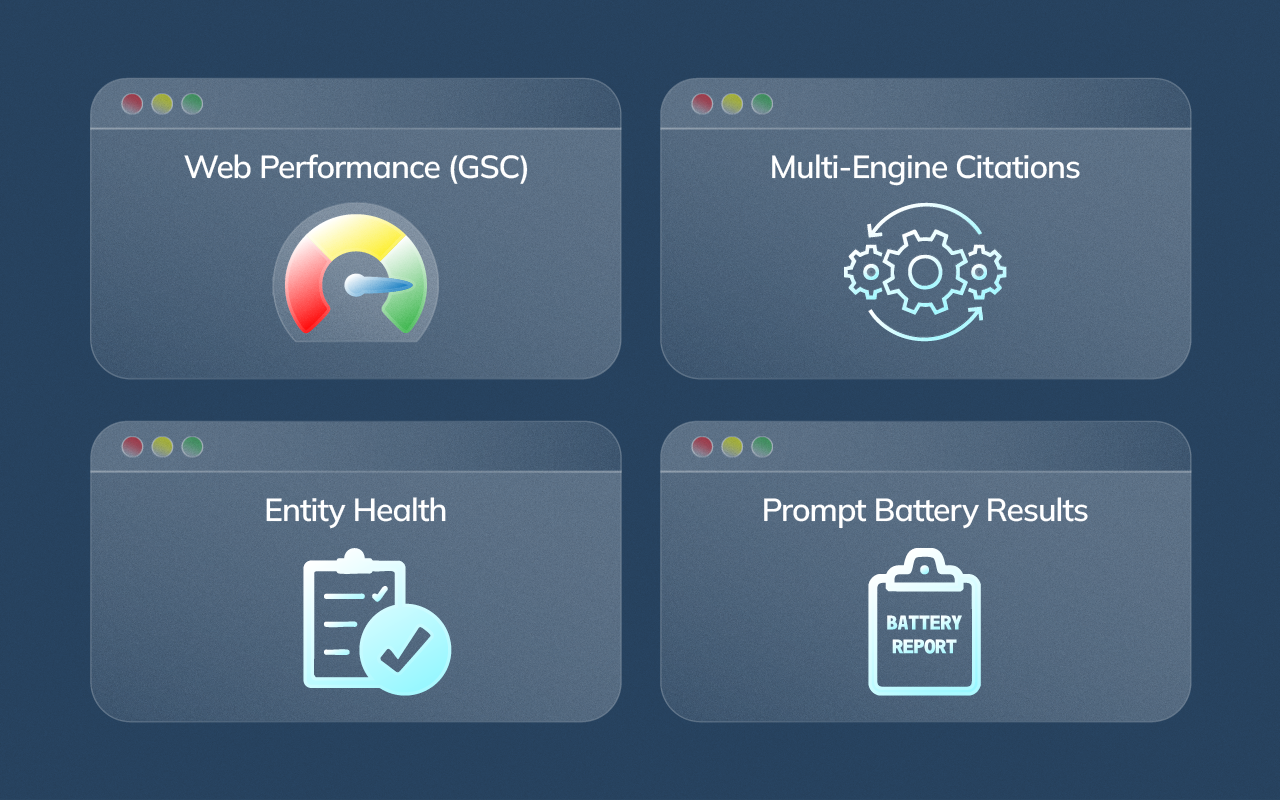
a. Track “Web” Search in Google Search Console (Indirect AEO Signal)
Google confirmed that AI Overviews and AI Mode influence Web performance—not Discover, not Video, not Shopping.
Monitor changes in:
- Impressions (especially on high-intent BOFU pages)
- CTR
- Average position (directionally, not as a KPI)
- Queries that trigger AI-style summaries
- Pages gaining impressions without ranking improvements
These are early indicators that Google’s AI systems are surfacing your content—even if it’s not shown as a traditional link.
Google Search Console won’t show AEO directly, but it shows the side effects of it.
b. Run Multi-Engine Citation Checks Monthly
Your brand’s AEO performance depends on how consistently answer engines cite you across:
- ChatGPT with browsing
- Bing Copilot
- Perplexity
- Google AI Overviews / AI Mode
Check consistency in:
- whether your brand appears
- whether your pages are cited
- whether your definitions or frameworks are reused
- whether competitors appear more often than you
- whether your content is summarized cleanly
You’re looking for patterns—not perfection.
If you show up across multiple engines, you’re gaining authority. If a competitor appears more often, you know where to strengthen your presence next.
c. Monitor Entity & Schema Health
Strong AEO depends on clear entity signals and technically clean markup.
Check:
- Organization schema validity
- sameAs links (accuracy + consistency)
- product/service schema
- FAQPage / QAPage / HowTo schema validation
- Wikidata accuracy
- Knowledge panel consistency (if applicable)
If your entity is unclear, LLMs simply cannot use your information reliably.
d. Track External Mentions and Natural Citations
LLMs reward content that is cited by:
- other websites
- experts and creators
- Reddit threads
- GitHub repos
- YouTube videos
- academic sources
- industry writers
Track:
- new backlinks (quality > quantity)
- organic Reddit mentions
- creator citations
- academic or institutional references
- industry newsletter features
Natural, unforced citations are some of the strongest AEO signals.
e. The Prompt Battery — Your Quarterly Diagnostic Tool
This is your AEO health check. Run it once per quarter across the major answer engines.
Ask engines questions like:
Authority & Positioning
- Who are the leading experts in [topic]?
- Which sources are most trusted for learning about [topic]?
Definition & Extraction
- Define [term]. Provide the most widely accepted explanation.
- Summarize the core steps for [task].
Citation & Framework Recognition
- Who created the [framework/methodology]?
- What frameworks are used for evaluating [topic]?
Consensus Questions
- What is the general consensus on [debated topic]?
- What do experts agree on regarding [X]?
Content Attribution
- Which sites or creators publish original data on [topic]?
- Which guides or playbooks are considered authoritative?
What you’re looking for:
- Do you appear?
- Do competitors appear?
- Does the model quote or paraphrase your content?
- Does your terminology or framework show up?
- Does the AI cite your URLs?
- Do your definitions influence the answer?
- This is how you measure real-world LLM authority.
f. Watch for Leading Indicators of AEO Growth
As your AEO system matures, you’ll start to see:
- more branded queries
- improved entity recognition
- cleaner citations in AI summaries
- higher impressions in GSC’s Web reports
- more organic creator mentions
- more Reddit links you didn’t create
- increased appearance in Perplexity results
- better grounding in ChatGPT browsed answers
These micro-signals show your authority is compounding.
Why This Step Matters
You can’t measure AEO with traditional SEO metrics alone.
AEO is about:
- being cited
- being trusted
- being grounded
- being used as evidence
- being consistently referenced
- being a stable authority across engines
- The brands that perform best in AI search are the ones that monitor these signals and iterate based on real visibility—not guesswork.
With measurement in place, your AEO system becomes a quarterly engine—self-correcting, continually strengthening, and increasingly difficult for competitors to displace.
For an easy-to-follow version of this framework, check out Appendix C: Final AEO Checklist.
AEO Is the Future of Authority
Search has changed. Users ask. LLMs answer. And they cite the sources they trust most.
This means visibility no longer comes from ranking — it comes from being reference-worthy.
To win in AI search, your expertise must be:
- easy for LLMs to find
- structured for LLMs to extract
- authoritative enough to cite
- present across every surface LLMs learn from
Brands that adapt will dominate AI-generated answers.
Brands that don’t will fade, even if they still “rank” in Google.
But here’s the truth:
AEO Only Works When the Right Team Runs It
This playbook gives you the system.
Execution requires specialists who can ship:
- LLM-ready content
- transcripts and multimodal assets
- clean schema and entity alignment
- research, data, and authoritative signals
With the right people, AEO becomes your competitive moat.
Without them, it stays theoretical.
That’s where Hire Overseas helps you win.
We help companies build high-quality, cost-effective SEO, content, research, and technical marketing teams — the exact roles needed to run this AEO system consistently.
Book a demo and start building your AEO-ready marketing team the right way.
FAQs About Answer Engine Optimization (AEO) & AI Search
Who is AEO actually for — startups, enterprises, or content creators?
AEO matters for anyone whose audience discovers them through search or research: SaaS and devtools companies, B2B service firms, content and media brands, educators, and expert-led businesses.
Enterprises get leverage from turning existing content into LLM-ready assets, while startups can use AEO to “punch above their weight” by becoming the clearest, most frequently cited source in a niche.
Do small or new websites have a real chance to show up in AI answers?
Yes, but not by out-writing big publishers on generic topics. Smaller brands win when they:
- Specialize in a narrow, high-intent niche
- Publish original data, frameworks, and tools
- Show up consistently across multiple surfaces (YouTube, GitHub, Reddit, podcasts, etc.)
- Make their content extremely clear, structured, and easy to cite
You’re unlikely to outrank Wikipedia on “what is AI,” but you can own very specific workflows, verticals, and problem spaces.
That’s exactly what we did at Hire Overseas: by focusing on a clear niche, structuring answer-first content, and working with AEO/SEO specialists, the site started showing up in LLM answers within the first few months of serious website optimization.
What kind of team do I need to run AEO well?
You don’t need a huge org, but you do need cross-functional skills. A lean AEO-ready team usually includes:
- Strategic SEO/AEO lead – connects AEO to positioning, ICP, and roadmap
- Senior content strategist / editor – turns expert knowledge into answer-first assets
- Technical SEO / web ops – handles schema, robots, performance, and site structure
- Research / data person – produces original benchmarks, surveys, or datasets
- Multimedia specialist – repurposes insights into video, audio, slides, and transcripts
One person can wear multiple hats in early-stage teams, as long as someone owns the system end to end.
How does AEO affect traditional SEO KPIs like traffic and rankings?
AEO doesn’t replace SEO metrics, but it reframes them:
- Traffic: Some answers will be resolved inside AI interfaces, but your brand mentions and citations increase.
- Rankings: You may not always be “position #1,” but your content fuels AI Overviews, summaries, and citations.
- Branded search & demand: As you get cited more, branded queries and direct visits usually rise.
You still track impressions, clicks, and positions but you also care about where and how AI engines use your content, not just where you sit in the 10 blue links.
Is opening my site to GPTBot and OAI-SearchBot risky for my business?
For most brands, allowing reputable grounding bots is a net positive:
- It increases your chances of being cited in AI-generated answers
- It helps models retrieve fresher, more accurate information from your site
The main risks are:
- Exposing private or sensitive content you never intended to be public
- Letting unreviewed, low-quality pages represent your brand
You mitigate this by tightening your information architecture: keep sensitive areas blocked and ensure anything public is something you’re happy to see quoted.
How does AEO work for multilingual or multi-region websites?
For international brands, AEO adds a few extra layers:
- Consistent entities across languages: your organization schema, brand name, and sameAs profiles must align globally.
- Localized authority: build region-specific citations and community presence (local media, regional forums, language-specific YouTube channels).
- Native-language clarity: answer-first content and Answer Cards should exist in the local language, not just machine translations.
LLMs increasingly handle multilingual content but they still reward brands that invest in true local clarity and authority.
Where should I start if my current content is “okay” but not AEO-ready?
A practical sequence:
- Pick 2–3 of your highest-value money pages or pillar guides.
- Add Answer Cards at the top with TL;DR summaries, definitions, and step-by-step clarity.
- Tighten the structure with shorter paragraphs, stronger headers, and better internal linking.
- Add valid schema (Organization, FAQPage, HowTo — only where it matches visible content).
- Repurpose each guide into at least one video, one audio asset, and one downloadable resource.
You don’t need to overhaul your entire site — start by upgrading the pages that matter most, turning them into LLM-ready, citation-worthy assets.
If you want to shortcut months of trial and error, you can book a strategy call with Hire Overseas to get paired with the top 1% of SEO and AEO strategists who specialize in building these systems for fast visibility inside AI engines.
Appendix A: The LLM Source Map (Training + Answer-Time)
A concise reference for where AI systems actually pull information from.
This appendix gives you a clear, scannable map of every major data source modern LLMs rely on—both during training and when generating real-time answers.
Training-Time Sources (What LLMs “Know”)
These datasets shape the model’s understanding of topics, entities, and authority.
1. Public Web + Licensed Publishers
LLMs are trained on high-trust publishers and vetted information sources, including:
- Associated Press
- Financial Times
- Business Insider / Politico (Axel Springer)
- News Corp
- Major niche publishers
Being cited here boosts your chances of appearing in AI answers.
2. Common Crawl
Billions of web pages.
If your site is crawlable and technically clean, it’s part of this dataset.
3. Community Knowledge
Collective intelligence from:
- StackOverflow
- Quora
- Niche forums
These help models detect consensus and real-world patterns.
4. Wikipedia + Wikidata
The strongest entity signals in the LLM ecosystem.
5. GitHub
Critical for SaaS and devtools. Models learn from public code, docs, and patterns.
Answer-Time Sources (What LLMs “Check Live”)
These sources power real-time grounding in ChatGPT, Bing Copilot, Perplexity, and Google AI.
1. Google AI Overviews / AI Mode
Pulls from supporting pages that follow clean SEO fundamentals.
2. Bing Copilot
Answers and citations from the Bing index.
3. Perplexity
Real-time citations, highly transparent.
4. OpenAI Search (OAI-SearchBot)
Live retrieval layer for ChatGPT’s grounded answers.
5. Multimodal Sources
Critical for AEO:
- YouTube transcripts
- Podcast transcripts
- Public PDFs
- Slide decks
- Datasets
- Expert interviews
If you’re not publishing transcripts, you’re invisible across a major layer of answer-time retrieval.
The LLM Data Ecosystem (3-Ring Model)
AEO requires visibility across:
Inner Ring — Authority
Licensed news, Wikipedia, government data.
Middle Ring — Consensus
Reddit, StackOverflow, blogs, GitHub.
Outer Ring — Context
Transcripts, PDFs, datasets, videos.
Use this map as you plan your multichannel AEO strategy.
Appendix B: Technical Templates and Robots.txt for LLMs
A drop-in technical toolkit for implementing AEO cleanly and consistently.
1. Robots.txt Template (Allow Grounding Bots)
Use this template by pasting it directly into your site's robots.txt file. Replace the sitemap URL with your own domain.
User-agent: OAI-SearchBot
Allow: /

User-agent: GPTBot
Allow: /

User-agent: ChatGPT-User
Allow: /

Sitemap: https://yourdomain.com/sitemap.xml
2. Organization Schema Template
Copy this into your <head> section or schema manager. Update fields like brand name, logo, and URLs to match your company.
{
"@context": "https://schema.org",
"@type": "Organization",
"name": "Your Company Name",
"url": "https://yourdomain.com",
"logo": "https://yourdomain.com/logo.png",
"sameAs": [
"https://www.linkedin.com/company/yourcompany",
"https://twitter.com/yourcompany"
],
"description": "Short, clear description of your brand."
}
3. FAQPage Template
Add this schema to pages containing FAQs. Make sure each question and answer matches the visible text exactly.
{
"@context": "https://schema.org",
"@type": "FAQPage",
"mainEntity": [
{
"@type": "Question",
"name": "Your question here?",
"acceptedAnswer": {
"@type": "Answer",
"text": "Your answer here."
}
}
]
}
4. HowTo Template
Use this on instructional or procedural pages. Update steps so they reflect the real process shown on the page.
{
"@context": "https://schema.org",
"@type": "HowTo",
"name": "How to complete [task]",
"step": [
{
"@type": "HowToStep",
"text": "Step 1: Explain clearly."
}
]
}
5. Answer Card HTML Template
Place this block at the top of major guides or playbooks. You can add it via an HTML embed (Webflow) or as a reusable component in your CMS.
What You Need to Know
- Key insight 1
- Key insight 2
Definitions
Term: Definition goes here.
Steps
- Step one
- Step two
6. Ethical Reddit AMA Template
Use this when hosting an AMA in a relevant subreddit (with mod approval). Replace the placeholders and follow Reddit’s disclosure rules.
Title: I’m [Name], [Role] at [Company]. Ask Me Anything About [Topic].

Hi everyone — I’m [Name], and I [explain expertise].
Ask me anything about:
• topic 1
• topic 2

Proof: [link]
Disclosure: I work at [Company].
Appendix C: Final AEO Checklist
Your operational checklist for all new AEO-ready pages, guides, and assets.
Technical Foundations
- Pages are crawlable and fast
- Mobile-friendly
- Updated XML sitemap
- Grounding bots allowed
- No thin/duplicate content
Entity Clarity
- Valid Organization schema
- Accurate sameAs links
- Consistent brand description everywhere
- Updated profiles and listings
- Clean Wikidata entry (if applicable)
Answer-First Structure
- Answer Card at the top
- TL;DR summary
- Definitions block
- Steps or frameworks
- Tables or comparisons
- FAQs
- Author bios
Schema Coverage
- FAQPage schema
- QAPage schema
- HowTo schema
- Schema matches visible content
Multichannel Assets
- YouTube video + SRT transcript
- Podcast + transcript
- Public PDF or slide deck
- Dataset
- GitHub / code asset (if relevant)
Consensus Signals
- Ethical Reddit participation
- Community contributions
- Consistent terminology
- Frameworks shared across channels
Authority Signals
- High-trust publisher citations
- Original research or benchmarks
- Expert interviews
- Natural creator or expert citations
Measurement
- Quarterly Prompt Battery
- Multi-engine citation checks
- Schema validation
- Answer Card updates
- IndexNow submissions
- Entity cleanup
