



A modern playbook for building expert-led YouTube content engines that earn trust, compound views, and scale sustainably with the help of overseas talent.
Most company YouTube channels fail for predictable reasons.
They publish random videos. They chase “virality.” They don’t build a real workflow. And they never figure out how to scale production without burning out the team.
The good news:
You don’t need a huge studio. You don’t need celebrity creators. You don’t need a massive in-house team. You need a repeatable content system that produces trustworthy videos consistently.
This playbook shows you how to grow a YouTube channel for your company using the exact system we used with Rupa Health’s YouTube Channel, including:
- how we built a team of 12 medical professionals (NPs, MDs, PhDs) as on-screen educators
- how a YouTube Manager picked topics monthly using high-demand / low-supply “demand gaps”
- how we ensured FTC and FDA compliance with medically cited scripts
- how we scaled editing with six full-time overseas video editors through Hire Overseas
- how we published 3–4 times per week using a repeatable content mix
- how pairing ranking SEO articles with matching YouTube videos repeatedly produced 10k+ view videos and created a 50k+ view example (Slippery Elm)
- how one creator produced a video that hit 1M+ organic views
This is not a theory. It’s an execution playbook designed to help founders and marketers build a company YouTube channel that compounds.
STEP 1: Understand What YouTube Growth Really Means (YouTube ≠ Uploading)
Most companies treat YouTube like a place to “post content.”
That mindset guarantees slow growth.
For companies, YouTube is a compounding distribution engine with three jobs:
- Trust: earn belief through expert-led education
- Discovery: rank in search and get recommended through watch time
- Conversion: turn viewers into subscribers, leads, and customers over time
If you run YouTube like a system, each month increases your baseline performance.
If you run YouTube like a random content feed, every upload starts from zero.
That’s why Step 2 is about defining the goal and guardrails before you produce anything.
STEP 2: Define Your Goal, Ideal Customer Profile (ICP), and Channel Guardrails
Before you publish your next video, decide what success looks like.
a. Choose one primary goal
Pick the one outcome that matters most over the next 6–12 months:
- build category authority
- grow inbound demand and traffic
- support sales with trust content
- create a long-term acquisition channel
- educate a market (especially for complex products)
If you try to optimize for everything, you’ll optimize for nothing.
b. Define your ICP (the exact viewer you’re trying to win)
Company channels stall when they try to speak to everyone.
Define:
- role/title
- industry
- company stage (if B2B)
- pain point the viewer is actively solving
- why they would trust you over others
Rupa’s strategy was “medical practitioner education that consumers can also understand.”
That clarity drove topic selection and tone.
c. Set channel guardrails
Guardrails prevent wasted production and keep the channel focused.
Examples:
- “We only publish educational videos and webinars. No product demos as standalone content.”
- “We prioritize evergreen topics and demand gaps over trend-chasing.”
- “We will not ship claims without citations and compliance review.”
- “We publish 3–4 times/week, but never at the expense of trust.”
Now that the strategy foundation is defined, you can do the setup correctly.
STEP 3: Set Up a Company YouTube Channel the Right Way (Foundations)
Many teams ask:
How to start a YouTube channel for a business?
How to start a company YouTube channel without making it look amateur?
How to set up a company YouTube channel so it scales cleanly later?
This step answers those questions.
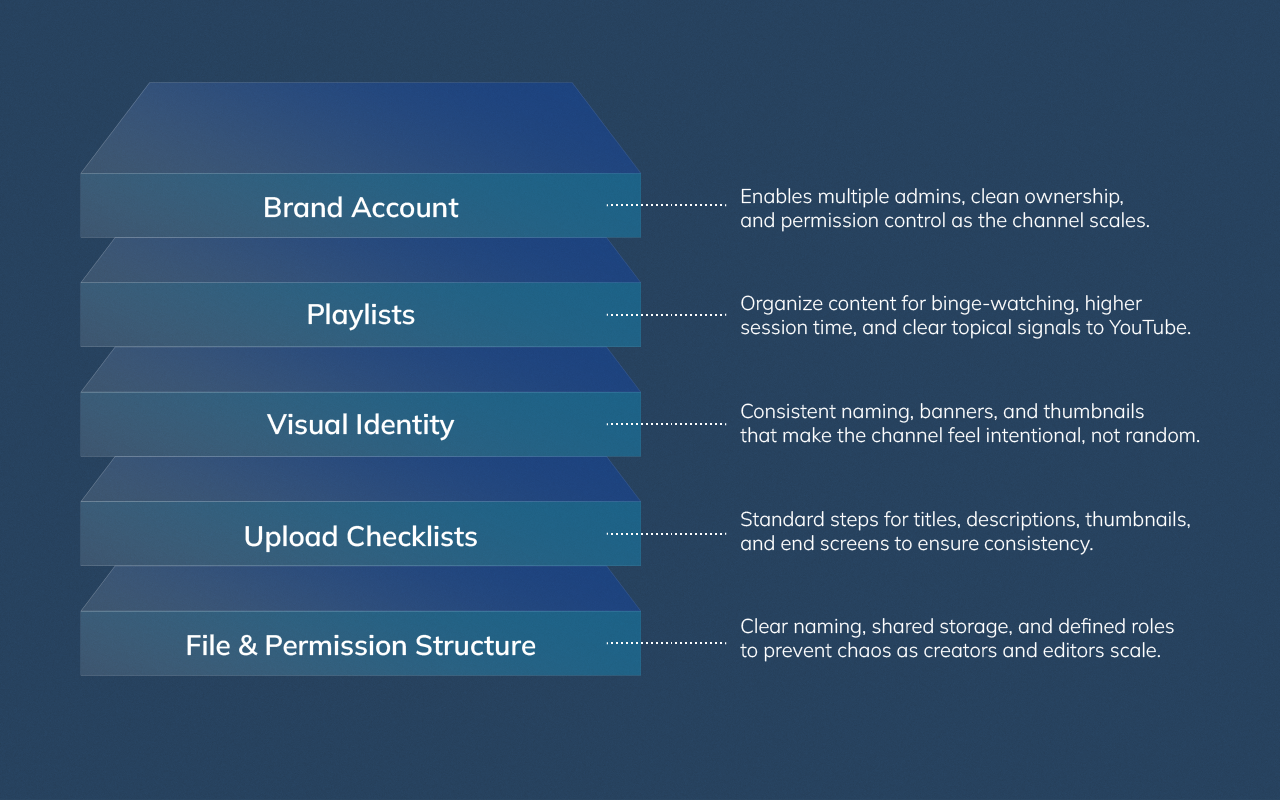
a. Create the channel under a Brand Account
If you’re asking how to make a YouTube channel for a company, this matters:
A Brand Account allows:
- multiple admins and roles
- clean ownership (not tied to one employee’s Gmail)
- permission control as you scale the team
b. Lock the positioning and visual identity
Before you upload:
- channel name and handle
- clear channel description aligned to your ICP
- banner that states the promise of the channel
- consistent thumbnails by content type
Rupa had different thumbnail systems for:
- pre-recorded educational videos
- webinars / “live classes”
- podcast videos/clips
This made the channel feel intentional, not random.
c. Build the channel structure before volume
Create your core playlists up front:
- Educational videos
- Webinars / Live Classes
- Podcast content
- Playlists by creator (if you have multiple experts)
This improves session time, helps viewers binge, and signals topical clarity to YouTube.
d. Build the operational setup
Before you publish heavily, set the basics that prevent chaos later:
- Create an upload checklist (title, description, tags, end screens, chapters)
- Set naming conventions for files and projects (so editors don’t guess)
- Standardize thumbnail specs and rules by content type (educational vs webinar vs podcast)
- Define where everything lives (scripts, citations, raw footage, edits, thumbnails, final exports) in one shared system like Drive + Notion
- Assign channel permissions and roles (who can upload, edit, publish, and respond)
This isn’t “ops work.” It’s what makes consistent publishing possible when you scale creators and overseas editors.
Now that the foundation is set, you need the engine: the creators.
STEP 4: Build an Expert Content Team (Authority Scales Better Than Personality)
Most companies assume they need one charismatic “face of the brand.”
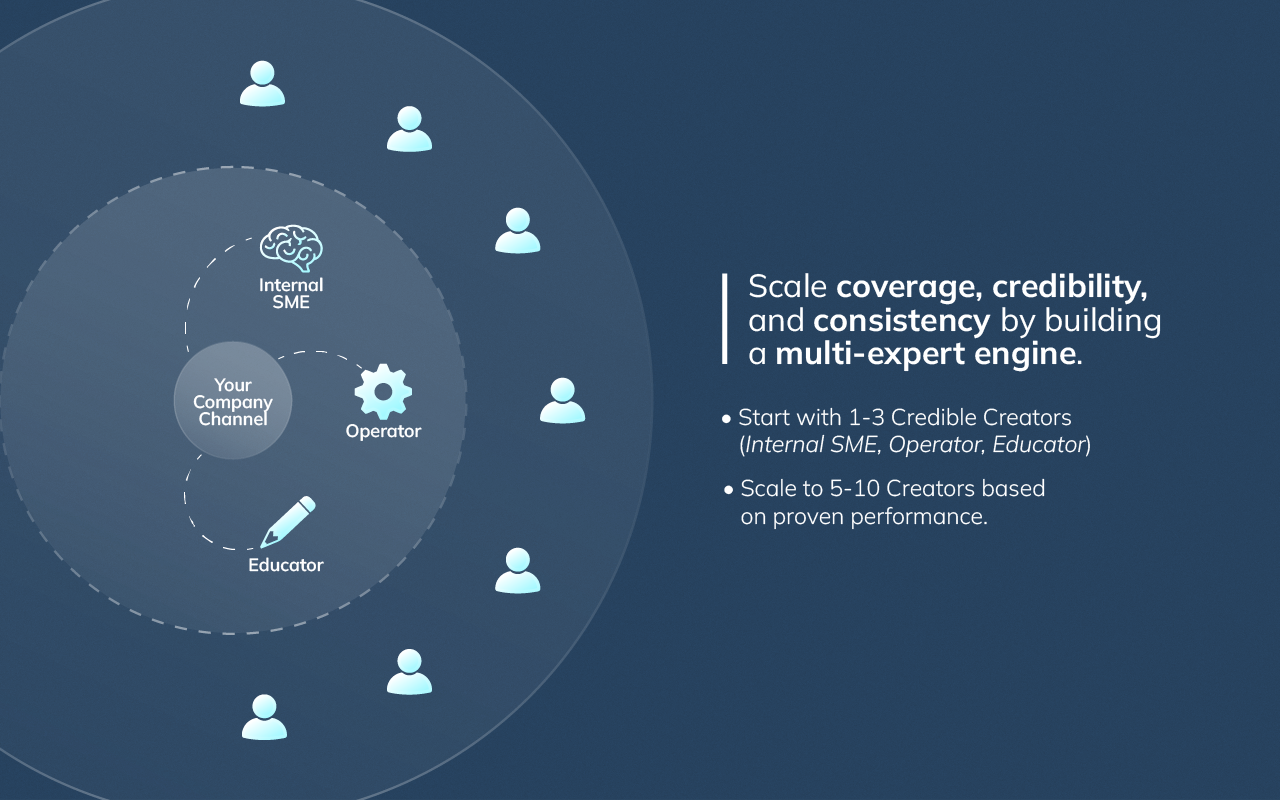
Rupa proved a different model works better for trust-based categories: build a multi-expert engine.
What we did at Rupa Health
We built a team of 12 medical professionals, including:
- nurse practitioners
- MDs
- PhDs and SMEs
Each became an on-screen educator.
Why this worked
- authority transferred instantly because the content came from real experts
- topic coverage expanded because specialists could teach their domain
- consistency improved because the channel didn’t rely on one person’s schedule
How to replicate this for your company
You do not need 12 experts to start.
Most companies can begin with:
- 1–3 credible creators (internal SME, operator, educator)
- then expand to 5–10 creators once you see who performs best
The goal is to find creators who can teach clearly, not promote loudly.
Next, you need a topic system that consistently finds wins.
STEP 5: Find Topics Using Demand Gaps (High Demand, Low Supply)
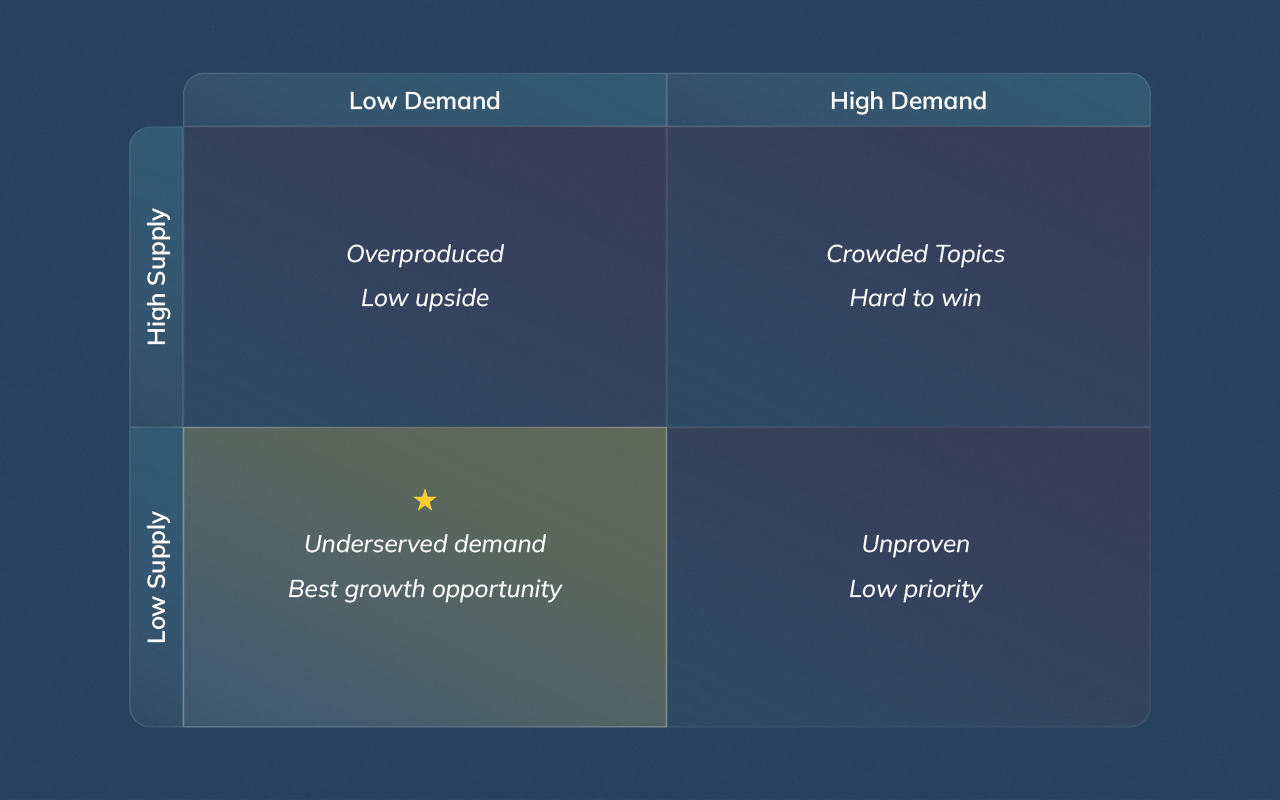
Volume doesn’t create growth. Topic selection creates growth.
Rupa’s YouTube Manager ran monthly planning using a simple framework:
Demand Gap Framework
Choose topics where:
- demand is high (people search for it)
- supply is low (few good videos exist)
This is how smaller channels beat bigger channels.
BPC-157 example
When the peptide BPC-157 began trending on Twitter/X, there was almost no high-quality YouTube content explaining it clearly and accurately.
We identified the gap early, produced expert-led educational videos quickly, and published.
The result: we created one of the top three performing videos on the topic — watch the BPC-157 explainer here
Where to find demand gaps
- YouTube autocomplete (the fastest signal)
- Reddit threads and recurring questions
- Google Trends (to catch rising interest)
- Twitter/X for emerging trends
- TubeBuddy / vidIQ for keyword supply indicators
The goal is not “viral.”
The goal is “underserved demand + high trust content.”
Now you have topics. Next is building scripts that protect trust.
STEP 6: Scriptwriting, Compliance, and Citations (FTC/FDA Trust Layer)
In healthcare, compliance and accuracy are non-negotiable.
But the same principle applies to any category where trust matters.
How Rupa handled scripts
Doctors had creative control:
- they wrote their own outline
- they wrote scripts or talking points
- they taught in their own voice
But every medical claim had to be:
- medically accurate
- FTC/FDA compliant
- supported with citations
Support workflow
We supported creators by:
- helping source credible citations
- reviewing scripts for compliance
- ensuring citations appeared on-screen or in the description
This isn’t just risk management. It’s performance management.
Trust increases retention. Retention increases watch time. Watch time increases distribution.
Next, you need production quality that matches the authority.
STEP 7: Production That Looks and Sounds Credible (Setup + Batch Recording)
YouTube trust is visual and audible.
Rupa ensured consistency by equipping creators with:
- high-quality cameras
- professional microphones
- proper lighting
- clean backgrounds
Batch recording system
Each doctor recorded about one hour of raw footage.
From that, we extracted multiple videos.
That single operating move is what makes expert-led YouTube scalable:
one setup, one session, multiple outputs.
Now you need the scaling layer: editors.
STEP 8: Scale Editing, Thumbnails, and Publishing With Overseas Talent
Rupa scaled production by hiring six full-time overseas video editors through Hire Overseas.
Team structure
- each editor was assigned to 1–2 doctors
- editors learned tone, pacing, and subject matter over time
- quality improved because the work wasn’t constantly shuffled
What the editors handled
- full edits (cuts, pacing, B-roll)
- custom thumbnails by content type
- metadata optimization (titles, descriptions, tags)
- playlist organization
This system consistently produced 10–15 videos per month.
Performance reality
Not all creators perform equally.
Over time:
- 3–5 doctors became consistent winners
- one doctor produced a breakout video that hit 1M+ organic views
Scaling output is how you find your winners.
Now you need the publishing cadence that keeps the machine compounding.
STEP 9: Publish on a Repeatable Cadence (3–4 Uploads/Week System)
Consistency matters more than frequency spikes.
Rupa published 3–4 times per week:
- 1–2 educational doctor-led videos
- 1 webinar recording (“Live Class”)
- 1 podcast episode or clip
Why this works:
- YouTube rewards consistency and habit
- mixed formats increase session time
- webinars add depth and trust signals
We tested podcast clipping. It underperformed due to lower engagement.
That lesson matters: repurposing is useful, but not every format earns distribution.
Now we finish with the compounding layer: conversion and cross-channel flywheels.
STEP 10: Conversion and Compounding (CTAs, Playlists, Repurposing, SEO Pairing)
A company YouTube channel should not exist purely for awareness.
a. CTAs inside every video
Rupa included:
- spoken and on-screen CTAs
- links in the description to product/signup pages
- subscription prompts at natural breakpoints
Treat every video like a guided next step, not a dead end.
b. Playlists that increase session time
We created:
- playlists by content type (Educational, Webinar, Podcast)
- playlists by creator (follow specific doctors)
This increased retention and binge sessions.
c. Repurpose weekly webinars
Weekly webinars became “Live Classes,” then became YouTube assets.
Benefits:
- extended lifespan
- captured ongoing interest
- created evergreen educational library
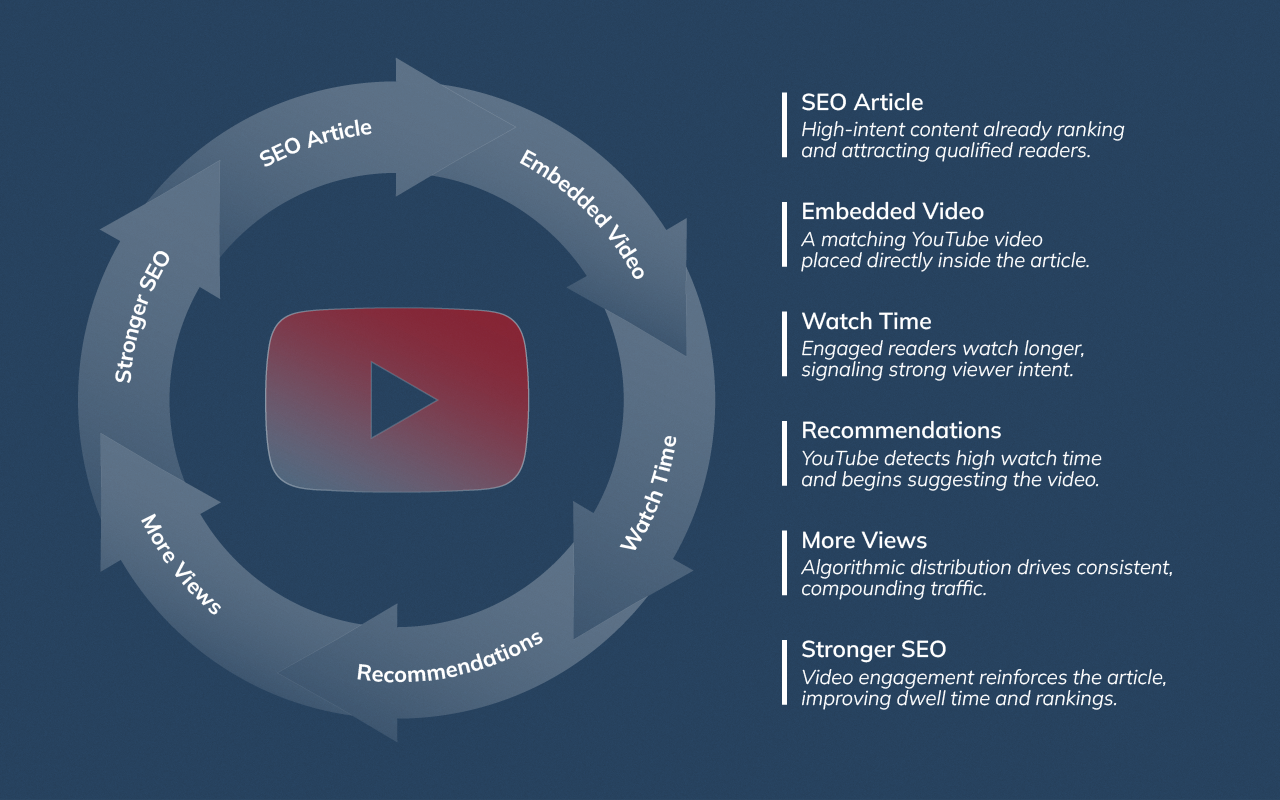
d. The SEO → YouTube growth hack
Whenever an SEO article started ranking, we created a matching YouTube video and embedded it into the article.
What happened:
- high-intent readers watched the video longer
- watch time spiked
- YouTube began recommending the video
- videos often crossed 10k views reliably
- Slippery Elm exceeded 50k views primarily from this pairing strategy
Every high-traffic SEO article should have a corresponding YouTube video and vice versa.
Here’s how Rupa Health put this entire framework into practice, turning individual tactics into a structured YouTube system that consistently produced views, trust, and long-term traffic.
Case Study: The Full Rupa Health YouTube System (End-to-End Breakdown)
Rupa Health didn’t grow its YouTube channel by chasing viral moments or relying on a single creator. It built a structured, expert-led system designed to scale authority, accuracy, and output at the same time.
The channel system included:
- A bench of 12 medical professionals (nurse practitioners, MDs, and PhDs), each contributing content within their specialty to ensure depth, credibility, and coverage across a wide range of topics.
- Monthly topic planning led by a dedicated YouTube Manager, using demand-gap analysis to identify high-interest topics with limited high-quality content on YouTube.
- Doctor-written scripts and outlines, with every medical claim reviewed, cited, and aligned with FTC and FDA compliance requirements to protect trust and long-term visibility.
- Standardized creator setups with professional cameras, microphones, lighting, and clean backgrounds to maintain consistent visual and audio quality across all videos.
- Batch recording sessions, where each doctor recorded roughly one hour of raw footage per session, allowing the team to produce multiple polished videos efficiently.
- Six full-time overseas video editors, each assigned to specific doctors, handling:
- video editing and pacing
- custom thumbnails by content type
- metadata optimization (titles, descriptions, tags)
- playlist organization
- A consistent publishing cadence of 3–4 videos per week, combining:
- expert-led educational videos
- recorded webinars (“Live Classes”)
- podcast video content
- Clear conversion paths in every video, with spoken CTAs, on-screen prompts, and links in descriptions directing viewers to relevant product or signup pages.
- Intentional playlist architecture, organized by content type and by individual doctor, increasing session time and helping viewers follow the experts they trusted most.
- A powerful SEO-to-YouTube flywheel, where high-traffic SEO articles were paired with matching YouTube videos and embedded directly into those pages—regularly producing videos that surpassed 10,000 organic views.
The result was not just channel growth, but a scalable, multi-expert content engine—including a breakout video that surpassed 1 million organic views, driven by search, watch time, and sustained audience trust.
Why This System Worked
Rupa Health’s YouTube growth wasn’t driven by luck or viral hits. It worked because the channel was built as a system.
- Authority was native. Real medical professionals led every video, which built trust and sustained watch time.
- Topics were demand-driven. Videos filled clear demand gaps instead of chasing trends.
- Quality and compliance were consistent. Accurate, cited content protected long-term visibility.
- Production was specialized. Creators taught, editors edited, and a manager owned cadence.
- Distribution was integrated. SEO articles, playlists, and CTAs worked together to drive discovery and conversion.
Nothing relied on a single creator or one-off win.
The system was repeatable—and that’s why it scaled.
Below, we break this system down into a practical execution appendix so you can apply the same framework inside your own company without guessing.
A YouTube Channel Is a System—And Systems Need Owners
If you take only one thing from this playbook, let it be this:
Companies don’t grow on YouTube by uploading more videos.
They grow by building a system that produces trusted, educational content consistently.
That system works when:
- topics are chosen intentionally
- experts lead the conversation
- quality stays high as volume increases
- distribution and SEO compound over time
This is how YouTube becomes a durable acquisition channel—not a brand experiment.
But here’s the deeper truth:
A great YouTube strategy still fails without the right people to run it.
Most companies don’t struggle with ideas.
They struggle with execution.
To run a scalable YouTube system, you need:
- a YouTube Manager to own strategy, cadence, and topic selection
- subject-matter experts or on-screen educators to deliver authority
- video editors to handle cuts, thumbnails, and optimization
- operational support to keep production moving week after week
Without clear ownership, YouTube stalls.
With the right team, it compounds.
This is where Hire Overseas becomes a force multiplier.
We help companies build cost-effective, high-performing YouTube teams using overseas talent—so this playbook doesn’t stay theoretical. You get vetted editors, managers, and operators who can execute consistently without breaking your budget.
Build the system.
Staff it correctly.
Let the results compound.
Book a demo and start building your YouTube team the right way.
FAQs About Company YouTube Growth
Is YouTube still worth it for companies starting in 2025?
Yes, especially for companies in education-heavy, trust-based, or complex categories. YouTube remains the second-largest search engine and one of the few platforms where content compounds for years. While competition has increased, most niches are still undersupplied with expert-led, high-trust content, which is where companies have a natural advantage.
What types of companies benefit most from YouTube?
YouTube works especially well for companies that:
- Sell complex or high-consideration products
- Need to build trust before conversion
- Educate their market (B2B, healthcare, fintech, SaaS, marketplaces)
- Rely on long sales cycles or inbound demand
If your customers ask questions before buying, YouTube can answer them at scale.
How long does it take for a company YouTube channel to see results?
Most company YouTube channels begin seeing meaningful traction within 3–6 months when publishing consistently and targeting search-driven topics. Early wins usually come from evergreen, problem-aware queries rather than subscribers or viral spikes. The biggest inflection point tends to happen once your library reaches 30–50 high-quality videos.
Should a company YouTube channel focus on subscribers or views?
For most businesses, views and watch time matter more than subscribers early on. Subscribers are a lagging indicator. A smaller channel with strong search-driven views can outperform a larger channel that relies on notifications or trends. Optimize for solving specific problems well—subscribers follow naturally.
How do you know when to invest more in YouTube?
Signals it’s time to invest further:
- videos consistently rank in search
- certain creators or topics repeatedly outperform
- YouTube drives qualified traffic to your site
- content continues to get views weeks or months after publishing
At that point, YouTube has proven leverage—and scaling becomes a rational decision, not a gamble.
What happens if a company stops publishing for a few months?
Unlike social media, YouTube content doesn’t disappear when you pause. Well-performing videos often continue to get views. That said, long gaps slow momentum and delay compounding. Channels that resume with consistency usually recover—but sporadic publishing prevents sustained growth.
How does YouTube compare to podcasts or blogs for companies?
YouTube often outperforms both in:
- discoverability
- long-term reach
- trust-building speed
Blogs excel at intent capture, podcasts at relationship depth. YouTube sits in the middle—searchable, visual, and authoritative—which is why it pairs so well with SEO rather than replacing it. The main constraint isn’t strategy, but execution. Hire Overseas can help staff editing and channel operations so YouTube can scale consistently without becoming a team bottleneck.
Appendix: The Company YouTube Growth System (Execution Reference)
This appendix turns the playbook into an operating system.
Use it to launch faster, hire correctly, and avoid common execution gaps.
Appendix A: How to Start a Company YouTube Channel (Setup Checklist)
Use this checklist when you’re setting up or resetting a company YouTube channel.
1. Channel Setup (Foundational)
☐ Create or convert a Google account into a Brand Account
☐ Name the channel clearly (company name or company + category)
☐ Write an “About” section explaining:
- who the channel is for
- what problems it helps solve
- why the company is credible
☐ Add website, email, and social links
☐ Upload: - profile image (logo or brand mark)
- channel banner (clear value proposition)
This establishes trust and clarity before you publish.
2. Content Strategy Setup
☐ Define your ICP (who the channel is for)
☐ Choose 1–3 core content categories (e.g. educational, explainers, webinars)
☐ Decide on creator model:
- single expert
- multiple experts
☐ Set minimum cadence (recommended: 3–4 videos/week)
☐ Decide what the channel will not publish
Clarity here prevents random content later.
3. Topic Research & Planning
☐ Assign a YouTube Manager or Content Lead
☐ Run monthly topic planning using:
- YouTube search autocomplete
- Google Trends
- Reddit and forums
- Twitter/X trends
- TubeBuddy or vidIQ
☐ Prioritize topics with: - high interest
- low-quality existing videos
This is where most growth is won.
4. Creator & Recording Setup
☐ Assign each creator a consistent setup:
- camera (1080p+)
- microphone
- lighting
- background
☐ Create a simple recording guide: - framing
- audio distance
- lighting rules
☐ Encourage batch recording (1 hour = multiple videos)
Consistency builds trust and speed.
5. Editing & Publishing Infrastructure
☐ Hire or assign editors (ideally dedicated per creator)
☐ Define editing standards:
- pacing
- captions
- visual style
☐ Create thumbnail rules by content type
☐ Standardize: - titles
- descriptions
- tags
☐ Define publishing checklist: - upload
- playlist assignment
- CTA placement
This is where overseas talent shines.
6. Conversion & Measurement
☐ Add CTAs to every video:
- spoken
- on-screen
- description links
☐ Track: - watch time
- retention
- subscriber growth
- traffic to site
☐ Identify top creators and formats monthly
YouTube is not just awareness—it’s a funnel.
Appendix B: Team Structure (Who You Need to Run This System)
A scalable company YouTube channel requires clear role ownership, not heroics.
Core Roles
YouTube Manager
- owns strategy and topic planning
- manages cadence and backlog
- reviews performance monthly
Subject-Matter Experts / Creators
- create educational content
- write outlines or scripts
- maintain credibility and trust
Video Editors (Overseas)
- edit long-form videos
- create thumbnails
- optimize metadata
- organize playlists
Optional Support
- Virtual Assistant for uploads and scheduling
- compliance reviewer (regulated industries)
This structure allows volume without burnout.
Appendix C: Monthly Operating Rhythm (Copy This)
Week 1
- review analytics
- identify demand gaps
- finalize topics
Week 2
- creators write outlines/scripts
- citations and compliance checks
Week 3
- batch recording sessions
- editors begin post-production
Week 4
- publish consistently
- refresh playlists
- review CTA performance
Repeat monthly. Improve quarterly.
Appendix D — SEO + YouTube Flywheel Checklist
☐ Identify top-performing SEO articles
☐ Create matching YouTube videos
☐ Embed videos into articles
☐ Link articles in video descriptions
☐ Monitor watch time from external traffic
This flywheel is one of the fastest ways to break through.
How to Use This Appendix
- Appendix A helps you set up the channel correctly
Appendix B ensures you hire the right people - Appendix C keeps execution consistent
- Appendix D accelerates growth through SEO
Together, they turn YouTube from a content project into infrastructure.
