




A modern playbook for building medically credible, search-optimized healthcare SEO systems that rank, earn trust, and scale with confidence.
Everyone knows that the SEO for the healthcare industry isn’t like any other kind of search optimization — it’s higher stakes, tougher to win, and impossible to fake. Patients aren’t just searching for answers; they’re searching for trust. And with Google and AI tools raising the bar for medical accuracy, only brands that publish expert-reviewed, evidence-based content will stand out.
If you want your healthcare company to rank, convert, and earn authority, you need more than keywords, you need a system built for credibility and consistency.
This playbook walks you step-by-step through how to turn healthcare SEO into a long-term authority channel your patients and algorithms rely on.
STEP 1: Understand the Golden Rule of Healthcare SEO – Create the Best Content in the World
If you take one principle from this playbook, it’s this: Every piece of content you publish must be the single best resource on the internet for that topic.
That’s not exaggeration; it’s the new SEO reality for healthcare brands.
Healthcare is a YMYL (Your Money or Your Life) category. This means:
- Google evaluates accuracy and credibility more strictly
- AI Overviews give priority to clinically reliable sources
- Shallow content can harm patients and tank rankings
Trust is the ultimate ranking factor.Google (and now AI Overviews) weigh E-E-A-T far more heavily here than in other verticals. Inaccurate or shallow health content can cause real harm.
What Makes Healthcare SEO Content Different
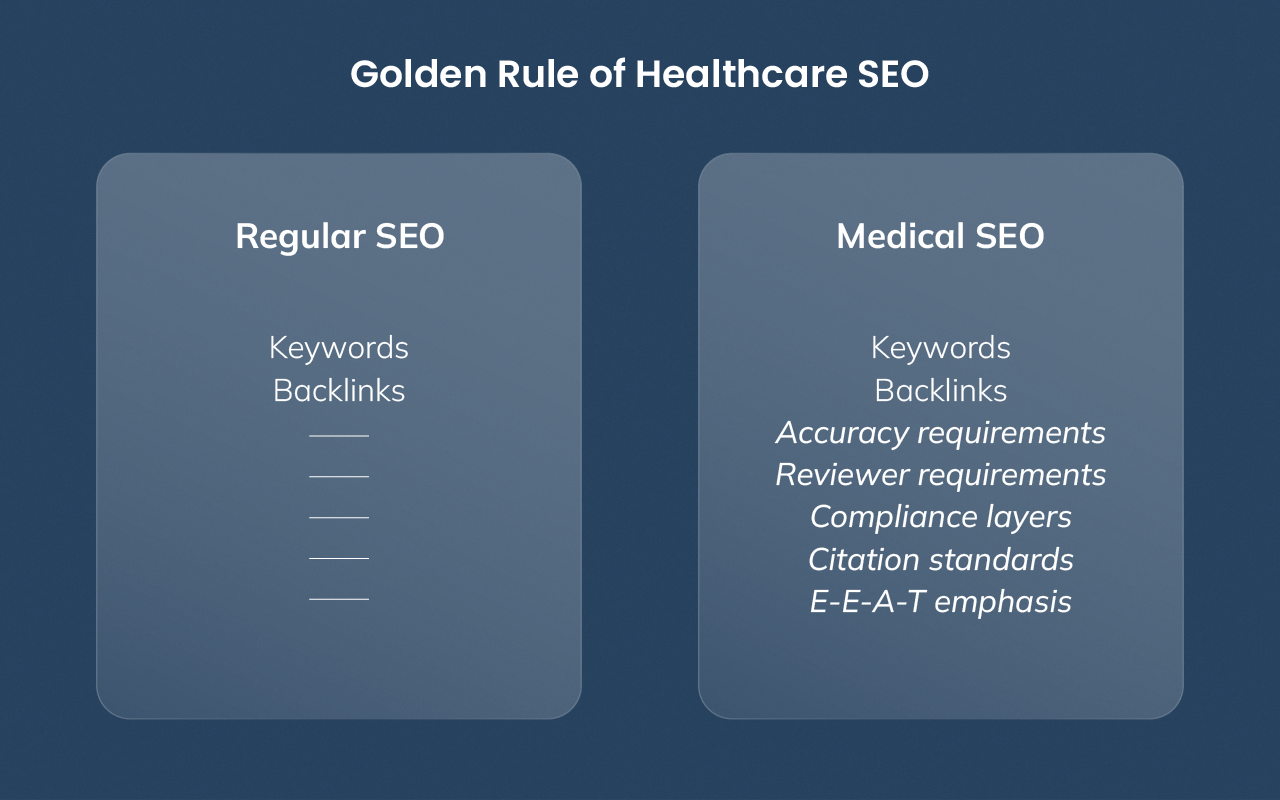
Healthcare SEO goes beyond keywords and backlinks. It demands medical accuracy, regulatory compliance, and visible expertise — because in health, misinformation can cost trust, credibility, and even lives.
Here’s the most important aspect of SEO for healthcare companies.
- Accuracy over volume. Every claim must be evidence-based and traceable to a peer-reviewed source.
- Compliance. Follow HIPAA, FDA, and FTC rules when referencing medical advice or treatments.
- Compassion. Write for anxious patients, not algorithms.
- Transparency. Show who wrote, who reviewed, and when it was last updated.
Brands That Set the Standard
Study these leaders:
- Rupa Health – Proof that medical accuracy and scale can coexist.
- Healthyish Content – A masterclass in authoritative, E-E-A-T-driven SEO.
- WebMD & Healthline – Still the industry’s gold standards for reviewed content and structure.
Action Steps
(Upcoming sections cover each of these actions in detail.)
- Prioritize E-E-A-T with visible authorship, medical reviewers, citations, and disclaimers.
- Publish only A-level articles using a grading rubric
- Refresh content every six months
- Use structured data for machine readability (author, reviewedBy, MedicalWebPage)
STEP 2: Study the Rupa Health Content Machine
To understand how to execute healthcare SEO at a high level, you need a real model. Rupa Health is one of the clearest examples of how to scale content responsibly while maintaining strict medical integrity.
Their Starting Point
They began publishing 20 articles a month. Within a year, that grew to 200+ medically reviewed articles per month, all high-quality and consistent.
How They Built It
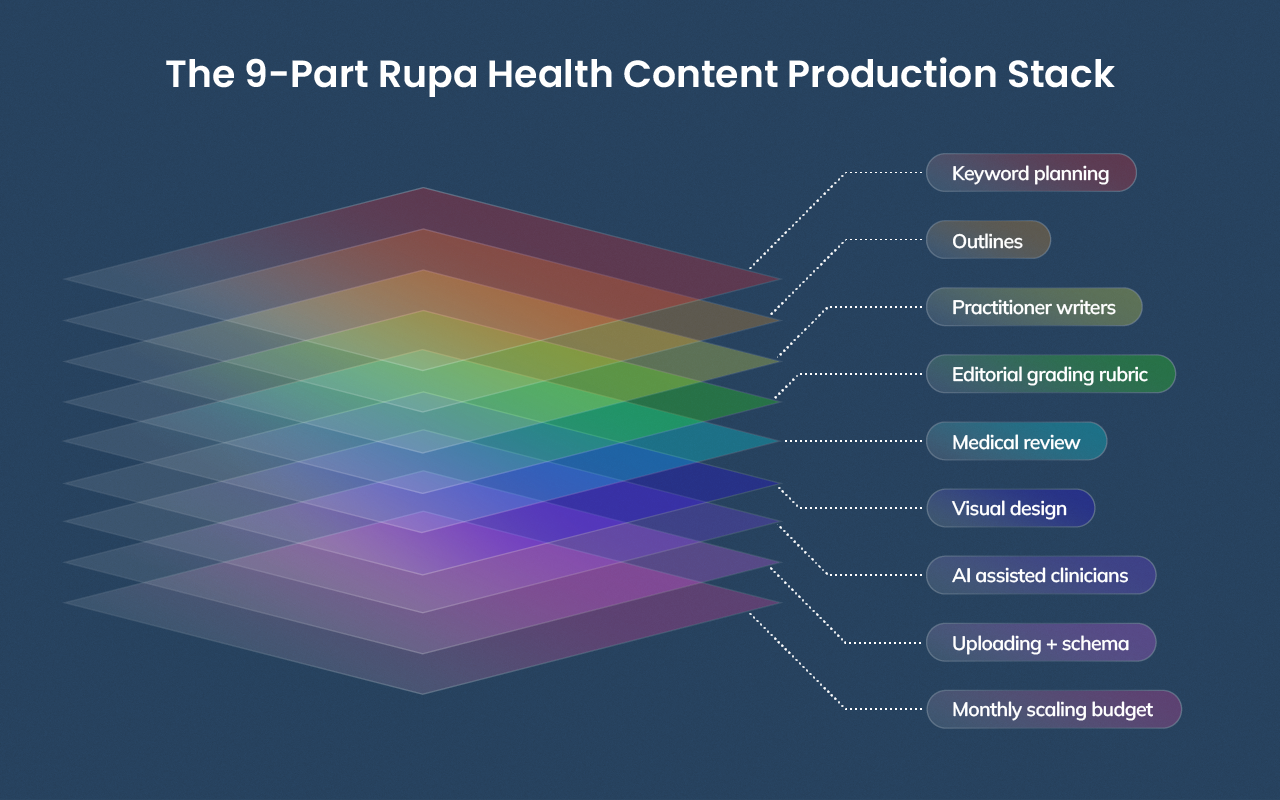
Here’s the core framework that made Rupa Health’s growth possible.
1. Monthly Keyword Planning
An overseas SEO specialist handled monthly keyword strategy.
- Selected 200 article topics
- Balanced search intent + difficulty
- Ensured clinical relevance
- Managed everything in a master Google Sheet
2. Content Outlines
Every outline included:
- Target keyword
- Intent
- Headings
- Required subtopics
- References
- Writer + reviewer assignments
Sample SEO + Medical Outline: “What Is Fecal Calprotectin?”
Topic Example: Fecal Calprotectin
Target Keyword: what is fecal calprotectin
Secondary Keywords: fecal calprotectin test, fecal calprotectin levels, calprotectin IBD, calprotectin IBS, intestinal inflammation biomarker
Search Intent: Informational / Clinical (explain what fecal calprotectin is, how it works, how to interpret results, and when to use it in diagnosing or monitoring GI disease.)
Audience: Clinicians, healthcare practitioners, and medically informed patients.
What Is Fecal Calprotectin?
Concise, clinician-focused overview for Rupa Health and healthcare partners.
At a Glance
- Noninvasive stool test for intestinal inflammation
- High negative predictive value (NPV) for ruling out IBD
- Supports decisions on endoscopy and treatment changes
Overview — What Fecal Calprotectin Measures
- High-level definition of fecal calprotectin as a neutrophil-derived stool biomarker.
- Why clinicians use FC to detect and monitor intestinal inflammation.
- Why symptoms alone cannot reliably differentiate IBD from IBS.
How Fecal Calprotectin Works (Mechanism of Action)
- What calprotectin is and its origin in neutrophils.
- Role of neutrophils in gut inflammation and mucosal injury.
- Why FC is more accurate than CRP/ESR for intestinal-specific inflammation.
Clinical Applications
Distinguishing IBD vs IBS
- ACG recommendations for fecal calprotectin in suspected IBD and IBS.
- Sensitivity and specificity at commonly used FC cutoffs.
- Scenarios where FC can safely reduce the need for colonoscopy.
Monitoring IBD Activity & Predicting Relapse
- Serial FC measurements to track disease activity over time.
- FC cutoffs for predicting mucosal healing, remission, and relapse.
- Pediatric and pregnancy-specific considerations.
Guiding Treatment Decisions
- When normal or low FC can support deferring endoscopy.
- When elevated FC supports treatment escalation or optimization.
- FC thresholds in biologic therapy monitoring and treat-to-target strategies.
How to Interpret Fecal Calprotectin Results
- Normal, borderline, and elevated FC ranges and how they are reported.
- Pros and cons of lower versus higher FC cutoffs depending on clinical setting.
- Key confounders and false positives (e.g., NSAIDs, infection, recent GI procedures).
Testing Methods & Variability
- Overview of ELISA, CLIA, and PETIA methods for FC measurement.
- Accuracy and limitations of home and point-of-care tests.
- Lack of universal standardization across assays and laboratories.
- Best practices for sample collection, transport, and storage.
Other Conditions That Elevate Fecal Calprotectin
- FC is not specific to IBD; it reflects neutrophil-driven intestinal inflammation.
- Other causes include infection, colorectal cancer, polyps, NSAID enteropathy, celiac disease, etc.
- Importance of interpreting FC values in full clinical context.
Frequently Asked Questions
Key Takeaways for Clinicians
- FC is a noninvasive, first-line tool in the evaluation of suspected IBD.
- High NPV makes FC useful for ruling out IBD in low-risk patients.
- Serial measurements and consistent use of the same assay improve interpretability.
- Always integrate FC results with clinical assessment and other investigations.
Disclaimer
References
Suggested: 10–30 peer-reviewed citations, including:
- Guideline sources (e.g., ACG, AGA) for IBD diagnosis and monitoring.
- Major fecal calprotectin diagnostic and monitoring studies.
- Systematic reviews and meta-analyses on FC performance and cutoffs.
Writer & Reviewer Assignments
3. Writing Team
Posted simple job listings on LinkedIn to source licensed medical professionals (one of the fastest ways to find practitioner writers). Writers included:
- MDs
- NPs
- RDs
- PhDs
Requirements:
- Every claim cited
- Peer-reviewed sources only
4. Editorial Rubric
Editors scored every draft using a simple A–D system:
| Letter Grade | Criteria | Example Articles |
|---|---|---|
| A+ | Outstanding, world-class quality. Exceptional clarity, depth, evidence-based precision, and readability. Surpasses expectations and qualifies for writer bonuses. | What Is Fecal Calprotectin? |
| A | The best possible version on the internet. Clear, concise, medically accurate, fully cited, and easy for an 8th grader to understand. |
Pros & Cons of Hormone Pellets For Menopause What is EBT and how does it work? |
| B | Good but not exceptional. Some sentences are overly complex or not value-additive. | |
| C | Meets the basic intent of the title but over 50% of the content is general, bland, or not unique. Lacks depth, clarity, or strong evidence. | |
| D | Written primarily with AI or lacks substantial original content. Medically risky, incomplete, or non-compliant with sourcing and medical guidelines. |
"Good enough" never went live. Only A-level articles were published.
5. Medical Review
The lead medical editor:
- Verified every claim
- Fact-checked risks and contraindications
- Approved all final content + visuals
- Ensured guideline compliance
5.1. Regulatory Compliance (FTC + FDA Basics
At Rupa’s scale, every article also had to be FTC/FDA-safe. In practice, that meant:
- No personal medical advice or diagnosis/treatment promises
- Using structure/function language (supports, helps maintain) instead of cure/treat claims
- Citing only primary, evidence-based sources (PubMed, NIH, major medical orgs)
- Protecting privacy and always including clear educational disclaimers
Want the full breakdown? Read our guide: How to Create FTC/FDA-Compliant Healthcare.
Along with clinical accuracy, every article underwent a regulatory compliance pass to ensure alignment with FTC and FDA rules for healthcare and medical content.
6. Designer & Overseas Physicians
- Designers created medical diagrams
- Overseas physicians double-checked accuracy
7. AI-Assisted Physicians (The Nigeria Team)
Two former surgeons in Nigeria:
- Used AI to create first drafts
- Added citations
- Verified accuracy
- Passed to reviewers for full clinical approval
This enabled scalable, medically sound content.
8. Uploading, Schema & Coordination
A virtual assistant:
- Uploaded articles
- Applied schema
- Checked accessibility
- Updated tracker statuses
- Managed follow-ups
9. Scaling Budget
- Startup: $5K/month
- Scale: $30K–$50K/month
Roles Rupa Hired:
- SEO Specialist
- Content Editor
- Medical Editor
- Practitioner Writers
- Designer
- Virtual Assistant
STEP 3: Build Your Own Healthcare SEO Engine
Now that you’ve seen how Rupa scaled their content machine, the next move is building your own. You don’t need hundreds of writers to get started. What you need is a lean, consistent workflow that produces accurate, trustworthy content you can scale later.
Core Team Roles You Need
| Role | Core Responsibility |
|---|---|
| SEO Specialist | Keyword research, outlines, clustering, on-page optimization |
| Practitioner Writers | Draft accurate, cited, empathetic articles |
| Medical Reviewer | Verify clinical accuracy, update guidelines |
| Content Editor | Structure, readability, consistency |
| Graphic Designer | Custom diagrams and visuals |
| Virtual Assistant | Upload, tag, coordinate, QA |
Core Production Workflow
1. SEO Creates Briefs
Plans keywords, outlines, and search intent. Ensures every topic aligns with audience needs, ranking potential, and clinical relevance before assigning to writers.
2. Writers Draft and Cite
Practitioner writers craft medically accurate articles, citing authoritative sources like PubMed or NIH to maintain credibility and comply with E-E-A-T standards.
3. Editor Ensures Clarity
Refines structure, tone, and readability. Simplifies complex medical concepts for patients while preserving scientific accuracy and brand voice consistency.
4. Reviewer Approves Medically
A licensed clinician verifies all claims, data, and recommendations. Confirms compliance with current medical guidelines and adds reviewer credentials for transparency.
5. Designer Adds Visuals
Creates custom diagrams, infographics, and tables to explain key ideas clearly. Visuals improve engagement, accessibility, and SEO performance.
6. Virtual Assistant Uploads and Tracks Updates
Publishes approved content, applies schema and tags, and maintains the production tracker for version control and future refresh reminders.
Pro Tips for a Smooth Workflow
- Use one centralized production tracker to manage outlines, drafts, reviews, and publishing status.
- Set automated 180-day refresh reminders to keep medical content current.
- Document your workflow in a simple SOP so every team member follows the same process.
STEP 4: Publish With Medical Authority and Full Medical Compliance
With your workflow established, the next step is ensuring every article you publish demonstrates real medical authority. In healthcare SEO, authority isn’t optional — it is the foundation of rankings, patient trust, and regulatory compliance.
Google evaluates medical content under strict standards, which means your publishing process must make authorship, clinical review, accuracy, and safety unmistakably clear.
Below is the publishing framework used by top healthcare brands.
Author & Reviewer Attribution
Use dual bylines:
- Written by: [Name, Credentials]
- Medically Reviewed by: [Name, MD]
Each name links to a bio page that must include:
- Credentials
- Years of experience
- Licensure
- Publications
Demonstrate E-E-A-T
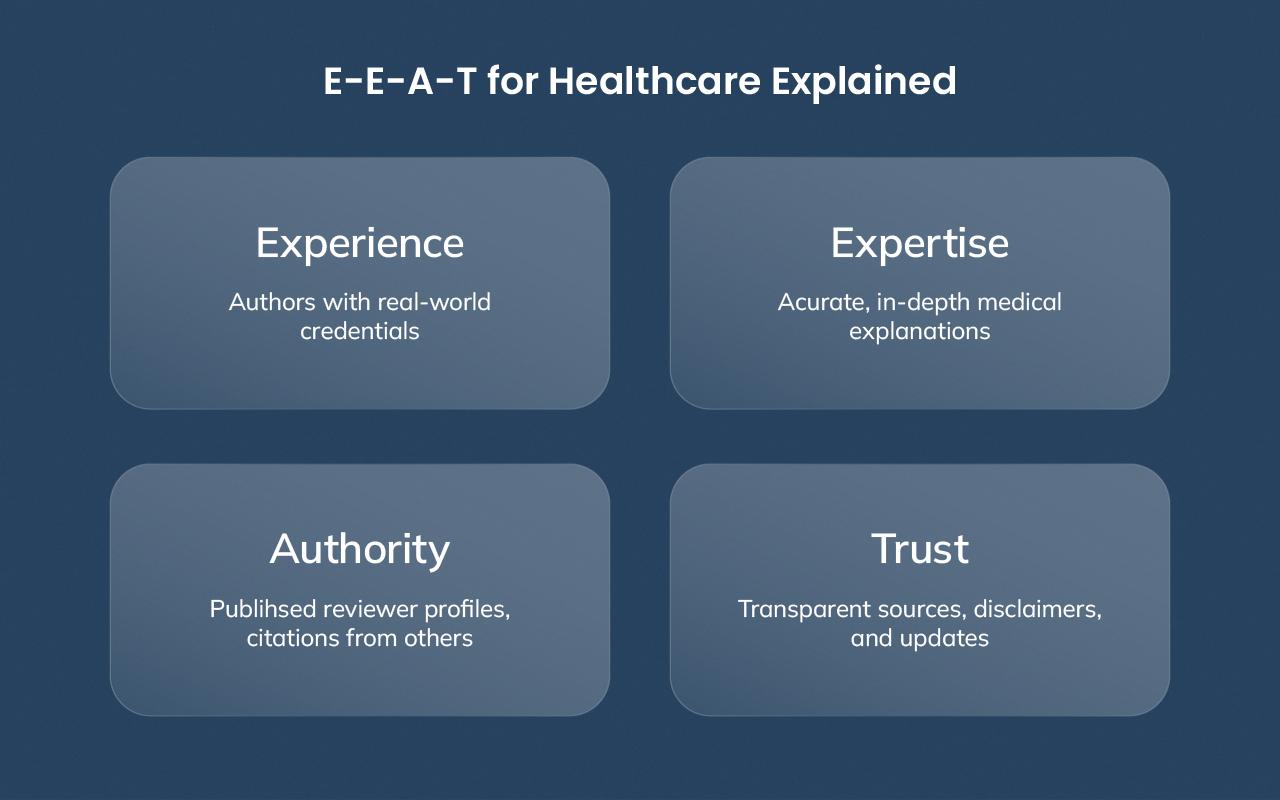
E-E-A-T (Experience, Expertise, Authoritativeness, and Trustworthiness) is the foundation of healthcare SEO. Demonstrating it through credible authors, clinical accuracy, and transparent sourcing shows both Google and your readers that your content deserves to be trusted.
| Principle | How to Demonstrate |
|---|---|
| Experience | Authors with real-world credentials |
| Expertise | Accurate, in-depth medical explanations |
| Authority | Published reviewer profiles, citations from others |
| Trust | Transparent sources, disclaimers, and updates |
Add Disclaimers
Disclaimers protect your readers and your brand. They clarify that your content is educational, not medical advice, reinforcing transparency and compliance.
Sample Disclaimer: “This content is for educational purposes only and not a substitute for medical advice. Always seek professional medical guidance before making healthcare decisions.”
Medical Compliance Standards (Clinical + FTC/FDA)
Every healthcare article must meet both clinical and regulatory compliance requirements to protect readers, search visibility, and your brand.
Clinical Requirements
- HIPAA: Never include identifiable patient information
- Clinical accuracy: Cite current AGA, ACG, NIH, or peer-reviewed guidelines
- Risk transparency: Include side effects and contraindications for treatments
- Reviewer approval: A licensed clinician must verify all medical claims
- Recency: Add “Last updated” dates reflecting your latest review
Regulatory Snapshot (FTC/FDA Essentials)
To keep content safe, non-misleading, and compliant with patient-facing guidelines:
- Avoid claims that diagnose, treat, cure, or prevent disease
- Use structure/function language: “supports,” “helps maintain…”
- Cite only primary evidence (PubMed, NIH, major medical orgs)
- Avoid personalized medical advice in any form
- Include disclaimers in all content
- Remove “anti-” disease phrasing (anti-inflammatory, anti-cancer)
- Keep supplement, nutraceutical, and condition language FDA-safe
Make Compliance Part of Your Publishing Workflow
To make compliance consistent and scalable, embed it directly in your CMS and content tracker:
- Add a compliance checklist to every article before publishing
- Require Reviewer Name + Credentials + Date as a mandatory field
- Store approvals in a Medical Review Log
- Use standardized templates for disclaimers & citations
This builds a repeatable, foolproof approval process that works even as your team scales.
STEP 5: Implement Advanced Healthcare SEO Tactics
Once your SEO foundation is strong, it’s time to scale impact. These advanced tactics help you deepen topical authority, strengthen E-E-A-T signals, and future-proof your healthcare content for Google and AI-driven search. Start implementing the following strategies to maintain a consistent, high-quality workflow.
Content Clustering
Organize your content around pillar topics (e.g., Gut Health) with supporting cluster pages.
Example cluster:
- Pillar: Gut Health
- Clusters: IBS, Probiotics, Leaky Gut, Microbiome Diets
Each article interlinks for context and authority.
Pro Tips for Stronger Content Clusters
- Build simple topic maps so every condition or theme has clear pillar and subtopic coverage.
- Interlink related articles to strengthen contextual depth and improve overall authority.
- Add a “Related Articles” section to increase session time and guide readers through your cluster.
Medical Schema Markup
Schema tells search engines who wrote your content, who reviewed it, what condition it covers, and when it was updated. It strengthens credibility signals — essential for any YMYL healthcare page.
Here’s the simplest way to implement it:
1. Use the right schema types
For most medical articles, include:
- MedicalWebPage
- Person (Author)
- Physician (Reviewer)
- MedicalCondition
And where relevant, also include:
- Therapy (when describing treatments)
- FAQPage (when adding an FAQ section)
- Organization (to define your healthcare brand)
2. Gather your details
You’ll need:
- Author + reviewer names and credentials
- Article title + URL
- Date published + last updated
- Condition or topic name
3. Generate schema
Use any beginner-friendly tool:
- TechnicalSEO Schema Builder
- Merkle Schema Generator
- RankMath / Yoast (WordPress)
Paste your information → copy the JSON-LD code.
4. Add schema to your CMS
Insert the JSON-LD into:
- A “Custom Code” or “Header” field
- Or an SEO plugin schema block (WordPress)
5. Validate schema
Use:
- Google Rich Results Test
- Schema Markup Validator
Make sure there are no errors.
AI-Assisted Writing (Human Reviewed)
AI can accelerate production, but it cannot replace medical expertise. Use AI to support your Best Uses for AI:
Topic ideation
- Draft outlines and FAQs
- Suggest structure or section flow
- Summarize existing research for writers to verify
AI Should Not Do:
- Publish unverified medical statements
- Replace clinician review
- Generate final recommendations, diagnoses, or treatment guidance
Pro Tips for Safe and Effective AI Use
- Use AI for scaffolding, not conclusions — let clinicians finalize all medical statements.
- Keep a review log to document who verified each AI-assisted draft for compliance and accuracy.
- Train writers on how to blend AI-generated structure with expert fact-checking and proper medical citations
STEP 6: Build Ethical, High-Authority Backlinks
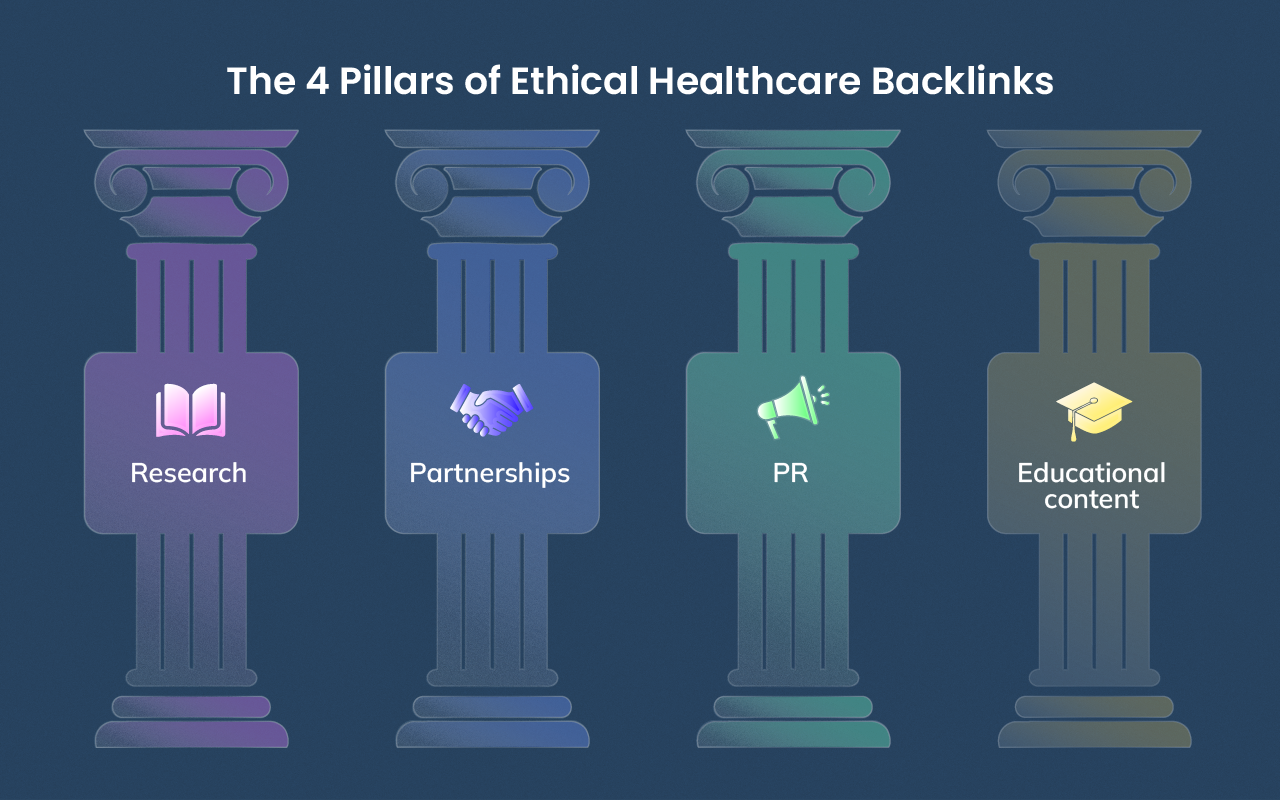
Backlinks matter in healthcare SEO, but only when they’re earned through credibility, transparency, and data. Unlike other industries, healthcare brands cannot rely on link schemes or manipulative tactics — Google evaluates YMYL sites with far higher scrutiny. Your link-building strategy must demonstrate expertise. Here’s how to build trust-driven, ethical backlinks at scale:
Publish Link-Worthy Research Assets
Create content that naturally attracts citations from clinicians, educators, and publishers:
- Research summaries and evidence reviews
- Clinical explainer graphics
- Industry surveys
- Data-backed reports
- Medical infographics
These formats become reference sources others link to organically.
Collaborate With Credible Organizations
Partnerships are one of the strongest link engines in healthcare.
Build relationships with:
- Universities and academic groups
- Medical associations
- Health nonprofits
- Practitioner communities on LinkedIn
Collaborative content — such as joint reports or co-authored pieces — often earns high-authority links.
Pitch Your Insights Proactively
High-quality data deserves visibility.
Share your findings with:
- Journalists
- Medical newsletters
- Industry podcasts
- Practitioner influencers
- Healthcare publications
When your content adds real value, publishers will cite and link to it.
Pro Tips for Ethical Healthcare Link Building
- Release quarterly reports or surveys to give others fresh data to cite.
- Track backlinks and new referring domains using Ahrefs or Semrush.
- Avoid paid links, link swaps, or private link networks — high risk in YMYL.
- Turn your best-performing clusters into downloadable PDFs to increase shareability.
STEP 7: Ship → Measure → Refresh
Publishing is only the midpoint of healthcare SEO. To grow authority and maintain accuracy, you must continuously monitor performance and refresh your content. This step ensures your content stays competitive, medically current, and aligned with Google’s expectations
Track the Metrics That Actually Matter
Focus on the five categories that determine long-term SEO health:
| Area | Metric | Tool |
|---|---|---|
| Authority | % of articles with author/reviewer schema | Screaming Frog |
| Content Quality | Average editorial grade | Manual tracking |
| Engagement | Time on page, bounce rate | GA4 |
| Visibility | Keyword rankings, AI mentions | Semrush, Scrunch |
| Recency | Median days since last update | CMS dashboard |
These metrics reveal whether your content is trustworthy, engaging, and medically up-to-date.
Follow a Strategic Refresh Cadence
Healthcare content becomes stale faster than other verticals. Use this refresh rhythm:
1. Light Refresh (every 6 months):
Update citations, fix outdated guidelines, refresh visuals.
2. Major Refresh (as needed):
When new medical guidelines appear or clinical standards change.
3. Cluster Audit (quarterly):
Check for content gaps, new subtopics, internal linking improvements.
Refreshing protects both accuracy and rankings.
Pro Tips for Effective Content Maintenance
- Set automated “aging” alerts for any article older than 180 days.
- Track ranking changes after each refresh to see impact.
- Prioritize updates for your highest-traffic or highest-value URLs.
- Group refreshes by cluster to improve topical authority efficiently.
STEP 8: Launch Your 90-Day Healthcare SEO Plan
The fastest way to build momentum is to start small, stay consistent, and scale only when your system works. This 90-day roadmap gives you a proven sequence for launching your healthcare SEO engine the right way.
Days 1–7: Build Your Foundation
- Hire an SEO specialist with Hire Overseas.
- Identify 3–5 priority medical topics to focus on first.
- Build your editorial rubric and production tracker.
Goal: Set the direction and create the structure.
Days 8–30: Produce Your First Wave of Content
- Hire 2–3 practitioner writers + 1 medical reviewer.
- Publish your first 10–20 medically reviewed articles.
- Add author bios, reviewer bios, and disclaimers.
- Set up your schema templates for consistent markup.
Goal: Establish quality and workflow consistency.
Days 31–60: Build Early Authority
- Launch your first topic cluster (5–10 interlinked articles).
- Connect GA4, Google Search Console, and your Looker dashboards.
- Create one data-backed “link magnet” (report, summary, infographic).
- Goal: Strengthen topical relevance and begin earning links.
Days 61–90: Optimize and Scale
- Audit published content for quality, accuracy, and freshness.
- Refresh early posts with updated citations and visuals.
- Evaluate ROI, team performance, and ranking improvements.
- Scale roles or publish volume only when results justify it.
Goal: Strengthen your system before scaling it.
Pro Tips for Your First 90 Days
- Start with quality, not volume — healthcare rewards depth.
- Follow the workflow: SEO → Writer → Editor → Reviewer → Upload.
- Scale production only when your medical accuracy and publishing process are stable.
Healthcare SEO Isn’t About Ranking. It’s About Responsibility.
Healthcare SEO isn’t just a marketing channel — it’s a responsibility to patients who depend on credible, accurate, and evidence-based information. The brands that win aren’t publishing the most content; they’re publishing the most medically trustworthy content, built on systems of clinical review, accuracy, and consistency.
This playbook gives you the framework, but the real differentiator is your team.
To succeed in healthcare SEO, you need:
- An SEO specialist who understands medical search intent
- Practitioner writers who can explain complex topics accurately
- A medical reviewer who verifies every claim
- A designer who creates clinically sound visuals
- A Virtual Assistant who -manages publishing, QA, and updates
Hire Overseas is the partner that helps you build this exact team — quickly, cost-effectively, and with vetted healthcare-ready talent.
Ready to turn this playbook into a functioning SEO engine that ranks, earns trust, and scales responsibly?
Book a demo with Hire Overseas and start building your healthcare SEO team the right way.
FAQs About SEO for Healthcare Companies
What types of healthcare content perform best in SEO?
The formats that consistently rank and convert include:
- Condition + symptom explainers
- Diagnostic test guides
- Supplement and treatment overviews
- Practitioner-authored “clinical deep dives”
- Patient-friendly step-by-step guides
- Visual explainers (tables, diagrams, ranges)
These formats build trust, attract backlinks, and strengthen topical authority quickly.
What risks exist if healthcare content is inaccurate or outdated?
The risks go far beyond SEO:
- Loss of trust from patients and practitioners
- Higher bounce rates and lower conversions
- Increased legal vulnerability
- Possible manual actions from Google for harmful content
Healthcare SEO rewards precision — and punishes negligence.
Can AI write healthcare content safely?
AI can assist with structure, research summaries, and speed — but cannot produce final medical content. A clinician must review every claim, citation, recommendation, and contraindication before publishing. AI is a tool, not a replacement for medical authority.
Do small healthcare companies stand a chance against WebMD and Healthline?
Absolutely, as long as you don’t try to compete on volume. Smaller brands win by:
- Targeting precise, high-intent keywords
- Publishing deeper, more expert-driven content
- Specializing in a specific clinical domain
- Refreshing content faster than enterprise sites
Niche authority beats general authority in modern healthcare SEO.
What’s the biggest mistake healthcare companies make with SEO?
Trying to scale before establishing a medically sound system. Publishing fast without controlled workflows leads to inconsistent quality, inaccurate claims, or compliance issues — which can permanently damage domain trust.
Is link building still necessary in healthcare SEO?
Yes but only ethical, medically aligned backlinks matter. Healthcare companies earn the strongest links through:
- Data
- Research summaries
- Infographics
- Practitioner collaborations
Paid links or low-quality link swaps carry high penalty risk in YMYL sectors.
Why should healthcare companies hire overseas SEO teams?
Because healthcare SEO requires high output and meticulous compliance. Overseas talent allows companies to:
- Scale content production affordably
- Delegate research, outlines, uploading, schema, and QA
- Maintain a fast publishing cadence
This frees clinicians and editors to focus on accuracy, not admin work, and makes it easier to scale through structured healthcare outsourcing instead of expensive in-house hiring.
