



A modern playbook showing how Rupa Health built an expert-led media engine that earned trust, compounded reach, and scaled sustainably through systems and overseas execution.
Most companies treat content as marketing output.
Rupa Health treated it as infrastructure.
In late 2024, Rupa Health—a Series A+ healthcare startup—was acquired by Fullscript, a multi-billion-dollar company. While product and revenue mattered, one factor consistently stood out:
Rupa Health had built one of the most trusted and influential media brands in modern medicine—entirely owned by the company.
Not a personal brand.
Not an influencer network.
A company-built media engine.
This playbook breaks down exactly how that system was designed, staffed, and scaled—and how you can replicate the same approach for your company using overseas execution through Hire Overseas.
This is not a branding essay.
It’s an operating model.
STEP 1: Redefine What a Media Brand Is (Media ≠ Marketing)
Most companies confuse content with a media brand.
Content is output.
A media brand is infrastructure.
From the beginning, Rupa Health’s goal was not impressions, likes, or followers. It was to become the most trusted educational source in its category, consistently returned to by practitioners, patients, and partners.
This required a fundamental shift:
- Content was not a campaign
- Content was not founder-driven
- Content was not experimental
It was a long-term asset the company owned.
If you’re building a media brand, the first decision is not where to post. It’s what role education plays in your business.
What You Should Do
Stop asking:
“How do we get more impressions?”
Start asking:
“What educational asset would our audience return to even if we never sold anything?”
Design your media brand to:
- outlive individual creators
- reinforce trust before conversion
- support multiple channels simultaneously
If your content disappears when one person stops posting, you don’t have a media brand—you have a bottleneck.
STEP 2: Design for Distributed Expertise (Not Personal Brands)
Rupa Health did not build its brand around a single voice.
Instead, it leaned into distributed expertise.
Dozens of credible medical professionals contributed content under one cohesive brand. Each expert brought depth in a specific area, while the company retained ownership of the platform.
This unlocked three advantages:
- Scale without burnout
- Authority without personality risk
- Continuity even as contributors changed
The brand grew stronger as more experts contributed—because trust was attached to the system, not an individual.
What You Should Do
Identify 1–10 credible contributors who:
- already understand your audience’s problems
- can explain complex ideas clearly
- don’t need to become influencers to add value
Then:
- standardize contribution formats
- centralize editing, publishing, and distribution
- let performance—not seniority—determine who stays active
Authority scales when expertise is distributed but execution is centralized.
STEP 3: Build Content for Reach Without Losing Credibility
Rupa’s core audience was medical practitioners. But limiting content only to professionals would cap reach.
So content was designed with a dual lens:
- Deep enough to be respected by clinicians
- Clear enough to be understood by consumers
This expanded top-of-funnel reach while reinforcing authority.
The key strategic questions were:
- Who must trust us?
- Who could benefit from our expertise?
- How can education bridge the two?
Education became the bridge—and later, the business model.
What You Should Do
Design every piece of content through two filters:
- Would an expert respect this?
- Could a motivated non-expert understand it?
This approach:
- expands reach without diluting trust
- positions your company as an educator, not a promoter
- unlocks SEO, YouTube, and social distribution simultaneously
When education is designed correctly, credibility scales with reach.
STEP 4: Turn Education Into a Revenue Lever
Rupa Health didn’t stop at free content.
It launched Rupa University, a cohort-based medical education program for practitioners.
The result:
- Nearly $2M in course revenue
- Stronger feedback loops between content and product
- Increased brand loyalty and authority
Free education built trust at scale.
Paid education monetized that trust.
Together, they formed a flywheel.
What You Should Do
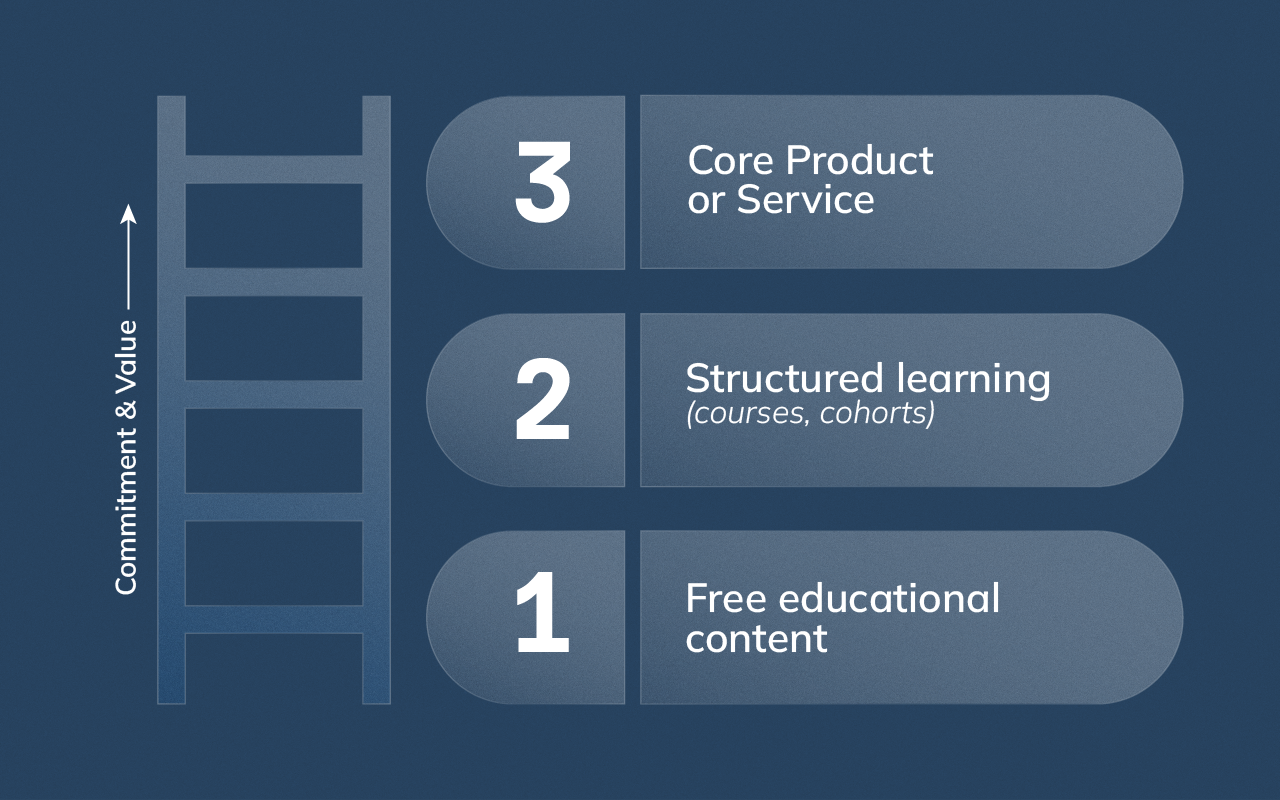
Create an education ladder:
- Free education
Broad, evergreen content that builds trust at scale. - Structured learning
Courses, cohorts, or workshops that help your best-fit audience apply what they’ve learned. - Core product or service
Positioned as the natural next step once trust is earned.
Your content should constantly surface:
- problems worth paying to solve
- gaps that structured learning fills
- outcomes your product delivers
Free education earns attention.
Paid education qualifies and monetizes it.
STEP 5: Build Systems That Run Without Founders
A media brand that depends on founders cannot scale.
Rupa documented everything:
- workflows
- standards
- decision criteria
Instead of personalities, the company invested in playbooks.
These playbooks allowed multiple channels to run in parallel:
- SEO as a discovery engine
- YouTube as a trust amplifier
- Podcasts as long-form authority
- Social as distribution layers
The result was growth without linear headcount increases.
What You Should Do
Turn intuition into documentation:
- how topics are chosen
- how contributors are evaluated
- how content is reviewed, edited, and published
Replace personalities with playbooks.
If a new hire can’t run the system with documentation alone, the system isn’t finished.
STEP 6: Scale Channels as an Ecosystem (Not Silos)
No single channel carried the brand.
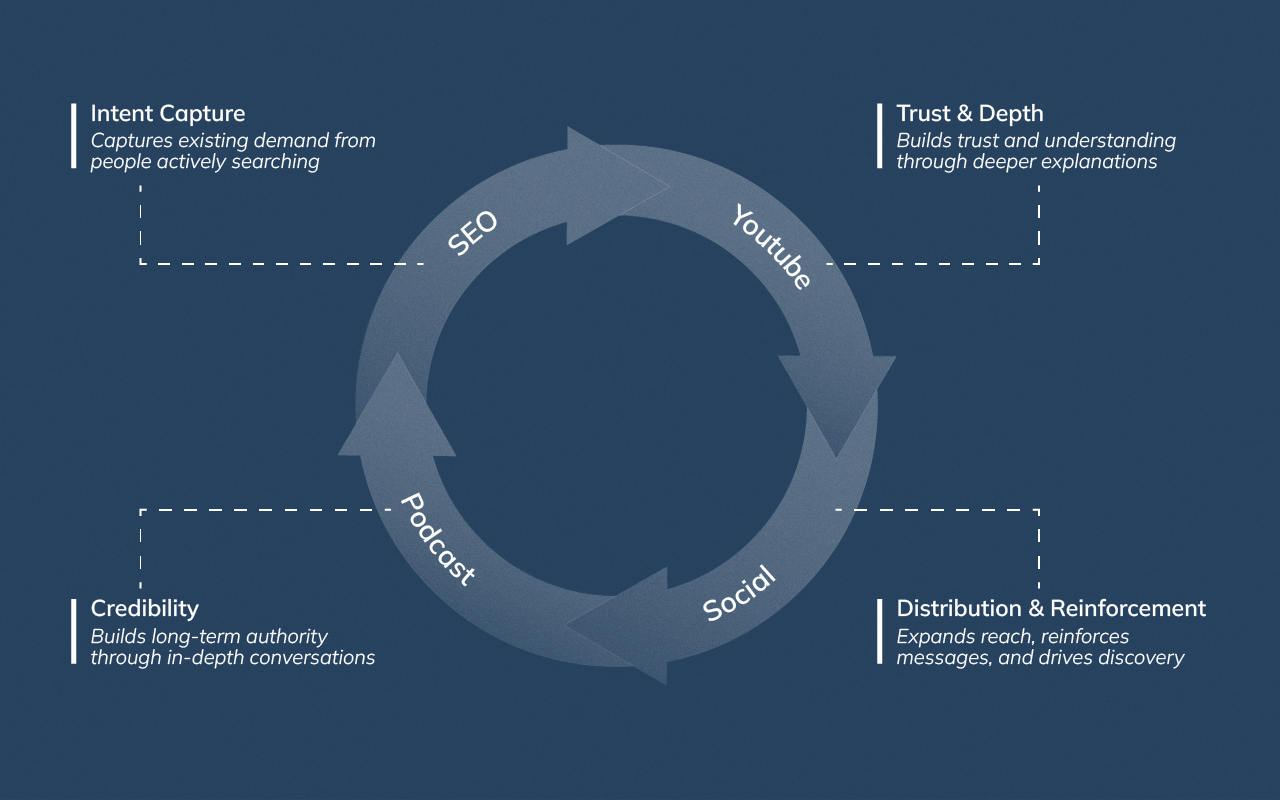
Each channel reinforced the others:
- Search fed YouTube
- YouTube fed social
- Podcasts created authority
- Social drove top-of-funnel discovery
Performance at scale included:
- Hundreds of thousands of monthly readers via search
- One of the largest medical communities on Facebook
- Millions of YouTube views
- A podcast that turned doctors into industry voices
The insight: media brands scale as ecosystems, not channels.3
What You Should Do
Assign each channel a specific role:
- Search = intent capture
- Video = trust and depth
- Social = distribution and reinforcement
- Long-form = credibility
Channels shouldn’t compete.
They should feed each other.
STEP 7: Engineer YouTube as a Multi-Contributor System
Early YouTube efforts failed when reliant on one expert. The solution was to redesign YouTube as a system, not a personality:
- Contract multiple medical professionals
- Standardize compensation per submission
- Allow asynchronous content uploads
- Retain contributors based on performance
This removed bottlenecks and unlocked scale.
Behind the scenes:
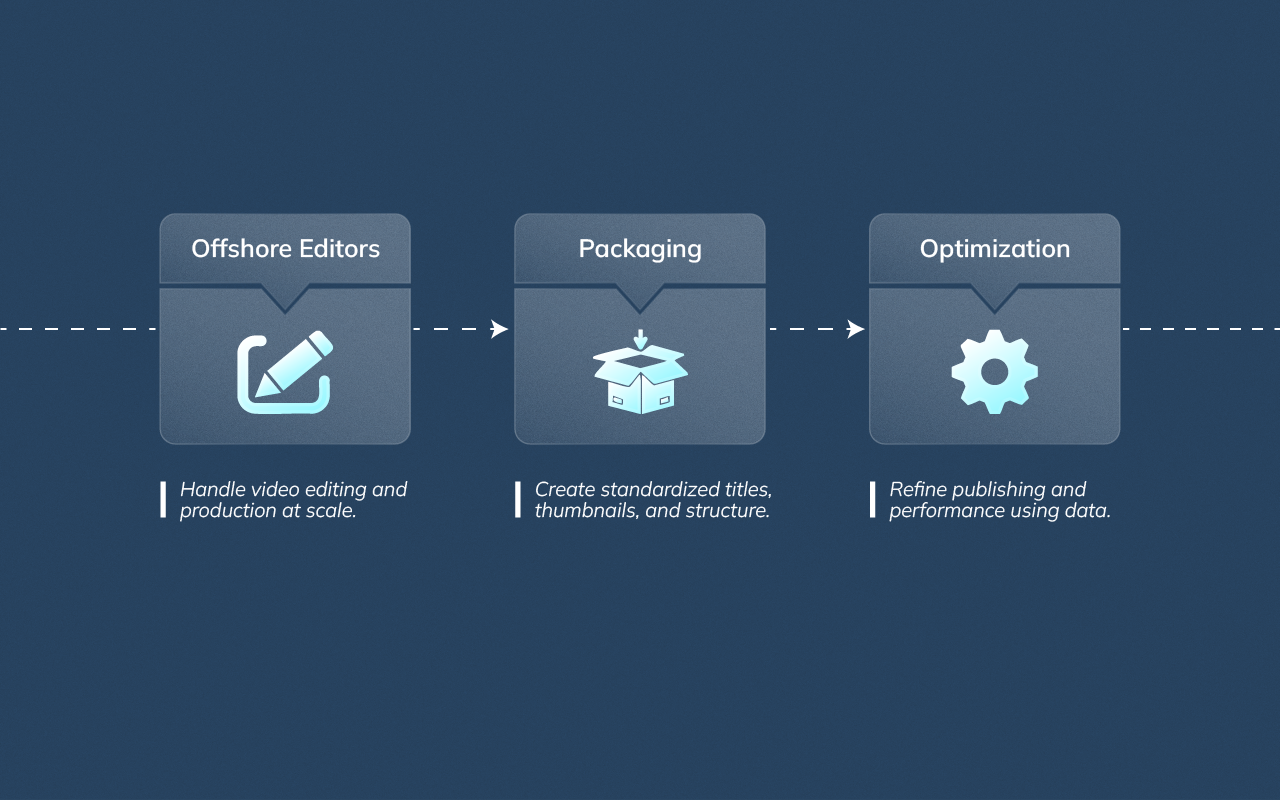
- Offshore editors handled production
- Coordinators managed workflows
- Growth assistants optimized publishing
Once the system worked, it was documented and handed off.
YouTube continued growing without leadership involvement.
What You Should Do
Redesign your YouTube channel around throughput, not talent dependency:
- recruit several credible experts instead of one “star”
- centralize editing, packaging, and optimization
- use performance data to decide who continues producing
Support the system with clearly defined execution roles rather than ad-hoc help:
- assign ownership for editing, publishing, and optimization
- document workflows so contributors only focus on recording
- remove leadership from day-to-day production decisions
When YouTube runs on systems and roles, it becomes a scalable growth asset instead of a founder bottleneck.
STEP 8: Treat SEO Like a Product, Not a Blog
Doctors don’t aspire to write blog posts.
They want to contribute to publications that carry authority.
Rupa Health didn’t build a blog.
It built a digital medical magazine with clear standards, structure, and editorial oversight.
Execution required a hybrid system:
- offshore medical researchers and writers for scale
- overseas SEO specialists for structure and optimization
- U.S.-based medical reviewers for accuracy
- offshore designers and publishers for speed
This model made it possible to compete with—and eventually surpass—legacy health publishers without a massive internal team.
What You Should Do
Redesign SEO as a product, not a content calendar:
- define clear content categories and formats
- document quality and editorial standards
- separate research, writing, review, and publishing roles
Use offshore teams to handle repeatable execution while keeping final approval and strategy centralized.
When SEO is treated like a product:
- quality stays consistent
- output scales predictably
- authority compounds over time
That’s how smaller companies win against entrenched publishers—through systems, not headcount.
STEP 9: Systematize Social Media Without Chaos
Social growth was not spontaneous.
Every platform ran on workflows:
At Rupa Health, execution followed a clear sequence:
- offshore medical professionals handled research
- AI assisted with summarization and first drafts
- designers created consistent visuals
- growth assistants scheduled and distributed content
This kept social channels active, accurate, and on-brand—without constant oversight.
What You Should Do
Deconstruct social media into repeatable steps and assign ownership:
- separate research from writing
- standardize formats and templates
- automate drafting where possible
- delegate scheduling and publishing
When roles are clear and workflows are documented:
- output stays consistent
- quality doesn’t degrade
- leadership time isn’t consumed
Consistency beats spontaneity.
STEP 10: Use Overseas Teams to Unlock Leverage
The most important takeaway:
Scale came from leverage, not headcount.
Rupa’s core team stayed lean. Execution power came from overseas specialists operating inside clear systems.
By partnering with Hire Overseas, Rupa was able to:
- build large execution teams quickly
- control costs without sacrificing quality
- scale output without adding management overhead
This contractor-first model made it possible to operate like a media company without becoming one internally.
What You Should Do
Design your media and content team around leverage:
- keep strategy, standards, and final decisions centralized
outsource repeatable execution to trained overseas specialists - document workflows so roles are interchangeable, not fragile
Build teams around functions—not individuals:
- editors edit
- researchers research
- designers design
- coordinators manage flow
When execution is offshore and systems are clear:
- output scales without burnout
- costs stay predictable
- leadership time is preserved
This is how modern companies build media brands that grow faster than their headcount—and why overseas execution is a competitive advantage, not a compromise.
Case Study: The Full Rupa Health Media Engine
Rupa Health didn’t rely on a single channel or personality.
It built a company-owned media engine by combining multiple systems into one cohesive framework.
The engine was powered by:
- expert-led education (STEP 2–4)
- demand-driven SEO and YouTube content (STEP 5–8)
- offshore execution for scale (STEP 9–10)
- documented workflows that removed bottlenecks (STEP 6–7)
The SEO + YouTube Flywheel in Practice
High-performing SEO articles consistently inspired corresponding YouTube videos.
Those videos were embedded back into the articles.
This created a compounding loop:
- high-intent readers spent more time on the page
embedded videos captured long watch sessions - external traffic boosted YouTube watch time
- higher watch time improved YouTube rankings
- stronger rankings drove more organic discovery
Each loop reinforced the next—without paid spend.
Why This System Scaled
Because every step was intentional:
- experts focused only on teaching
- offshore teams handled execution
- systems replaced manual oversight
- channels reinforced each other instead of competing
No single channel carried the brand.
Each one strengthened the others.
The result was a media engine that compounded trust, reach, and authority over time while remaining operationally lightweight.
That’s the difference between “doing content” and building a scalable media brand.
The appendix below converts this framework into an execution system, outlining the roles, workflows, and operating rhythms required to scale it.
Media Brands Are Built With Systems and People, Not Posts
Rupa Health didn’t win because it posted more content. It won because it built infrastructure.
Education became trust. Trust became distribution. Distribution became revenue.
And none of it depended on a single personality, founder, or moment in time.
The real advantage was not creativity—it was repeatability. A documented system, clear standards and execution powered by overseas specialists who made scale possible without bloated headcount.
This is the shift modern companies must make:
Stop treating content as marketing output. Start treating media as a company-owned asset.
But here’s the truth: Great Systems Fail Without the Right People
You can understand the framework perfectly and still stall if execution is fragile.
To run a scalable media engine, you need:
- subject-matter experts who can teach, not sell
- editors who can maintain quality at volume
- researchers who feed demand-driven topics
- coordinators who keep workflows moving
- growth assistants who make sure nothing breaks
Hiring all of this locally is slow and expensive but not hiring leads to burnout and inconsistency.
This is where Hire Overseas becomes your leverage. We help companies build overseas media, growth, and content teams trained to operate inside documented systems—so your brand scales without depending on heroics.
The Rupa Health story isn’t about healthcare. It’s about building a company-owned media engine that compounds.
Now you have the system.
The next step is building the team that makes it run.
Schedule a conversation with us and build an expert-led media system designed to earn trust and scale.
FAQs About Building A Company Media Brand
Can early-stage or mid-sized companies build a media brand, or is this only for large startups?
Early-stage and mid-sized companies are often best positioned to build media brands because they can design systems from scratch. With clear workflows and overseas execution, smaller teams can compete with much larger publishers and brands.
What types of companies benefit most from building a media brand?
Media brands work best for companies that sell complex, trust-driven products or services—such as healthcare, SaaS, fintech, education, professional services, and B2B platforms—where education directly influences buying decisions.
Is paid advertising required to grow a media brand?
No. While paid promotion can accelerate distribution, strong media brands are primarily driven by organic channels like search, video platforms, podcasts, and social distribution. The goal is compounding reach, not ongoing ad spend.
Can a media brand directly increase company valuation?
Yes. A strong, company-owned media engine can significantly increase brand equity, customer trust, and defensibility. It becomes an owned distribution channel that reduces acquisition costs and strengthens the business beyond any single product or campaign.
Appendix: The Company Media Brand Operating System
This appendix exists to do three things:
- Turn the playbook into an execution guide
- Make the system delegable to overseas teams
- Remove founder dependence from media growth
Use it as a reference when hiring, onboarding, or scaling your media operation.
Appendix A: The Media Brand System Map
A scalable company media brand is not one channel.
It is a system of reinforcing components.
Core Components
- Authority — credible experts, not generic creators
- Education — content that teaches, not promotes
- Systems — documented workflows, not ad-hoc effort
- Leverage — overseas execution, not headcount growth
Primary Channels
- SEO (search-driven discovery)
- YouTube (trust and long-form authority)
- Podcasting (depth and relationship building)
- Social platforms (distribution layers)
Each channel exists to support the others.
No single channel carries the brand alone.
Appendix B: Expert-Led Content Model (Distributed Expertise)
Avoid building your media brand around one person.
Recommended Structure
- 5–15 subject-matter experts
- Standardized content guidelines
- Clear quality and compliance standards
Performance-based continuation
Why This Works
- Removes single-point-of-failure risk
Increases content throughput - Expands topical coverage
- Builds brand authority independent of personalities
Your brand becomes the authority—not the individual.
Appendix C: Media Team Roles (Offshore-First)
A lean internal team supported by offshore execution.
Core Roles
- Media Lead / Strategist
- Defines standards, priorities, and direction
- YouTube or Channel Manager
- Topic planning, performance review, coordination
- Subject-Matter Experts
- Create educational content asynchronously
Offshore Execution Roles
- Video editors (long-form + short-form)
- Thumbnail designers
- SEO specialists
- Researchers / writers
- Publishing coordinators
- Growth assistants (scheduling, QA, reporting)
This structure scales output without scaling management overhead.
Appendix D: Monthly Content Planning Framework
Use demand gaps, not intuition.
Monthly Planning Loop
- Review top-performing SEO articles
- Identify high-demand / low-supply topics
- Assign topics to experts
- Approve outlines (not full scripts)
- Batch production
- Review performance and prune
Inputs to Monitor
- Google Search Console
- YouTube autocomplete
- Community discussions (Reddit, Twitter/X)
- Internal customer questions
- Existing high-traffic pages
Planning monthly—not weekly—creates stability and speed.
Appendix E: SEO + YouTube Flywheel Template
This is the highest-leverage growth loop in the system.
The Loop
- Publish high-quality SEO article
- Create a corresponding YouTube video
- Embed the video into the article
- Drive high-intent external traffic
- Increase watch time and retention
- Improve YouTube rankings
- Generate additional discovery
Rule
- Every high-traffic article gets a video.
- Every strong video supports an article.
- This compounds without paid spend.
Appendix F: Documentation & Handoff Checklist
Your media brand should run without you.
What to Document
- Content standards
- Topic selection criteria
- Editing rules
- Thumbnail styles
- Publishing cadence
- QA checklists
- Performance benchmarks
Handoff Test
If the media lead steps away for 30 days:
- Does output continue?
- Does quality hold?
- Do metrics remain stable?
If yes, the system works.
Appendix G: What to Measure (Ignore Vanity Metrics)
Primary Signals
- Search impressions and rankings
- Watch time and session duration
- Repeat viewers
- Content-assisted conversions
- Lead quality influenced by content
Secondary Signals
- Subscriber growth
- Follower counts
- Engagement rates
Vanity metrics indicate reach.
Compounding metrics indicate value.
How to Use This Appendix
- Use Appendix A–C when hiring and structuring teams
- Use Appendix D–E during monthly planning
- Use Appendix F to remove founder bottlenecks
- Use Appendix G to keep decisions grounded
Together, these appendices turn the playbook into an operating system, not a thought piece.
