



A Bullseye playbook for finding your first real growth channel
(Based on “Traction” by Gabriel Weinberg & Justin Mares)
Most early-stage founders don’t really understand how to grow a business or reach their first $1M in ARR (Annual Recurring Revenue). They never figure out how to reliably acquire customers.
The good news:
You don’t need twenty channels.
You don’t need complicated funnels.
You don’t need a huge marketing team.
You only need one great marketing channel.
And you only need two to three channels to reach $10M ARR.
This playbook teaches you the exact process for finding those channels — a modern, battle-tested version of the Bullseye Framework from Traction, adapted for today’s growth environment.
STEP 1: Understand What Growth Really Means (Growth ≠ Marketing)
Before you choose channels or run tests, you need to understand what growth actually is — because growth and marketing are not the same.
Marketing is one part of growth.
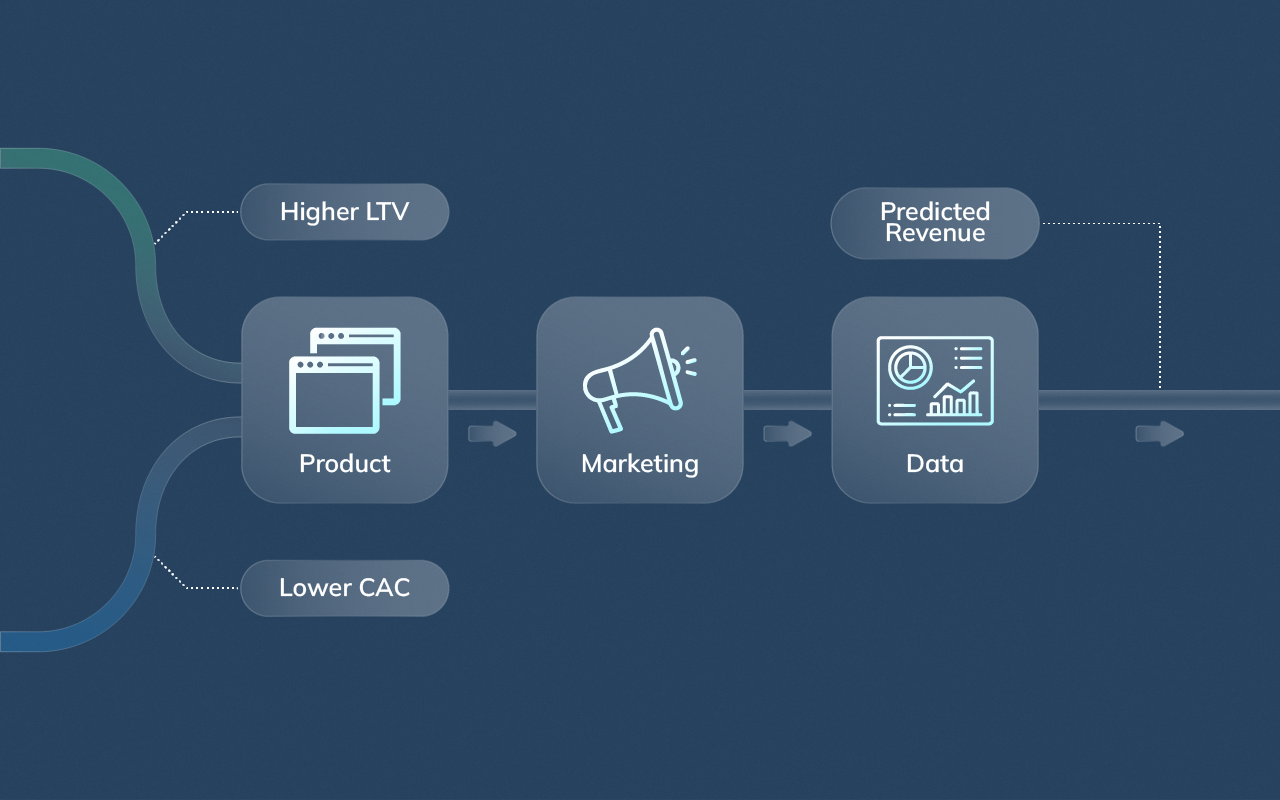
Growth is the entire system that makes revenue predictable, repeatable, and profitable.
Growth integrates product, marketing, and data together. It’s not just about getting users, it’s about building the machine that turns those users into long-term revenue.
Growth is a data-informed way to turn your business into a money machine
Your business earns revenue, but it costs money to acquire and serve customers.
Your goal is to make this machine as profitable as possible by:
- keeping CAC (customer acquisition cost) as low as possible, and
- increasing LTV (customer lifetime value) as much as possible.
If CAC is low and LTV is high, your business can scale sustainably.
If CAC gets too high, your business collapses no matter how good your marketing looks.
“The purpose of growth is to build the lowest-cost, highest-retention system for acquiring customers so your business becomes a compounding revenue engine.”
Without this understanding, you will misread early signals, chase vanity metrics, and scale channels that don’t support your economics.
That’s why the next step is defining the metrics and guardrails that keep your decisions grounded in reality.
STEP 2: Define Your Growth Metric and Guardrails
Before you explore channels or start testing anything, you need clarity on what you’re optimizing for and the financial boundaries you will not cross. This step sets the foundation for every growth decision your startup will make.
Your North Star metric
Choose the one metric that best reflects real traction for your business, such as:
- demos booked
- sales calls
- paid activations
- opportunities created
- new subscriptions
Everything in your growth and marketing strategy should optimize this number.
Your guardrails
These guardrails prevent wasted spend, false signals, and getting attached to channels that don’t actually make economic sense.
Here’s what each guardrail means in plain founder language:
Target CAC (Customer Acquisition Cost) and the maximum CAC you’ll tolerate
This includes:
- ad spend
- software costs
- labor costs (your time or a contractor’s time)
- agency fees
- creative or production costs
- any incentives used to convert
- tools tied directly to acquisition
A simple formula:
- CAC = Total acquisition costs ÷ Number of new customers acquired
- If you spent $5,000 on experiments and got 5 customers, your CAC is $1,000
If your CAC is higher than what a customer is worth, you don’t have a business—you have a donation program. Founders who don’t set these numbers inevitably burn cash on channels that were never going to be profitable.
Max payback period (usually < 12 months for early startups)
Payback period = how long it takes for you to earn back your CAC.
Example:
- CAC = $1,000
- Customer pays $250/month
Payback = 4 months.
For most early-stage startups, a payback of under 12 months is the recommended ceiling.
Under 6 months is even better.
What this means:
- Long payback = you tie up cash
- Short payback = you can reinvest sooner and grow faster
- Investors care deeply about it
- It determines how scalable your channel really is
No channel should be scaled unless payback is ≤ 12 months.
ICP definition (Ideal Customer Profile)
This is a precise description of the person or company who is most likely to:
- buy fast
- stay long
- refer others
- get value quickly
ICP is usually defined by:
- Industry
- Company size
- Budget
- Role/persona
- Pain points
- Urgency
- Maturity level
- Geography (sometimes)
If you don’t know exactly who you’re optimizing for, you’ll chase the wrong signals and your experiments will produce noise instead of insight.
Clear disqualification rules
These are the people you do NOT want to serve, even if they show interest.
Bad-fit customers:
- churn early
- overuse support
- distort your roadmap
- demand discounts
- hurt your metrics
- clog your funnel
- create false positives for channels
For example:
- “Any lead under 10 employees is disqualified.”
- “We don’t serve agencies.”
- “Anyone with a budget under $2,000/month is a no.”
- “We exclude students, DIY users, and hobbyists.”
Good growth depends as much on saying no as saying yes. This keeps your metrics honest and prevents tests from being distorted by customers who were never going to be profitable.
Now that you’ve set your metrics, boundaries, and disqualification rules, you’re ready for the Bullseye Framework.
STEP 3: The Bullseye Starting Point
The fastest path to startup traction begins with adopting the Bullseye mindset from Traction:
“Your breakout growth will come from one channel — your job is to discover which one.”
Gabriel Weinberg’s research shows founders consistently guess wrong about which channels will work. The Bullseye Framework solves that by forcing you to:
- widen your exploration
- challenge your assumptions
- test channels systematically
- and let real data reveal the winner
This is not about predicting your growth channel.
It’s about discovering it through disciplined experimentation.
Why this matters
Founders default to:
- the channels they know,
- channels their competitors use,
- or channels they believe “should work.”
Reality: your winning channel is usually one you didn’t expect.
Prerequisite: Basic Product Traction
Before running growth and marketing experiments, confirm:
- retention is stable,
- users return without reminders,
- word-of-mouth is happening naturally.
Marketing amplifies demand, it cannot create it from zero. Once you have early proof, it’s time to enter Bullseye.
STEP 4: Write the Giant List
Founders dramatically underestimate how many channels could work for them. But Traction proves the winning channel often comes from the unexpected places.
So you begin by creating a wide-open brainstorm.
Your goal: list 10–20 potential channels
Yes, twenty. Even if:
- you think they won’t work,
- you’ve never tried them,
- your competitors don’t use them.
This step eliminates founder bias and opens up channels you would never naturally consider.
Start with the 19 classic traction channels
- Viral Marketing
- PR
- Unconventional PR
- Search Engine Marketing
- Social & Display Ads
- Offline Ads
- SEO
- Content Marketing
- Email Marketing
- Engineering-as-Marketing
- Targeting Blogs
- Business Development
- Sales
- Affiliate Programs
- Existing Platforms
- Trade Shows
- Offline Events
- Speaking Engagements
- Community Building
Every one of these has been a breakout channel for successful startups.
Then add modern channels
- Paid: Meta, TikTok, YouTube, LinkedIn, PMAX, Microsoft Ads (including DuckDuckGo), Reddit Ads, Quora Ads
- Organic: SEO + AEO, LinkedIn content, YouTube channels, TikTok content, Reddit engagement
- Creators: UGC (User-Generated Content) creators, micro-influencers, Spark Ads, creator whitelisting
- Outbound & ABM: Cold email, cold calling, personalized ABM gifting, 1:1 founder outreach
- IRL: Founder dinners, roundtables, meetups, workshops, webinars, conferences
- Partnerships: Podcast sponsorships, newsletter sponsorships, co-marketing, review sites, app store marketplaces
How to brainstorm effectively
Open a spreadsheet and create one row per channel category.
Then list:
- one idea per channel minimum
- ideally 3–5 ideas for channels that spark interest
- even “unlikely” ideas, because those often win
This giant list becomes the raw material for the next steps.
When building your giant list, use the Appendix at the end of this playbook. It includes every Traction channel + modern channels you can test.
STEP 5: Shortlist and Run 5% Tests
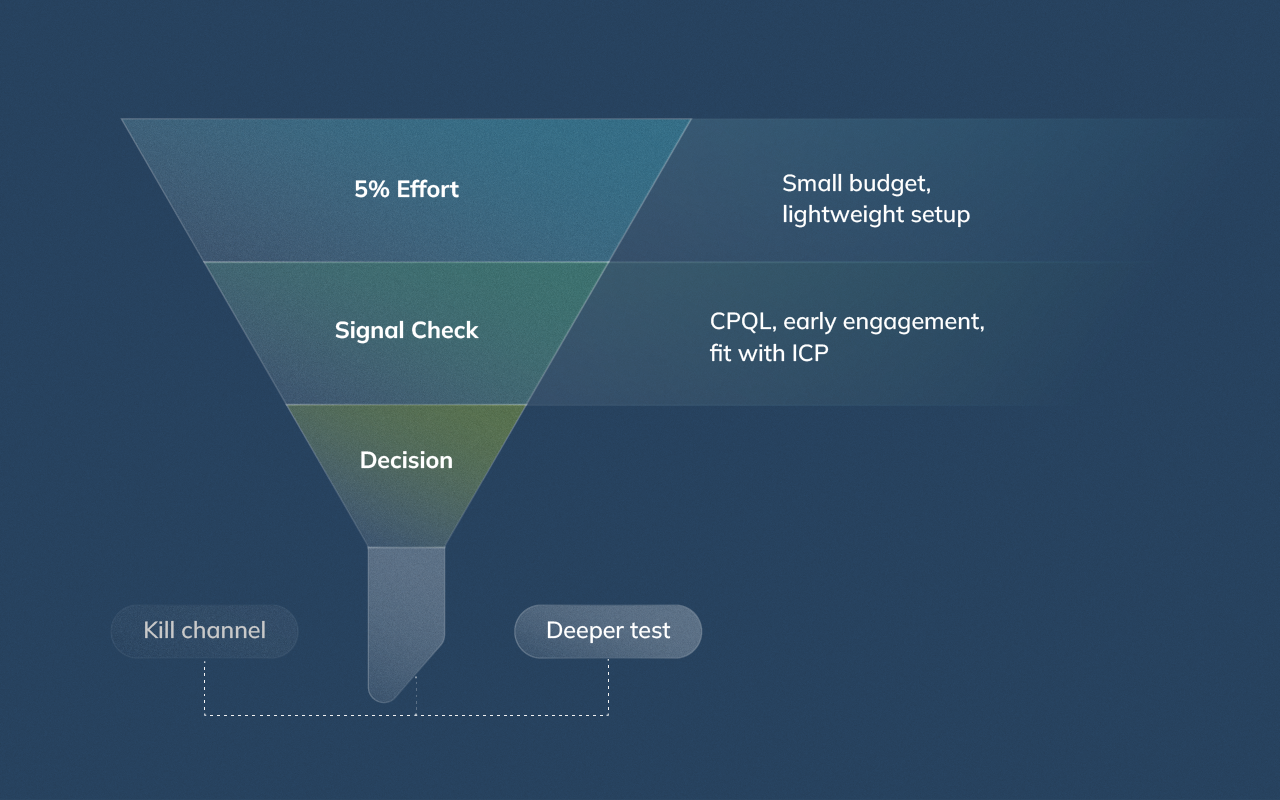
From your giant list, choose the three channels that seem most promising for your ICP, budget, and sales motion.
This step maps directly to the Inner Ring of the Bullseye Framework from the book Traction. The phase where you rank → prioritize → test the channels most likely to work before committing a real budget.
Run “5% tests”
A 5% test is a tiny, cheap, fast experiment designed to reveal whether a channel shows any meaningful potential. It is not meant to prove scalability. It is not meant to deliver full ROI. It is not meant to be optimized.
A 5% test answers one question:
“Does this channel show enough early signals to justify deeper testing?”
If the early signal is weak, you cut it. If the early signal is promising, you keep testing.
This prevents you from over investing in channels that never had a chance to work.
Examples of 5% tests:
Below are compact examples of what “5% effort” looks like across different channel types.
Paid Ads (Meta, LinkedIn, Google)
Run a lightweight structure:
- 2–3 audiences
- 3 creatives
- 2 offers
Measure CPQL (cost per qualified lead), not clicks
Goal: Determine whether paid ads can reliably generate qualified conversations at an acceptable early cost.
SEO + AEO
Publish three fast BOFU pages:
- Pricing
- Comparison
- Best-for-[ICP]
Track:
- early impressions
- indexing
- long-tail ranking velocity
Goal: Assess whether these pages begin surfacing in search and answer engines quickly enough to validate SEO/AEO as a viable channel.
UGC / Micro-Influencers
- Recruit 20–50 small creators
- Request 1–2 content pieces each
- Boost only the top 10–20% performers
Goal: Verify whether UGC drives stronger engagement or more efficient acquisition than brand-produced creative.
LinkedIn + Webinar
- Two founder posts per week
- One tightly focused partner webinar
- Follow up within 48 hours
Goal: Evaluate whether webinars and founder-led content reliably convert into booked calls and qualified opportunities.
ABM Gifting
- Send 25 personalized gifts to ideal accounts
- Include a short Loom video
- Follow with a value-driven message
Goal: Validate whether highly targeted accounts respond, engage, or take meetings at a significantly higher rate than broad outbound.
IRL Micro-Events
- Host one small founder dinner (8–12 people)
- Curate attendees around a single shared pain point
- Track booked calls and opportunities in the next 14 days
Goal: Determine whether in-person conversations convert faster and create a stronger pipeline than digital outreach alone.
STEP 6: Prune, Double Down, and Pick Your Bullseye Channel
After running your 5% tests, the Bullseye Framework instructs you to cut ruthlessly and reinvest confidently. This is where you transition from exploration to focus.
a. Prune – Cut half the channels immediately
Directly from Traction, this step eliminates noise and forces discipline. If a channel didn’t show promising early signals, stop testing it.
Weak channels do not “magically” improve with more budget — they only waste it.
b. Double Down – Reinvest in the strongest one or two channels
These are the channels that showed:
- the best CPQL
- highest intent engagement
- smoothest path to booked calls
- resonance with your ICP
- early repeatability
Run deeper validation tests
→ stronger offers
→ more creative variations
→ refined targeting
→ slightly higher budget
This isn’t scaling — it’s confirming.
Your goal is to verify whether the positive early signals persist under more volume.
c. Pick Your Bullseye Channel
You’ll know you’ve found your Bullseye when:
- CPQL improves instead of getting worse
- Meetings booked increase in volume and consistency
- Messaging resonates across multiple variations
- Your ICP responds predictably
- Results stabilize instead of spiking randomly
When your Bullseye emerges, stop tinkering with everything else. This channel is now your engine. This is how you get to your first $1M in ARR.
STEP 7: Scale Your Growth And Marketing Engine
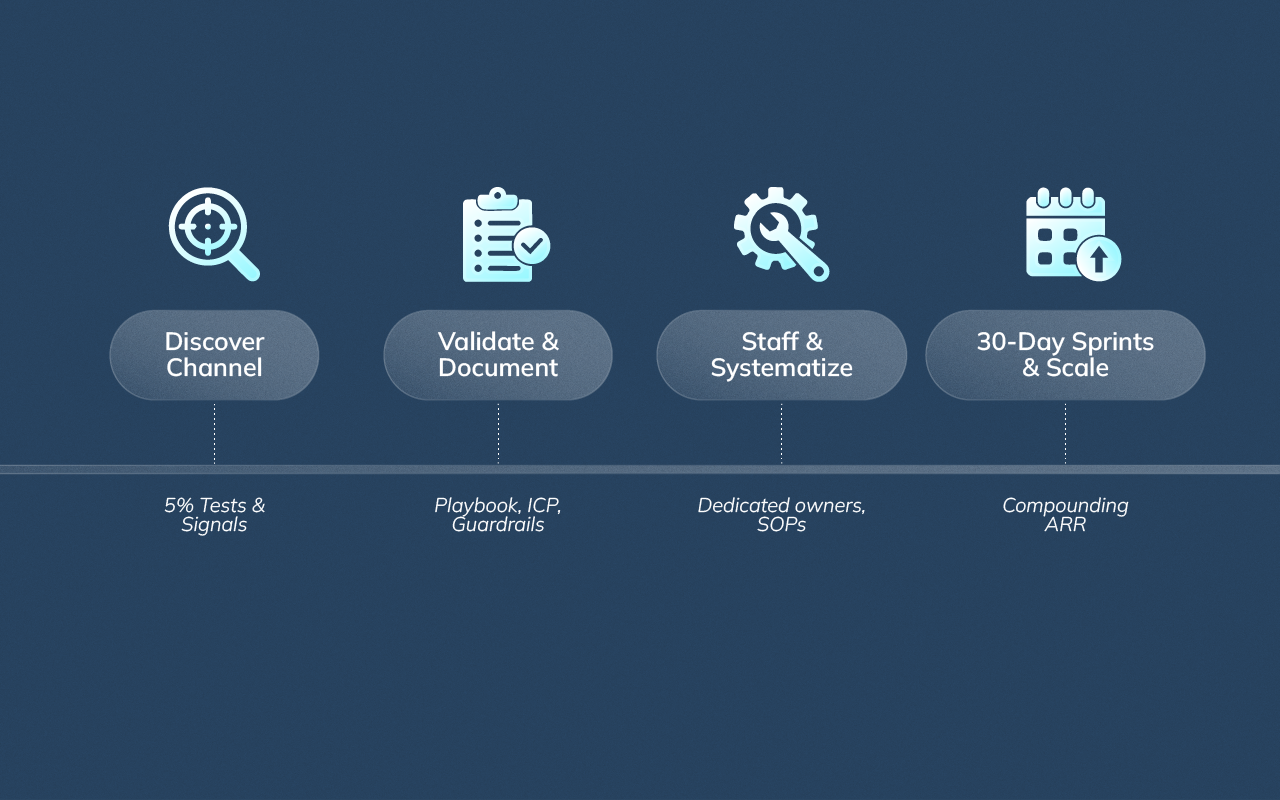
Once you've identified your breakout channel, your job shifts from “discovering what works” to building the system that lets it scale. This is where growth becomes a machine.
a. Systematize the channel
Document everything that makes the channel work so you can:
- remove guesswork
- onboard support quickly
- maintain quality as volume increases
- scale predictably
Document:
- audience segments
- targeting rules
- messaging and angles
- offers
- positioning
- creative formats
- follow-up sequences
- qualification criteria
- reporting cadence
This gives you a “playbook inside the playbook.”
b. Staff the engine
Scaling requires more hands and more focus.
Depending on your Bullseye channel, your next hires may include:
- Growth and marketing specialist
- Paid ads manager
- SEO/AEO lead
- Content strategist
- UGC manager
- Events or partnerships coordinator
These aren’t hires for the sake of hiring — these are people who help you scale the thing that is already working.
c. Layer supporting channels
Once your primary channel is stable and predictable, you can introduce 1–2 complementary channels that extend or amplify it.
Examples:
- SEO + webinars (organic demand + education)
- LinkedIn + ABM (top-of-funnel presence + high-touch outreach)
- Paid social + UGC (distribution + creative volume)
- Events + partnerships (trust + authority)
Adding channels too early creates chaos. Adding them after your Bullseye is validated creates compounding growth. This step is how you move from $1M → $10M ARR.
STEP 8: Launch Your First 30-Day Startup Growth Sprint
This 30-day sprint is where everything comes together. You’ll move fast, test smart, and gather the signals you need to identify your first real growth channel.
Week 1 — Plan
- finalize your ICP
- define your North Star metric
- write your giant list of channels (see Appendix for full channel list)
- shortlist the top three channels to test
You now have direction.
Weeks 2–3 — Test
Run your 5% tests across all three shortlisted channels:
- launch small, fast experiments
- track leading indicators
- collect directional data
- avoid full optimization
This is about learning, not scaling.
Week 4 — Evaluate
- prune half the channels
- double down on the top performer(s)
- plan your next set of validations
Then repeat the cycle until one channel clearly outperforms.
Once a channel consistently delivers qualified conversations, it becomes your Bullseye.
Case Study: How Hire Overseas Found Its Growth Channels
I want to show you how we applied this exact Bullseye framework with Hire Overseas, because we went through the same messy, uncertain testing cycle you’re about to go through. We didn’t magically know which channel would work. We discovered it through disciplined experimentation.
Here’s exactly how we approached it — what failed, what showed promise, and what ultimately drove consistent revenue.
What Didn’t Work (And We Cut Fast)
When we first started testing channels, we tried a wide mix to see what could generate signal. A lot of it didn’t work — at all — and that was the point. The Bullseye Framework is designed to expose the failures quickly so you don’t keep burning money on channels that never had a chance.
Here’s what failed for us:
- Meta ads — We spent $60,000 and got zero customers.
- Podcast sponsorships — not a single call booked.
- Newsletter sponsorships — also zero calls.
- Twitter/X content — didn’t produce anything meaningful.
We cut all of these immediately. No ego. No emotional attachment. Just data.
What Showed Some Signal (But Not Enough to Scale)
A few channels produced some traction, but not enough to become our primary engine.
- LinkedIn founder content — led to a handful of qualified calls.
- Micro-events — small dinners created early interest and conversations.
These were helpful, but they weren’t consistent or scalable enough to build around.
What Actually Worked (Our Breakout Channels)
Then we found the channels that truly moved the needle — and all of them came from testing, not guessing.
SEO + AEO (Our Breakout Channel)
We decided to put our expertise to work by hiring a dedicated SEO specialist to build and execute a comprehensive content strategy. Within two months, our pages started ranking and inbound calls came in. We closed those customers, proved the channel worked, and invested more to scale it.
Referrals (Our Highest-ROI Channel)
Referrals started flowing in from happy customers. We added a simple $1,000 referral incentive, and this became one of our most consistent and profitable channels.
ABM Gifting (High-Touch, High-Conversion)
We used a targeted gifting strategy to reach dream accounts.
Our favorite example:
We sent a custom movie poster featuring a target company’s founders.
It opened a conversation instantly — no cold email could have done that.
LinkedIn Webinars (Reliable B2B Pipeline)
We hosted short, hyper-specific webinars with partners. These consistently produced qualified meetings and warm opportunities, especially when paired with ongoing LinkedIn content.
Our Bullseye Channel Mix
After multiple testing cycles, here’s what our Bullseye looked like:
- Primary: SEO/AEO
- Secondary: LinkedIn content + webinars
- Strategic Layer: ABM gifting + referrals
This is the exact combination that generated predictable pipeline, qualified meetings, and recurring revenue. It matched everything Traction teaches:
“Test widely → cut aggressively → double down → scale what works.”
This wasn’t theoretical.
This was our real experience building Hire Overseas.
Key Takeaway
If you take anything from our story, make it this:
You don’t “pick” your channel.
You discover it.
Most of the channels we thought would work didn’t.
Most of the channels that actually worked weren’t even our first instinct.
Our job was simply to run the Bullseye process with discipline:
- test widely
- kill quickly
- follow the signal
- focus relentlessly
That’s how we found the channels that ultimately grew Hire Overseas — and you can do the same.
Growth Is a Discovery Process, Not a Plan
If you can take only one thing from this playbook, it’s this:
Startups grow by discovering their channel — not by predicting it.
You do that by:
- brainstorming widely
- testing cheaply
- pruning aggressively
- focusing relentlessly
One channel gets you to $1M ARR.
Two to three channels get you to $10M ARR.
This is how you build a predictable, durable growth engine that compounds over time.
But here’s the deeper truth:
A Great Framework Still Needs a Great Team
You now know how to find your Bullseye channel but executing this system consistently requires the right people. Most startups need:
- a growth specialist to run experiments
- an SEO/AEO expert to build organic demand
- a content or UGC creator to generate volume
- an ABM or outbound operator to drive targeted plays
- a virtual assistant to keep everything moving
With the right team, this playbook becomes your engine.
Without it, it stays theoretical.
This is where Hire Overseas helps you win.
We help startups hire top-tier marketing and growth talent cost-effectively, so you can execute this playbook with consistency and scale.
Book a demo and start building your growth team the right way.
FAQs About Getting Started With Startup Growth & Marketing
Who is this growth playbook actually for?
This playbook is designed for early-stage startups (usually pre-seed to Series A) that want to reach their first $1M–$10M in ARR with a focused startup growth strategy. It works especially well for B2B SaaS, service businesses with recurring revenue, and product-led companies that can run fast experiments across multiple traction channels.
Do we need a “perfect” product before we start growth and marketing?
No, but you do need basic product traction. You should see signs like users coming back on their own, real retention, and at least a few customers who would be upset if you shut down. If you don’t have that yet, your priority is product–market fit, not scaling growth. This playbook works best once you’ve seen early proof and now want to build a repeatable customer acquisition system.
How much budget should we set aside for early growth experiments?
A simple rule of thumb: start by allocating 5–10% of your projected annual revenue (or funding) to a dedicated experimentation budget. Your goal in this phase isn’t to “scale ads” but to buy information—quick signals about which channels might become your Bullseye. If money is tight, you can still run scrappy tests using founder-led outbound, content, LinkedIn, and partnerships before touching paid acquisition.
How long does it usually take to find a winning growth channel?
Most startups need several 30–90 day cycles to discover their Bullseye channel. Expect a few months of deliberate testing, pruning, and doubling down before you see a channel consistently generating qualified pipeline. The mistake founders make is quitting too early on the process or spreading themselves across too many channels at once instead of running focused, time-boxed growth sprints.
Will this framework work for B2C or product-led growth (PLG) businesses?
Yes. The Bullseye mindset and traction channel menu apply to both B2B and B2C—what changes are your ICP, offers, and success metrics. PLG companies often lean more heavily on organic channels (SEO, content, virality, in-product loops), but they still benefit from structured 5% tests across channels like paid social, creators, and partnerships to find scalable startup growth.
What’s the difference between a “growth” hire and a traditional marketer?
A traditional marketer often focuses on campaigns, brand, and channels in isolation. A growth hire owns the system: experiments, metrics, funnels, and the link between acquisition, activation, and revenue. They’re comfortable running tests across multiple traction channels, instrumenting data, and making decisions based on CAC, LTV, payback period, and pipeline quality—not vanity metrics.
When should a startup hire its first growth or marketing specialist?
You’re usually ready for your first dedicated growth/marketing hire when:
- Founders can no longer personally handle all experiments and follow-ups
- You’ve seen signs that 1–2 channels could work but need more consistent execution
- You’re leaving money on the table because nobody is “owning” growth week to week
At that point, bringing in a growth marketer, SEO/AEO specialist, or outbound operator (even part-time or remote) makes your system more consistent and less founder-dependent.
Can bootstrapped startups run this Bullseye process without big ad budgets?
Absolutely. Many bootstrapped companies find their first real growth channel through low-cost plays like founder-led outbound, LinkedIn content, webinars, micro-events, partnerships, and SEO. The key isn’t spending—it’s discipline. Even with a small budget, you can:
- Brainstorm widely
- Run tiny, well-structured 5% tests
- Cut losers fast
- Double down on whatever reliably creates qualified conversations
What if we’re in a very niche market—does this still work?
Yes, but your channel mix may lean more on high-touch and relationship-driven strategies: ABM, gifting, founder-led outbound, highly curated events, and deep partnerships. Niche markets often don’t support huge broad-reach campaigns, but they do reward personalized outreach, authority content, and tight ICP focus—all of which fit perfectly into this growth and marketing playbook.
How can Hire Overseas help us execute this growth playbook in practice?
This playbook gives you the system—but you still need capable people to run it consistently. Hire Overseas helps startups build remote growth and marketing teams cost-effectively, including:
- Growth marketers to own experiments and reporting
- SEO/AEO specialists to build long-term organic demand
- Content and UGC creators to power your channels
- ABM/outbound operators and virtual assistants to execute playbooks
Instead of piecing together random freelancers, you get a managed, offshore team that can run the Bullseye process end to end—so you can focus on strategy, product, and closing customers.
Appendix: The Full Traction Channel Menu + Growth Glossary
This appendix is your quick reference guide for two things:
- Every marketing channel you can use when building your Giant List
- Every abbreviation and growth term used in this playbook
Use this section anytime you run a Bullseye cycle. It expands your thinking, prevents founder bias, and helps you avoid confusion as you analyze results.
A. The Full Traction Channel Menu (Modern Edition)
This list combines: the original 19 channels from Traction, and all relevant modern channels founders use today. Most founders default to the handful of channels they already know.
This list forces you to explore widely — because your winning channel may not be the one you expect.
The Classic Traction Channels (from Traction)
1. Viral Marketing — referral loops, incentives, product invites
2. PR — earned press, interviews, media coverage
3. Unconventional PR — stunts, unique publicity plays
4. Search Engine Marketing — Google Ads, Microsoft Ads
5. Social & Display Ads — paid placements across major platforms
6. Offline Ads — TV, radio, billboards, direct mail
7. SEO — search rankings, on-page/off-page optimization
8. Content Marketing — blogs, guides, playbooks
9. Email Marketing — lead nurturing, onboarding flows
10. Engineering-as-Marketing — tools, calculators, templates
11. Targeting Blogs — guest posting, contributor features
12. Business Development — partnerships, co-selling
13. Sales — outbound email, cold calling, SDR processes
14. Affiliate Programs — revenue-share channels
15. Existing Platforms — marketplaces, review sites
16. Trade Shows — expo booths, industry shows
17. Offline Events — meetups, workshops, local gatherings
18. Speaking Engagements — conferences, panels, webinars
19. Community Building — Slack/Discord groups, forums
Modern Channels
Paid Acquisition
- Meta Ads (Facebook + Instagram)
- TikTok Ads
- LinkedIn Ads
- YouTube Ads / Shorts Ads
- PMAX (Performance Max)
- Microsoft Ads (Bing + DuckDuckGo)
- Reddit Ads
- Quora Ads
- Newsletter sponsorships
- Podcast sponsorships
- Programmatic native ads (Taboola/Outbrain)
Organic Channels
- SEO + AEO (Answer Engine Optimization)
- LinkedIn posting
- TikTok organic
- YouTube channels
- Reddit engagement (transparent, non-astroturfing)
- Founder-led content
Creator / UGC Channels
- UGC creators
- Micro-influencers
- Creator whitelisting
- Spark Ads
- Influencer seeding
Outbound & ABM
- Cold email
- Cold calling
- Intent-based outbound
- Personalized ABM gifting
- Custom Looms, teardown videos, audits
Events & Experiences
- Founder dinners
- Roundtables
- Workshops
- Webinars
- Virtual summits
- Partner events
- Conferences
Partnerships
- Co-marketing
- Referral partnerships
- API integrations
- App store listings
- Review platforms (G2, Clutch, Capterra)
Product-Led Growth (PLG)
- Freemium → paid loops
- In-product prompts
- Onboarding optimization
- Feature discovery flows
- Embedded referral loops
B. Growth Glossary (All Abbreviations Explained)
A clean, founder-friendly reference for every abbreviation used in this playbook.
Core Revenue Metrics
ARR — Annual Recurring Revenue
Predictable yearly revenue from subscriptions or contracts. Used to benchmark growth stages (e.g., $1M ARR, $10M ARR).
LTV — Lifetime Value
Total revenue a customer generates over their entire relationship with your business.
LTV:CAC Ratio
A profitability indicator. Healthy early-stage businesses aim for 3:1.
Acquisition & Performance Metrics
CAC — Customer Acquisition Cost
Total cost to acquire one paying customer (ads, software, labor, incentives).
CPQL — Cost Per Qualified Lead
Cost to acquire a lead who fits your ICP and is sales-ready. A better metric than CPL.
CPL — Cost Per Lead
Cost per general lead (not necessarily qualified).
CTR — Click-Through Rate
% of users who click an ad or link.
CPC — Cost Per Click
The amount paid per click in a paid ad campaign.
ROAS — Return on Ad Spend
Revenue generated per dollar spent on ads.
Funnel & Content Terms
BOFU — Bottom of Funnel
High-intent content targeting buyers ready to make a decision (pricing, comparisons).
MOFU — Middle of Funnel
Education and evaluation content (webinars, use cases).
TOFU — Top of Funnel
Awareness and broad education content (blogs, guides).
SEO & AEO Terms
SEO — Search Engine Optimization
Optimizing content to rank in Google.
AEO — Answer Engine Optimization
Optimizing content so AI engines (ChatGPT, Perplexity, Copilot) quote or reference your content.
Outbound & Sales Terms
ICP — Ideal Customer Profile
The exact type of customer most likely to buy, stay long-term, and refer others.
ABM — Account-Based Marketing
Highly personalized marketing/outreach to specific high-value accounts.
SAL — Sales Accepted Lead
A lead that meets sales qualification criteria and is accepted into the pipeline.
Paid Ads & Platforms
PMAX — Performance Max
Google’s automated ad product distributing across all Google surfaces.
Growth Strategy & Product
PLG — Product-Led Growth
When your product drives acquisition, activation, and conversion (free → paid loops, in-product prompts).
Creator & Social Terms
UGC — User-Generated Content
Creator-made content used for ads or organic distribution.
