


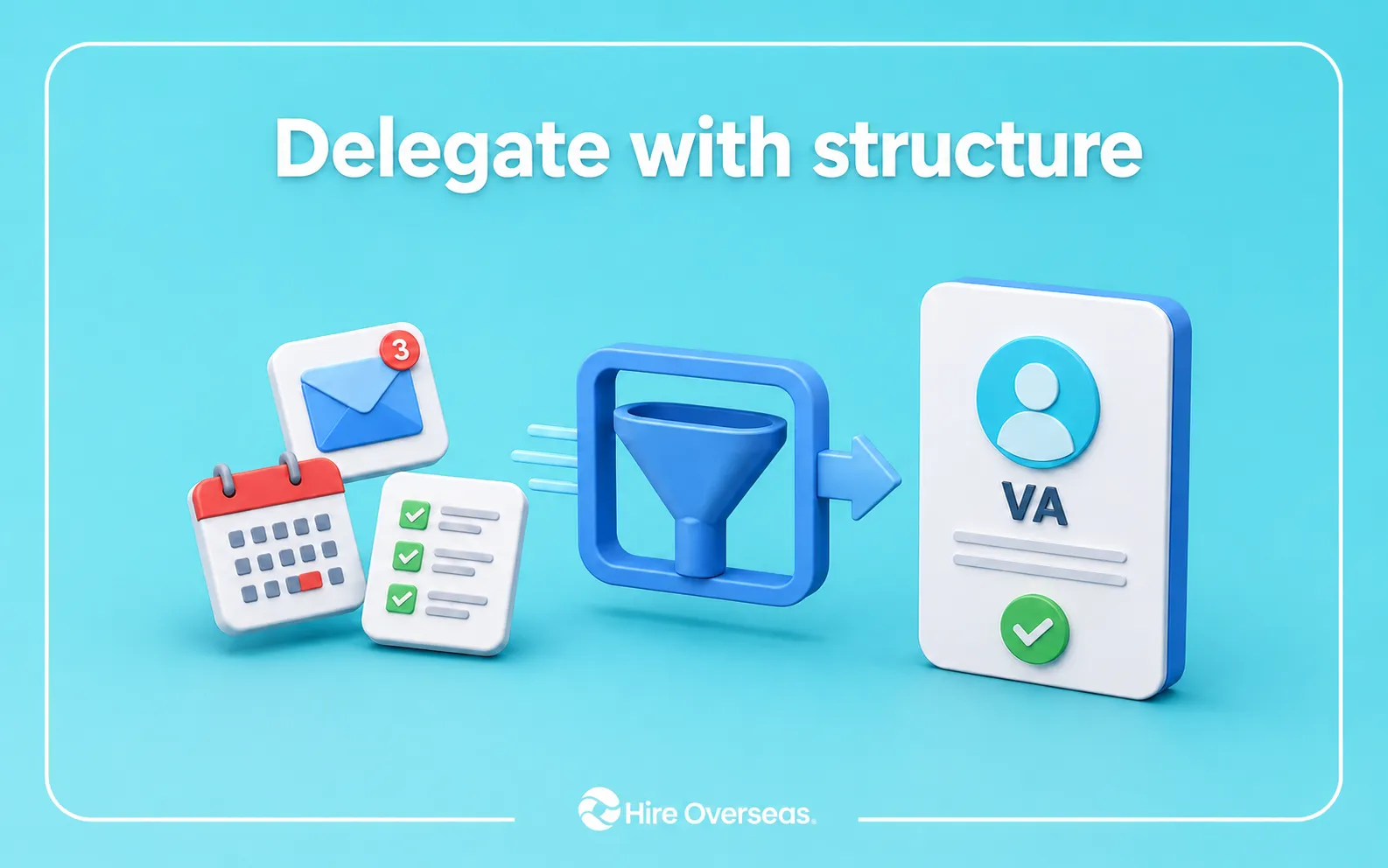
Most founders don’t hire a virtual assistant because they’re ready. They hire because they’re overwhelmed.
Inbox is messy. Tasks are scattered. You’re context-switching all day.
And at some point, you realize: You are the bottleneck.
This guide is not just about how to hire your first virtual assistant.
It is about doing it in a way that actually removes pressure from your day instead of adding more.
Why First-Time Founders Struggle When They Hire a Virtual Assistant
Hiring a VA seems simple.
But for first-time founders, it often creates more work instead of less.
Not because virtual assistants do not work, but because the role is not designed properly from the start.
What usually happens is predictable.
If you're unsure whether your workload justifies a dedicated hire or a freelance option, this comparison of freelancer vs virtual assistant breaks down which model fits founders who need fewer than 20 hours per week of support.
You Delegate Tasks Instead of Outcomes
Most first hires look like this:
- “help with emails”
- “assist with admin”
- “support wherever needed”
At first, it feels like progress.
But very quickly, you notice something:
You are still answering questions all day.
- “What should I reply here?”
- “Is this important?”
- “How do you want this done?”
Instead of removing work, you create a loop where every task still depends on you.
This leads to:
- constant interruptions
- repeated explanations
- inconsistent output
A virtual assistant does not succeed with vague tasks.
They succeed when they own a clear outcome.
You Have No Defined Workflow
Most founders operate reactively.
Tasks come in throughout the day, priorities shift, and processes live in your head.
When you bring in a VA without structure, they inherit that same chaos.
They rely on:
- clear instructions
- repeatable processes
- defined expectations
Without these, they cannot operate independently.
So what happens?
- tasks get done differently each time
- mistakes increase
- you spend time correcting instead of delegating
Even a highly skilled VA will underperform in an unstructured environment.
You Stay Involved in Everything
This is the biggest issue.
Even after hiring, you are still:
- reviewing every message
- approving every action
- answering every question
Nothing actually leaves your plate.
You have added coordination, but not removed responsibility.
At this point, the VA becomes:
- an extra step in your workflow
- not a replacement for it
What This Looks Like 2–4 Weeks After Hiring
This is the reality most founders experience when hiring without structure:
- You spend time assigning tasks instead of focusing on growth
- You re-explain the same instructions repeatedly
- You double-check everything before it goes out
- You feel like managing the VA is another job
Instead of relief, you feel more overwhelmed.
This is why many founders say:
“Hiring a VA didn’t work for me.”
The Real Problem
The issue is not the virtual assistant.
It is how the role was designed.
A VA is not there to “help when needed.”
They are there to own a defined part of your operations.
The Goal of Your First Virtual Assistant
Your first VA should do one thing well: Remove decisions and execution from your plate.
That means:
- fewer interruptions
- fewer small decisions
- fewer repetitive tasks
When done right, your VA does not just complete tasks.
They create space for you to focus on higher-value work.
That is the difference between hiring help and actually scaling your time.
If you're not yet clear on the full scope of tasks a VA can realistically take over, this breakdown of what a virtual assistant actually does covers the specific daily functions — from calendar management to CRM updates — that founders typically offload first.
How to Hire a Virtual Assistant When You’ve Never Done It Before
If this is your first time hiring a virtual assistant, the process needs to be simple and structured.
The goal is not to hire fast.
The goal is to hire in a way that removes work from your plate.
Here is the step-by-step process first-time founders should follow.
If you're weighing whether to go through an agency or hire independently, this guide to hiring a reliable virtual assistant walks through the vetting criteria and red flags that separate consistent performers from costly misfires.
Step 1: Identify the Bottleneck You Want to Remove
Do not start by asking what tasks you can outsource.
Start by asking what keeps interrupting your day.
For most founders, it is one of these:
- inbox management
- scheduling and follow-ups
- customer support
- admin coordination
- content publishing
Your first VA should solve one recurring bottleneck, not become a catch-all for random work.
This matters because vague roles create vague results.
Step 2: Turn That Bottleneck Into a Clear Function
Once you know the bottleneck, define what the VA will fully own.
For example, instead of saying:
- help with emails
say:
- organize the inbox daily
- flag urgent emails
- draft replies for review
- respond directly to routine messages
This is the shift from task delegation to functional ownership.
It gives the role structure and makes success measurable.
Once you've identified the bottleneck and scoped the role, this deep dive into hiring a freelance virtual assistant covers the exact contract structure and trial-task framework that lets you validate ownership ability within the first 5 days.
Step 3: List the Exact Tasks, Tools, and Expectations
Now define the basics of how the role works.
Write down:
- recurring tasks
- tools they will use
- hours or overlap needed
- communication cadence
- what should be escalated to you
This step is important because most first-time founders hire from memory. They know what they need in their head, but they do not document it clearly enough for someone else to follow.
Step 4: Decide Where to Hire
Once the role is clear, choose your hiring channel.
If you want flexibility and lower cost, freelance platforms are the usual option.
Common places include:
- Upwork
- Fiverr
- OnlineJobs.ph
If you want a faster and lower-risk process, agencies can help by handling sourcing and screening for you.
This is where you choose between direct hiring and virtual assistant outsourcing, which we will cover in the succeeding section.
Step 5: Write a Job Description That Attracts the Right Candidates
At this stage, you are ready to write the role.
A strong job description should explain:
- what the VA will own
- what tasks they will handle
- what tools they need to know
- what success looks like
- how to apply
This helps filter out weak candidates early and improves the quality of applicants. We will break this down in more detail in the next section, since your job description is one of the biggest factors that determines whether your first hire succeeds or fails.
Step 6: Shortlist Based on Communication, Not Just Experience
When applications come in, do not focus only on resumes.
Look closely at:
- how clearly they write
- whether they follow instructions
- how relevant their experience is to the actual role
- how responsive they are
For a first VA, communication and reliability usually matter more than an impressive-looking background.
Step 7: Give a Small Paid Test Task
Before interviewing too deeply, assign a simple paid task that reflects the real work.
Examples include:
- drafting an email reply
- organizing a spreadsheet
- summarizing a document
- responding to a mock customer request
This quickly shows whether the person can follow instructions, communicate clearly, and execute without heavy supervision.
Step 8: Interview for Ownership and Problem-Solving
The interview should confirm how the person works, not just what they have done before.
Ask questions like:
- How do you handle unclear instructions?
- How do you prioritize tasks when several come in at once?
- When do you decide to escalate something?
- How do you usually update a client or founder on progress?
You are trying to see whether they can think independently within structure.
Step 9: Start With a Narrow Scope First
Do not hand over your whole business immediately.
Start with one workflow or one function.
This could be:
- inbox support
- scheduling
- customer support admin
- content upload and formatting
A narrow scope makes onboarding easier and gives both of you time to build trust and rhythm.
Step 10: Set Expectations From Day One
Once hired, make the workflow clear immediately.
Define:
- daily or weekly updates
- response time expectations
- where tasks are tracked
- what “done” looks like
- what needs your approval
This is the step that determines whether your VA becomes real support or another person you have to manage constantly.
What First-Time Founders Need to Remember
Hiring your first virtual assistant works best when you treat it like building a small operating system around one part of your business.
That means:
- clear role
- clear ownership
- clear process
- clear expectations
Without those, even a strong hire can underperform.
With them, your first VA can become the person who finally takes recurring work off your plate.
How to Write a Job Description for a Virtual Assistant (+Sample Templates)
By this point, you already know what you want your VA to own.
Now the next step is turning that into a job description that attracts the right candidates and filters out the wrong ones.
This is important because once you post the role, you will start receiving applications quickly. The clarity of your job description determines whether you spend time reviewing strong candidates or sorting through noise.
Start With the Outcome, Not the Task List
The biggest mistake is listing tasks without context.
Instead of writing:
- “manage emails and admin work”
Start with:
- what the VA is responsible for
- what success looks like
Example:
- “You will manage and maintain a clean inbox daily, prioritize important messages, and ensure timely responses are handled or drafted.”
This gives candidates clarity before they apply.
Clearly Define What the VA Will Own
Ownership reduces confusion after hiring.
Spell out:
- what they are responsible for
- what they can handle independently
- what needs your input
Without this, your VA will constantly ask for direction, which puts you back into the workflow.
Break Down the Core Responsibilities
Now list the actual tasks in a structured way:
- organize inbox and categorize emails
- respond to routine inquiries
- draft replies for review
- schedule meetings and manage calendar
- update trackers or documents
This helps candidates quickly assess if they are a fit.
Specify Tools, Communication, and Availability
Set expectations early to avoid mismatches.
Include:
- tools (Gmail, Slack, Notion, etc.)
- working hours or timezone overlap
- expected response time
- how often they report updates
Example:
- “Must overlap at least 3 hours with EST and provide daily updates via Slack.”
- Define What Success Looks Like
Most job descriptions miss this.
Be specific:
- inbox stays organized daily
- no missed messages
- responses handled within 24 hours
- minimal need for follow-ups
When success is defined, performance becomes measurable.
Add a Simple Application Filter
Include a small instruction like:
- “Add the word ‘organized’ in your application”
This filters out low-effort candidates immediately.
Virtual Assistant Job Description Templates
Here are two examples based on the most common first VA roles: internal operations and customer support.
Virtual Assistant Outsourcing vs. Direct Hiring (Which Is Better for First-Time Founders)
Once your role is clear and your job description is ready, the next decision is:
Where should you actually hire your virtual assistant?
For most first-time founders, this comes down to two options:
- hiring directly
- virtual assistant outsourcing
Hiring a Virtual Assistant Directly
This usually means hiring through platforms like Upwork, Fiverr, or OnlineJobs.ph.
When This Works Best
- you have time to review candidates
- you are comfortable managing and training
- you want flexibility and lower cost
What to Expect
- you will review many applications
- quality will vary
- you are responsible for vetting, onboarding, and management
This approach gives you control, but it also requires more effort.
Virtual Assistant Outsourcing
This means working with a provider that gives you pre-vetted virtual assistants.
When This Works Best
- you are already overwhelmed
- you want to avoid screening and trial-and-error
- you need someone who can start quickly
What to Expect
- candidates are pre-screened
- onboarding is faster
- less involvement in hiring
You trade slightly higher cost for speed and reduced risk.
A Practical Option for First-Time Founders
For founders hiring their first VA, working with a trusted provider like Hire Overseas can simplify the process.
Instead of managing everything yourself, you get:
- pre-vetted candidates who are already tested for reliability
- faster matching based on your actual workflow needs
- lower risk of hiring the wrong person
- cost efficiency compared to hiring locally
- end-to-end support from hiring and onboarding to payroll and ongoing management
This is especially useful if you are already stretched thin and cannot afford multiple hiring mistakes.
A Good Way to Decide
Ask yourself:
- Do I have time to screen and manage someone properly?
- Can I clearly define and oversee the role?
- Do I want control or convenience right now?
If your answer is:
- “I have time” → direct hiring can work
- “I need help now” → outsourcing is usually the better path
What Matters More Than the Channel
Whether you hire directly or through outsourcing, success still depends on:
- clear role definition
- structured workflow
- defined expectations
Without these, even the best candidate will struggle.
With them, either option can work.
This decision does not determine success. Your clarity as a founder does.
You’re Not Supposed to Do Everything Yourself
At some point, doing everything yourself stops being productive.
It becomes the reason things slow down.
Hiring your first virtual assistant is not just about getting help. It is about removing yourself from repeatable work so you can focus on what actually grows the business.
When done right, your VA:
- handles tasks without constant input
- reduces daily decisions
- brings consistency to your operations
When done wrong, you end up managing more instead of less.
That is why structure and the right hiring approach matter.
If you want to avoid trial and error, Hire Overseas connects you with pre-vetted virtual assistants who can integrate into your workflow from day one, with full support from onboarding to payroll.
Plans start at $2,000, making it a cost-efficient way to get reliable support without the complexity of hiring on your own.
Book a call and get matched with a VA who can start taking work off your plate.
