


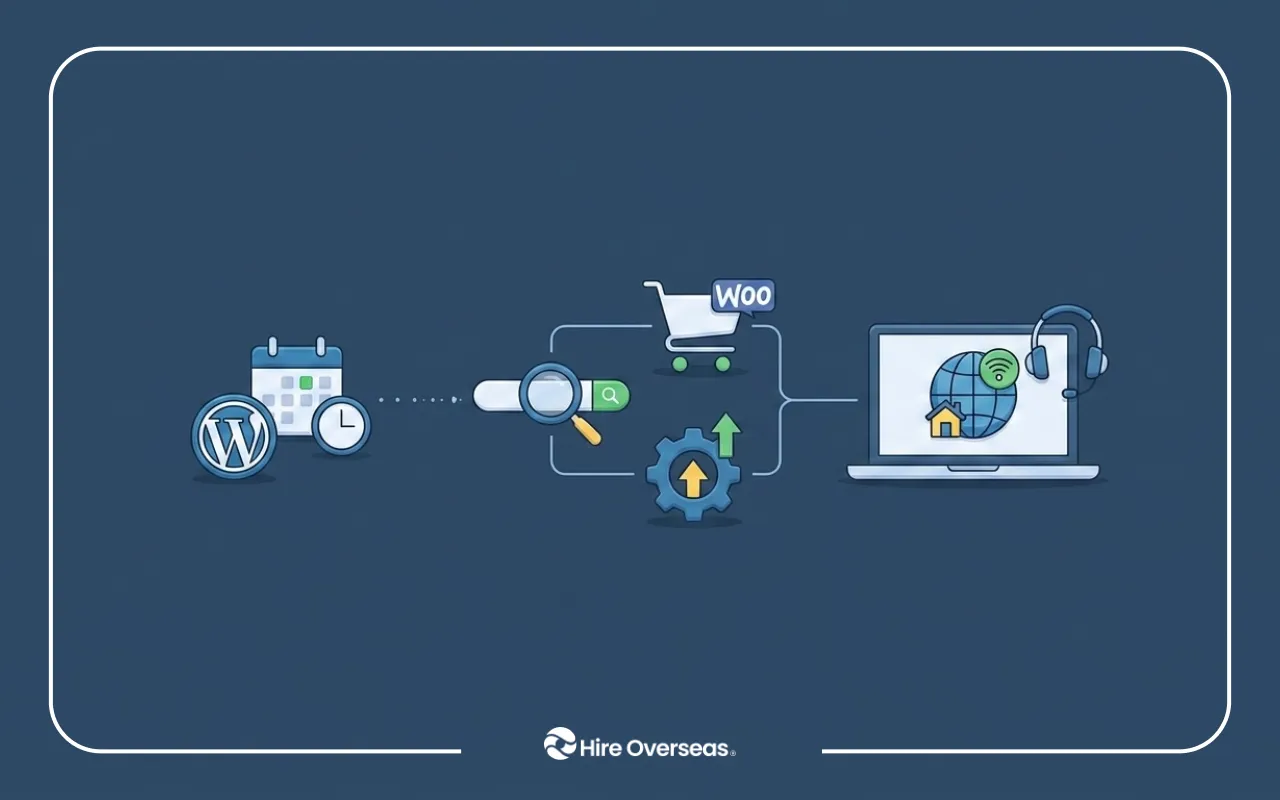
Many companies initially rely on freelance WordPress developers for website updates, landing pages, and occasional technical fixes.
At first, this works. But as websites become more tied to SEO growth, WooCommerce operations, performance optimization, and ongoing marketing execution, development requests quickly become continuous instead of occasional.
This is usually when companies begin looking to hire remote WordPress developers who can provide more consistent development support without significantly expanding internal engineering overhead.
Hire Overseas Insider: What Pushed Companies Beyond Freelance WordPress Support
One pattern became clear after working with companies managing WordPress at scale:
Most businesses did not initially plan to hire remote WordPress developers.
In many cases, they started with freelance support for:
- landing pages
- plugin updates
- small technical fixes
- occasional design changes
At first, this worked well.
But as websites became more tied to SEO growth, WooCommerce operations, lead generation, and marketing execution, development requests became continuous instead of occasional.
That is usually when freelance support started becoming operationally limiting.
When Marketing Execution Started Depending on Developer Availability
One of the most common issues companies faced was delayed marketing execution caused by inconsistent development support.
Marketing teams often depended on developers for:
- landing pages
- conversion tracking
- SEO implementation
- A/B testing
- content publishing
- campaign deployment
But freelance developers were not always available when execution timelines changed quickly.
As a result, campaign launches, SEO improvements, and website updates often became delayed by development bottlenecks.
This is one reason many businesses eventually hired remote WordPress developers with more dedicated operational availability.
For teams where delayed developer availability was directly stalling campaign timelines, this breakdown of scaling marketing teams with remote talent covers how companies restructured development and marketing execution to run in parallel without bottlenecks.
When WooCommerce Development Became Too Complex for Reactive Support
For eCommerce companies, WooCommerce operations usually became significantly more complex as the business scaled.
Many businesses needed ongoing support for:
- custom checkout functionality
- subscription workflows
- payment gateway integrations
- plugin compatibility
- shipping configurations
- conversion-focused performance optimization
At that stage, development support was no longer occasional.
Companies needed developers who could consistently manage evolving WooCommerce infrastructure without relying on reactive freelance availability.
This is one reason many businesses eventually explored offshore WordPress developers or dedicated WordPress development teams.
For eCommerce businesses at that stage, this guide on hiring offshore development teams covers how companies structured dedicated WooCommerce support without absorbing full-time local engineering costs.
When Website Performance Started Affecting SEO and Revenue
Another common trigger was performance issues becoming directly tied to business growth.
As WordPress environments expanded, companies often experienced:
- slow page speeds
- Core Web Vitals issues
- bloated themes
- unstable plugins
- poor mobile performance
- hosting inefficiencies
Over time, these issues started affecting:
- SEO rankings
- paid advertising efficiency
- conversion rates
- customer experience
At that point, WordPress development became operational infrastructure instead of occasional technical support.
Companies increasingly needed long-term development support focused on website stability, optimization, and scalability.
When Agencies and Content Teams Needed Faster Development Capacity
Agencies and content-heavy businesses often reached a point where website execution became too dependent on limited freelance availability.
This created delays across:
- client deliverables
- SEO implementation
- landing page production
- website revisions
- content publishing workflows
Many companies partnered with Hire Overseas after realizing they needed more predictable WordPress development capacity to support ongoing marketing and client operations.
As SEO publishing and content production scaled, many businesses realized development bottlenecks were only part of the problem, content operations themselves also needed more scalable remote support. Teams expanding SEO and publishing workflows often compare offshore hiring markets using this breakdown of the best countries for hiring remote content support roles.
When Businesses Needed More Operational Consistency
A recurring issue companies experienced with freelance WordPress support was inconsistency.
Businesses often dealt with:
- changing availability
- delayed maintenance
- inconsistent code quality
- reactive troubleshooting
- limited operational ownership
This became especially difficult for:
- WooCommerce businesses
- agencies managing multiple client sites
- SEO-heavy content operations
- companies operating multiple WordPress properties
As a result, many businesses moved toward hiring remote WordPress developers who could provide more stable long-term development support integrated into ongoing business operations.
If your team is evaluating the shift from freelance to dedicated support, this guide on how to hire remote developers covers the vetting criteria and engagement structures that work specifically for ongoing development roles.
Growth Insight: What Companies Learned About Hiring WordPress Developers
After working with startups, agencies, eCommerce brands, and growing marketing teams at Hire Overseas, one pattern became clear:
The companies that succeeded with remote WordPress development were not simply hiring for technical output.
They were hiring for operational consistency.
Many businesses initially focused heavily on coding ability alone. But over time, companies realized the strongest long-term outcomes usually came from developers who could consistently support the company’s workflows, execution speed, and ongoing operational priorities.
WordPress Specialization Matters More Than General Development Experience
One of the biggest mistakes companies made early on was hiring general developers for highly WordPress-specific environments.
This became especially common among:
- startups scaling SEO content quickly
- WooCommerce brands managing custom storefronts
- agencies handling multiple client websites
- marketing teams dependent on landing page execution
As websites became more operationally important, companies increasingly needed developers experienced with:
- custom theme development
- Advanced Custom Fields (ACF)
- Gutenberg block development
- WooCommerce customization
- plugin architecture
- multisite management
- WordPress performance optimization
Businesses that hired WordPress specialists often experienced:
- faster implementation cycles
- fewer plugin conflicts
- cleaner development workflows
- more stable long-term maintenance
Communication Directly Affected Development Performance
Another common lesson companies learned was that communication quality directly affected operational efficiency.
This became especially important for:
- startups operating asynchronously
- agencies managing fast-moving client timelines
- offshore WordPress development workflows
- marketing teams requiring rapid implementation cycles
For many companies, communication quality became just as valuable as technical expertise itself.
Businesses operating across time zones usually discovered that communication reliability became just as important as technical execution once WordPress development became tied to marketing speed and operational continuity. Companies building async remote teams often reference this breakdown of hiring Filipino remote talent because it explains why communication consistency became a major advantage for long-term operational support.
Long-Term Development Support Worked Better Than Reactive Freelancing
Many businesses initially relied on freelance remote WordPress developers because project-based support worked well early on.
But as companies scaled, recurring website needs became harder to manage through reactive freelance workflows.
Businesses often struggled with:
- inconsistent availability
- delayed support during urgent updates
- fragmented development ownership
- inconsistent code standards across projects
This became increasingly difficult for:
- WooCommerce businesses
- agencies managing multiple websites
- SEO-heavy content operations
- startups scaling marketing execution quickly
As a result, many companies eventually shifted toward dedicated remote WordPress development support instead of relying entirely on one-off freelance engagements.
Operational Reliability Became More Valuable Over Time
One of the biggest shifts companies experienced was realizing that reliable execution often mattered more than finding the “best” developer technically.
As websites became more tied to:
- SEO growth
- lead generation
- paid advertising performance
- eCommerce revenue
- customer experience
companies increasingly prioritized developers who could:
- maintain consistent turnaround times
- support ongoing website operations
- work inside existing workflows
- proactively manage development tasks
- provide long-term operational continuity
This is usually when hiring remote WordPress developers stopped being viewed as occasional outsourcing and started becoming part of the company’s operational infrastructure.
If cost is a factor in the decision, this breakdown of the cost of hiring remote employees includes specific salary benchmarks for developer roles across different offshore markets.
How to Hire a WordPress Developer Based on Your Business Model
One of the biggest mistakes companies made when hiring remote WordPress developers was treating every WordPress role the same.
In reality, the right developer usually depended on how the website supported the business operationally.
A startup focused on SEO growth often needed very different development support compared to:
- a WooCommerce brand
- a digital agency
- a SaaS company
- a business managing multiple WordPress properties
After working with different companies at Hire Overseas, one pattern became clear:
The businesses that hired more successfully usually aligned WordPress development roles directly with operational priorities first.
Step 1: Identify Whether Your Website Supports Marketing, Revenue, or Operations
Before hiring a WordPress developer, companies first needed to understand what role the website played inside the business.
For example:
- SEO-driven businesses usually prioritized publishing speed and performance optimization
- WooCommerce brands prioritized checkout stability and conversion performance
- agencies prioritized fast client execution and maintenance support
- multi-site businesses prioritized scalability and operational continuity
This usually determined what type of remote WordPress developer the company actually needed.
Step 2: Match the Developer’s Specialization to Your Website Environment
One of the biggest hiring mistakes companies made was hiring general developers for highly WordPress-specific workflows.
Different business models often required different specializations.
For example:
SEO and content-focused companies usually needed developers experienced with:
- Core Web Vitals optimization
- technical SEO implementation
- schema markup
- Advanced Custom Fields (ACF)
- Gutenberg customization
- landing page development
WooCommerce businesses often prioritized developers experienced with:
- custom checkout flows
- subscription functionality
- payment integrations
- plugin compatibility
- WooCommerce performance optimization
Agencies usually needed developers comfortable with:
- multisite management
- staging environments
- white-label workflows
- rapid revisions
- ongoing maintenance support
The strongest hires usually happened when companies aligned WordPress specialization directly with business priorities.
Step 3: Evaluate Communication and Workflow Reliability
Many companies initially focused only on coding ability.
But after hiring remote WordPress developers, businesses often realized communication quality directly affected operational performance.
The developers who performed best were usually the ones who could:
- communicate technical issues clearly
- collaborate with marketers and designers
- work inside project management systems
- document workflows properly
- operate independently across time zones
This became especially important for:
- offshore WordPress developers
- async development environments
- fast-moving marketing teams
- agencies handling multiple projects simultaneously
Step 4: Decide Whether You Need Project-Based Support or Dedicated Development Capacity
Many companies initially hired freelance remote WordPress developers for:
- occasional fixes
- plugin troubleshooting
- one-time landing pages
- short-term projects
At first, this often worked well.
But businesses with continuous development needs usually reached a point where reactive freelance support became operationally inconsistent.
This became especially common among:
- WooCommerce brands
- SEO-heavy businesses
- agencies
- companies managing multiple WordPress websites
At that stage, many businesses moved toward dedicated offshore WordPress development support for:
- ongoing maintenance
- performance optimization
- continuous implementation work
- long-term operational continuity
Step 5: Build for Long-Term Operational Support, Not Just Immediate Tasks
One of the biggest lessons companies learned was that WordPress development eventually becomes operational infrastructure.
As websites became more tied to:
- SEO growth
- lead generation
- paid advertising performance
- eCommerce revenue
- customer acquisition
businesses increasingly prioritized developers who could support:
- ongoing website operations
- scalable development workflows
- long-term maintenance
- proactive optimization
- operational consistency across projects
This is usually when companies stopped viewing WordPress development as occasional outsourcing and started treating it as a long-term operational function.
Additional Considerations Before Hiring a Remote WordPress Developer
After working with startups, agencies, WooCommerce brands, and SEO-driven companies at Hire Overseas, several hiring considerations appeared repeatedly.
Many businesses focused heavily on technical skills during hiring, but long-term success usually depended on how well the developer aligned with the company’s operational needs, workflows, and website infrastructure.
Before hiring a remote WordPress developer, these were some of the most common considerations growing companies evaluated more carefully over time.
Balance Front-End Design Skills With Infrastructure Experience
Strong visual execution is important, especially for:
- landing pages
- marketing websites
- conversion-focused design
But many companies eventually realized long-term website stability depended equally on:
- clean theme architecture
- plugin stability
- scalable development structure
- performance optimization
- maintainable codebases
The strongest WordPress environments usually balanced both design quality and long-term infrastructure reliability.
Evaluate Whether WooCommerce Experience Is Actually Needed
Many businesses initially treated WooCommerce like standard WordPress development.
But growing eCommerce operations often required experience with:
- checkout optimization
- payment gateway integrations
- subscription workflows
- plugin compatibility management
- conversion-focused performance optimization
- high-traffic operational stability
For WooCommerce-heavy businesses, direct platform experience usually became increasingly important as stores scaled.
Prioritize Communication and Workflow Reliability
Many companies discovered operational consistency mattered just as much as coding ability.
This became especially important for:
- remote WordPress developers
- offshore WordPress teams
- async workflows
- agencies managing multiple projects
Businesses increasingly prioritized developers who could:
- communicate technical issues clearly
- work inside project management systems
- document changes properly
- collaborate with marketers and designers
- maintain predictable turnaround times
Decide Whether You Need Project-Based or Ongoing Development Support
Freelance support often worked well for:
- one-time redesigns
- isolated fixes
- occasional landing pages
- smaller development requests
But businesses managing:
- SEO-heavy websites
- WooCommerce operations
- continuous marketing execution
- multiple WordPress properties
usually reached a point where website support became ongoing operational work instead of isolated projects.
This is often when companies started exploring dedicated remote WordPress development support.
Align the Developer’s Strengths With Your Business Priorities
One of the biggest hiring improvements companies made was evaluating developers based on operational business needs rather than technical output alone.
For example:
- SEO-driven businesses often prioritized performance optimization and publishing workflows
- WooCommerce brands prioritized checkout stability and conversion performance
- agencies prioritized speed, flexibility, and revision capacity
- multi-site businesses prioritized scalability and maintenance continuity
The companies that hired most successfully were usually the ones that aligned development support directly with how the website supported business growth itself.
If you want to see how this plays out for a marketing-dependent team, the Arist case study shows how they rebuilt their entire GTM engine with offshore talent and doubled leads while cutting costs by 90%.
WordPress Stops Being “Just a Website” for Scaling Companies
One of the biggest patterns we observed after working with startups, agencies, WooCommerce brands, and SEO-driven businesses is this: As companies grow, WordPress stops functioning as a simple marketing website.
Another shift many companies experienced was how WordPress became increasingly tied to broader growth operations. SEO execution, landing page velocity, analytics implementation, and performance optimization started directly affecting campaign performance and customer acquisition efficiency. As a result, businesses increasingly needed WordPress developers capable of operating inside faster-moving marketing and operational environments.
That is why many growing companies eventually move beyond reactive freelance support and start building more dedicated WordPress development capacity through:
- remote WordPress developers
- offshore WordPress development teams
- long-term operational support structures
For many businesses, the shift is no longer about occasional website updates.
It becomes about building development support capable of scaling alongside the business itself.
See what changes when WordPress development starts supporting growth instead of slowing it down.
Consult our hiring experts at Hire Overseas to see how dedicated remote WordPress developers can support your website operations as your business scales.
