


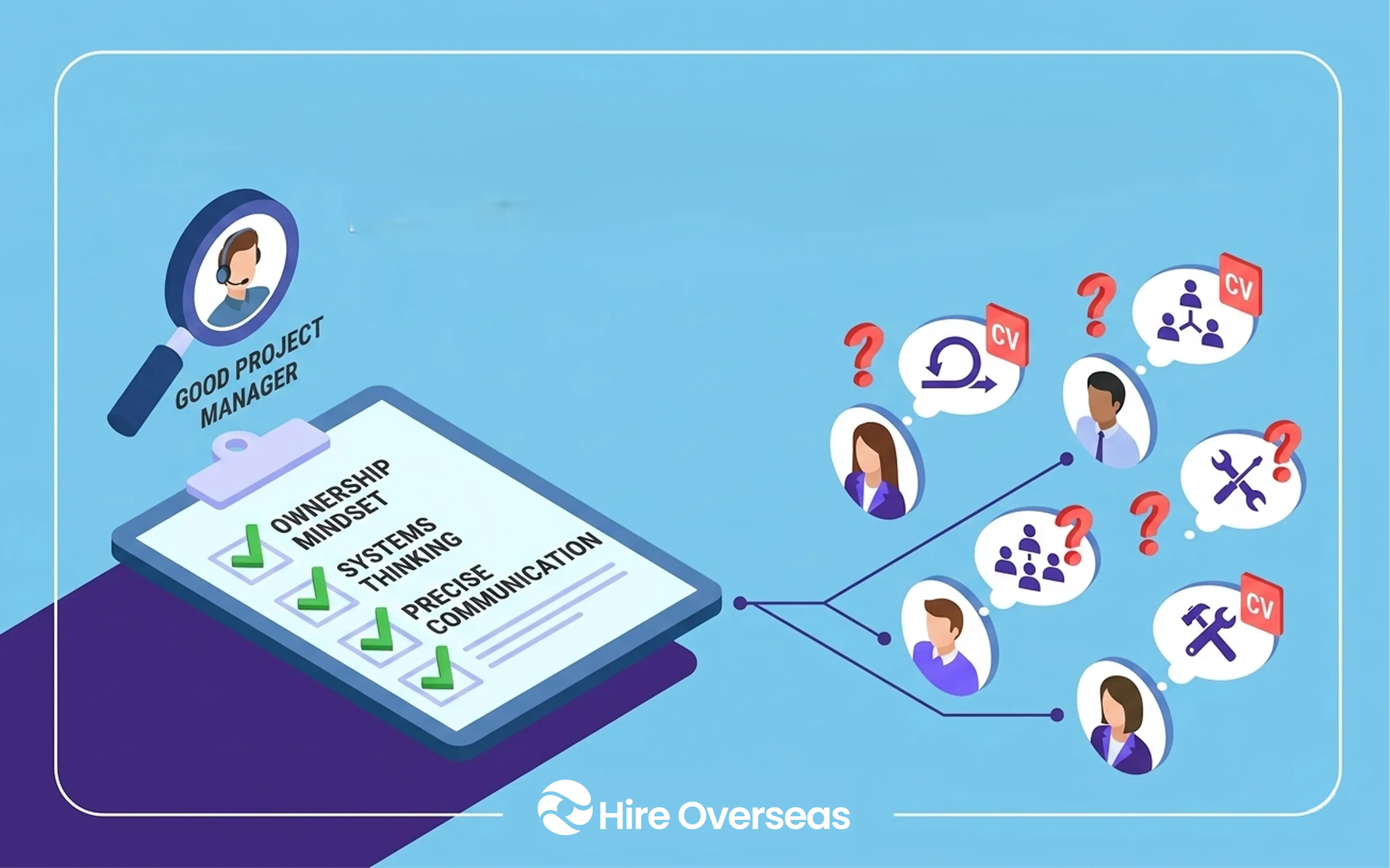
Most founders reach the same frustrating point.
You’ve decided to hire a project manager, reviewed resumes, and conducted interviews but still feel unsure. Because most candidates sound the same.
They talk about Agile, stakeholders, and tools. But that does not show how they handle missed deadlines, scope changes, or underperforming teams.
The reality is simple: The qualities that define a successful project manager rarely show up on a CV.
At Hire Overseas, we evaluate project managers based on how they perform in real situations. This guide breaks down what actually matters and how to identify the right hire before you make a costly mistake.
What a Good Project Manager Actually Does in Practice
To understand what makes a good project manager, start with what they actually do day to day.
Not the tools they use or the frameworks they follow, but the actions that change how work moves inside your business.
These are what good project managers actually do in practice:
They Reduce Problems Before They Escalate
The simplest way to understand what a good project manager does: They reduce the size and impact of problems early.
Weak project managers report issues after they happen.
Strong ones surface risks before they become delays and come with context and next steps.
In one Hire Overseas client case, a project manager flagged a launch risk 10 days before deadline due to a hidden dependency. That early visibility allowed the founder to adjust resources and still hit launch.
The difference is not awareness. It is timing, ownership, and action.
This is a core part of what makes a successful project manager in practice.
If you're comparing project managers against product managers and wondering which role your growing team actually needs first, this guide to hiring remote product managers walks through the responsibility overlap and the decision criteria for teams under 20 people.
Teams Stay Aligned Without Constant Check-Ins
In businesses without an effective project manager:
- teams duplicate work
- priorities shift frequently
- execution slows down due to confusion
In businesses with one:
- ownership is clear
- priorities stay consistent
- work ties directly to outcomes
This is how successful project managers keep teams aligned.
Not by increasing communication, but by improving clarity and structure.
Deadlines Become Predictable, Not Aspirational
Average project managers treat deadlines as estimates.
Strong ones treat them as commitments supported by planning.
They:
- build realistic timelines with buffers
- identify risks early in the process
- communicate trade-offs when constraints appear
The result is not perfect execution.
It is predictable execution.
This is one of the key qualities of a project manager that directly impacts business performance.
Once you've identified the right project manager, retaining them through the first 90 days is where most companies lose momentum — this playbook on attracting and retaining talent outlines the onboarding milestones and compensation structures that keep high-performers past year one.
Scope Is Managed Without Slowing Progress
Scope creep is one of the most common challenges in growing businesses.
Weak project managers either accept everything or push back inconsistently.
Strong project managers apply structure.
This is how effective project managers manage scope creep:
- every request is documented
- impact on timeline and resources is assessed
- decisions are made transparently
This keeps projects controlled while maintaining trust with clients and stakeholders.
Work Moves Without Founder Intervention
One of the biggest signs of an effective project manager is this:
You stop being the person holding everything together.
Before hiring, you are:
- following up on tasks
- checking progress
- coordinating across teams
After hiring a strong project manager:
- updates are visible without asking
- follow-ups happen automatically
- execution continues without your involvement
This is how a project manager helps a business scale execution without increasing chaos.
If you're scaling execution by building a distributed team around your project manager, this remote team hiring checklist covers the 12-step vetting process that ensures every new hire integrates without adding coordination overhead.
The Pattern Behind High-Performing Project Managers
Across all of this, one pattern is clear: A good project manager does not add more control. They create clarity, structure, and ownership. This is the foundation of how to be an effective project manager and what defines a high-performing project manager in real business environments.
Because when work is clear, it moves.
And when work moves, the business grows.
What Makes a Good Project Manager (Core Traits That Drive Results)
Most lists of project manager qualities are too broad to be useful.
They mention leadership, communication, and organization.
But in real business environments, only a few traits consistently determine whether a project manager performs or struggles.
Ownership Mindset (They Take Responsibility for Outcomes)
This is the most important of all qualities of a project manager.
Average project managers track tasks.
A successful project manager owns results.
They do not say:
- “The team missed the deadline”
They ask:
- “Where did execution break down and how do we fix it?”
How it shows up:
- issues are escalated early
- problems are not ignored
- outcomes are prioritized over activity
This is one of the clearest indicators of an effective project manager.
Structured Thinking (They Think in Systems, Not Tasks)
Weak project managers manage to-do lists.
Strong ones manage how work flows.
They:
- break projects into clear phases
- map dependencies between tasks
- anticipate where delays might happen
This is what prevents execution from becoming reactive.
It is also how effective project managers manage scope creep and keep projects stable even when things change.
Communication Precision (They Make Things Clear, Not Just Visible)
Most teams are not lacking communication.
They are lacking clarity.
A good project manager communicates:
- what matters
- what changed
- what needs attention
Without unnecessary detail.
You do not have to interpret their updates.
You understand them immediately.
This is a defining trait of a highly successful project manager.
Ability to Lead Without Authority
In most businesses, project managers do not directly manage the team.
They rely on:
- influence
- clarity
- accountability
They keep people aligned without controlling them.
This is one of the most overlooked characteristics of a project manager, especially in small and growing teams.
Adaptability Without Losing Structure
Projects rarely go exactly as planned.
A strong project manager adapts, but does not lose control.
This is how great project managers handle unexpected project changes:
- priorities shift, but alignment remains
- timelines adjust, but visibility stays clear
- execution continues without disruption
They stay flexible, but structured.
The Real Difference
Most people focus on skills. But the difference between an average and successful project manager is how they think and operate under pressure.
A good project manager creates clarity in uncertain situations.
They make decisions, maintain structure, and keep work moving even when things are not perfect.
That is what makes them effective.
How to Identify a High-Performing Project Manager During Hiring
Knowing what makes a good project manager is only useful if you can actually identify one before you hire.
This is where most founders struggle.
Because on paper, many candidates look qualified. But in practice, only a few can consistently drive execution.
The goal is to evaluate how they think, not just what they have done.
What a Good Project Manager Looks Like on Paper vs. in Practice
On paper, strong candidates usually show:
- experience managing multiple projects
- familiarity with tools and frameworks
- exposure to different industries
But this does not guarantee performance.
In practice, what matters is:
- how they structure work
- how they handle problems
- how they communicate under pressure
This is the gap between a candidate who interviews well and one who actually performs.
Interview Questions That Reveal Real Strength
The right questions will show how a project manager operates.
Ask:
- “Tell me about a project that went off track. When did you realize it?”
- “How do you handle scope changes mid-project?”
- “How do you manage multiple priorities at once?”
- “Describe a time someone was not delivering. What did you do?”
These questions reveal:
- ownership
- decision-making
- communication style
This is how to identify a high-performing project manager during an interview.
Green Flags When Interviewing a Project Manager
Strong candidates show clear patterns.
Look for:
- specific, real examples instead of vague answers
- ownership of failures, not blame
- structured thinking when explaining problems
- clear and concise communication
These are strong green flags when interviewing a project manager.
Red Flags to Watch Out For
Some signals are easy to miss early but become problems later.
Avoid candidates who:
- speak in general terms without specifics
- rely heavily on tools instead of process thinking
- overpromise timelines without explaining trade-offs
- struggle to communicate clearly during the interview
These are common issues when hiring an average project manager.
How to Assess Leadership and Cultural Fit
In small and growing businesses, cultural fit matters more than credentials.
A strong project manager should:
- work well without heavy structure
- communicate directly and clearly
- take initiative without waiting for instructions
Ask about:
- how they structure their day
- how they prioritize work
- how they communicate with teams
This helps you understand how to evaluate project manager candidates for your startup.
Use References to Validate What You See
Most founders skip this step.
But references often reveal what interviews miss.
Ask:
- “How did they handle pressure or delays?”
- “How did they communicate when things went wrong?”
- “Would you trust them to run execution independently?”
This is one of the most reliable ways to confirm what makes a project manager stand out to employers.
The Real Test
The real test of a project manager is not how they describe their experience.
It is how they break down a real problem.
Give them a scenario from your business:
- a delayed project
- unclear ownership
- missed deadlines
Then ask: “How would you handle this?”
A strong project manager will:
- structure the problem quickly
- identify gaps in ownership or process
- explain how they would move work forward
An average one will stay vague or rely on general advice.
Hire Overseas Insights: How Good Project Managers Create Real Impact in Growing Businesses
At Hire Overseas, the difference a good project manager makes is not theoretical.
It shows up in how a growing business starts operating differently.
Not in reports.
But in how work moves, how teams coordinate, and how much founders are still involved in execution.
Case 1: From a Single Hire to a Scalable Execution Function
In one growing product-focused company, we placed a project manager to support execution.
Early on, she stood out for one reason:
She did not just manage tasks. She improved how work flowed.
Within months:
- execution became more consistent across teams
- delays were reduced without adding oversight
- coordination no longer depended on leadership
As the business grew, so did her role.
She was promoted and now manages a team of project managers, also vetted through Hire Overseas.
Execution is no longer tied to one person.
It is now a structured function inside the business.
The impact:
- scalable execution without increasing complexity
- reduced reliance on founders for coordination
- a repeatable system for managing multiple projects
Case 2: Removing the Founder as the Bottleneck in Execution
In a growing creative agency, execution depended heavily on the founders.
They were:
- managing timelines across client work
- coordinating between teams
- stepping in daily to keep projects moving
As client demand increased, this became unsustainable.
Hire Overseas placed a dedicated project manager to own execution.
The role was clear:
- manage timelines end-to-end
- coordinate across account, design, and production teams
- resolve blockers before they escalated
Execution no longer depended on founder availability.
The business gained structure without losing speed.
The impact:
- consistent delivery across projects
- improved team coordination
- more time for founders to focus on growth and strategy
What These Cases Show
In both businesses, the change was not adding more people.
It was adding ownership.
A good project manager does not just support the team.
They:
- take control of execution
- reduce dependency on founders
- create systems that allow work to move consistently
This is what creates real impact in growing businesses.
Not more activity. But better execution.
For a more formal breakdown of how project managers impact execution, explore a full case study here: How Golden Egg Built an Operations Backbone
A Good Project Manager Changes How Work Gets Done
Most growing businesses do not struggle with ideas or talent.
They struggle with execution.
Work is happening, but it depends on follow-ups, reminders, and constant coordination. Projects move, but not consistently. And over time, the founder becomes the system holding everything together.
That is the real bottleneck.
A good project manager changes that.
They do not just manage tasks. They take ownership of execution, remove friction from daily operations, and make sure work continues without depending on you.
This is what creates real leverage.
As seen in the case studies, the impact is not incremental. It is structural:
- founders step out of day-to-day coordination
- teams operate with clarity and accountability
- projects move forward without constant intervention
That is when a business starts to scale properly.
If you are still managing execution yourself, the cost is already there. It just shows up as lost time, slower delivery, and unnecessary complexity.
Hire Overseas helps you replace that with a project manager who is already vetted for real-world performance, not just experience.
If you are ready to step out of execution and get your time back, book a call and we will match you with a project manager who can take that off your plate.
