


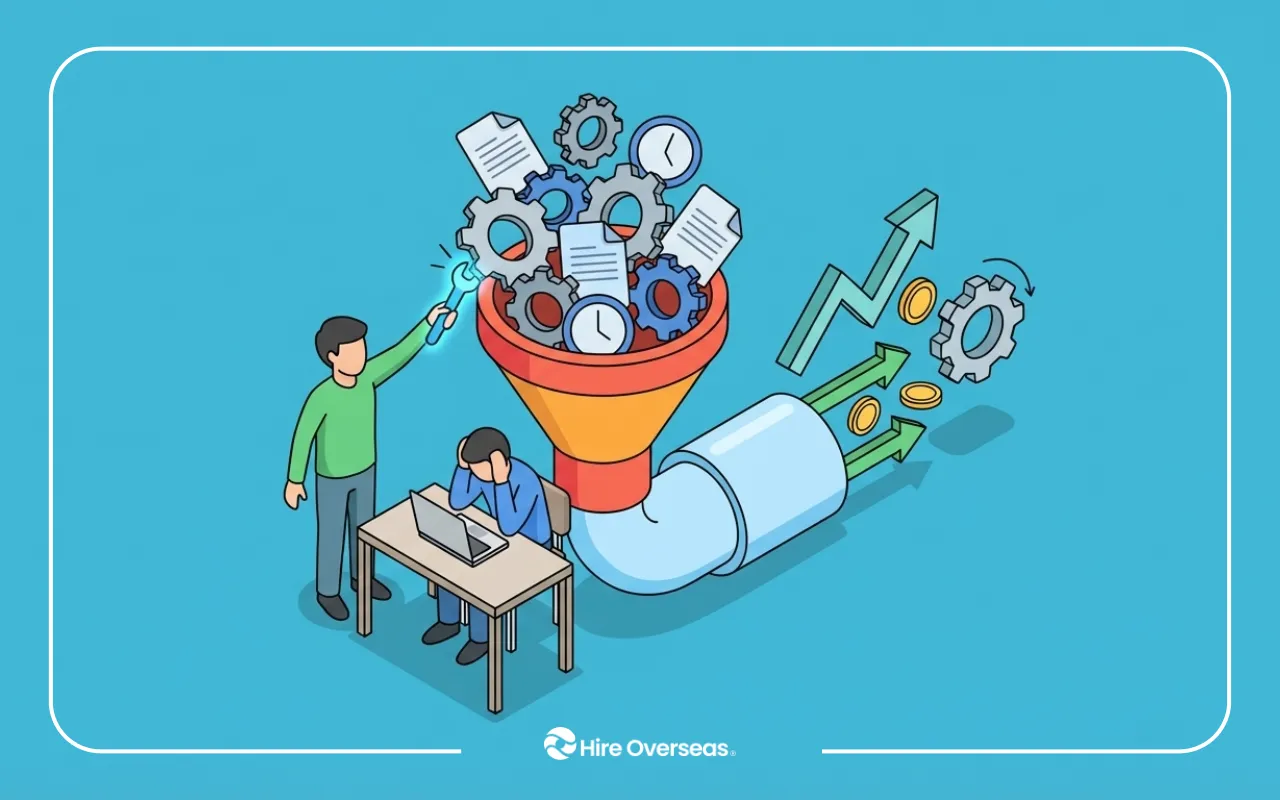
A small business virtual assistant is often seen as extra help. But for most startups, the real need is not support. It is removing the bottlenecks that slow down execution.
Many founders delay hiring because they think they can handle everything. But over time, tasks pile up, execution becomes inconsistent, and growth slows down.
The question is not if you need help. It is when your business reaches the point where doing everything yourself becomes the biggest constraint.
5 Signs Your Startup Needs a Small Business Virtual Assistant
Most founders do not come to us saying, “I need a virtual assistant.”
On our discovery calls, they describe what is happening inside their business. The patterns are consistent across different industries and stages.
These are the signals we hear most often.
1. You’re Doing Everything Yourself
This is one of the most common signs.
You are handling:
- Inbox and customer replies
- Scheduling and coordination
- CRM updates and follow-ups
- Admin and small operational tasks
Your day starts with clearing messages and ends with catching up on unfinished tasks.
You may feel productive, but most of your time is spent on work that does not move the business forward.
For example, if you spend 2–3 hours daily managing emails and scheduling, that is 10–15 hours per week not spent on sales, strategy, or growth.
At this point, the issue is not effort. It is misalignment.
You are operating below your highest value.
This is where a virtual assistant for small business owners becomes necessary. Delegating repetitive tasks allows you to free up time as a small business owner and focus on work that actually drives results.
If you're unsure what tasks are actually worth delegating first, this breakdown of what a virtual assistant does covers the specific task categories — from inbox management to CRM updates — that founders typically offload in the first 30 days.
2. Things Are Slipping Through the Cracks
Another clear sign is inconsistency in execution.
You start noticing:
- Leads sitting in your inbox without follow-up
- Customer messages getting delayed
- Content being posted irregularly
- Tasks being pushed to “later” repeatedly
Nothing is completely broken, but nothing is fully reliable either.
For example, a potential customer might inquire about your service, but you respond a day later because you were busy. By then, they have already moved on.
This is not a discipline problem. It is a capacity problem.
When everything depends on your availability, important tasks get delayed or missed.
A virtual assistant for small businesses helps fix this by creating consistency:
- Follow-ups happen on time
- Messages are handled promptly
- Content is scheduled in advance
This is how you improve business productivity with a virtual assistant and prevent small gaps from turning into lost opportunities.
3. You’re Busy All Day but Not Moving Forward
This is where many founders start feeling stuck.
You are working long hours, but most of your time is spent:
- Answering messages
- Fixing small issues
- Managing day-to-day operations
At the end of the day, everything feels “done,” but nothing meaningful has progressed.
For example, you might spend the entire day clearing tasks, but:
- No new deals were closed
- No systems were improved
- No growth initiatives were started
You are maintaining the business, not growing it.
This is a clear signal that your time is being consumed by operational work instead of high-impact activities.
A business virtual assistant helps shift this by taking over routine execution so you can:
- Focus on revenue-generating work
- Build partnerships
- Improve your offer
This is how you start to focus on high-value business activities and move the business forward instead of just keeping it running.
4. You Can’t Keep Up With the Volume Anymore
As your business grows, the number of tasks increases faster than your capacity.
You start noticing:
- More customer inquiries than you can respond to on time
- More leads than you can properly follow up with
- More tasks than you can realistically complete in a day
At first, you try to keep up by working longer hours. But eventually, that stops working.
For example, you may:
- Miss messages because there are too many
- Delay follow-ups because your schedule is full
- Push important tasks to the next day repeatedly
This is where growth starts creating pressure instead of progress.
The issue is not demand. It is execution capacity.
A virtual assistant for small business owners helps absorb this volume by:
- Handling incoming messages
- Managing follow-ups
- Keeping daily operations moving
This allows you to scale your business without hiring full-time staff while maintaining quality and responsiveness.
5. Everything Depends on You
This is the most important sign.
If your business only moves when you are actively involved, you have become the bottleneck.
You might notice:
- Tasks only get done when you initiate them
- Team members wait for your input before moving forward
- Projects slow down when you are unavailable
- Nothing runs without your constant oversight
For example, if:
- Leads are only followed up when you remember
- Content is only posted when you have time
- Clients are only onboarded when you personally handle it
Then your business cannot operate without you.
This limits growth, no matter how hard you work.
A virtual assistant for online business helps remove this dependency by:
- Taking ownership of repeatable processes
- Keeping workflows moving without constant supervision
- Supporting daily execution even when you are focused elsewhere
This is how you start to streamline business operations using virtual assistants and reduce reliance on your time.
The Pattern Behind These Signs
These problems may seem different, but they point to the same issue:
Your business has outgrown your ability to manage everything alone.
A small business virtual assistant is not just extra help. It is how you:
- Restore consistency
- Increase execution capacity
- Remove yourself as the bottleneck
The earlier you act on these signs, the easier it is to scale without creating more chaos.
If you've decided a VA is the right move but want to avoid common mistakes in the process, this guide to hiring a reliable virtual assistant walks through the exact vetting steps that separate consistent operators from task-droppers.
What Changes When You Hire a Small Business Virtual Assistant
Once you recognize the signs, the next step is understanding what actually changes inside your business.
A small business virtual assistant does not just take tasks off your plate. It shifts how your business operates day to day.
Each problem from the previous section has a direct outcome when the right support is in place.
You’re No Longer Doing Everything Yourself → You Operate at a Higher Level
When you stop handling repetitive tasks, your role changes.
Instead of:
- Clearing inboxes
- Scheduling meetings
- Managing admin
You focus on:
- Closing deals
- Building partnerships
- Improving your offer
For example, those 2–3 hours per day spent on admin can now be used for revenue-generating activities.
This is how a virtual assistant for small business owners helps you free up time as a small business owner and operate where you create the most value.
Things No Longer Slip Through the Cracks → Execution Becomes Consistent
When a VA is managing daily operations, tasks no longer depend on your availability.
Instead of:
- Delayed responses
- Missed follow-ups
- Irregular content
You get:
- Timely communication
- Consistent follow-ups
- Scheduled and predictable output
For example, leads are contacted within hours, not days.
This is how a virtual assistant helps improve business productivity and protect opportunities.
You’re No Longer Busy All Day Without Progress → You Start Moving Forward
When operational work is delegated, your time is no longer consumed by maintenance.
Instead of:
- Constant task-switching
- Reacting to small issues
- Ending the day with no progress
You begin to:
- Focus on strategic initiatives
- Launch new campaigns
- Build growth channels
This is where a business virtual assistant enables you to focus on high-value business activities that actually move the business forward.
You Can Keep Up With Growth → Capacity Scales With Demand
As volume increases, your VA absorbs the workload.
Instead of:
- Falling behind on messages
- Missing tasks
- Feeling overwhelmed
You maintain:
- Fast response times
- Organized workflows
- Controlled operations
For example, customer inquiries and lead follow-ups continue smoothly even during busy periods.
This allows you to scale your business without hiring full-time staff while maintaining quality.
Your Business No Longer Depends on You → You Remove the Bottleneck
This is the most important transformation.
Instead of:
- Everything requiring your input
- Work stopping when you are unavailable
- Growth being tied to your time
You create:
- Systems that run daily
- Processes that continue without you
- A business that operates independently
A virtual assistant for online business helps streamline operations so execution continues even when you are focused elsewhere.
The Real Shift
Each of these changes points to one outcome:
You move from doing the work to running the business.
A small business virtual assistant is not just support. It is what allows:
- Consistent execution
- Scalable operations
- Sustainable growth
This is the point where your business stops depending on your time and starts building real capacity.
If your workload is growing faster than your capacity, this virtual assistant for small business guide shows how startups handle increasing demand without hiring full-time staff.
Signs You Hired the Wrong Virtual Assistant for Your Small Business
Now you know the signs that your business needs a virtual assistant.
But hiring is only the first step. The next challenge is knowing whether the person you brought in is actually helping.
Many founders hire a VA and expect immediate relief. But instead, they find themselves still involved in everything, or managing the assistant just as much as the work itself.
These are the signs that the hire is not working.
You Still Have to Explain Everything
If you find yourself constantly:
- Writing detailed instructions for simple tasks
- Repeating the same processes
- Answering basic follow-up questions
Then the assistant is too dependent.
For example:
You ask them to follow up with leads, but instead of executing, they ask what to say, when to send it, and how to track it.
At that point, you are still doing the thinking.
A small business virtual assistant should be able to:
- Recognize patterns
- Repeat workflows
- Handle routine decisions without constant input
If everything requires your involvement, the role is not reducing your workload.
Tasks Get Done but Nothing Actually Improves
This is one of the most common issues.
Work is being completed, but:
- Leads are not tracked properly
- Content is posted without structure
- Admin tasks are finished but not organized
For example:
Posts go live, but there is no content calendar, no consistency, and no follow-through.
This means the assistant is completing tasks, but not supporting execution.
A virtual assistant for small businesses should contribute to flow, not just output.
You Feel Just as Busy After Hiring
One of the clearest signs is this:
You hired help, but nothing changed.
You are still:
- Managing tasks daily
- Checking work constantly
- Fixing mistakes or gaps
For example:
You assign tasks in the morning, review them in the afternoon, and correct them at night.
Instead of freeing up time, you have added another layer to manage.
A virtual assistant for small business owners should reduce your involvement, not increase it.
They Can Only Handle One Type of Task
Small businesses require flexibility.
If your assistant:
- Only handles admin
- Refuses anything outside their defined role
- Struggles with mixed responsibilities
Then they are likely not suited for a small business environment.
In reality, you need someone who can:
- Manage inbox and scheduling
- Handle follow-ups
- Support light marketing or coordination
A strong assistant for small business should be comfortable working across functions as needed.
You Start Adjusting Your Business to Fit Them
This is a subtle but important warning sign.
If you notice yourself:
- Avoiding tasks because they cannot handle them
- Simplifying workflows just to make things easier
- Taking work back instead of delegating
Then the direction is wrong.
For example:
You stop assigning follow-ups because they are not done properly, so you start doing them again.
Now the system breaks.
A virtual assistant for online business should adapt to your workflow, not force you to adjust yours.
Hire Overseas Insight: Why Structured Support Works Better Than Hiring Alone
If you’ve seen the signs of a wrong hire, the next question is: Why does hiring a virtual assistant often fail for small businesses?
The answer is not the idea of hiring. It is the lack of structure behind how the hire is made.
Most founders are trying to evaluate:
- Skills
- Communication
- Reliability
- Independence
All at once, with no system. That is where mis-hiring happens.
Hire Overseas Solves the Fit Problem Before You Hire
The biggest issue from the previous section was fit.
- Assistants who need constant direction
- Assistants who only complete tasks
- Assistants who cannot handle mixed responsibilities
These problems happen because fit is only discovered after hiring.
Hire Overseas changes this by filtering for:
- Ability to operate independently
- Experience with small business workflows
- Comfort with mixed responsibilities
This means you are not testing fit after hiring. It is already evaluated before placement.
Before budgeting for this hire, this virtual assistant cost breakdown compares hourly, part-time, and full-time pricing across regions so you can match the right arrangement to your current revenue stage.
Hire Overseas Removes the Dependency Issue
One of the biggest frustrations founders face is:
“I still have to manage everything.”
This happens when assistants:
- Wait for instructions
- Cannot make routine decisions
- Do not follow through consistently
Hire Overseas addresses this by selecting for:
- Process-following ability
- Communication clarity
- Execution consistency
The goal is simple: The assistant should reduce your involvement, not increase it.
Hire Overseas Prioritizes Execution, Not Just Skills
Most hiring platforms focus on:
- Experience
- Technical skills
- Resume quality
But as you saw earlier, the real issue is not skill. It is execution.
Hire Overseas focuses on:
- How the assistant handles real workflows
- How they manage ongoing tasks
- How they maintain consistency over time
This directly prevents the “tasks get done but nothing improves” problem.
Hire Overseas Aligns the Assistant With Small Business Reality
Small businesses require:
- Flexibility
- Mixed responsibilities
- Fast adaptation
Many assistants are trained for:
- Corporate environments
- Narrow, specialized roles
Hire Overseas specifically matches assistants who can:
- Handle multiple functions
- Adapt to changing priorities
- Work in less structured environments
This is what makes them suited for a small business virtual assistant role.
If you're weighing whether to bring someone in-house or go remote, this comparison of virtual assistants vs. in-house assistants breaks down the real cost and flexibility differences for teams under 5 people.
The Right Time to Hire Is When You Become the Bottleneck
Most founders wait too long. You do not need to feel overwhelmed to hire. The right time is when everything still depends on you.
If:
- Tasks only move when you initiate them
- Follow-ups rely on your memory
- Execution slows when you are busy
Then you are the bottleneck.
At this stage, working harder will not fix the problem. It will only slow growth further.
A small business virtual assistant changes this by removing you from daily execution. Work continues, tasks get completed on time, and your business stops depending on your availability.
This is when you finally:
- Free up your time
- Focus on growth
- Build consistent execution
The difference is not more effort. It is leverage.
If you are ready to stop being the bottleneck and start scaling with consistency, book a discovery call with Hire Overseas so we can match you with a dedicated virtual assistant built for small business execution.
