


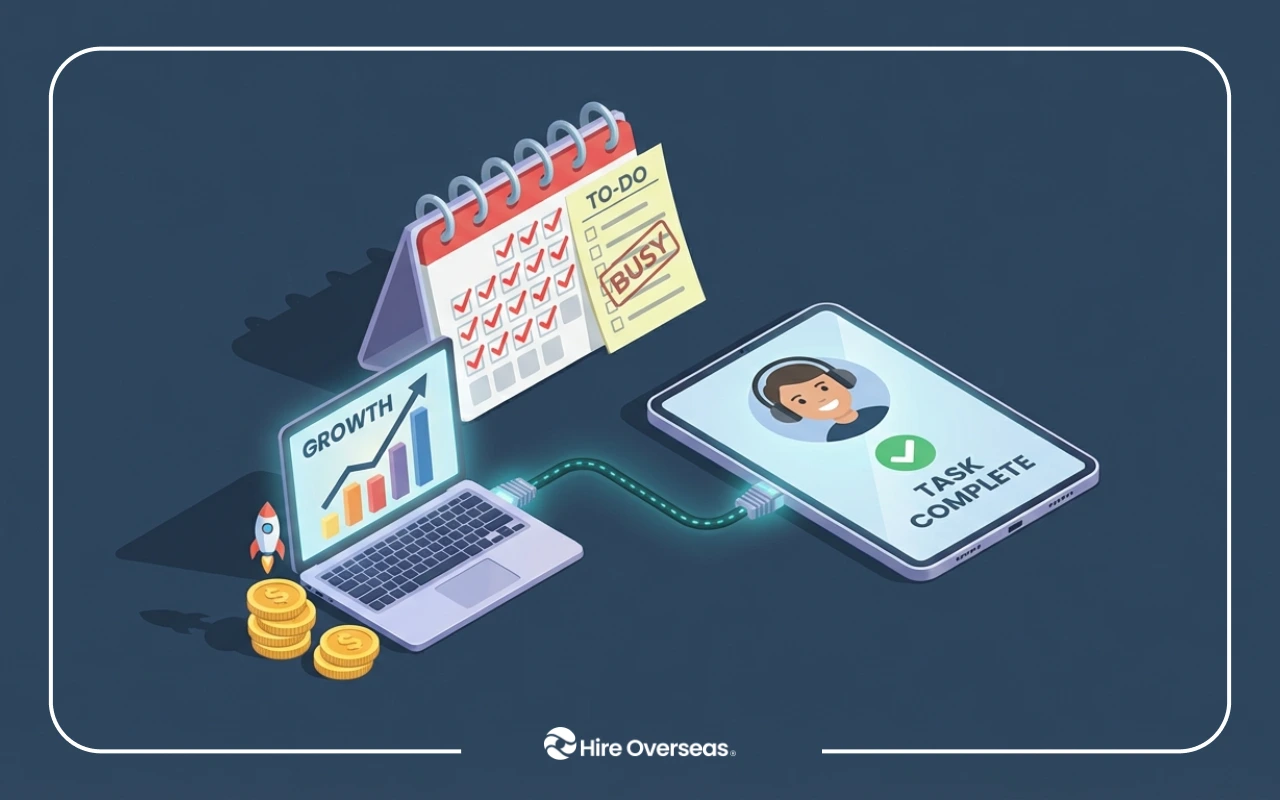
Hiring a virtual assistant for a small business is a common choice to reduce overhead and increase efficiency.
But the real advantage is not just cost savings. It is access to exceptional talent that expands your execution capacity without adding full-time complexity.
Small businesses do not stall because of bad ideas. They stall because founders are overloaded. The right small business virtual assistant removes that bottleneck and turns daily operations into scalable systems.
If you want leverage, the goal is not simply to get help. The goal is to find high-caliber operators who strengthen your business structure from day one.
What Is a Virtual Assistant for Business Owners?
A virtual assistant for small business is a remote professional who supports operational, administrative, sales, or marketing functions so founders can focus on strategic priorities.
Unlike traditional in-house hires, virtual assistants for small businesses work on flexible arrangements and can scale up or down depending on workload and growth stage.
They may operate as a small business assistant handling daily admin, or as a specialized virtual business assistant supporting sales, marketing, or operations.
For business owners, this model provides structure without the long-term overhead of full-time hiring.
What This Means for Growth as a Small Business Owner
For small business owners, this means:
- Hiring assistants without full time local costs
- Flexible staffing for small businesses
- Cost effective virtual assistant hiring
- Virtual support for growing businesses
But the real advantage is not just flexibility or savings. It is operational stability.
A structured assistant for small business creates repeatable systems that reduce chaos, protect execution quality, and ensure important tasks do not stall.
When daily operations are stable, founders can focus on revenue, partnerships, product development, and strategy.
Growth accelerates when execution becomes predictable.
What Exceptional Virtual Assistants for Small Businesses Actually Own
If growth is the goal, you cannot hire a virtual assistant for a small business without defining ownership.
Before you hire, clarify the function they are responsible for. Clarity prevents overlap, reduces confusion, and improves measurable results.
Exceptional assistants are not general helpers who wait for instructions. They are outcome-driven operators who take responsibility for specific areas of execution. Most high-performing virtual assistants for small businesses operate across four core functions.
Administrative Support for Entrepreneurs
Administrative support is often the first area founders delegate, but it must be structured correctly.
Core small business assistant responsibilities include:
- Inbox and calendar management
- Document organization
- CRM updates
- Scheduling and coordination
- Day to day business assistance
At a higher level, this means protecting founder focus.
When administrative support for entrepreneurs is handled consistently, meetings are organized, communications are prioritized correctly, and internal documentation stays clean. This reduces friction across the entire business.
Strong admin ownership creates operational stability, which is the foundation of scalable growth.
Sales and Lead Generation Support
If revenue growth is your priority, ownership of the pipeline cannot be vague.
The best virtual sales assistant for small business focuses on predictable deal movement and follow-up consistency.
They manage:
- Lead research
- CRM management virtual assistants updating deal stages
- Sales pipeline support remotely
- Follow-up email coordination
- Lead generation virtual assistant support
The impact is measurable.
When follow-ups are tracked, leads are qualified properly, and CRM data is accurate, conversion rates improve. Revenue consistency often increases simply because opportunities are not forgotten or delayed.
Sales support is not administrative. It is revenue infrastructure.
Marketing Virtual Assistant for Small Business
Marketing frequently slows down in lean teams because execution depends on founder availability.
A marketing virtual assistant for small business ensures campaigns move forward regardless of daily distractions.
They support:
- Social media scheduling
- Email campaign setup
- Blog formatting and publishing
- Analytics tracking
- Marketing support through virtual assistants
This creates execution rhythm.
Consistent publishing, consistent follow-ups, and consistent analytics review build brand visibility over time. Marketing compounds when it does not stall.
Exceptional marketing support protects momentum, which directly influences long-term growth.
Operational Support Through Virtual Assistants
As a company grows, operational gaps become more expensive than missed tasks.
A virtual business assistant can take ownership of operational structure, including:
- SOP documentation
- Vendor coordination
- Workflow tracking
- Startup operations support remotely
- Automation driven business assistance
This is where operational support through virtual assistants shifts from task execution to infrastructure development.
Documented processes reduce onboarding time. Clear workflows reduce internal confusion. Automation reduces repetitive work.
When operations are structured properly, the business becomes less dependent on founder memory and more dependent on systems.
That shift is what allows sustainable scaling.
Exceptional virtual assistants do not just complete assignments. They own functions that protect revenue, preserve execution quality, and build systems that support long-term growth.
If you are trying to avoid hiring someone who needs constant supervision, this guide to hiring a reliable virtual assistant breaks down the screening signals, red flags, and evaluation structure we use to identify true ownership mindset early.
Hire Overseas Insider: The AI-Powered Virtual Assistant for Small Business
As small businesses adopt automation, one question comes up repeatedly: should you rely on AI tools alone, or hire a person?
From our experience supporting growing companies, the most effective model is not replacement. It is integration.
An AI-powered virtual assistant for small business is not just someone who knows how to use tools. It is a professional who understands how to design workflows where automation increases speed, but human oversight protects quality.
This is where many small businesses either gain leverage or create new problems.
What an AI-Powered Virtual Assistant Actually Does
An exceptional AI-enabled virtual assistant combines:
- AI powered virtual assistant tools
- Structured AI virtual assistant workflows
- Human assisted AI business support
- Clear systems for combining AI tools with assistants
The assistant does not simply click buttons inside software. They supervise, refine, and improve automation over time.
For example:
- AI drafts marketing emails, but the assistant adjusts messaging to match brand voice and audience nuance
- Automation logs CRM entries, but a human verifies data accuracy and pipeline logic
- AI generates performance reports, while the assistant interprets trends and highlights business implications
- Chatbots handle high-volume support, while the assistant escalates sensitive or revenue-critical conversations
In this structure, automation handles volume. The assistant protects judgment, context, and accountability.
Why This Model Matters for Small Business Owners
For a virtual assistant for online business, especially in ecommerce, SaaS, or service-based models, operational volume increases quickly.
Without structure, AI can create errors at scale. Without automation, teams get overwhelmed.
The hybrid model allows small businesses to:
- Increase execution capacity without immediately expanding payroll
- Maintain quality control across automated workflows
- Improve response times while preserving personalization
- Build scalable assistant support models that grow with demand
The advantage is not just efficiency. It is controlled scalability.
Hire Overseas Expert Guide: How To Hire AI-Enabled Virtual Assistants
Hiring a virtual assistant for a small business should never be reactive. When AI tools are embedded into your operations, the hiring bar must be higher. You are not just delegating tasks. You are protecting automated systems that influence revenue, marketing performance, and customer experience.
An AI-enabled virtual assistant is not simply someone who uses tools like ChatGPT or CRM automation. It is a professional who understands workflow logic, system accountability, and human oversight.
Here is the structured framework we recommend when hiring AI-powered virtual assistants.
Step 1: Define Outcomes, Not Just Tasks
Do not start with “I need help with admin.” That creates vague delegation and inconsistent performance.
Instead, define measurable outcomes tied to business impact, such as:
- Inbox cleared daily with priority tagging applied
- CRM updated within 24 hours of every sales interaction
- Weekly marketing content scheduled at least 7 days in advance
- Reports delivered consistently every Monday before leadership review
- Automation dashboards reviewed weekly with flagged anomalies
Clear outcomes do two critical things:
- They attract higher-caliber candidates who are confident in owning results.
- They make performance measurable and objective.
AI-enhanced roles require even greater clarity because automation amplifies both strengths and weaknesses. A structured operator will improve systems. A disorganized one will scale mistakes.
Step 2: Screen for AI Fluency and Systems Thinking
Not every assistant understands how to operate inside AI-driven systems. Many can use tools. Fewer can manage workflows.
An AI-enabled virtual assistant must:
- Be comfortable working across CRM, automation, and AI platforms
- Understand workflow logic, not just task completion
- Communicate clearly when automation fails or needs adjustment
- Think in systems rather than isolated assignments
This is the difference between someone who “uses AI” and someone who manages AI workflows responsibly.
Ask candidates how they would:
- Handle an automation error inside a CRM
- Improve an AI-generated report
- Refine prompt instructions to improve output quality
- Monitor repetitive workflows for inconsistencies
The goal is not to hire someone experimenting with AI tools casually. The goal is to secure someone who can monitor, improve, and scale AI-enhanced processes with accountability.
Step 3: Test Reliability Early
Before committing long term, assign a paid micro-task that mirrors real responsibilities.
Evaluate:
- Responsiveness and turnaround time
- Clarity of written communication
- Attention to detail
- Time-zone alignment
- Ability to follow structured instructions
If AI tools are part of your workflow, incorporate a small automation-related task. For example:
- Updating a CRM entry correctly with tagging logic
- Summarizing a performance report generated by AI
- Reviewing an automated email draft for tone, clarity, and personalization
- Identifying inconsistencies in an AI-generated output
Reliability reveals itself quickly. Strong operators demonstrate structure, ownership, and critical thinking from day one.
Step 4: Choose the Right Support Model
You typically have three primary options:
- Freelance virtual assistants for business
- Agency-based virtual assistant services for small businesses
- Dedicated virtual business assistant services
If AI systems are embedded in your operations, structured recruitment and vetting matter more than speed.
Pre-vetted models reduce hiring risk, improve onboarding quality, and support scalable assistant support models as your company grows.
From experience, the strongest AI-powered virtual assistants are selected for both operational discipline and technology fluency. Small businesses benefit most when recruitment evaluates not only skills, but ownership mindset, communication structure, and systems thinking.
If you are deciding between independent contractors and structured support models, this freelancer vs. virtual assistant comparison explains the differences in accountability, reliability, and long-term scalability.
Step 5: Understand Virtual Assistant Pricing for Businesses
Virtual assistant pricing for businesses varies based on specialization, region, and experience level.
Hiring assistants without full time costs through remote models often reduces expenses by 40 to 70 percent compared to local hiring.
However, pricing should not be evaluated based on hourly rate alone.
The more important metric is operational impact:
- Does automation run more smoothly?
- Are errors reduced?
- Is reporting more accurate and actionable?
- Are follow-ups more consistent?
- Is founder time protected from repetitive tasks?
Exceptional AI-powered virtual assistants generate return far beyond salary because they increase output while preserving standards and minimizing risk.
If you are comparing hourly rates and trying to understand what different experience levels actually cost, this virtual assistant cost breakdown shows current global pricing ranges and what impacts ROI the most.
The Strategic Outcome
When structured correctly, the AI-powered virtual assistant becomes a force multiplier for small businesses.
Automation increases output.
Human oversight preserves standards.
System ownership reduces chaos.
Together, these elements create sustainable growth without operational instability.
Hiring the right AI-enabled assistant is not simply about saving money or delegating tasks. It is about building execution capacity that scales with your business while maintaining quality control at every stage of growth.
If you are exploring structured agencies instead of hiring solo freelancers, this breakdown of the top virtual assistant companies explains how vetting standards, training models, and management layers differ across providers.
The Right Help Changes the Trajectory of Your Business
Scaling a small business does not mean doing more yourself. It means knowing when to ask for the right help.
A strong virtual assistant for small business is not just extra support. It is exceptional talent that protects execution, strengthens systems, and allows you to operate at a higher level. When you bring in the right operator, follow-ups happen on time, automation runs smoothly, marketing stays consistent, and revenue opportunities are not missed.
The challenge is not deciding to hire. It is finding talent that truly thinks in systems, understands AI-enhanced workflows, and takes ownership of outcomes.
Small businesses succeed when founders stop trying to carry everything alone and start building a team designed for leverage.
If you are ready to find exceptional, AI-enabled virtual assistants who can help your business grow with structure and stability, book a strategy call with Hire Overseas and take the next step toward scalable success.
