
Freelancer vs. Virtual Assistant: Which Is Right for Long-Term Support?
Key Summary (TL;DR)
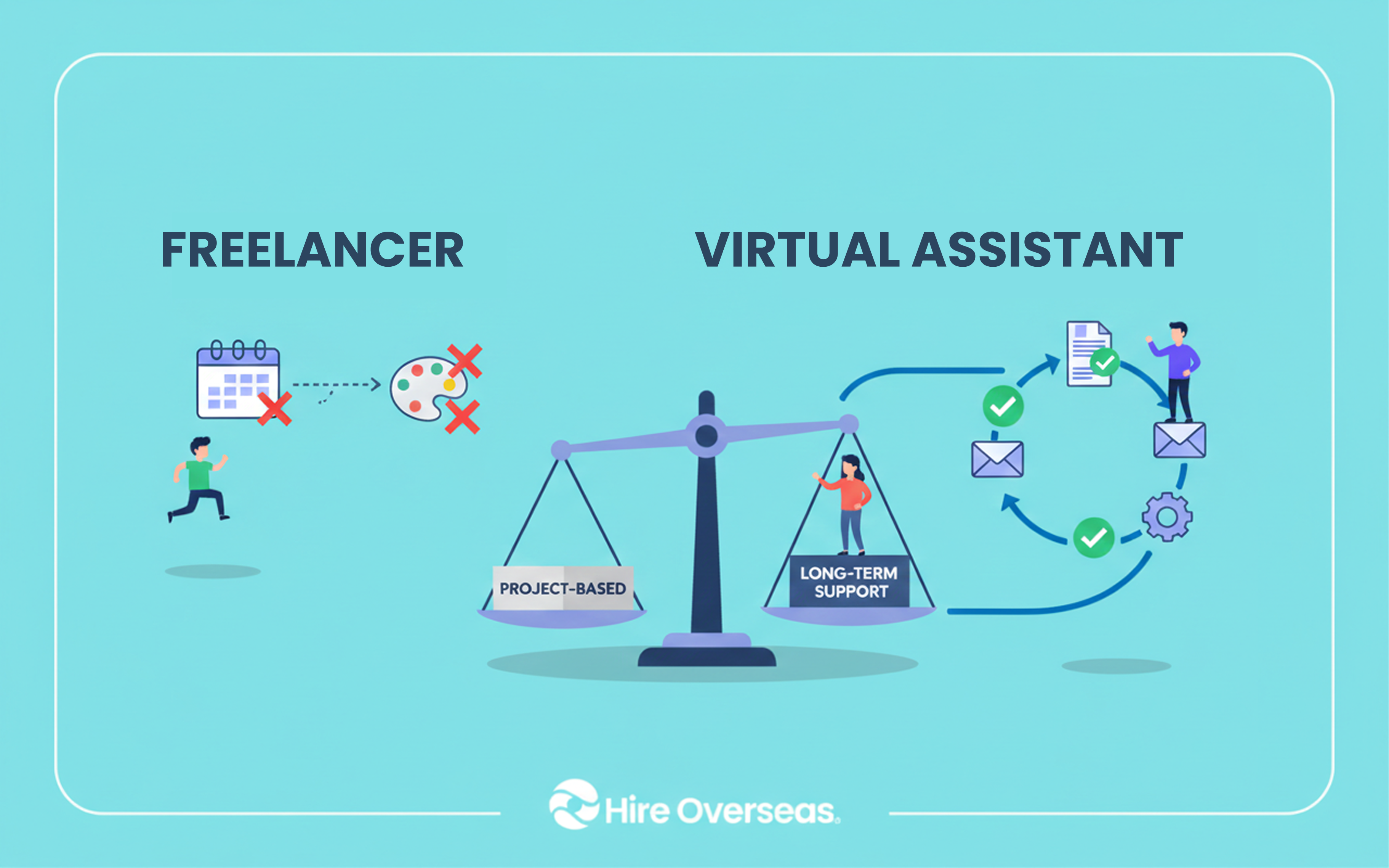
Freelancers and virtual assistants differ less by skill and more by structure. Freelancers are built for short-term, project-based output, while virtual assistants are designed for ongoing ownership and operational continuity. For businesses that rely on recurring workflows, accumulated context, and consistent follow-through, virtual assistants provide greater reliability, lower management overhead, and more durable long-term support as complexity grows.
The freelancer vs. virtual assistant debate often starts with flexibility and cost. For founders and small teams, it should start with reliability, accountability, and how work holds up over time.
Both freelancers and virtual assistants play valuable roles. The difference is not skill. It is how work is structured, owned, and sustained once the business moves beyond one-off tasks.
This guide breaks down virtual assistant vs. freelancer through the lens that matters most to growing businesses: consistency of work and long-term operational support.
Understanding the Core Difference: Freelancers vs. Virtual Assistants
At a glance, freelancers and virtual assistants can look interchangeable. Both work remotely. Both can support a wide range of tasks. The difference appears in how each is engaged and, more importantly, how responsibility and continuity are defined.
One model is built around delivery. The other is built around ownership.
What a Freelancer Is Designed For: Output, Not Continuity
A freelancer is typically engaged for project-based or outcome-based work.
In practice, freelancers are:
- hired for a specific deliverable or result
- working independently across multiple clients
- setting their own processes, timelines, and priorities
- disengaging once the project is completed
Freelancers are optimized for speed and specialization. They perform best when scope is clear and work has a defined endpoint. This makes them ideal for short-term needs such as designing a website, developing a feature, or producing a campaign asset.
This model aligns naturally with ongoing support vs. project-based work decisions where continuity, internal context, and long-term ownership are not required.
What a Virtual Assistant Is Designed For: Ongoing Ownership
A virtual assistant is designed for ongoing, embedded support within daily operations.
In practice, virtual assistants:
- work as a dedicated extension of your internal team
- follow your systems, tools, and SOPs
- support recurring tasks and workflows
- build operational context over time
A dedicated virtual assistant is not hired to complete one outcome and move on. They are hired to keep processes running smoothly, reduce operational friction, and create consistency across repeated tasks.
This is the foundation of long-term remote support, where reliability, continuity, and accountability matter more than short-term output.
If you’re evaluating virtual assistants for long-term operational ownership, this breakdown of top virtual assistant companies shows which models are built for continuity rather than task volume.
[blog-cta_component]
Long-Term Support Reality: How Each Model Holds Up Over Time
Execution Consistency Over Time
🏆 Winner: Virtual Assistant
Long-term support depends on steady execution more than peak productivity.
Why Freelancers Struggle With Consistency
Freelancers optimize for flexibility across clients. Over time, this creates variability:
- availability shifts as client load changes
- response times slow during peak periods
- priorities are re-ranked based on urgency and pay
- context must be reintroduced repeatedly
Even highly reliable freelancers experience these constraints. This is why the reliability of freelancers varies once work becomes ongoing rather than project-based.
Why Virtual Assistants Preserve Cadence
Virtual assistants operate on fixed schedules and recurring workflows. They show up consistently, follow defined processes, and own tasks across weeks and months.
For long-term support, this predictability matters more than speed. Consistency allows work to compound instead of restarting every cycle.
Ownership, Accountability, and Follow-Through
🏆 Winner: Virtual Assistant
Long-term operations break down when ownership is unclear.
Accountability Limits in Freelancer Models
Freelancers are accountable to deliverables, not systems.
Once work is delivered:
- responsibility typically ends
- follow-ups depend on the client
- ownership resets with each new task
This weakens accountability in outsourcing for ongoing support and increases management overhead over time.
How Virtual Assistants Create Durable Ownership
Virtual assistants are embedded into daily operations. They are accountable for:
- recurring processes
- follow-through and escalation
- maintaining operational continuity
This produces higher consistency of work and fewer dropped handoffs as complexity grows.
Cost Over Time, Not Cost Per Hour
🏆 Winner: Virtual Assistant for Long-Term Support
Hourly rates hide the real cost of ongoing work.
Freelancer Cost in Monthly Terms
Freelancers often appear cheaper because costs are variable, but monthly equivalents add up quickly.
Typical freelancer rates:
- general admin or ops support: $20–$40/hour
- specialized roles: $50–$120+ per hour
Monthly cost equivalents for ongoing support:
- 10 hours/week at $30/hour ≈ $1,200/month
- 20 hours/week at $40/hour ≈ $3,200/month
- 40 hours/week at $50/hour ≈ $8,000/month
These figures exclude coordination time, onboarding, and context loss.
Virtual Assistant Cost for Long-Term Support
Virtual assistants usually operate on fixed monthly costs:
- part-time VA: $800–$1,500/month
- full-time dedicated VA: $1,200–$2,500/month
In freelancer vs. virtual assistant cost comparisons, the real question is not hourly price. It is cost per unit of reliable, repeatable output over time.
For teams comparing freelancer rates to long-term support costs, this virtual assistant cost breakdown shows what ongoing ownership actually costs month to month.
Project Work vs. Long-Term Support Fit
🏆 Winner: A Split Decision
When a Freelancer Is the Right Choice
Choose a freelancer when:
- work is discrete and finite
- output matters more than process
- long-term context is unnecessary
This aligns with ongoing support vs. project-based work decisions where continuity is not required.
When a Virtual Assistant Is the Right Choice
Choose a virtual assistant when:
- work repeats daily or weekly
- context compounds over time
- consistency matters more than speed
- you need true long-term remote support
This is where freelancer or virtual assistant decisions consistently favor virtual assistants.
Hire Overseas Founder Insight: Why Long-Term Support Decisions Compound Over Time
After helping founders build and manage long-term remote support teams, one pattern shows up consistently. Businesses do not struggle because freelancers lack skill. They struggle because the support model cannot accumulate context or survive over time.
The difference between freelancers and virtual assistants becomes clear only after months of real operations, not during the first few weeks.
Context Is the Asset Most Teams Underestimate
Long-term support improves when context compounds.
Virtual assistants who remain embedded over time:
- need fewer instructions
- understand priorities without being told
- anticipate issues before they escalate
- shift work from reactive to proactive
This context is not documentation. It is operational memory. Freelancers rarely reach this stage because engagements reset, pause, or rotate. Even strong freelancers repeatedly start from partial context.
Context accumulation is a hidden growth lever.
The Real Cost Is Management Overhead, Not Labor
Founders often compare hourly rates and miss the real expense.
Freelancers require ongoing management:
- repeated explanations
- constant alignment checks
- follow-ups and coordination
- rework due to context gaps
With virtual assistants, management load decreases over time. Instructions shorten. Trust builds. Delegation becomes lighter.
For long-term support, the lowest-cost model is the one that minimizes founder attention, not the one with the lowest visible rate.
Small Errors Become Expensive at Scale
In long-term operations, mistakes compound.
Missed follow-ups, inconsistent CRM data, delayed responses, or reporting errors create downstream costs that far exceed the price of the original task.
Freelancers optimize for completion. Virtual assistants optimize for correctness within a system. Over time, fewer mistakes matter more than faster output.
Long-Term Support Must Survive Turnover
Every support model should assume change.
When freelancers disengage, context leaves with them. Onboarding restarts. Output pauses.
When virtual assistant roles are structured correctly, workflows are documented, handovers are possible, and recovery is faster. Continuity matters more than individual performance.
Long-term support should be designed to absorb change, not break under it.
Incentives Shape Outcomes Over Time
Freelancers are incentivized to maximize billable output across clients. Virtual assistants are incentivized to maintain stability, accuracy, and trust inside one operation.
Over time, this difference affects prioritization, responsiveness, and ownership. Incentives shape behavior more than skill.
The Founder Threshold Most Teams Cross Quietly
There is a point where freelancers stop being efficient for ongoing support.
If your business relies on:
- recurring workflows
- customer-facing consistency
- systems that require upkeep
- work that fails when one person drops the ball
you have crossed the threshold where embedded ownership matters more than flexible output.
Reducing Cognitive Load Is the Real Win
Founders do not scale by doing more. They scale by carrying less.
Virtual assistants reduce mental load because:
- work happens without reminders
- issues surface proactively
- trust builds through repetition
That reduction in cognitive overhead is not a soft benefit. It is operational leverage.
The Hire Overseas Perspective
From our perspective, the freelancer vs. virtual assistant decision is not about preference. It is about durability.
Freelancers are excellent for projects. Virtual assistants are built for long-term support.
The teams that scale cleanly design support models that compound context, reduce management load, and preserve continuity over time. That is what long-term remote support actually requires.
Long-Term Support Is About Durability
The freelancer vs. virtual assistant decision is not about talent. It is about whether your support model holds up as the business grows.
Freelancers are built for projects. They deliver fast and disengage cleanly. Virtual assistants are built for continuity. They absorb context, reduce management overhead, and keep work moving when priorities shift.
As operations become more complex, inconsistency becomes expensive. Context resets, follow-ups slip, and founders spend more time managing work than building the business. That is not a people problem. It is a systems problem.
At Hire Overseas, we help founders build long-term remote support as infrastructure, not ad hoc help. Our engagement models start at $2,000, with no hidden fees, so teams know exactly what they are committing to from day one.
If your business depends on recurring execution and operational follow-through, the right model should work quietly in the background.
Talk to us at Hire Overseas to see what durable long-term support looks like in practice.




Unlock Global Talent with Ease
Hire Overseas streamlines your hiring process from start to finish, connecting you with top global talent.
FAQs About Freelancers vs. Virtual Assistants
Can a virtual assistant replace multiple freelancers?
Yes, in many operational roles a single dedicated virtual assistant can replace several freelancers. Because a VA works across recurring workflows—admin, CRM updates, inbox management, reporting, and coordination—they reduce the need to hire separate freelancers for each function. This consolidation lowers management overhead and improves cross-task continuity.
Are virtual assistants suitable for scaling startups or only small businesses?
Virtual assistants are often more valuable as startups scale. As volume increases, recurring workflows multiply and context becomes critical. A VA who already understands internal systems, priorities, and tools can scale output without the constant onboarding required when rotating freelancers.
What types of tasks should not be handled by a virtual assistant?
Highly specialized, short-term, or creative work with unclear processes—such as brand design, advanced development, or one-off strategy projects—are better suited for freelancers or agencies. Virtual assistants perform best when tasks are repeatable, system-driven, and ongoing.
Is hiring a virtual assistant risky if the business changes direction?
No, provided the role is structured around processes rather than individuals. When workflows, SOPs, and documentation exist, virtual assistant roles can adapt to new priorities more easily than ad-hoc freelancer arrangements, which often rely on personal context instead of systems.
Do virtual assistants require more training than freelancers?
Initially, yes. Virtual assistants need onboarding into your tools, workflows, and expectations. However, this upfront investment pays off quickly because training is not repeated every time work is assigned. Freelancers often require re-alignment for each new task or phase.
What is the biggest mistake founders make when choosing between freelancers and virtual assistants?
The most common mistake is optimizing for short-term flexibility instead of long-term durability. Founders often choose freelancers because they feel lower-commitment, only to discover later that inconsistency, context loss, and management overhead slow the business down.
Unlock Global Talent with Ease
Hire Overseas streamlines your hiring process from start to finish, connecting you with top global talent.
