


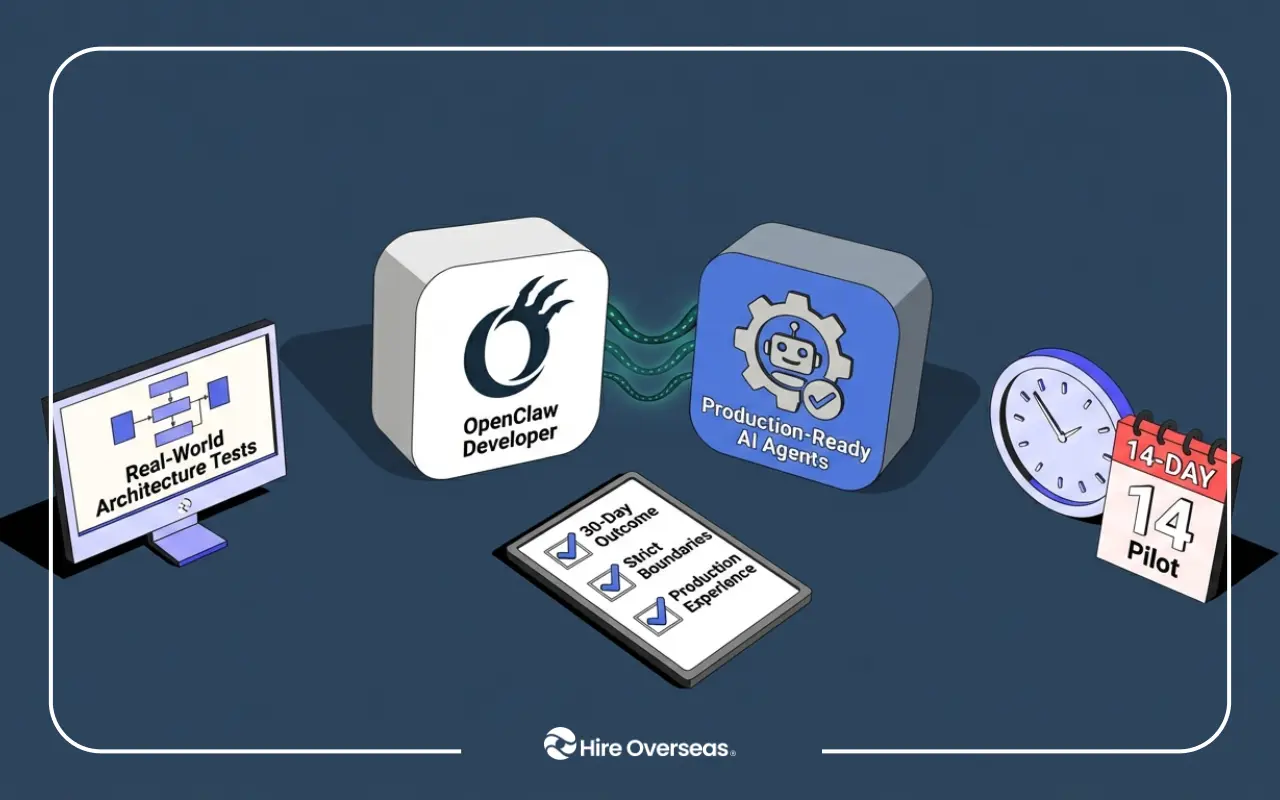
OpenClaw can automate complex workflows and integrate directly into your business systems. But deploying it in production is not an experiment. It is an operational commitment.
The real question is not whether OpenClaw works. It is whether you have the right developer to implement, secure, and scale it properly.
This Hire Overseas guide shows you exactly how to hire an OpenClaw developer so your automation runs reliably, integrates cleanly, and delivers measurable results from day one.
1. Define the Outcome Before You Hire an OpenClaw Developer
Hiring starts with clarity, not resumes.
OpenClaw is an execution framework. That means the developer you hire will not just write code. They will design systems that interact with live business data, APIs, and operational workflows.
Before you interview anyone, define what success looks like in 30 days.
If you cannot describe the workflow in plain language, you are not ready to hire.
a. Write a Clear 30-Day Outcome
A strong 30-day outcome answers five questions:
- What exact workflow will be automated?
- Which systems will the agent touch?
- What data is involved?
- What level of autonomy is allowed?
- How will you measure success?
Strong examples:
- Deploy one OpenClaw workflow that pulls data from your CRM, validates and enriches records, updates specific fields, and logs every action with traceable run IDs.
- Replace a manual weekly reporting task with an automated agent that retrieves source data, generates a formatted summary, attaches raw references, and distributes it to leadership with audit trails.
- Implement ticket triage automation that classifies tickets, assigns priority levels, routes them to the correct team, and includes human-in-the-loop approval with runtime monitoring.
Notice what these examples include:
- Specific systems
- Specific actions
- Logging requirements
- Oversight mechanisms
Weak example:
“Build an AI agent.”
That statement defines nothing about scope, integrations, guardrails, or accountability.
Specific outcomes attract execution-focused OpenClaw developers.
Vague goals attract experimenters who build impressive demos but struggle in production.
b. Define Boundaries Before Autonomy
OpenClaw agents can take action across systems. That makes boundary-setting critical.
Before hiring, define:
- What systems the agent cannot access
- Whether it can write data or only read data
- Whether human approval is required before execution
- What triggers escalation
This step prevents over-permissioning and reduces operational risk.
Experienced OpenClaw engineers will appreciate clearly defined constraints. In fact, strong candidates often ask for them.
c. Choose the Right OpenClaw Role
Not every AI engineer is suited for OpenClaw production work. Match the role to your scope and automation maturity.
OpenClaw developer
Builds and refines agent logic, task decomposition, and tool orchestration. Ideal for controlled workflows with defined boundaries.
OpenClaw developer for hire (short-term)
Best for tightly scoped pilot projects or validating a single automation use case before scaling.
Hire OpenClaw engineer
Best for production deployment, long-term ownership, integration maintenance, and performance optimization.
OpenClaw integration specialist
Handles API connections, authentication, CRM systems, database schemas, error handling, and infrastructure alignment. Critical when agents interact with multiple tools.
OpenClaw implementation expert
Designs governance layers, runtime monitoring systems, scaling architecture, documentation standards, and enterprise rollout frameworks.
If your OpenClaw use case touches sensitive data or multiple business systems, you likely need more than a single builder. You need someone who thinks in terms of infrastructure, not features.
d. Recognize Overlapping Titles
You may also see candidates under related titles such as:
- AI agent developer
- AI automation developer for hire
- autonomous AI engineer
- AI implementation engineer
- OpenClaw AI engineer
Titles can vary widely across regions and industries.
What matters more than the label is whether the candidate has:
- Deployed agent-based systems in production
- Designed monitoring and logging architecture
- Managed API reliability issues
- Handled real-world automation failures
Ask for examples of agents that ran in live environments, not just sandbox demos.
e. Focus on Deployment Experience, Not Tool Familiarity
Many developers can explain how OpenClaw works.
Fewer have:
- Managed drift after model updates
- Rebuilt integrations after API changes
- Designed fallback workflows when external services fail
- Created documentation that allows others to maintain the system
When hiring for OpenClaw, prioritize candidates who have maintained systems over time, not just built them.
Production experience is what turns OpenClaw from a prototype tool into reliable automation infrastructure.
If you are evaluating long-term ownership rather than short-term projects, this remote employee hiring breakdown explains how to assess accountability, documentation habits, and operational maturity before extending an offer.
2. Build a Hiring Scorecard That Filters for Production Thinking
Once your outcome is defined, the next step is designing a hiring filter that separates real OpenClaw engineers from surface-level AI builders.
Most hiring mistakes happen here.
Companies screen for:
- Python experience
- LLM familiarity
- API knowledge
But OpenClaw production work requires something deeper:
Systems thinking under real-world constraints.
a. Define What “Production-Ready” Means for Your Business
Before evaluating candidates, define your internal standard for production readiness.
For OpenClaw deployment, that typically includes:
- Stable integration with at least one live business system
- Authenticated API access with secure credential handling
- Structured logging for every execution run
- Error handling with retry logic
- Human escalation rules
- Clear documentation of workflow logic
If a candidate cannot describe how they would implement all six, they are not ready for production-level automation.
b. Separate Workflow Builders from Infrastructure Designers
There are two common types of candidates:
1. Workflow builders
They can:
- Write prompt logic
- Connect basic APIs
- Build demo automations
But they often:
- Skip monitoring design
- Overlook logging
- Ignore failure scenarios
2. Infrastructure designers
They:
- Think about failure before success
- Design observability systems
- Create rollback strategies
- Define permission boundaries
- Anticipate edge cases
When you hire OpenClaw developer talent for real business use, you want infrastructure designers.
c. Add Observability Requirements to Your Scorecard
Autonomous agents fail quietly if you do not build visibility.
Your OpenClaw scorecard should require:
- Unique execution IDs per run
- Timestamped structured logs
- Tool-call trace tracking
- Performance metrics (runtime, failure rate, retry count)
- Alerting thresholds
Ask candidates:
- How would you detect silent task failure?
- How would you monitor drift over time?
- How would you differentiate model reasoning error from API failure?
If answers are vague, that is a risk indicator.
d. Evaluate Error Handling Depth
Production OpenClaw systems must account for:
- API rate limits
- Schema changes
- Network timeouts
- Partial task completion
- Corrupted or unexpected data
- External tool outages
Strong candidates will discuss:
- Exponential backoff retries
- Circuit breaker patterns
- Fallback workflows
- Safe failure states
- Escalation triggers
Weak candidates will say:
“The agent will retry.”
Retrying without guardrails creates loops.
e. Require Governance Thinking
OpenClaw can interact with:
- CRMs
- Financial dashboards
- Customer records
- Internal reporting tools
That introduces responsibility.
Your OpenClaw integration specialist or engineer should design:
- Role-based access control
- Least-privilege permissions
- Credential vault integration
- Environment separation (dev, staging, production)
- Audit logs for compliance
If your automation touches sensitive data, governance must be built in from day one.
f. Ask for Real Production Examples
Do not ask:
“What projects have you worked on?”
Ask:
- What broke in production and why?
- How did you detect it?
- What monitoring did you add afterward?
- What was your rollback plan?
Engineers who have maintained automation systems over time will have concrete answers.
Engineers who have only built demos will not.
The Hire Overseas Insight
At Hire Overseas, we evaluate OpenClaw candidates based on:
- Outcome alignment
- Infrastructure awareness
- Failure modeling
- Monitoring architecture
- Integration stability
- Documentation discipline
Because autonomous systems do not fail during demos.
They fail during edge cases.
Your hiring process should reflect that reality.
3. Vet OpenClaw Candidates With a Real-World Execution Test
Resumes show exposure.
Interviews show confidence.
Execution tests reveal competence.
If you want to hire an OpenClaw developer who can handle production environments, you must simulate real conditions before making an offer.
This is where most companies cut corners.
Step 1: Run a Production Ownership Deep Dive
Start with structured questions that reveal operational maturity.
Ask:
- What is the most complex autonomous workflow you deployed?
- What systems did it integrate with?
- What failed after launch?
- How did you detect the failure?
- What changes did you implement to prevent recurrence?
You are not testing theoretical knowledge. You are testing lived experience.
Strong candidates will discuss:
- Monitoring gaps they discovered
- Integration drift after API changes
- Data validation errors
- Performance degradation over time
- Governance adjustments
Weak candidates will focus only on how they built the system, not how they maintained it.
Step 2: Conduct a Live Architecture Design Exercise
This is the most important part of your evaluation.
Give a realistic business scenario. For example:
Design an OpenClaw workflow that:
- Pulls new inbound leads from a web form
- Validates required fields
- Enriches data from an external API
- Updates CRM records
- Notifies the sales team in Slack
- Logs all actions
- Escalates when enrichment fails
Then evaluate how they approach it.
Look for:
- Clear task decomposition
- Tool selection logic
- Permission boundaries
- Data validation steps
- Failure detection mechanisms
- Logging structure
- Escalation triggers
High-quality OpenClaw engineers think in systems, not just prompts.
They define boundaries before building.
Step 3: Introduce a Failure Scenario
Once they design the workflow, introduce friction.
Ask:
- What happens if the CRM API rate-limits requests?
- What happens if enrichment returns corrupted data?
- What happens if Slack is temporarily unavailable?
- What happens if model output conflicts with validation rules?
This step reveals whether they design for resilience.
Strong candidates will mention:
- Retry logic with backoff
- Fallback states
- Dead-letter queues
- Partial execution rollback
- Alert triggers for human review
Production OpenClaw systems must degrade safely.
Step 4: Test Documentation and Communication
OpenClaw automation does not live in isolation. Other team members must understand it.
Ask the candidate to:
- Write a short deployment plan
- Outline the monitoring structure
- Define success metrics
- Document assumptions
You are testing clarity.
Engineers who cannot explain their architecture clearly often struggle in collaborative environments.
Red Flags That Predict Production Problems
Avoid candidates who:
- Say “the agent will handle it” without defining guardrails
- Cannot describe logging structure
- Ignore data validation
- Skip human escalation design
- Avoid discussing system failure scenarios
Autonomous AI increases operational responsibility.
If the candidate treats it casually, that is a warning.
Why This Step Matters
OpenClaw production deployment is not about writing code. It is about building reliable execution pipelines.
The difference between:
- a working demo
- and stable automation infrastructure
is how the system behaves under stress.
A structured evaluation reveals that before you commit.
4. Run a Controlled 14-Day Pilot Before Scaling OpenClaw
Even if a candidate performs well in interviews and architecture tests, you should not immediately scale automation across critical systems.
Autonomous AI must earn trust through controlled execution.
A structured 14-day pilot protects your business while validating real-world performance.
Step 1: Choose a Low-Risk, High-Visibility Workflow
Start with a workflow that is:
- Structured and repeatable
- Operationally meaningful
- Measurable
- Low regulatory risk
Good pilot examples:
- Lead enrichment with CRM updates
- Weekly performance reporting
- Ticket classification and routing
- Internal data synchronization
Avoid starting with:
- Financial disbursements
- Compliance-critical workflows
- Customer-facing decisions without oversight
The goal is validation, not maximum automation on day one.
Step 2: Define Clear Pilot Success Metrics
Do not evaluate the pilot subjectively.
Define measurable criteria such as:
- Execution accuracy rate
- Failure rate
- Average runtime
- Number of escalations
- Logging completeness
- Integration stability
For example:
“The workflow must complete successfully 95% of the time without manual correction.”
This forces accountability and avoids vague assessments like “it seems to work.”
Step 3: Test Under Stress Conditions
Do not only test ideal scenarios.
Intentionally simulate:
- API timeouts
- Missing data fields
- Corrupted payloads
- External service downtime
- Unexpected input formats
A production-ready OpenClaw engineer should have designed:
- Safe failure states
- Retry limits
- Escalation triggers
- Clear logging for debugging
If the system collapses under minor disruption, it is not ready to scale.
Step 4: Validate Monitoring and Visibility
During the pilot, confirm:
- Each execution has a unique run ID
- Logs are structured and searchable
- Alerts trigger when thresholds are exceeded
- Failures are categorized clearly
- Escalations are documented
Ask yourself:
If this automation breaks at 2 a.m., how quickly would we know?
If the answer is unclear, the monitoring layer is incomplete.
Step 5: Document Everything Before Expanding Scope
Before moving beyond pilot stage, require:
- Workflow documentation
- Tool integration diagrams
- Permission mapping
- Failure-handling documentation
- Escalation procedures
This ensures continuity if the original OpenClaw developer becomes unavailable.
Infrastructure without documentation creates dependency risk.
Add Operational Oversight Early
Autonomous systems do not eliminate the need for supervision.
The most stable structure is:
- OpenClaw engineer builds and maintains
- AI operations support monitors performance and handles edge cases
This dual-layer model prevents automation drift and integration decay.
At Hire Overseas, we frequently help companies combine OpenClaw implementation with structured AI operations oversight to ensure long-term stability rather than short-term experimentation.
Why the Pilot Phase Is Critical
Most automation failures occur not during development but during scaling.
The pilot phase reveals:
- Hidden integration weaknesses
- Edge case handling gaps
- Monitoring blind spots
- Documentation deficiencies
A disciplined 14-day validation phase dramatically reduces production risk.
Final Hire Overseas Insight: Hire an OpenClaw Developer for Ownership
The biggest mistake companies make when they hire an OpenClaw developer is optimizing for technical skill instead of operational ownership.
OpenClaw is not a side project. It is execution infrastructure. It touches your CRM, your reporting systems, and your internal workflows. That means the person you hire must think beyond building and into monitoring, governance, and long-term stability.
At Hire Overseas, we look for engineers who design for failure before success. Developers who assume integrations will break, APIs will change, and edge cases will appear. Because in production, they always do.
The right OpenClaw engineer does not just ship automation. They protect your systems while increasing execution capacity.
If you are ready to hire an OpenClaw developer and want to structure the role correctly from the start, schedule a remote hiring consultation today.
