


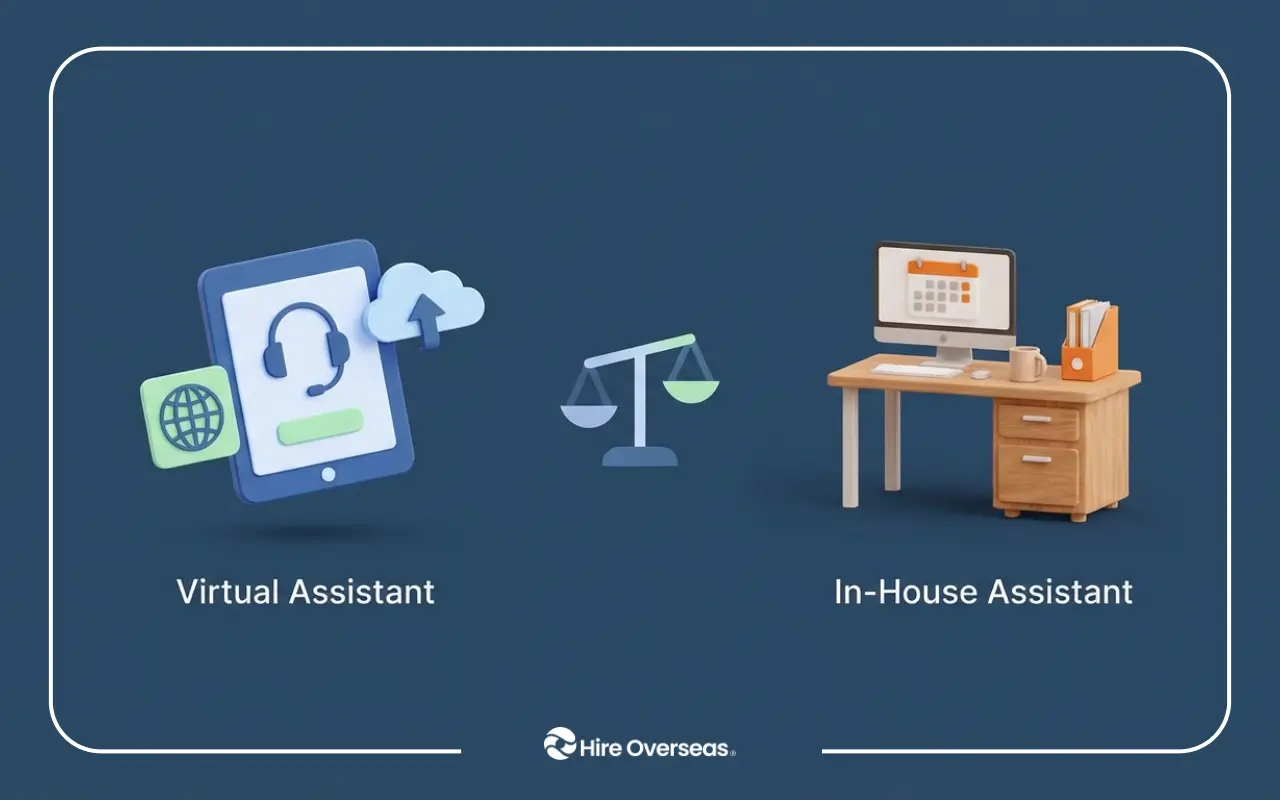
As companies grow, support needs become more consistent and more complex.
Eventually, leaders face a structural decision:
Should we hire a virtual assistant or bring someone in-house?
The virtual assistant vs in-house assistant decision is not about which role is better. It is about cost structure, control, scalability, and how well the model supports long-term growth.
This guide offers a practical comparison across structure, cost, integration, and role scope so growing teams can choose confidently.
The Foundational Difference Between Virtual and In-House Assistants
The core difference between a virtual assistant and an in-house assistant is not skill level or task capability. It is the employment structure.
Understanding this distinction is critical because structure affects cost, risk, flexibility, and long-term scalability.
What Is a Virtual Assistant?
A virtual assistant (VA) is a remote professional engaged through contract based assistant engagement rather than traditional full-time employment.
Instead of being added to payroll, a virtual assistant operates as an independent contractor or through a remote staffing provider. This means businesses are not responsible for payroll taxes, benefits administration, or long-term employment liabilities.
Virtual assistants commonly support:
- Administrative tasks such as email management, scheduling, and data entry
- Operations and workflow coordination
- Marketing and sales support
- Customer service
- Executive and founder assistance
Most virtual assistants work remotely and may be:
- Offshore
- Nearshore
- Based in the US but operating remotely
Because they are not full-time employees, companies benefit from flexibility in workload, hours, and cost structure. For businesses focused on hiring assistants without payroll overhead, this model reduces financial commitment while maintaining operational support.
The defining characteristic of a virtual assistant is flexibility in structure, not limitation in scope.
For founders defining scope before hiring, this breakdown of what a virtual assistant actually does includes task categories, real-world examples, and workload benchmarks by business stage.
What Is an In-House Assistant?
An in-house assistant is a full-time employee hired under standard employment classification for assistants and typically works on-site at the company’s office.
This model includes:
- Fixed working hours
- Salary and benefits
- Employer payroll taxes
- Direct supervision
- Physical presence within the workplace
In-house assistants are deeply embedded into company culture and daily workflows. They often support office-based coordination, in-person communication, and ongoing operational needs that require physical presence.
This structure provides stability and proximity but also creates long-term financial and compliance commitments.
If you’re deciding between short-term freelancers and long-term structured support, this freelancer vs. virtual assistant comparison explains the differences in accountability, stability, and operational ownership.
The Structural Distinction
When comparing virtual assistant vs employee, the primary difference is not what they can do. It is how they are engaged.
A virtual assistant is a flexible, contract-based resource integrated into digital workflows.
An in-house assistant is a payroll employee integrated into physical operations.
That structural distinction shapes everything else, including cost, scalability, management approach, and risk exposure.
Understanding this foundation makes the rest of the comparison clearer and more practical for growing teams.
Cost and Commitment: Virtual Assistant Versus Full-Time Employee
🏆 Verdict:
- Virtual Assistant for Flexibility
- In-House Assistant for Long-Term Stability
For growing teams managing cash flow and scaling carefully, virtual assistants typically offer lower structural risk. For established organizations with predictable workloads, in-house assistants provide stability and deeper internal integration.
The financial difference between a virtual assistant versus full time employee goes beyond salary.
It is about commitment.
The True Cost of an In-House Assistant
Hiring an in-house assistant includes more than base compensation.
Typical annual cost components:
- Base salary
- Employer payroll taxes (7–10%)
- Health insurance ($5,000–$12,000 annually per employee in the U.S.)
- Paid leave
- Equipment and office space
- HR administration and compliance
For example:
If you hire an in-house assistant at $60,000 per year, your true annual cost may look like:
- $60,000 salary
- $6,000 payroll taxes
- $8,000 health insurance
- $3,000 equipment and overhead
Estimated total: $77,000 annually
That does not include recruitment costs or turnover risk.
The Cost Structure of a Virtual Assistant
Virtual assistants operate through contract based assistant engagement, typically billed monthly.
Average market pricing:
- Offshore virtual assistant (full-time): $1,200–$2,500/month
- U.S.-based remote virtual assistant: $3,000–$5,000/month
- Executive virtual assistant: $2,500–$4,500/month
There are no payroll taxes, benefits, or employment liabilities.
For example:
A full-time offshore virtual assistant at $2,000/month equals:
$24,000 annually
Even at the higher end of $3,000/month:
$36,000 annually
This is often less than half the cost of a U.S.-based in-house assistant.
If you're comparing offshore hiring options, this breakdown of the top countries to hire virtual assistants explains cost differences, English proficiency levels, and time zone alignment considerations.
Cost Comparison Matrix: Virtual assistant vs. In-house assistant
Below is a simplified annual comparison for a full-time equivalent role:
What the Matrix Actually Shows
The difference is not just price.
It is financial commitment.
An in-house assistant creates fixed overhead and employment liability. A virtual assistant converts support into controlled operational expense.
For businesses focused on:
- Hiring assistants without payroll overhead
- Maintaining cash flexibility
- Reducing employment classification risk
- Scaling support with workload
Virtual assistants often provide stronger structural leverage.
However, if your organization requires daily physical presence and long-term embedded support inside office operations, the higher cost of in-house staff may be justified.
For small business owners evaluating whether the savings justify the transition, this guide to hiring a virtual assistant for small businesses breaks down when outsourcing becomes financially smarter than expanding payroll.
Control and Integration: Remote Assistant Versus In-House Staff
🏆 Verdict:
- In-House for Physical Oversight
- Virtual Assistant for Digital Scalability
If your operations rely on in-person coordination and office-based interaction, in-house assistants provide stronger proximity control. If your workflows are digital and system-driven, virtual assistants offer scalable integration without increasing overhead.
The discussion around remote assistants versus in-house staff is rarely about capability. It is about visibility, supervision, and workflow structure.
The right model depends on how your organization functions day to day.
Where In-House Assistants Excel
In-house assistants provide:
- Immediate face-to-face communication
- Physical presence during meetings
- On-site document handling
- Real-time coordination with office staff
- Direct supervision and instant feedback
This model is particularly effective in environments where:
- Leadership prefers in-person communication
- Work requires physical access to files or equipment
- Teams collaborate heavily in a shared office
- Office culture and presence are strategic priorities
For organizations with established physical operations, in-house assistants can reduce small logistical delays that occur when coordination happens remotely.
However, this level of proximity also increases long-term payroll commitment and operational overhead.
Where Virtual Assistants Excel
Virtual assistants are designed to operate within structured digital systems. They typically provide:
- Process-based task execution
- Clear accountability through dashboards and reporting
- Flexible scheduling across time zones
- Integration into CRMs, project management tools, and communication platforms
For companies running operations through platforms such as Slack, Google Workspace, HubSpot, Notion, or Asana, virtual assistants can operate seamlessly without physical presence.
They are especially effective when:
- Tasks are recurring and system-driven
- Workflows are documented
- Deliverables are measurable
- Communication is centralized
In these environments, efficiency comes from clarity and process rather than proximity.
Visibility vs Process: Management Style Matters
The virtual assistant vs. in-house assistant decision often comes down to how leaders measure control.
In-house assistants provide visual oversight. Leaders can walk over, check in, and receive immediate updates.
Virtual assistants provide structured oversight. Progress is tracked through shared dashboards, documented processes, and scheduled reporting.
Neither model is inherently superior. The effectiveness depends on whether your management style is proximity-driven or system-driven.
Scalability and Operational Maturity: Flexibility vs. Structure
As companies grow, operational complexity increases. The question becomes whether your support model can adapt without creating friction.
In-house assistants scale linearly. Each new hire increases payroll, compliance, and administrative responsibility.
Virtual assistants scale more flexibly. Hours, responsibilities, and scope can expand gradually without creating permanent employment obligations.
For growth-stage companies optimizing for agility and cost control, this flexibility often becomes a structural advantage.
For organizations with stable office-based workflows and predictable demand, in-house integration may provide stronger long-term alignment.
Control and Integration Comparison Matrix
Practical Takeaway
- If your team relies heavily on in-person interaction and physical coordination, in-house assistants provide natural alignment.
- If your operations are digital, cloud-based, and process-oriented, virtual assistants integrate effectively while preserving flexibility.
- For most growth-stage, tech-enabled teams, scalability and process discipline often outweigh the need for proximity.
Role Scope Comparison: Executive and Personal Support Models
🏆 Verdict:
- Virtual Assistants for Digital and Scalable Roles
- In-House Assistants for High-Proximity Leadership Support
When comparing assistant models, many teams confuse structure with responsibility.
The real question is not just where the assistant works, but what level of ownership, access, and proximity the role requires.
This becomes especially important when evaluating executive and personal support positions.
Virtual Assistant vs. Executive Assistant
The virtual assistant vs. executive assistant comparison is often misunderstood.
An executive assistant traditionally operates as a close strategic partner to leadership. Responsibilities typically include:
- Complex calendar management and prioritization
- Travel coordination and logistics
- Investor and stakeholder communication
- Preparation of reports and presentations
- Internal coordination across departments
- Confidential document handling
Historically, executive assistants worked in-house because proximity made coordination easier. However, modern digital workflows have changed this dynamic.
An executive virtual assistant can now perform many of these same functions remotely, provided:
- Workflows are structured
- Communication channels are centralized
- Expectations are clearly defined
- Systems are documented
In many digitally driven organizations, executive support is largely calendar, communication, and coordination based, which makes remote execution practical.
The deciding factor becomes how often leadership requires in-person access.
For leadership teams seeking higher-level executive support, this review of top virtual assistant companies highlights providers specializing in senior-level calendar control, investor coordination, and confidential executive workflows.
Executive Assistant vs. Virtual Assistant: Level of Strategic Ownership
The executive assistant vs virtual assistant distinction is primarily about depth of responsibility.
A general virtual assistant typically focuses on execution, such as:
- Inbox organization
- Scheduling meetings
- CRM updates
- Document formatting
- Task tracking
An executive assistant, whether remote or in-house, usually operates at a higher strategic level by:
- Filtering priorities
- Managing executive time proactively
- Anticipating scheduling conflicts
- Coordinating with senior stakeholders
- Preparing executive summaries
The difference is ownership scope, not employment type.
Many growth-stage companies now hire outsourced executive assistants to gain senior-level coordination without expanding payroll. This allows them to maintain executive support while preserving flexibility.
Virtual Assistant vs. Personal Assistant
The virtual assistant vs personal assistant comparison depends almost entirely on whether tasks require physical presence.
A traditional personal assistant often manages:
- Errands and physical pickups
- Event coordination and on-site logistics
- Office-based scheduling
- Vendor visits
- Physical document handling
A virtual personal assistant or team of virtual personal assistants typically handles:
- Email and calendar management
- Travel booking
- Online purchases
- Research
- Digital file organization
- Vendor coordination through digital channels
If the role primarily involves online systems, communication, and scheduling, a virtual model is typically sufficient.
If responsibilities include frequent physical errands or in-person coordination, an in-house or hybrid solution may be necessary.
Role Scope Comparison Matrix
Practical Interpretation for Growing Teams
The virtual assistant vs in-house assistant decision becomes clearer when the role is defined first.
If the assistant must:
- Be physically present daily
- Coordinate in-office logistics
- Support in-person leadership interaction
then in-house may be stronger.
If the assistant’s responsibilities are:
- Digital
- Recurring
- Process-based
- Measurable
then a virtual assistant, executive virtual assistant, or outsourced executive assistant often delivers equivalent output with greater flexibility.
For most digitally operating growth-stage companies, virtual assistants can handle the majority of executive and administrative responsibilities without requiring physical presence.
The key is defining scope before choosing structure.
Choosing the Right Assistant Type for Growing Teams
As your company grows, the real question is not whether you need support. It is what type of support fits your structure.
If your workflows are digital, recurring, and system-driven, a virtual assistant often provides the flexibility and cost control growth-stage teams need. You avoid payroll overhead, reduce employment risk, and scale support gradually as operations expand.
If your business depends on daily in-person coordination, physical presence, and constant office interaction, an in-house assistant may offer stronger alignment.
The difference between a virtual assistant vs in-house assistant is not skill. It is commitment. One model increases fixed overhead. The other preserves adaptability.
Most growing teams benefit from starting lean and scaling intentionally.
If you want help evaluating which assistant structure fits your workload, budget, and growth plans, book a strategy call with our team at Hire Overseas.
The right support model should reduce friction today and remain sustainable tomorrow.
Related Video: How to Manage Overseas Teams & Contractors
If you are evaluating assistant structures for long-term growth, this framework will help you think beyond headcount and toward scalable team design.
In this breakdown, we explain:
- What an overseas contractor actually is (and why “virtual assistant” is often the wrong framing)
- How to structure US employees vs overseas contractors for leverage
- Why systems and playbooks matter more than effort
- How to manage contractors for outputs — not hours
- Where overseas hiring fails and how to prevent it
