


As global remote work becomes standard, U.S. companies are no longer asking whether to hire virtual assistants internationally. They are asking where the strongest, most reliable talent markets actually are.
The top countries to hire virtual assistants consistently emerge not because they are cheap, but because they combine education systems, outsourcing maturity, English proficiency, and workforce readiness that support predictable business outcomes.
This guide breaks down the best countries to hire virtual assistants using data points U.S. companies care about: workforce background, language capability, time-zone alignment, and operational scalability.
Why Certain Countries Dominate Virtual Assistant Outsourcing
While virtual assistants exist globally, only a handful of countries consistently support long-term offshore hiring at scale. These countries do not succeed by chance. Their dominance is the result of workforce systems that have been built, tested, and refined through years of serving international clients.
These countries share structural advantages:
- Large, educated labor forces aligned with service, administrative, and knowledge work, which ensures hiring depth and continuity
- Established outsourcing or nearshore industries that train workers in global business standards, tools, and performance expectations
- Strong English-speaking populations or bilingual capabilities that reduce communication friction and onboarding time
- Wage structures that support cost efficiency without sacrificing skill, enabling sustainable hiring rather than short-term arbitrage
- Proven adoption of remote tools and cross-border collaboration, shaped by long-term exposure to U.S. and European clients
What separates these countries from emerging markets is repetition at scale. Thousands of companies have hired, trained, and retained talent in these regions, creating institutional knowledge that compounds over time. This leads to faster onboarding, more predictable output, and lower operational risk for new employers.
This is why discussions around outsourcing virtual assistants by country continue to focus on the same regions year after year. The advantage is not just cost or talent availability. It is the reliability that comes from mature, globally integrated labor markets.
Philippines: The Benchmark for Offshore Virtual Assistants
The Philippines remains one of the top countries for virtual assistants due to institutional advantages rather than short-term labor trends.
Why the Philippines Consistently Performs
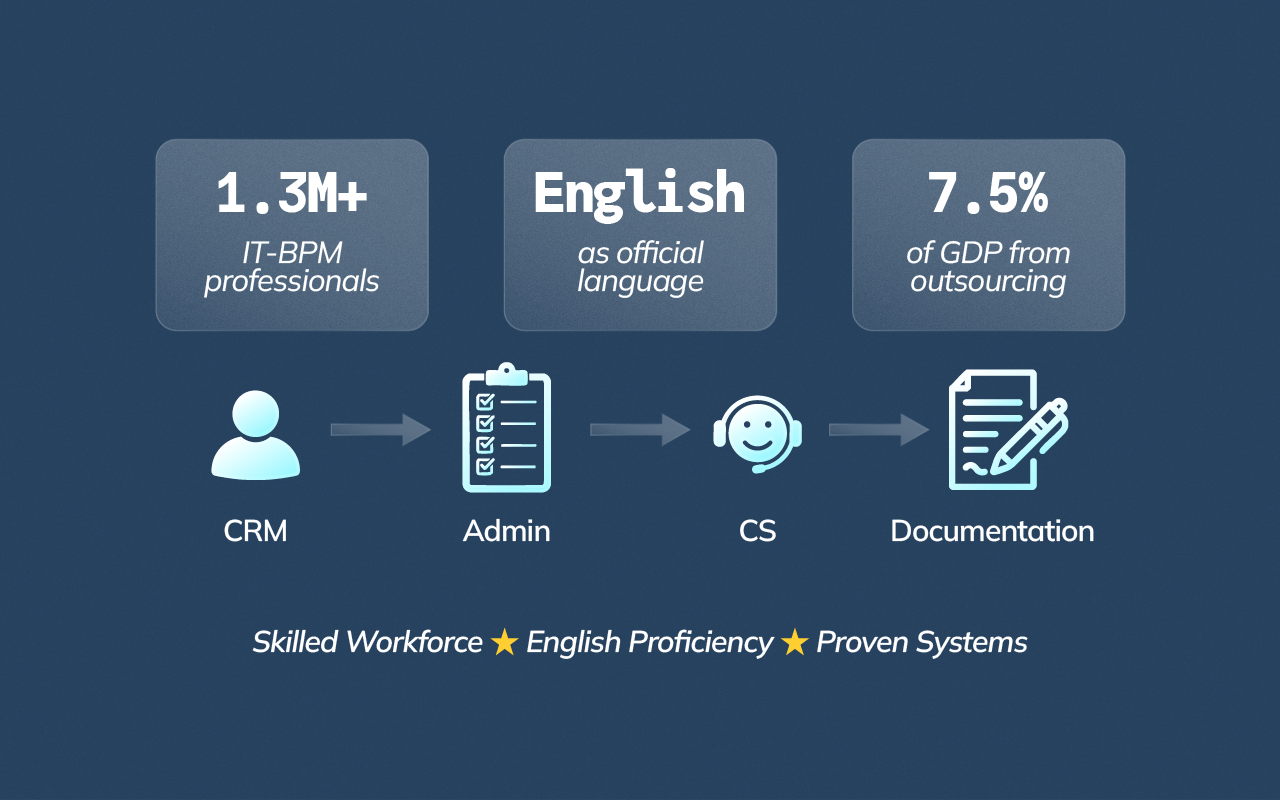
- English is an official language and the primary medium of instruction
- Over 1.3 million professionals work in the IT-BPM sector
- The outsourcing industry contributes roughly 7.5% of national GDP
- Decades of experience supporting U.S. companies
This ecosystem produces virtual assistants already trained in:
- CRM systems
- Administrative workflows
- Customer support standards
- Documentation-heavy tasks
Best Fit for U.S. Companies
- Virtual assistants for US businesses with structured workflows
- Back-office operations and admin-heavy roles
- 24/7 or night-shift coverage
The Philippines offers one of the strongest cost-to-output ratios for companies building large, process-driven teams.
Latin America: Nearshore Talent Built for Real-Time Collaboration
Latin America has become one of the best countries to hire virtual assistants for U.S. teams that value speed and collaboration.
Structural Advantages
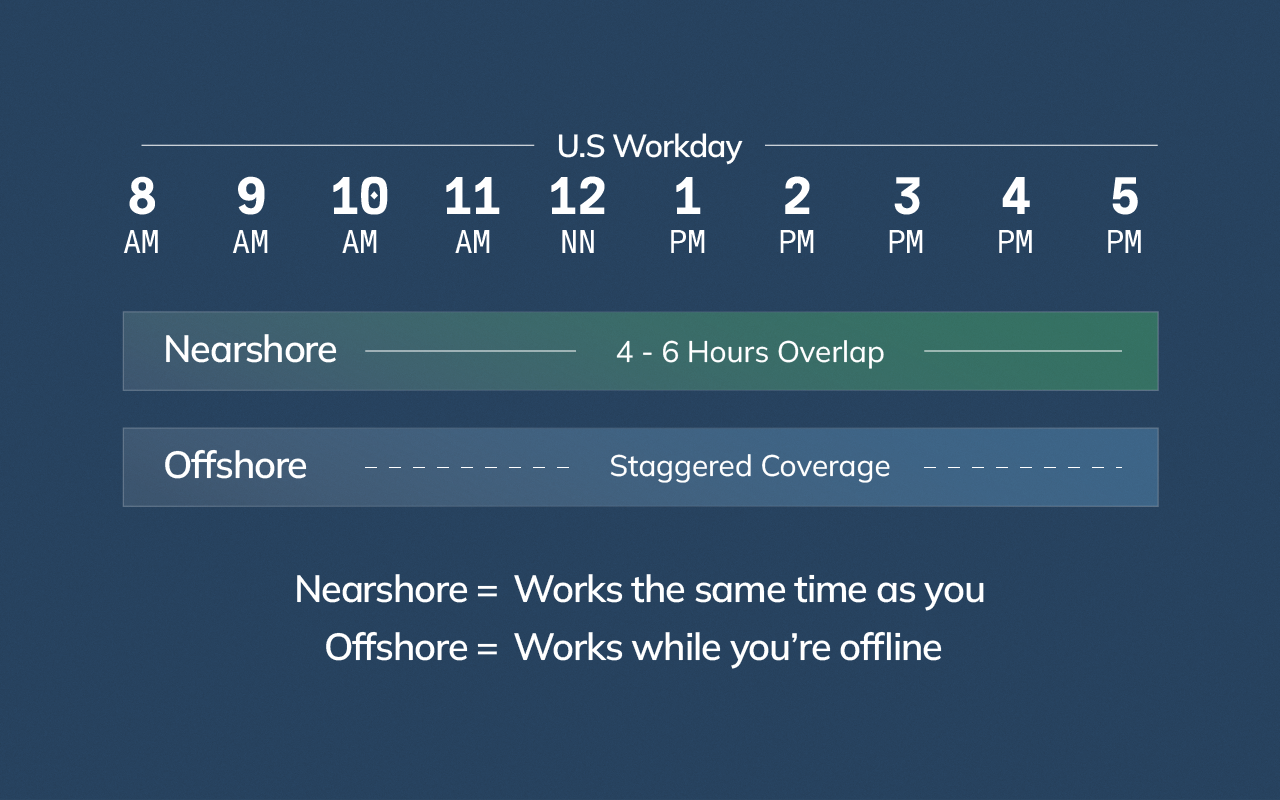
- Time zones between UTC-3 and UTC-7 align with U.S. business hours
- Strong growth in nearshore outsourcing
- Increasing English and bilingual Spanish-English proficiency
According to Auxis, 90% of global shared-services leaders already operate in or plan to expand into Latin America, reflecting the region’s growing role in U.S. operations.
Best Fit for U.S. Companies
- Time zone compatible virtual assistants
- Sales, marketing, and client-facing roles
- Bilingual customer support and operations
Latin America often costs more than Southeast Asia, but productivity gains from same-day collaboration offset the difference for many teams.
Mexico, Colombia, and Argentina: Country-Level Nearshore Strengths
Mexico: Nearshore Operational Scale
- Strong time-zone alignment with the U.S.
- Large professional and services workforce
- Mature nearshore outsourcing ecosystem
Mexico is one of the most established nearshore destinations for U.S. companies, supporting large-scale operations across administrative, customer service, and coordination roles.
Best for: Operational support, bilingual customer service, and cross-functional coordination at scale.
Colombia: Balanced Cost and Real-Time Collaboration
- Rapid improvement in English proficiency
- Strong university and professional talent pipeline
- Expanding BPO and tech-enabled services sector
Colombia has become one of the fastest-growing nearshore outsourcing markets as U.S. companies seek real-time collaboration without offshore time-zone gaps.
Best for: Sales support, marketing assistance, and client coordination.
Argentina: High-Skill Nearshore Talent
- High tertiary education attainment
- Strong backgrounds in business, marketing, and technology
- Extensive experience working with U.S. and European clients
Argentina offers a highly skilled professional workforce with strong cultural alignment and autonomy. While costs are higher than other Latin American markets, output quality and strategic capability are often stronger.
Best for: Marketing execution, operations coordination, and strategic assistant roles.
Choosing between offshore and nearshore talent comes down to more than cost.
Read more: Philippines vs Latin America Virtual Assistants
India: Scale and Specialization at Global Volume
India remains one of the cheapest countries to hire virtual assistants when scale and specialization matter.
Why India Remains Competitive
- One of the largest graduate pipelines globally
- Strong representation in IT, analytics, finance, and operations
- Mature global outsourcing presence.
According to Deloitte, 81% of organizations plan to increase outsourcing efforts in India due to cost efficiency, expertise access and technology adoption.
India excels in roles that are:
- Data-driven
- Process-oriented
- Technically complex
Considerations
- Communication styles vary by region
- Cultural alignment requires clearer SOPs and management
India works best for companies experienced in remote workforce management and distributed teams.
Eastern Europe: High Skill, Higher Investment
Eastern Europe is not always affordable, but it is highly reliable for specialized roles.
Key Strengths
- Native English proficiency
- Direct communication norms aligned with Western business culture
- High education levels in technical and analytical fields
Eastern Europe has a large pool of well-educated professionals, especially in STEM and IT fields. This talent base directly supports outsourcing services and technical delivery roles.
Best Fit
- Specialized remote assistants
- Analytical and project-based work
- Smaller teams where quality outweighs cost
Eastern Europe is rarely the best country for hiring a virtual assistant if cost is the primary driver, but it excels where precision matters.
Vietnam: Emerging Market With Cost Advantages
Vietnam is gaining attention among companies seeking affordable virtual assistants overseas.
Why Vietnam Is Growing
- Improving English proficiency
- Competitive wage structures
- Expanding participation in global outsourcing
Vietnam has invested heavily in IT services, digital transformation, and export-oriented service industries giving more professionals experience working with international clients and structured remote workflows.
Best Fit
- Back-office support
- Research and data entry
- Task-based operational roles
- E-commerce support and catalog management
Vietnam performs best when workflows are clearly defined and well documented.
Sri Lanka: Targeted English-Speaking Talent
Sri Lanka is an emerging option for companies seeking cost-efficient virtual assistants with strong English foundations particularly for roles that require accuracy, documentation and professional communication.
Why Sri Lanka Is Relevant
- English widely used in higher education and business
- Strong graduate output in business, finance, and IT
- Long-standing exposure to UK and U.S. outsourcing markets
Sri Lanka has decades of experience supporting international finance and professional services clients, creating strong familiarity with Western reporting standards and structured workflows.
Best Fit
- Administrative support
- Finance and accounting assistance
- Research and documentation
Sri Lanka works best for targeted roles rather than rapid scaling.
Africa: Country-Specific Virtual Assistant Markets
Africa is not a single outsourcing destination. Outcomes vary significantly by country. The most relevant markets today are Nigeria, Kenya, and South Africa.
Nigeria: Cost-Driven Entry-Level Talent
- Large English-speaking population
- Rapid growth in freelancing and outsourcing
- Expanding freelancing and remote work adoption
Nigeria’s outsourcing and BPO sector is rapidly growing and gaining traction as a global remote talent source.
Best for: Entry-level administrative tasks, data entry, lead list building, research support, basic customer support, and task-based operational work.
Kenya: Structured English-Speaking Service Talent
- English is an official language and the primary medium of instruction from secondary school onward
- Strong concentration of service-sector and NGO-trained professionals
- Government-supported growth in BPO and digital services
Best for: Customer support, admin assistance, and research roles.
South Africa: High Communication Quality Talent
- Native-level English proficiency
- Strong cultural alignment with U.S. and UK businesses
- Mature BPO and contact center industry
South Africa has one of the most established outsourcing sectors in Africa. Its workforce is well suited for client-facing and communication-heavy roles.
Best for: Client-facing roles, sales coordination, customer support, and high-touch administrative work. Costs are higher than other African markets but remain competitive compared to U.S. hiring.
Cost vs Capability: What the Data Shows
Country is only one part of the cost equation.
Read more: What Virtual Assistants Really Cost (and Why)
How U.S. Companies Actually Win With Global VA Hiring
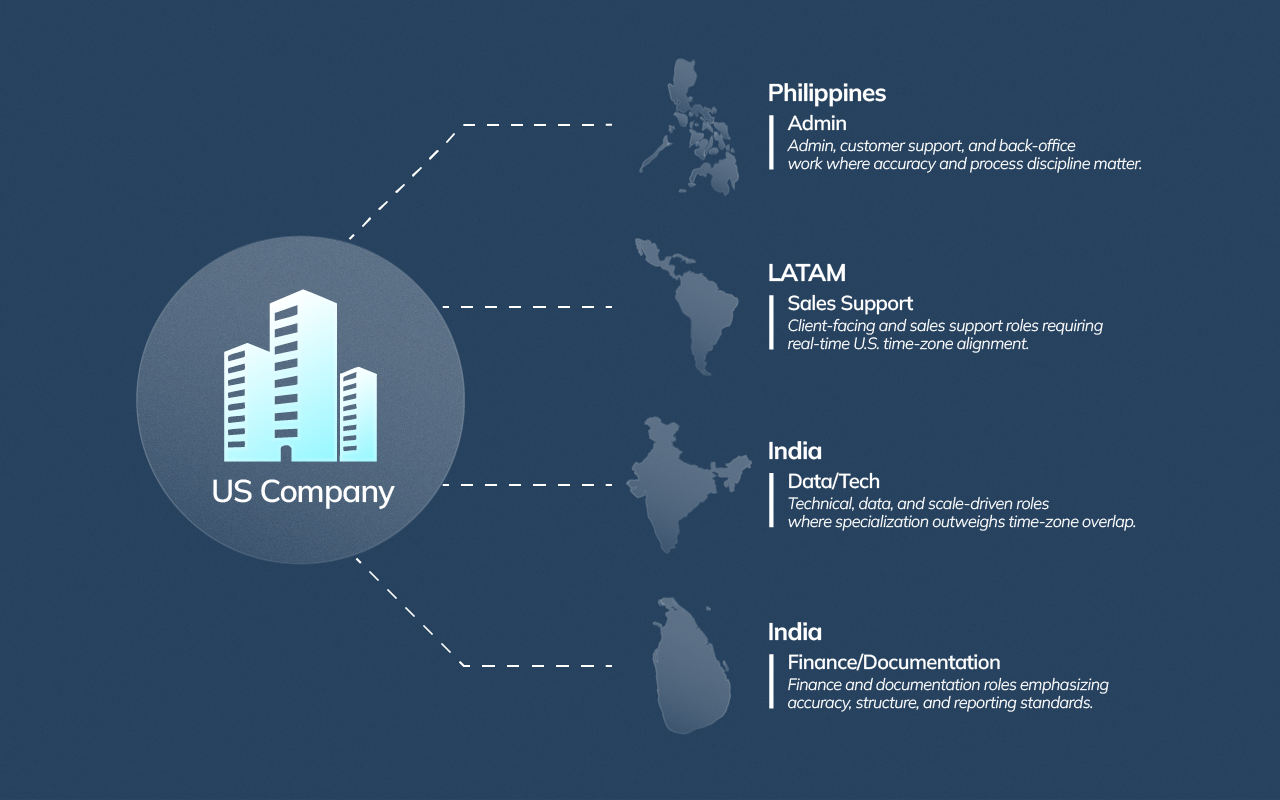
High-performing U.S. companies do not pick a single country and hope it works. They design role-based global hiring strategies that match talent markets to the type of work being done.
What separates winners from companies that struggle is not geography. It is how intentionally geography is used.
What Successful Teams Do Differently
Instead of asking, “Where is the cheapest place to hire a VA?” they ask, “Where does this role perform best over time?”
This leads to consistent patterns:
- Philippines for administrative support, documentation-heavy work, customer service, and back-office operations where accuracy, repetition, and process discipline matter most.
- Latin America for client-facing roles, sales support, and operational coordination that require real-time collaboration during U.S. business hours.
- India for scale, technical execution, and data-driven work where large talent pools and specialization are more important than time-zone overlap.
- Sri Lanka for targeted administrative, finance, and documentation-heavy roles where accuracy, structured workflows, and professional reporting standards matter more than rapid scale.
Why This Hybrid Model Works
Each region is optimized for different constraints:
- Time zone sensitivity
- Communication intensity
- Process complexity
- Cost tolerance
- Management overhead
By aligning roles to regions, companies reduce friction before it appears. Onboarding is faster. Performance is more predictable. Turnover decreases because expectations are realistic from day one.
This is especially critical as teams scale. A single-country model often breaks under growth pressure, while hybrid teams distribute risk across regions.
Designing the right global strategy is easier with the right partner.
Read more: Top Virtual Assistant Companies for U.S. Businesses
Hire Overseas Insider Insight on VA Hiring
The most common mistake we see is hiring based on country reputation rather than role design. When roles are misaligned, companies blame geography when the real issue is strategy.
The strongest global teams treat virtual assistants as part of a distributed operating system, not a labor arbitrage play. They build documentation, define success metrics, and place each role where it naturally performs best.
This approach is what enables scalable remote staffing without management overload. It is not about hiring more people. It is about hiring the right people, in the right places, for the right work.
Geography doesn’t fail, hiring systems do.
Read more: How to Hire a Reliable Virtual Assistant
Geography Is a Lever, Not the Strategy
There is no universally best country to hire virtual assistants from. There is only the right country for each role, workflow, and stage of growth.
The companies that consistently succeed with virtual assistant outsourcing do not optimize for geography alone. They design their workforce intentionally. They align roles with talent markets that support how the work actually gets done.
What sets top performers apart is focus on:
- Workforce design, not ad hoc hiring
- Clear systems and expectations that reduce friction across borders
- Cultural alignment that improves communication and trust
- Long-term retention, not short-term cost savings
When these elements are in place, hiring virtual assistants internationally stops being an experiment. It becomes a durable operating advantage that compounds as teams scale.
High-performing U.S. companies avoid trial and error by working with partners who understand how roles, regions, and workflows fit together. Hire Overseas helps businesses build role-based global teams by matching the right talent to the right markets from the start.
If you want to see how this approach works in practice, book a demo with Hire Overseas and get clear, role-specific recommendations for your team.
Frequently Asked Questions About Hiring Virtual Assistants by Country
Is it better to hire virtual assistants from one country or multiple countries?
Most scaling companies eventually move to a multi-country hiring model. Hiring from multiple regions allows businesses to align different roles with the markets where they perform best, reduce operational risk, and maintain flexibility as workloads grow. Single-country strategies often struggle as teams expand.
What are the biggest risks when hiring virtual assistants internationally?
The most common risks are not geographic—they are operational. These include unclear role definitions, lack of documentation, weak onboarding systems, and misaligned expectations. When companies design roles intentionally and match them to the right talent market, international hiring becomes highly predictable.
Are virtual assistants suitable for revenue-generating roles?
Yes, but only in specific regions and roles. Nearshore markets like Latin America and high-communication regions such as South Africa are often better suited for sales support, customer success, and client-facing work than lower-cost offshore markets focused on back-office execution.
What level of management oversight do virtual assistants require?
Well-matched virtual assistants require less oversight over time, not more. Initial structure is critical—clear KPIs, reporting rhythms, and communication norms—but once systems are in place, many international VAs operate with a high degree of autonomy comparable to in-house staff.
Can small businesses compete with large companies for top virtual assistant talent?
Yes. Top talent is often attracted to role clarity, stability, and growth opportunities, not just company size. Smaller U.S. businesses that offer well-defined roles and long-term intent frequently outperform larger companies that hire reactively or without structure.
Should I hire virtual assistants directly or through a staffing partner like Hire Overseas?
Direct hiring gives companies more control, but it also adds complexity around sourcing, vetting, compliance, payroll, and replacement—especially when hiring across multiple countries. This approach typically works best for companies with prior global hiring experience and established internal systems.
Staffing partners like Hire Overseas reduce execution risk by designing roles first, then matching each role to the strongest-performing country and talent pool. They handle recruiting, screening, and infrastructure, allowing U.S. companies to build distributed teams faster without management overload. This role-based approach minimizes trial-and-error and helps teams reach productivity sooner.
