


Most businesses don’t hire a project manager because they suddenly want structure.
They do it because growth starts creating friction.
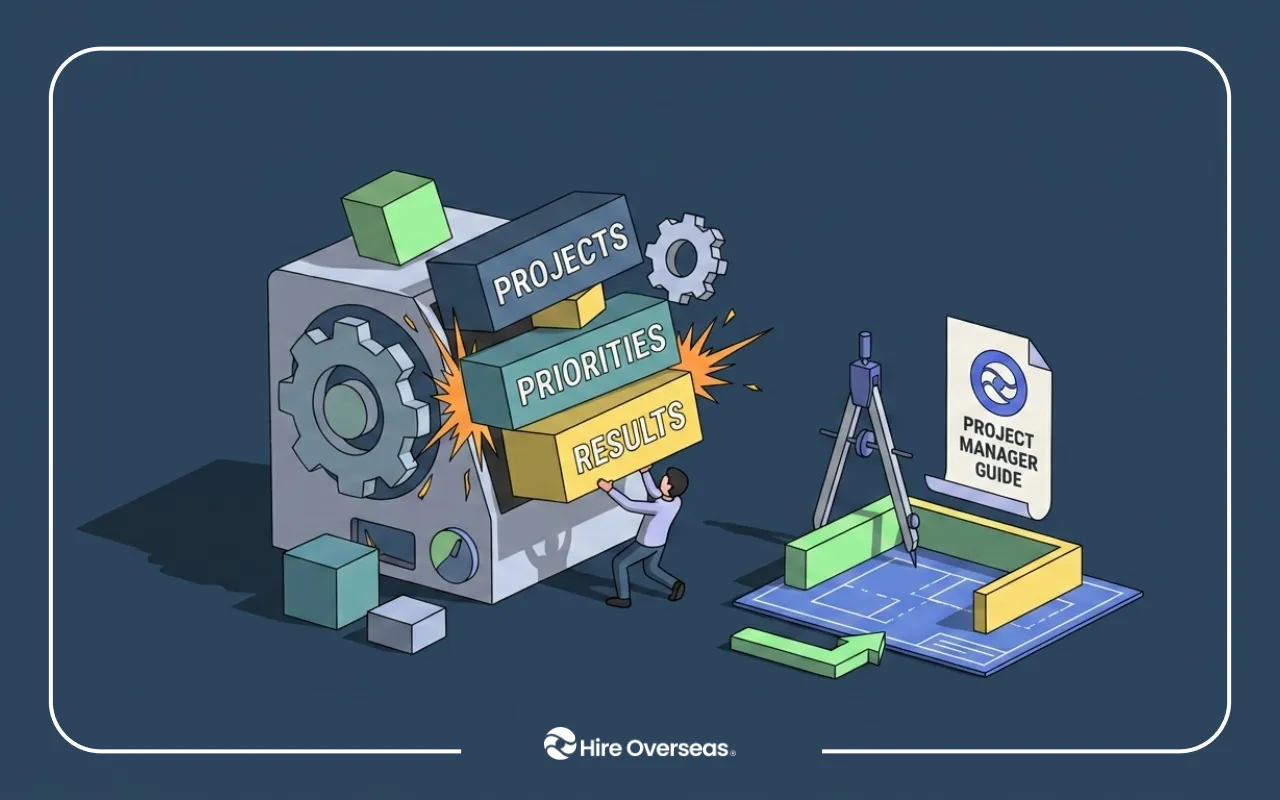
Projects stall. Priorities compete. Teams stay busy, but results feel inconsistent.
And at some point, you realize:
You are still the one holding everything together.
This guide explains how to hire a project manager, when your business actually needs one, and how this role changes execution inside growing teams.
Signs Your Business Needs a Project Manager
Most founders delay this hire.
They assume project management is something you add later, once the business is bigger.
But in reality, the need shows up much earlier, especially when growth starts adding complexity.
Work Is Happening, But Projects Keep Slipping
Tasks are getting done, but projects are not finishing.
At a glance, everything looks active. People are working, updates are happening, and progress feels constant. But when you zoom out, key initiatives keep getting delayed or losing momentum.
This usually means no one is actively managing:
- timelines
- dependencies
- ownership
- follow-ups
Work moves, but it does not move in the right sequence.
One delay affects another. Tasks get completed out of order. Priorities shift without alignment.
Without coordination, work stays fragmented and projects take longer than they should.
When you're ready to bring coordination tools into the mix alongside this hire, this comparison of collaboration tools for remote teams identifies which platforms actually reduce handoff delays versus which ones just add noise.
You Are Managing Execution Instead of Leading
If your day includes:
- checking progress
- reminding people
- coordinating across teams
- making sure things do not fall through
You are already acting as the project manager.
The problem is that this role was never meant to sit with the founder long-term.
It pulls you into:
- constant follow-ups
- small decisions
- operational details
This reduces your ability to focus on:
- strategy
- growth
- high-impact decisions
This is one of the clearest signs your business needs a project manager. Not because work is not getting done, but because you are the one keeping everything moving.
You Are Running Multiple Projects at Once
Growth introduces complexity faster than most teams expect.
You may be handling:
- launches
- hiring
- internal improvements
- client delivery
- marketing initiatives
Individually, each project is manageable.
But when they run at the same time, coordination becomes the problem.
Without a central owner:
- priorities compete
- deadlines overlap
- teams lose visibility
A project manager handles multiple projects at once by organizing priorities, mapping dependencies, and ensuring nothing stalls because of missed handoffs or unclear ownership.
If the product manager role is what your team actually needs instead — someone who owns the what and why rather than the how — this guide to hiring remote product managers walks through the key differences and the screening criteria that separate the two roles.
Team Productivity Feels Lower Than Expected
If your team is capable but output feels inconsistent, the issue is rarely effort.
It is usually coordination.
You may notice:
- tasks being completed, but not contributing to larger goals
- repeated questions about priorities
- delays caused by unclear ownership
- work needing revision due to misalignment
This is where project managers improve team productivity.
They create structure around how work moves:
- clarifying ownership so everyone knows what they are responsible for
- reducing confusion by aligning priorities across the team
- keeping deadlines visible so work stays on track
- ensuring follow-ups happen without constant reminders
The result is not just more activity, but more meaningful progress.
The Pattern Behind All These Signs
All of these issues point to the same underlying problem:
Execution is not being actively managed.
When no one owns coordination, the responsibility defaults to the founder or gets distributed across the team in an inconsistent way.
That works early on.
But as the business grows, it creates friction.
A project manager solves this by becoming the single point of accountability for execution, allowing the rest of the team to focus on their actual work.
What a Project Manager Actually Solves in a Growing Business
Most founders do not hire a project manager because they suddenly understand the role.
They hire because something starts breaking in how work gets done.
It usually looks like this:
- projects take longer than expected
- deadlines keep moving
- team members are busy but progress feels slow
- you are constantly following up to keep things moving
At that point, the problem is not effort.
It is execution.
The Real Problem: No One Owns Execution
In most small and growing businesses, work is distributed but not coordinated.
Everyone is responsible for their tasks.
But no one is responsible for:
- how tasks connect
- when things should happen
- what depends on what
- whether the project is actually moving forward
So what happens?
- tasks get done out of order
- work stalls between handoffs
- priorities shift without alignment
- projects lose momentum halfway through
This is where most execution breaks down.
If your team is already distributed across locations, the coordination gap gets even wider — this guide to managing global remote teams covers the specific handoff structures and async rituals that prevent exactly this kind of fragmentation.
What a Project Manager Actually Does Day to Day
A project manager becomes the person responsible for keeping work moving.
Not by doing the work themselves, but by managing how work flows.
That includes:
- turning goals into clear plans
- assigning ownership across the team
- setting timelines and milestones
- tracking progress consistently
- following up before things slip
- identifying blockers early
- keeping everyone aligned on priorities
Instead of work being reactive, it becomes structured.
What This Changes Inside the Business
When a project manager is in place, a few things shift quickly:
You stop asking:
- “What’s the status of this?”
- “Who’s handling this?”
- “Why is this delayed?”
Because the answers are already visible.
The team stops:
- waiting for direction
- duplicating work
- missing handoffs
Because expectations are clear.
Projects stop:
- dragging on
- restarting midway
- depending on constant reminders
Because someone is actively managing progress.
The Biggest Impact: You Stop Being the Coordinator
Before a project manager, the founder is usually the one holding everything together.
You are:
- checking progress
- reminding people
- connecting tasks across teams
- making sure nothing falls through
After hiring a project manager, that responsibility shifts.
You are no longer managing execution.
You are reviewing outcomes.
Why This Matters for Growth
As your business grows, execution gets more complex.
More people. More projects. More dependencies.
Without structure, this creates friction.
With a project manager:
- work moves faster
- timelines become more reliable
- the team operates with more clarity
- leadership can focus on higher-value work
The Bottom Line
A project manager does not add more work.
They make existing work easier to finish.
They solve the gap between:
- starting projects
and - actually completing them
And for most growing businesses, that gap is where time, revenue, and momentum are lost.
How to Hire a Project Manager (Step-by-Step for Growing Businesses)
Hiring a project manager does not need to be complex.
But it does need to be structured.
The goal is not just to fill a role.
It is to bring in someone who can immediately improve how work gets done.
Here is the step-by-step process.
Step 1: Identify Where Execution Is Breaking Down
Start with the problem, not the role.
Ask:
- Where are projects slowing down?
- What keeps getting delayed?
- Where am I constantly following up?
Look for patterns across your business.
This usually shows up in:
- missed deadlines
- unclear ownership
- stalled projects
- repeated coordination
This step defines why you need to hire a project manager.
Step 2: Define What the Project Manager Will Own
Do not hire a general “project manager.”
Define ownership clearly.
For example:
- manage all client delivery timelines
- coordinate internal launches
- oversee hiring and onboarding projects
- track execution across marketing and operations
The more specific the ownership, the faster they can contribute.
Step 3: Outline the Scope of Work
Now define what they will actually do day to day.
Include:
- planning and structuring projects
- assigning and tracking tasks
- managing timelines and deadlines
- coordinating across team members
- running updates or check-ins
- handling follow-ups
This becomes your project manager scope of work.
Step 4: Decide the Right Type of Hire
Choose based on your current needs:
- Part-time project manager → if you need structure but not full-time support
- Freelance or contract project manager → for short-term or specific projects
- Full-time project manager → if coordination is needed daily across multiple projects
- Remote project manager → if your team is distributed
Do not overhire. Match the role to your current level of complexity.
Step 5: Choose Where to Find a Project Manager
You have two main options:
- freelance platforms (Upwork, etc.)
- vetted providers or agencies
Freelance platforms require:
- sourcing
- screening
- vetting
Working with a partner like Hire Overseas simplifies this by giving you access to pre-vetted project managers matched to your needs.
Step 6: Vet for Execution, Not Just Experience
Do not focus only on resumes.
Instead, evaluate how they think and operate.
Ask:
- How do you manage multiple projects at once?
- How do you handle missed deadlines?
- How do you keep teams aligned?
You are looking for:
- structured thinking
- clear communication
- ownership mindset
Step 7: Use a Real Trial Task
Before committing, assign a small project or scenario.
For example:
- create a simple project plan
- organize tasks for a launch
- outline how they would manage a timeline
This shows how they actually work, not just what they say.
Step 8: Start With a Defined Project First
Do not hand over everything immediately.
Start with:
- one project
- one workflow
- one area of ownership
This allows you to:
- test fit
- refine expectations
- build trust
Step 9: Set Clear Expectations From Day One
Define:
- how progress is tracked
- how often updates happen
- what “on track” means
- what needs escalation
This prevents confusion and reduces oversight.
Step 10: Let Them Own Execution
This is where most founders struggle.
Once hired, avoid:
- stepping back into coordination
- overriding the system
- handling follow-ups yourself
If you do, the role loses its value.
The project manager should own execution flow.
You should focus on direction and decisions.
What to Remember
Hiring a project manager works when:
- ownership is clear
- scope is defined
- expectations are structured
Without that, even a strong hire will struggle.
With it, your business shifts from: reactive execution to consistent delivery.
This is what allows growing businesses to move faster without increasing chaos.
Hire Overseas Case Study: How a Project Manager Transforms Execution
At this point, the process to hire a project manager is clear.
But the real question is: What actually changes once the right person is in place?
Here is what that looked like for one growing business working with Hire Overseas.
Golden Egg Media: From Founder Bottleneck to Scalable Execution
As Golden Egg Media grew, execution started depending heavily on the founders.
They were managing timelines, coordinating teams, and running daily check-ins just to keep projects moving.
After hiring an offshore project manager through Hire Overseas, that changed.
- 20+ hours per week returned to founders
- 80% reduction in day-to-day involvement
- 100% of projects ran without constant oversight
The shift was simple:
Execution had a clear owner.
What This Shows
A project manager does not just support the team.
They remove the need for the founder to coordinate everything.
That is what creates real leverage.
Read the full case study here: How Golden Egg Built an Operations Backbone
You Don’t Need More Projects Started. You Need More Projects Finished
Most growing businesses don’t struggle with ideas.
They struggle with execution.
Projects start easily, but as complexity increases, finishing them becomes harder. More people are involved, priorities compete, and coordination starts depending on you.
That is where things slow down.
As seen in the Golden Egg case study, the shift does not come from adding more people. It comes from giving execution clear ownership.
Hiring a project manager is not about adding another role. It is about making sure work actually moves without constant follow-up.
When done right, a project manager:
- keeps projects on track
- reduces delays and confusion
- creates visibility across your team
This allows you to step out of day-to-day coordination and focus on growth.
If you want to avoid the time and risk of hiring on your own, Hire Overseas connects you with pre-vetted project managers matched to your business needs.
Book a call here and get matched with a project manager who can start improving execution immediately.
