


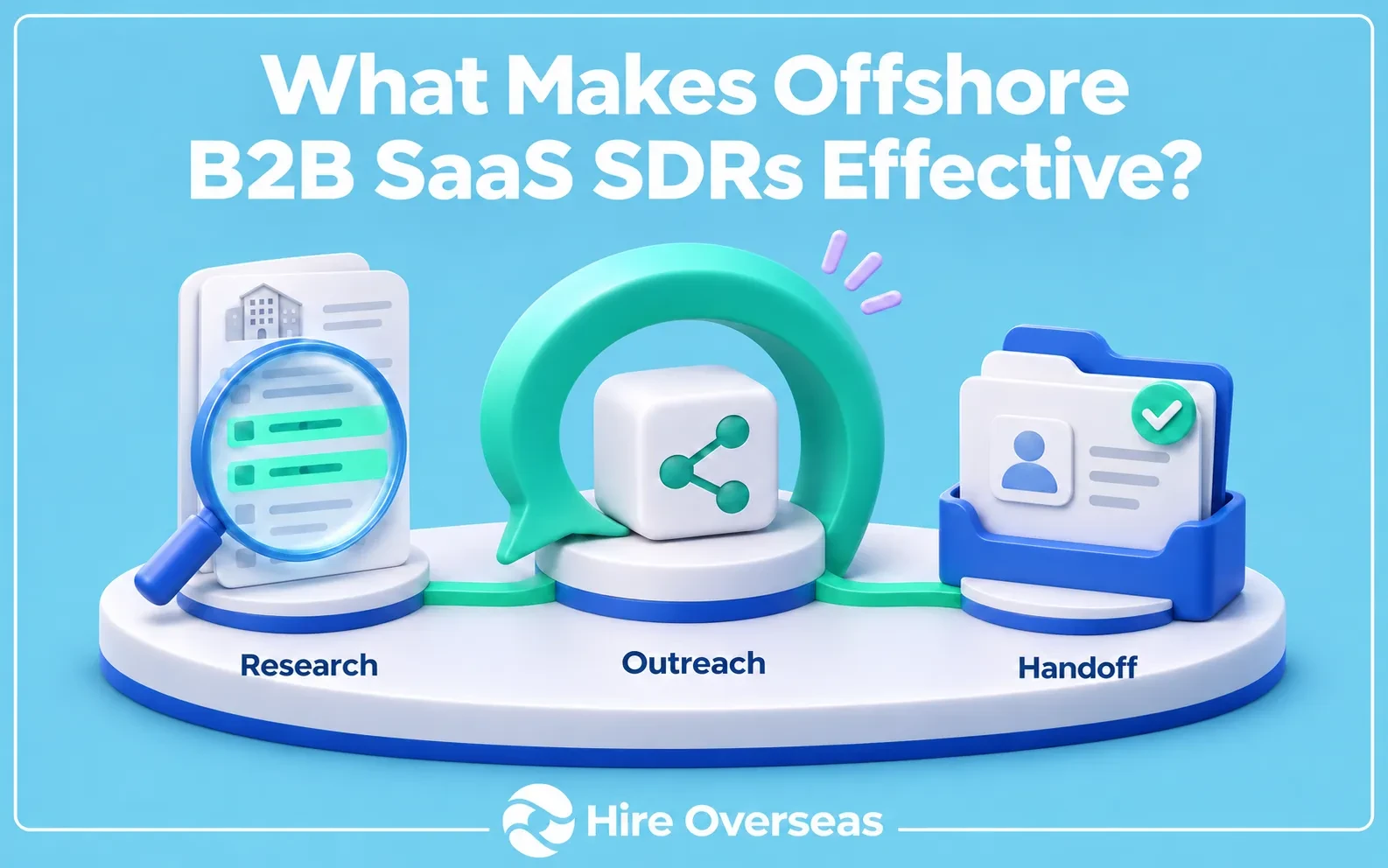
An offshore SDR should help your sales team reach suitable accounts, understand buyer needs, and start conversations worth continuing. A full calendar means little when prospects arrive without a relevant problem, or your account executives have to repeat the qualification work.
The SDR skills that matter most connect research, communication, technical understanding, and follow-through. Your rep needs to explain why your software deserves attention, use prospecting tools carefully, and give the next salesperson enough context to move the conversation forward.
At Hire Overseas, we build recruitment searches around your role, budget, and required working hours. For B2B SaaS teams, that brief should go beyond previous sales experience and identify the buyers, workflows, and responsibilities the person must handle.
What Makes a Good SDR in B2B SaaS?
For B2B SaaS, a good SDR connects a prospect’s situation to a relevant use case without promising outcomes the product cannot deliver. They ask useful questions, recognize poor-fit accounts, maintain accurate records, and secure a clear next step.
Look for evidence across five areas:
- Account judgment: Explains why a company and contact belong in the target segment.
- Buyer communication: Adjusts the conversation to the person’s responsibilities.
- Technical curiosity: Learns the product and recognizes questions requiring specialist input.
- Process discipline: Records facts, follows up, and respects account ownership.
- Coachability: Applies feedback to the next attempt.
Essential SDR Skills for Researching SaaS Accounts
Effective prospecting starts with a reason to contact an account. Give your SDR a defined ideal customer profile, including company characteristics, relevant roles, use cases, and disqualifying conditions.
The rep should distinguish verified facts from possible buying signals. A company hiring implementation specialists may be expanding its delivery team, but that does not prove it needs your onboarding software.
Connect Research to a Commercial Hypothesis
Ask the rep to explain the reasoning behind their outreach. Structure the assessment around three questions:
- What did you find? Identify a verified account fact.
- Why could it matter? Connect it to a relevant use case.
- What would you ask? Test the hypothesis with the buyer.
For example, a hiring announcement might support a question about onboarding capacity. It should not become an unsupported claim that the company has delivery delays or dissatisfied customers.
Prioritize Accounts Before Adding Contacts
A large contact list is not useful if the accounts fall outside your market. Have the SDR check company fit before spending time finding additional stakeholders.
For an assessment, provide ten sample accounts and ask the candidate to prioritize three. Score the reasoning, exclusions, and missing information, rather than rewarding whichever candidate collects the most names.
Write and Deliver Outreach That Gives Buyers a Reason to Respond
A relevant message connects the account research to a problem your product can address. Ask the SDR to explain why this person should consider a conversation now, using evidence appropriate to their role.
An operations leader may care about manual handoffs, while a technical evaluator may focus on implementation effort. Adapt the opening to the recipient’s responsibilities.
Keep Emails Specific and Easy to Answer
Give each message one clear purpose. Build it around three elements:
- Reason for contact: A verified detail relevant to the buyer.
- Potential relevance: A problem your product can address.
- Simple question: Something answerable without committing to a full evaluation.
An illustrative opening might read: “Your team is adding implementation roles. How are you keeping customer onboarding updates consistent as more people become involved?” This invites the buyer to confirm or reject the underlying hypothesis.
Review every personalized detail for accuracy. If AI assists with research or drafting, the SDR should check the original source and remove invented observations, unsupported benefits, and language that misrepresents the prospect’s situation.
Use Calls to Learn, Then Follow Up With Context
On calls, assess whether the rep can explain relevance briefly and give the prospect room to respond. Listening should change the next question, especially when the buyer’s actual problem differs from the initial research.
Follow-up should reflect what happened in the conversation. If the buyer requests information about implementation, send approved material addressing that topic and confirm the next step rather than restarting a generic pitch.
A practical writing test can pair a short call scenario with a follow-up email. Evaluate whether the candidate preserves the buyer’s meaning, answers the request, and avoids adding commitments that were never discussed.
Communicating With Technical Buyers Without Overpromising
Your SDR needs enough product knowledge to hold a credible opening conversation. For software sold to engineering, IT, or operations teams, that includes understanding the use case, implementation dependencies, and product boundaries.
Recognize When to Bring in a Specialist
Train the rep to distinguish documented capabilities from questions that require confirmation. Integration compatibility, deployment requirements, and product limitations should come from approved information.
A useful response is: “I’ll confirm that requirement with our technical team before the next conversation.” The SDR should then record the exact question and assign the follow-up, rather than leaving it in a call transcript.
Handle Objections Through Clarification
“We already use another solution” can mean satisfaction, concerns about switching, or simply low interest. The rep should ask one relevant follow-up before deciding whether there is a reason to continue.
Role-play an incumbent-tool objection and a technical question the candidate cannot answer. Assess listening, accuracy, and the proposed next step, including whether they recognize when to end the conversation respectfully.
Prospecting Tool Skills That Support Better Decisions
Tool familiarity matters when it improves research quality and execution. Your SDR should understand the information entering a workflow, the conditions controlling it, and how to check the result before expanding its use.
Separate everyday tool proficiency from responsibility for designing your entire outbound system. If the role includes complex automation ownership, make that requirement explicit in the hiring brief.
Data Enrichment and Conditional Logic
Enrichment tools can add company or contact information, while waterfall enrichment checks providers in a configured sequence. Conditional runs allow enrichment or other actions to execute only when specified conditions are met.
Ask candidates to walk through a small test before expanding a workflow. Look for these checks:
- Confirm account fit before searching for contact details.
- Inspect missing fields and conflicting company information.
- Check whether another salesperson already owns the record.
- Hold questionable results for review before importing them into outreach.
Assess how the candidate handles exceptions as well as successful results. The output should support the campaign’s targeting rules.
CRM Workflows and Follow-Up Ownership
CRM workflows can enroll records using defined triggers and perform actions such as creating tasks. Available triggers and actions depend on the platform, subscription, and permissions.
Assess whether the SDR understands the intended business rule. For example, when an eligible lead reaches an agreed qualification status, the workflow could create a follow-up task for the responsible person.
The rep should confirm ownership, required fields, and repeat-enrollment behavior with the workflow administrator. For the hiring exercise, ask the candidate to describe the trigger, action, and exceptions in plain language.
SDR-to-AE Handoffs That Preserve Buyer Context
A booked meeting should come with enough information for the account executive to prepare. Agree on the qualification standard before asking an SDR to deliver qualified opportunities.
Use a short handoff format that captures:
- Account and contact: Company fit, buyer role, and relevant stakeholders.
- Current situation: The workflow or approach the prospect described.
- Problem and impact: What needs attention and why it matters.
- Timing: Any stated deadline, trigger, or evaluation window.
- Open questions: Technical requirements and information still unconfirmed.
- Next step: Meeting purpose, attendees, owner, and agreed follow-up.
Keep assumptions separate from confirmed statements. “Budget unknown” gives the AE a more accurate starting point than a guessed figure entered to complete a field.
An illustrative handoff might identify manual onboarding updates as the problem and integration compatibility as an open question. It should also state what the buyer agreed to discuss next.
Have the AE accept the handoff or record a specific rejection reason. Review recurring gaps together so the SDR can improve qualification rather than simply increase booking volume.
SDR KPIs That Show Where Performance Breaks Down
Use SDR KPIs to connect activity with meeting quality and pipeline progression. Define each metric in writing so everyone evaluates the same outcomes. These suggested definitions are not universal targets.
Read Conversion Rates With Their Denominators
Report raw counts alongside percentages. Two accepted handoffs out of three provide much less evidence than twenty out of thirty.
Consider this illustrative meeting cohort:
- Meetings due: 12.
- Meetings held: 9, giving a 75% attendance rate.
- Held meetings meeting acceptance criteria: 6, or about 67% of held meetings.
Label the last measure separately from acceptance across all submitted handoffs. Different denominators answer different questions.
Compare similar segments and allow time for opportunities to develop. Closed revenue can inform the review, but it also depends on AE execution, product fit, pricing, and the buying process.
Remote Working Skills That Keep Outbound Moving
An offshore SDR needs clear ownership of the work between live conversations. Agree on coverage hours, response expectations, and how the rep should escalate questions when a manager or account executive is unavailable.
Keep end-of-shift updates focused on what needs attention:
- Active conversations: Buyer requests and the next promised response.
- Outstanding actions: Overdue work, its owner, and the recovery plan.
- Decisions needed: Questions blocking progress and who can resolve them.
Assess independent judgment with a realistic scenario: a prospect requests a technical answer while the AE is offline. The rep should acknowledge the request, capture the requirement, route it to the right person, and communicate a realistic follow-up expectation.
Reliability also means raising problems early. An SDR should flag missing account data, conflicting instructions, or a broken workflow before those issues affect a larger batch of prospects.
Turn SDR Skills Into a Practical Hiring Scorecard
Use the same brief, materials, and scoring criteria for every finalist. Give candidates enough product information to complete these exercises:
Then provide one specific piece of feedback and ask for a revision. The response shows whether the candidate can translate coaching into changed behavior.
After hiring, agree on an initial review period covering product learning, workflow accuracy, and supervised outreach. Review call quality and handoff completeness alongside activity, then set performance expectations using your actual segment and campaign results.
Hire an Offshore SDR Around the Skills Your SaaS Team Needs
An effective offshore SDR gives your sales team relevant conversations and usable buyer context. Research judgment, accurate product communication, disciplined tool use, and dependable handoffs should guide the hiring decision.
At Hire Overseas, we recruit dedicated offshore SDRs through searches matched to your role, budget, and time zone. You interview shortlisted candidates before deciding who joins your team.
Our typical dedicated SDR service costs $2,400–$3,400/month, including talent, HR, payroll, and compliance. Quotes reflect the seniority, tools, and working hours required, with flexible month-to-month terms and a forever replacement policy.
Product capabilities were checked against Clay documentation on waterfalls, enrichments, and conditional runs, plus HubSpot documentation on workflow enrollment triggers and actions. We cross-checked role definitions against Salesforce sales-development and lead-qualification resources. On November 11, 2026, we checked Hire Overseas recruitment coverage, service pricing, inclusions, and terms against our website and SDR service page. Assessment exercises, workflow scenarios, and KPI examples are editorial recommendations or illustrations, not performance benchmarks or client results.
