


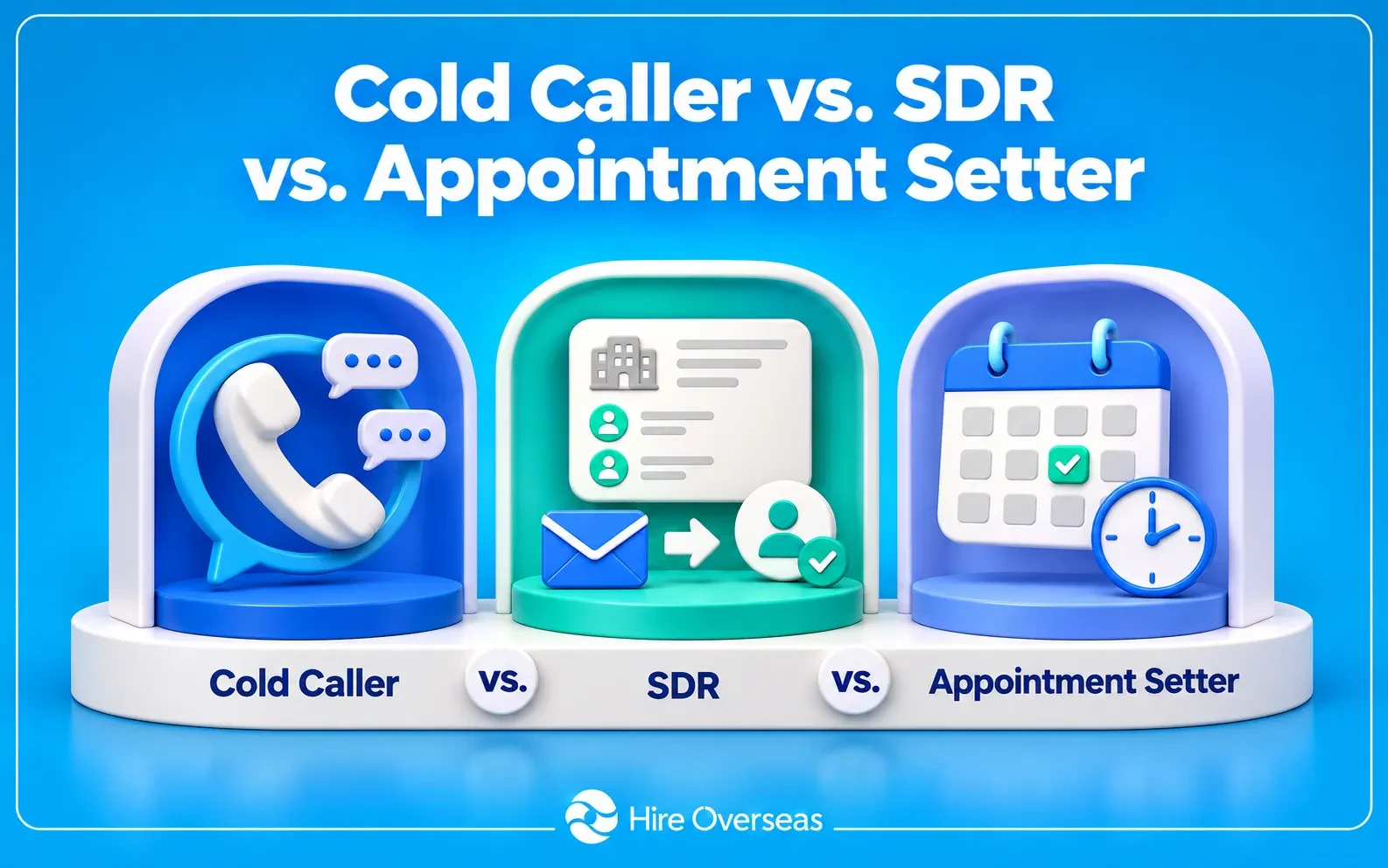
Hire a cold caller first if you have a target list and need more live conversations. Hire an appointment setter if leads already come in and too few make it to a qualified meeting. Hire a sales development representative (SDR) if someone needs to research accounts, run outreach across channels, and qualify prospects before handing them to a closer.
At Hire Overseas, we recruit for all four roles. We start with what your team can already do consistently. A founder who closes deals but cannot make enough calls needs a different hire from a team that books plenty of demos and regularly finds the wrong buyer on the call.
Cold Caller vs. SDR vs. Appointment Setter
The roles overlap at the top of the sales funnel. The difference is what each person owns before the lead moves on. Use the expected output to write the job description and decide what you’ll measure after the hire.
Our typical dedicated placement rates in U.S. dollars are $2,400–$3,400/month. They include talent, HR, payroll, and compliance support for the placement. Your quote depends on the required scope and experience. Set activity and output targets based on your lead volume, contact rates, and qualification criteria.
SDR vs. BDR in Sales
An SDR qualifies prospects and creates opportunities for the sales team. The role can cover inbound leads, outbound prospecting, or both. On a split team, an inbound SDR follows up with leads from marketing and checks whether they’re ready for a sales conversation.
A BDR in sales often opens conversations with net-new accounts. For example, a BDR targeting regional logistics companies might identify operations leaders, find a reason to reach out, and work multiple contacts before arranging an introduction. An outbound SDR can do the same work. When interviewing, ask candidates to describe who selected their accounts, how they qualified prospects, and what happened after they booked a meeting.
Specializing in prospecting and closing gives each person a distinct part of the sale to own. The SDR or BDR gets a qualified prospect to the handoff. The account executive (AE) runs deeper discovery, leads demos or proposals, negotiates, and closes. A full-cycle AE handles prospecting through close.
When a Cold Caller Should Be Your First Hire
- When to hire: You know who to call, have a clear offer, and need more live conversations to test or expand a working pitch.
- What they own: A commercial cleaning company might give the caller a list of local facilities managers. The caller verifies who handles vendor decisions, asks when contracts come up for renewal, and passes promising callbacks to the owner with enough context to follow up.
- What to measure: Define what counts as a connect, then track connect rate, relevant conversations, and useful handoffs. Review calls alongside the numbers. A low connect rate warrants checking list quality or calling windows. Frequent connects with few useful handoffs point to the pitch or audience as places to investigate.
When an Appointment Setter Should Be Your First Hire
- When to hire: Leads show interest, but too few make it to a qualified meeting. A setter can also work a cold list when the priority is moving interested prospects to an appointment. If your main need is to start more conversations, a cold caller is the better fit.
- What they own: A home services company may have steady quote requests that its technicians and office staff struggle to keep up with. A setter can return those inquiries, confirm service areas, book estimates, and handle confirmations or rescheduling. Give the setter clear booking rules and a contact for when a request falls outside them.
- What to measure: Track speed-to-lead from inquiry to first contact attempt, and use qualified meetings held as the primary measure. Calculate show rate by dividing meetings held by meetings scheduled to take place in the same period. Apply a consistent rule for cancellations and reschedules.
When an SDR Should Be Your First Hire
- When to hire: Reaching the right buyer takes account research, multiple outreach attempts, and judgment about which prospects are ready for a sales conversation.
- What they own: An SDR at a B2B SaaS company targeting finance teams might identify businesses with a relevant workflow, find contacts in finance and operations, and use calls and email to learn how those teams handle the problem today.
- What to hand off: Agree on what the account executive (AE) needs before accepting a handoff. For a straightforward offer, capture the buyer’s need, who makes the decision, and when they want to act. For a more complex deal, document the initial problem and the contact’s role. That gives the AE a place to start deeper discovery about buying criteria and the decision process without asking the buyer to repeat the first conversation.
- What to check before committing budget: Consider average contract value and sales cycle length. A longer sales cycle can justify more research and follow-up when the expected contract value supports the work. If you’re still testing product-market fit or frequently changing your target buyer, keep those conversations founder-led until you know which buyers engage and why.
Should You Hire an SDR Before an Account Executive?
Hire the SDR first if a founder or current AE can reliably take qualified meetings and close, but spends too much time sourcing the next conversation. If good opportunities already sit untouched after discovery or proposals stall because no one owns follow-up, prioritize closing capacity. A full-cycle AE can make sense when you need someone to prospect and close while you establish a repeatable sales process.
Review the last month of sales activity before you decide. Count the target accounts reached, qualified meetings held, opportunities accepted, and deals still waiting on a next step. Read a few records from the stage where work piles up. The notes can reveal whether you need someone to generate more activity, improve qualification, or keep active deals moving.
How to Budget for Your First Outbound Sales Hire
Start with the monthly cost, then compare how much work your team will manage and what each option costs per result.
Step 1. Calculate the Full Monthly Cost
For an in-house rep, include compensation, employer costs, software, prospect data, and management time. For a dedicated offshore hire, check what the placement fee covers and add the costs your team will carry, such as tools, data, and coaching.
Step 2. Decide Who Will Manage the Work
An outsourced appointment-setting agency can run the campaign. If it charges per meeting, agree on what counts as a qualified meeting, how no-shows are billed, and who owns the campaign data.
A freelancer can help with a smaller trial if your team can handle screening, onboarding, and supervision. An employer of record can administer local employment for someone you’ve already selected, while your team manages the sales work.
Step 3. Calculate the Cost per Result
Choose a measure that reflects what you’re hiring for. If an appointment setter costs $2,800/month and tools and data add $300/month, your monthly spend is $3,100 before internal management time.
- Cost per qualified meeting held. $3,100 ÷ 12 meetings = about $258 per meeting.
- Cost per accepted opportunity. If sales accepts six of those meetings as opportunities, $3,100 ÷ 6 = about $517 per opportunity.
Use your actual results to set quotas or decide whether to expand the team.
How to Interview a Cold Caller, Appointment Setter, or SDR
Give each candidate an exercise based on a decision they’ll make on the job. Use a fictional prospect and give candidates for the same role the same brief. Decide beforehand what a good response would contain so you can compare how each candidate handles the situation.
- Cold caller: Give the candidate a short pitch and play a prospect who says they already have a vendor. Listen for how the candidate acknowledges the response, asks a relevant follow-up, and closes the call. Then ask them to write the note they’d leave for the next caller. It should capture what the prospect actually said and any next step they agreed to.
- Appointment setter: Give the candidate a small queue with a new inquiry, a prospect who needs to reschedule, and a request that falls outside your booking rules. Ask which they’d handle first and have them draft a confirmation for one eligible appointment. Check whether they follow the rules and make it clear what the prospect should expect at the meeting.
- SDR: Provide a brief account profile and two potential contacts. Ask whom they’d approach first, what they’d say, and what they would need to learn before involving sales. Look for a reason to contact that person and a clear distinction between what the candidate knows about the account and what they still need to confirm.
After the exercise, coach one specific point and ask the candidate to try that part again. For example, have the setter revise a vague meeting confirmation so the prospect knows who will attend and what will be discussed. The revision shows how the candidate applies feedback they’re likely to get during ramp.
Hire for the Work Your Sales Team Needs Covered
Start where prospects get stuck. If too few buyers are hearing your offer, hire a cold caller to start more conversations. If interested leads rarely make it to a qualified meeting, hire an appointment setter to own follow-up and scheduling. If reaching the right buyer takes account research, several touches, and careful qualification, hire an SDR.
Before you open the search, review a few recent leads with the person who will take the handoff. Agree on what the new hire should deliver in a typical week and what information the sales team needs to take the next step. Those examples give you a clearer hiring brief and a practical way to coach the rep from day one.
We recruit dedicated cold callers, appointment setters, and SDRs around your buyers, coverage hours, and sales process. We handle recruitment, HR, payroll, and placement compliance support while your team directs the sales work.
Hire Overseas’ four role pages supplied rate and service details. Salesforce’s Rules of Engagement for Inbound and Outbound informed the role definitions, and Aaron Ross and Marylou Tyler’s Predictable Revenue informed the discussion of sales specialization. Time and Date and GOV.UK informed schedule examples. Budget figures are illustrative.
