


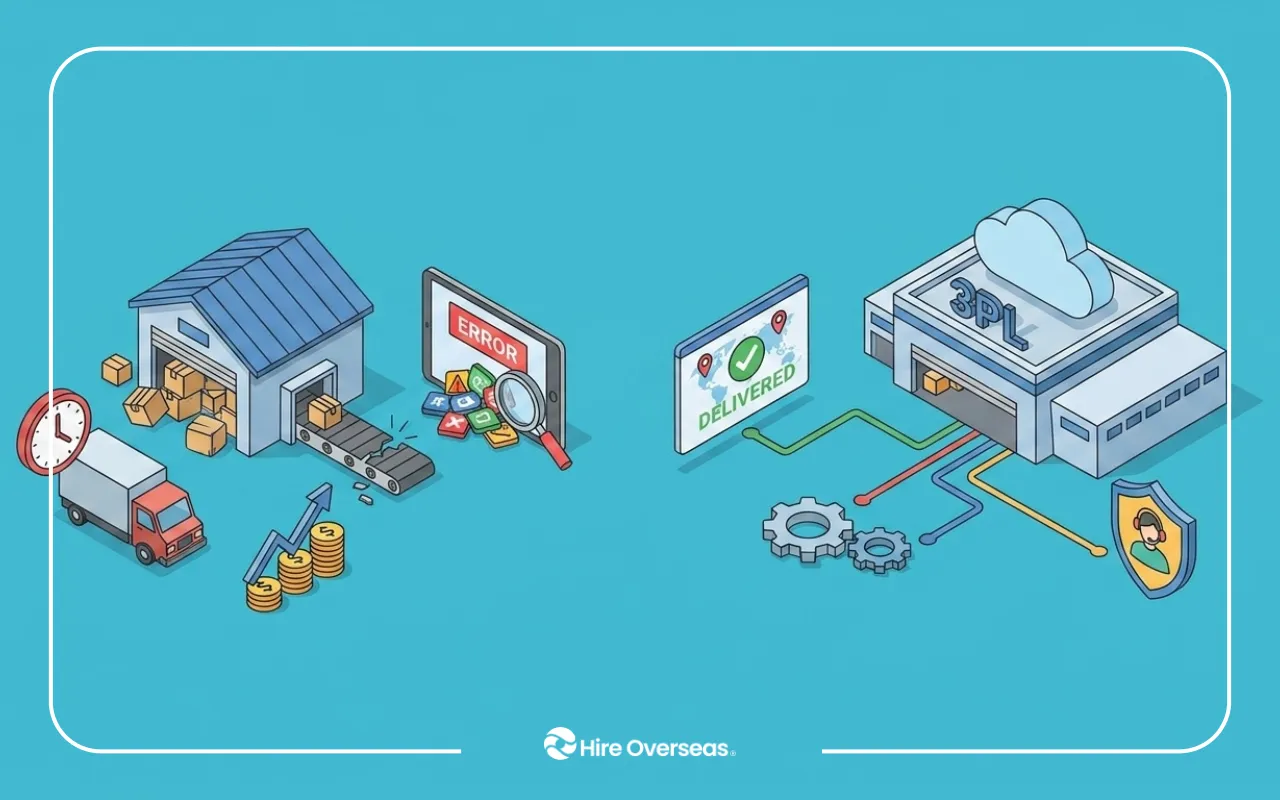
Managing fulfillment internally becomes increasingly difficult as businesses grow. Shipping delays, inventory issues, rising warehouse costs, and multi-channel complexity can quickly create operational bottlenecks. This is why many DTC and B2B brands now use third party logistics services to scale fulfillment more efficiently. But choosing the right 3PL model is no longer just about warehousing. Businesses also need operational visibility, vendor coordination, and reliable logistics support behind the scenes. This guide explains how modern 3PL services work, when businesses should outsource logistics, typical pricing structures, and how brands build more scalable fulfillment operations today.
What Third Party Logistics Services Are and Why Businesses Use Them
Third party logistics services, often called 3PL services, are outsourced logistics solutions that help businesses manage fulfillment, warehousing, shipping, inventory, and supply chain operations through external providers.
Instead of operating warehouses and fulfillment systems entirely in-house, businesses partner with third party logistics providers to handle operational logistics functions more efficiently.
Modern third-party logistics services commonly include:
- Warehousing and inventory storage
- Pick, pack, and shipping fulfillment
- Freight and transportation coordination
- Returns and reverse logistics
- Inventory management systems
- Multi-channel ecommerce fulfillment
- B2B and retail distribution support
For ecommerce and B2B brands, fulfillment complexity often increases faster than expected as order volume grows.
Businesses commonly experience:
- Shipping delays
- Inventory inaccuracies
- Rising warehouse overhead
- Customer service issues tied to fulfillment
- Multi-channel operational complexity
- Internal operations teams becoming overloaded
This is why outsourced logistics services have become increasingly common across:
- DTC ecommerce brands
- Amazon sellers
- Wholesale and B2B companies
- Subscription businesses
- Multi-channel retailers
- High-SKU ecommerce operations
The goal is not simply outsourcing shipping.
The goal is building a fulfillment operation that can scale without creating operational bottlenecks internally.
What Modern 3PL Logistics Solutions Typically Cover
Modern 3pl logistics solutions now go far beyond warehousing alone.
Many third party logistics fulfillment services provide:
- Real-time inventory visibility
- Automated order routing
- Distributed fulfillment networks
- Carrier rate optimization
- Retail compliance support
- Returns processing systems
- ERP and ecommerce integrations
This allows businesses to improve delivery speed, reduce operational overhead, and support growth across multiple sales channels more efficiently.
Why Businesses Outsource Fulfillment Operations
For many brands, fulfillment eventually becomes an operational coordination problem rather than simply a warehouse problem.
As businesses scale, internal teams often spend increasing time managing:
- Shipment tracking
- Carrier communication
- Inventory reconciliation
- Vendor coordination
- Returns management
- Customer fulfillment issues
At a certain stage, managing logistics internally can slow down growth more than support it.
This is often the point where businesses begin evaluating third party logistics companies and outsourced fulfillment services as a more scalable operational model.
For businesses trying to understand when internal operations have hit the point where outsourcing starts making more financial sense than absorbing the overhead, this practical guide to reducing operational costs across growing businesses covers how companies restructure workflows and external support before inefficiencies compound further.
Common Third Party Logistics Outsourcing Models Businesses Use
Once businesses decide to outsource fulfillment and logistics operations, the next challenge becomes choosing the right outsourcing structure.
Not every company needs the same type of logistics support.
Some businesses need fully managed warehousing and nationwide fulfillment infrastructure. Others need freight coordination, customer support, or operational assistance around existing logistics systems.
This is why logistics outsourcing has evolved into several different models.
Fully Managed 3PL Providers
This is the most traditional third party logistics outsourcing model.
Businesses outsource warehousing, fulfillment, shipping, and returns management directly to third party logistics providers.
Popular third party logistics companies include:
Why Businesses Use This Model
- Faster fulfillment scalability
- Access to warehouse infrastructure
- Nationwide or global shipping networks
- Reduced internal warehouse overhead
- Carrier and freight optimization
Main Limitation
As businesses scale, many realize fulfillment challenges extend beyond warehousing itself. Operational coordination, reporting, customer communication, and vendor management can still create bottlenecks internally.
Logistics BPO Providers
Countries such as the Philippines, India, Mexico, Colombia, and Eastern European outsourcing hubs have become increasingly important for logistics and supply chain support operations because of strong operational staffing infrastructure, multilingual support, and global coverage capabilities.
Many businesses use logistics BPO providers for:
- Shipment tracking
- Freight coordination
- Customer support
- Dispatch operations
- Inventory reporting
- Returns communication
- Logistics system updates
Why Businesses Use This Model
- Lower operational labor costs
- Easier access to large support teams
- 24/7 operational and customer coverage
- Faster scaling for logistics support functions
- Multilingual support capabilities
- Established enterprise operational processes
Main Limitation
Traditional logistics BPO structures often prioritize process scalability and volume support, but businesses may have less flexibility, visibility, and direct operational integration compared to more dedicated support models.
For companies comparing outsourced logistics support vs. fully managed BPO structures, this offshore staffing agency guide explains how dedicated offshore operational teams integrate directly into existing workflows without replacing your current systems.
Freight Forwarding and Transportation Outsourcing
Some businesses outsource freight movement and transportation coordination separately from warehousing and fulfillment.
This model is commonly used by companies managing:
- International shipping
- Supplier imports
- Container freight
- Customs clearance
- Multi-country distribution
- Freight carrier coordination
Popular freight forwarding and transportation providers include:
Why Businesses Use This Model
- Better international shipping coordination
- Access to global freight networks
- Customs and compliance support
- Carrier optimization
- Reduced transportation complexity
Main Limitation
Freight forwarding providers usually focus on transportation movement rather than full operational logistics management, so businesses may still need internal coordination support across vendors, warehouses, and fulfillment workflows.
Ecommerce Marketplace Fulfillment Models
Some ecommerce brands outsource fulfillment directly through marketplace ecosystems instead of standalone third party logistics providers.
This model is especially common for businesses selling through:
- Amazon
- Walmart Marketplace
- TikTok Shop
- Shopify marketplaces
- Multi-channel ecommerce platforms
Popular marketplace fulfillment providers include:
Why Businesses Use This Model
- Faster marketplace fulfillment setup
- Access to marketplace shipping infrastructure
- Improved delivery speeds
- Marketplace compliance support
- Easier multi-channel fulfillment scaling
Main Limitation
Marketplace fulfillment systems often create less operational visibility and flexibility compared to dedicated fulfillment structures, especially for brands managing multiple sales channels or custom logistics workflows.
Offshore Operations Support Models: A More Flexible Alternative for Growing Brands
Many businesses eventually realize that fulfillment challenges are not solved entirely by warehousing or shipping providers alone.
As logistics operations scale, brands often need additional support around:
- Shipment coordination
- Inventory reporting
- Vendor communication
- Returns management
- Freight tracking
- ERP and CRM updates
This is why Offshore Operations Support Models are becoming a more flexible alternative to traditional logistics outsourcing.
Instead of outsourcing entire logistics departments, businesses build dedicated operational support teams around existing fulfillment systems and third party logistics partners.
Why Offshore Operations Support Models Are Becoming More Popular
Many businesses eventually realize that logistics success depends not only on warehouses and shipping providers, but also on the operational systems coordinating fulfillment every day.
As logistics operations grow, businesses increasingly need support for:
- Shipment tracking
- Vendor coordination
- Inventory reporting
- Returns management
- Freight communication
- ERP and CRM updates
Instead of outsourcing everything to large enterprise providers, businesses are building flexible operational support teams around existing logistics systems. This gives companies more visibility, scalability, and operational control while keeping costs manageable.
This model works especially well for businesses already using:
- Shopify
- NetSuite
- ShipStation
- Amazon Seller Central
- SAP
For example:
- A DTC brand may add a logistics virtual assistant for shipment tracking and returns coordination.
- A scaling ecommerce company may add inventory reporting and vendor coordination support around existing 3PL providers.
Providers like Hire Overseas support this by helping businesses build dedicated logistics virtual assistants and operational support teams that integrate directly into existing fulfillment workflows.
For companies already using platforms like Shopify or Amazon Seller Central and wondering which roles to hire first around those systems, this insider checklist for hiring remote talent overseas walks through how experienced operators structure offshore support before scaling to avoid the compliance and coordination mistakes most businesses make early.
Hire Overseas Tips: How Businesses Actually Transition to Offshore Operations Support Models
Many businesses think logistics outsourcing starts with replacing warehouses or switching 3PL providers.
In reality, most successful transitions start by removing operational bottlenecks that internal teams can no longer manage efficiently.
At Hire Overseas, we usually see businesses transition into Offshore Operations Support Models after specific operational breakdowns start appearing repeatedly.
Ecommerce Brands Usually Transition After Customer Support Becomes a Logistics Team
What usually happens:
A Shopify or Amazon brand grows to 300–1,000+ orders daily. Suddenly, customer support agents spend most of their day checking tracking numbers, escalating warehouse delays, and resolving “Where is my order?” tickets manually.
At this stage, businesses often make the mistake of hiring more customer support agents instead of fixing the logistics coordination layer itself.
What High-Performing Brands Commonly Do Instead:
They build a dedicated logistics support layer separate from customer service.
Usually:
- 1 logistics VA monitors delayed shipments daily
- 1 operations support role handles warehouse escalations
- Customer support only communicates finalized updates to customers
This prevents support teams from becoming overwhelmed by fulfillment coordination work.
Practical Tip:
Many brands create a “shipment exception workflow” first before hiring.
This usually includes:
- Orders delayed beyond X days
- Lost shipment escalation process
- Refund approval rules
- Warehouse escalation contacts
- Carrier response timelines
Businesses that standardize this early usually scale support much faster.
Multi-Warehouse Businesses Usually Break at Inventory Visibility First
What usually happens:
A business starts using multiple warehouses, Amazon FBA, retail inventory, and Shopify fulfillment simultaneously.
Inventory numbers stop matching across systems.
Operations teams begin manually checking spreadsheets, warehouse portals, and marketplace dashboards daily.
This often creates:
- Overselling
- Stockout surprises
- Delayed purchase orders
- Fulfillment confusion across channels
What Scaling Brands Commonly Do Instead:
They add offshore operations support focused only on daily reconciliation workflows.
Usually:
- One support role checks inventory mismatches every morning
- Another updates ERP or inventory systems
- Operations managers only handle major exceptions
Practical Tip:
The businesses that scale logistics cleanly usually stop relying on warehouses as the “source of truth.”
Instead, they assign dedicated support ownership around:
- Inventory audits
- Daily discrepancy reporting
- Marketplace inventory sync checks
- Reorder threshold monitoring
This reduces operational surprises significantly.
B2B and Freight-Heavy Businesses Usually Transition After Internal Teams Become Too Expensive for Coordination Work
What usually happens:
A distributor or freight-heavy company realizes highly paid operations staff spend hours every day:
- Chasing carrier updates
- Updating spreadsheets
- Following up on shipment statuses
- Sending freight documents
- Updating ERP records manually
The issue is not lack of logistics infrastructure.
The issue is expensive internal labor being consumed by repetitive coordination work.
What Enterprise Operations Teams Commonly Do Instead:
They move repetitive logistics coordination into dedicated offshore operational support first.
Usually:
- Freight tracking gets assigned offshore
- Documentation workflows move offshore
- Shipment monitoring gets centralized
- Internal managers only handle escalations and strategic decisions
Practical Tip:
Many businesses transitioning successfully start with logistics reporting first because it exposes operational inefficiencies immediately.
For example:
- Which warehouse creates the most delays
- Which carriers create repeated shipment exceptions
- Which SKUs generate the most returns
- Which channels create fulfillment bottlenecks
Once reporting becomes visible consistently, scaling support becomes much easier operationally.
Key Takeaway From Businesses Scaling Logistics Successfully:
One pattern appears consistently across successful transitions:
Businesses that offshore repetitive operational coordination first usually scale logistics more efficiently than businesses trying to outsource entire operations immediately.
This is one reason many companies partner with Hire Overseas.
Instead of replacing existing 3PL providers or warehouse systems entirely, businesses build dedicated operational support structures around existing fulfillment workflows first, then expand support gradually as logistics complexity increases.
For ecommerce brands realizing their customer support team has quietly become a logistics coordination team, this guide on what outsourced administrative services actually fix inside growing operations explains how to separate coordination workflows from customer-facing roles before the bottleneck becomes structural.
More Businesses Are Moving Toward Hybrid Logistics Support Models
The way businesses scale logistics operations is starting to change.
Instead of choosing between fully in-house fulfillment or completely outsourcing operations to large third party logistics providers, many growing companies are now building hybrid support models around their existing logistics systems.
This gives businesses more flexibility as fulfillment complexity increases.
Warehouses and 3PL providers still handle shipping and infrastructure, but dedicated operational support teams help manage the coordination behind the scenes, including shipment tracking, vendor communication, inventory reporting, returns workflows, and logistics administration.
For many ecommerce brands and B2B businesses, this creates a more scalable way to grow fulfillment operations without continuously increasing internal operational overhead.
Hire Overseas helps businesses build dedicated logistics virtual assistants and operational support teams that integrate directly into existing fulfillment workflows and third party logistics providers.
If your business is scaling faster than your current logistics coordination process can support efficiently, book a call with Hire Overseas to explore a more flexible operational support structure for your fulfillment operations.
