


Key Summary (TL;DR)
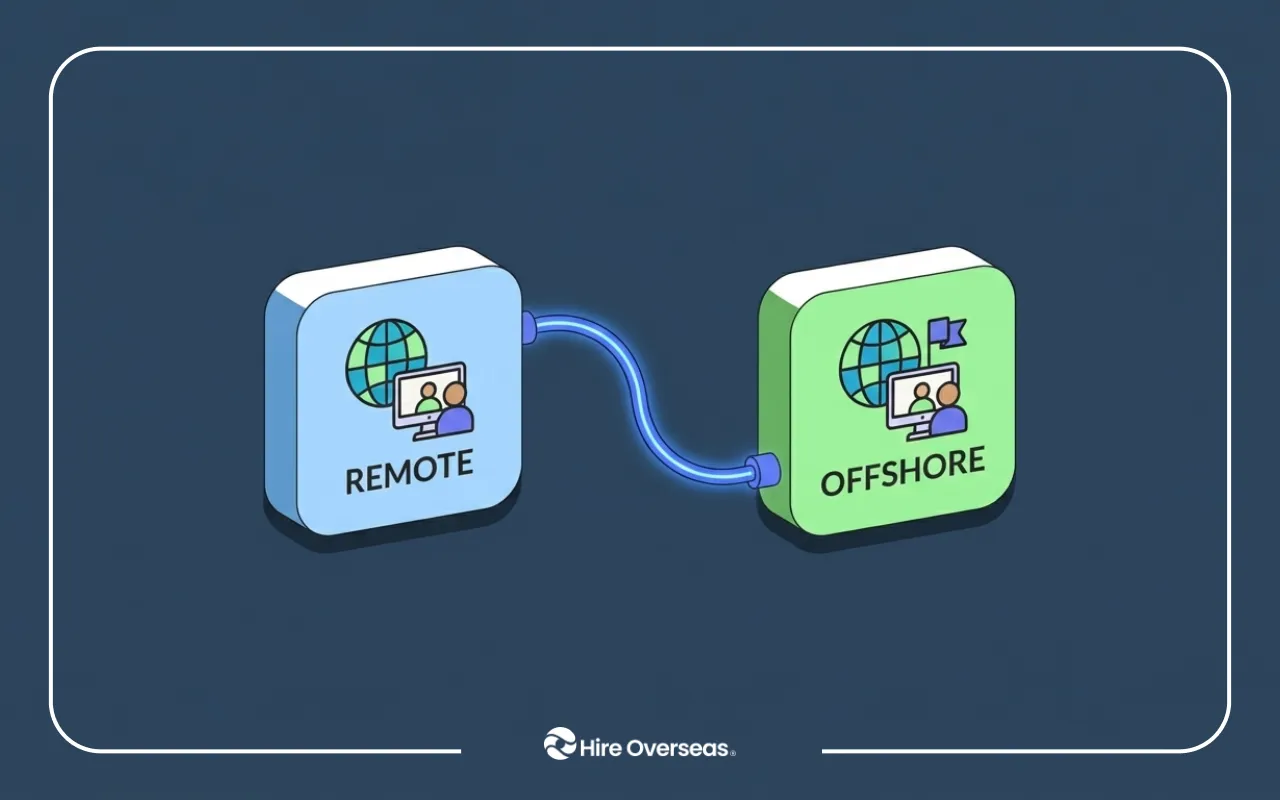
Remote hiring and offshore hiring are often confused, but they serve different strategic purposes. Remote hiring defines how work is performed outside an office, usually within the same country, while offshore hiring defines where talent is located across international borders. Companies that scale effectively often combine remote leadership teams with offshore operational teams to access global talent, reduce costs, and expand execution capacity while maintaining strategic control.
Many companies treat offshore hiring vs remote hiring as the same thing.
In reality, they represent two different workforce strategies.
Remote hiring describes how work is performed, while offshore hiring describes where talent is located geographically.
A remote employee works outside a company office but may still live in the same country. An offshore employee works from another country.
Because of this:
All offshore employees are remote by default
But not all remote employees are offshore
This difference matters. Offshore and remote hiring affect cost structures, compliance requirements, and long-term workforce strategy in very different ways.
Remote vs. Offshore Hiring: Structure vs. Geography
The most important difference between remote hiring vs offshore hiring is structural.
Remote hiring defines how work is organized. Offshore hiring defines where the employee is located geographically.
Understanding this distinction helps companies design the right workforce structure instead of treating both models as interchangeable.
Remote Hiring: A Distributed Workforce Structure
Remote hiring means employing people who work outside a physical office.
These employees may live:
in the same city
in another region of the country
in a different state or province
occasionally in another country
Most companies adopt remote hiring to support a distributed workforce management strategy.
This structure allows businesses to:
recruit talent beyond commuting distance
reduce office infrastructure costs
improve employee flexibility and retention
expand hiring into multiple domestic regions
For example, a company headquartered in New York may hire a remote engineer in Texas or Colorado instead of requiring relocation.
However, when employees remain in the same country, companies must still comply with domestic employment laws, payroll taxes, and benefits regulations.
Remote hiring changes where employees work, but usually not the legal framework of employment.
If you're expanding your team beyond commuting distance, this guide on how to hire remote employees walks through the legal setup, onboarding structure, and hiring process companies use to build effective distributed teams.
Offshore Hiring: A Cross-Border Talent Strategy
Offshore hiring refers to employing workers located in another country.
Companies typically hire offshore employees to:
access global talent markets
reduce long-term staffing costs
scale operational teams quickly
support international business expansion
Offshore hiring introduces additional considerations including:
cross-border payroll and tax compliance
local labor law requirements
international employment contracts
time zone and cultural coordination
Because of this complexity, offshore hiring is often used as part of a broader global operations optimization framework rather than just a hiring tactic.
In simple terms:
Remote hiring expands geographic flexibility within a workforce.
Offshore hiring expands the workforce across international borders.
If you're considering building an international team, this breakdown of hiring remote employees in other countries explains the compliance, payroll, and legal structures companies use when employing global talent.
Remote vs. Offshore Workforce: Talent Access and Cost Structure
When comparing a remote workforce vs offshore workforce, many companies focus only on salary differences.
In reality, the strategic impact involves three broader factors: talent access, cost structure, and operational scalability.
Talent Access and Global Workforce Strategy
Remote hiring expands your talent pool beyond a single city or commuting area. Offshore hiring expands your talent pool beyond national borders.
For example:
Hiring a remote domestic product manager allows companies to recruit talent anywhere in the country.
Hiring offshore engineers, analysts, or operations specialists opens access to international talent markets.
Companies building a strong global talent acquisition strategy often combine both models.
A common structure looks like this:
leadership, product, and strategy roles hired domestically
operational, technical, and support roles scaled offshore
This approach allows businesses to maintain close leadership coordination while expanding execution capacity globally.
For companies planning their first international hires, this remote hiring checklist for overseas talent outlines the key steps—from role definition to compliance setup—before building a global team.
Cost Comparison: Offshore vs. Remote Hiring
Cost is often the main reason companies explore offshoring, but the comparison is more nuanced than salary alone.
Domestic Remote Hiring Costs
Typical annual salary benchmarks in the United States include:
Software developer: $110,000 – $160,000
Operations specialist: $70,000 – $100,000
Administrative assistant: $45,000 – $65,000
Customer support representative: $50,000 – $70,000
In addition to salary, companies typically pay:
7–10% payroll taxes
15–25% benefits
HR, compliance, and equipment costs
As a result, a U.S. employee earning $100,000 often costs the company $120,000–$140,000 annually.
Offshore Hiring Costs
Offshore compensation varies depending on region and role.
Typical annual ranges include:
Administrative and operations roles: $10,000 – $25,000
Customer support specialists: $12,000 – $28,000
Developers and technical roles: $35,000 – $70,000
Eastern Europe
Software engineers: $45,000 – $90,000
Even after factoring in compliance, onboarding, and payroll services, offshore hires often cost 40–70% less than equivalent U.S. roles.
However, the biggest advantage of offshore hiring appears when companies scale teams, not just when hiring a single role.
For this reason, offshoring is most effective when used as part of a long-term global workforce scaling strategy, rather than a short-term cost-cutting tactic.
Outsourcing vs. Offshoring Explained: Ownership, Control, and Long-Term Capability
Another strategic distinction many companies overlook when discussing offshore hiring vs remote hiring is the difference between outsourcing and offshoring.
Although both models involve work being performed outside a company’s primary location, they represent very different operating structures.
Understanding this difference is essential for designing a sustainable global workforce strategy.
Offshoring: Building an Internal Global Team
Offshoring means hiring employees located in another country who work as part of your internal organization.
These employees may be:
direct international employees
hired through an employer-of-record (EOR) structure
part of a dedicated offshore team
In this model, the team is owned and managed internally. The offshore employees follow the same systems, culture, and operational processes as domestic staff.
Companies use offshoring to support:
scaling teams through offshoring
building long-term internal capability
reducing operational expenses globally
expanding international operations
Because the team remains internal, companies maintain full management control over workflows, hiring standards, and performance expectations.
Over time, offshore teams often become deeply integrated into a company’s operations.
Outsourcing: Contracting an External Service Provider
Outsourcing is fundamentally different.
Instead of hiring employees directly, companies contract a third-party vendor to deliver services.
This typically means:
the vendor hires and manages the team
work is delivered through contractual service agreements
the company manages outcomes rather than individuals
Common outsourced functions include:
call center services
IT support operations
back-office processing
customer service teams
In outsourcing models, companies trade direct operational control for simplified service delivery.
The Structural Difference: Control vs. Convenience
The core difference between outsourcing and offshoring comes down to ownership and control.
This distinction affects several long-term outcomes:
institutional knowledge retention
operational consistency
team culture and loyalty
flexibility to evolve workflows
Companies focused on long-term operational scalability often prefer offshoring because it allows them to build institutional capability rather than rely on external vendors.
Outsourcing can still be effective for clearly defined services, but it rarely provides the same level of operational integration as an internal offshore team.
Why This Difference Matters in Global Hiring Strategy
Many companies exploring offshore remote work initially assume outsourcing and offshoring are interchangeable.
They are not.
Outsourcing is primarily a service delivery model.
Offshoring is a global team-building strategy.
Organizations that understand this distinction make more informed decisions about:
vendor management versus employee management
long-term staffing costs
operational control
global workforce scalability
In practice, the choice between outsourcing and offshoring shapes how companies build their international business expansion model and how much operational ownership they retain.
Offshore vs Remote Hiring vs Outsourcing: Global Workforce Strategy Comparison
Key Strategic Takeaway
The difference between offshore and remote hiring is structural:
Remote hiring expands where employees can work.
Offshore hiring expands where talent is sourced globally.
Outsourcing shifts work to an external provider instead of building an internal team.
Companies building long-term global workforce strategies often combine these models:
Remote domestic leadership teams
Offshore operational teams
Selective outsourcing for specialized services
This layered structure allows businesses to scale operations globally while maintaining strategic control over core functions.
Offshore vs. Remote: A Hire Overseas Insider Perspective on Managing Global Teams
From the outside, a remote team vs offshore team can look similar. Both involve employees working outside a company’s physical office and collaborating digitally.
However, from an operational standpoint, the two models behave very differently.
At Hire Overseas, one of the most common patterns we see is that companies assume offshore hiring is simply remote hiring in another location. In reality, offshore teams require a different operational mindset.
Remote hiring is usually a flexibility model. Offshore hiring is an operational scaling model.
Understanding this distinction is critical when building distributed teams that actually perform.
How Remote Teams Typically Operate
Most remote teams operate within the same country and legal environment.
From a management perspective, this means:
employment laws remain consistent
payroll and HR processes remain familiar
working hours are largely aligned
collaboration tends to be synchronous
For example, a U.S. company hiring remote employees across multiple states is still operating within a relatively consistent regulatory framework.
The biggest benefit of domestic remote hiring is geographic flexibility, not necessarily operational transformation.
However, remote hiring alone rarely changes the economics of staffing because compensation is still tied to the same national labor market.
How Offshore Teams Operate Differently
Offshore teams introduce a different operational dynamic.
Based on our experience helping companies hire offshore employees and build global teams, the biggest difference is not location. It is workflow design.
Offshore teams succeed when companies implement structured systems such as:
clearly documented processes
defined task ownership
strong onboarding frameworks
asynchronous collaboration models
Without these systems, offshore hiring can create coordination friction.
With the right structure, however, offshore teams often increase execution capacity significantly.
One operational advantage we frequently see is what we call “extended execution windows.”
For example:
U.S. leadership teams operate during domestic business hours
offshore operational teams continue work during their local hours
tasks move forward across time zones rather than waiting until the next day
When designed intentionally, offshore teams can enable near-continuous operational progress.
Once your distributed team begins growing, this guide to managing remote teams at scale explains the systems, communication frameworks, and performance structures that keep global teams aligned.
The Operational Model That Works Best
Many modern companies combine both approaches.
A common distributed workforce structure we see among successful clients includes:
domestic remote leadership teams responsible for strategy and decision-making
offshore execution teams responsible for operational implementation
structured communication systems connecting both layers
This model allows organizations to maintain close leadership coordination while dramatically expanding operational bandwidth.
In practice, the most successful companies do not choose between remote teams or offshore teams.
They design systems where each model supports a different layer of the organization.
This is the operational framework we help companies implement when building scalable global teams through Hire Overseas.
Final Insight: Structure Determines Scale
The real difference between offshore vs remote hiring is not location or flexibility. It is how your organization is designed to operate.
Remote hiring expands your ability to recruit talent without geographic constraints. Offshore hiring expands your ability to scale execution across global talent markets.
Companies that treat these models as interchangeable often run into hidden complexity later. But companies that intentionally structure their workforce gain a powerful advantage. Leadership focuses on strategy while distributed teams execute with speed and consistency.
In practice, the most scalable organizations combine both approaches:
Domestic remote teams for leadership, strategy, and product decisions
Offshore teams for operational execution and capacity scaling
This structure allows companies to grow faster without dramatically increasing operating costs.
At Hire Overseas, we help businesses design offshore hiring strategies that integrate seamlessly with their remote teams and internal operations.
If you're considering offshore hiring vs. remote hiring, the most important step is designing the right structure before you start hiring.
Book a strategy call with Hire Overseas to map your global hiring strategy and identify the highest-leverage roles to offshore.
