


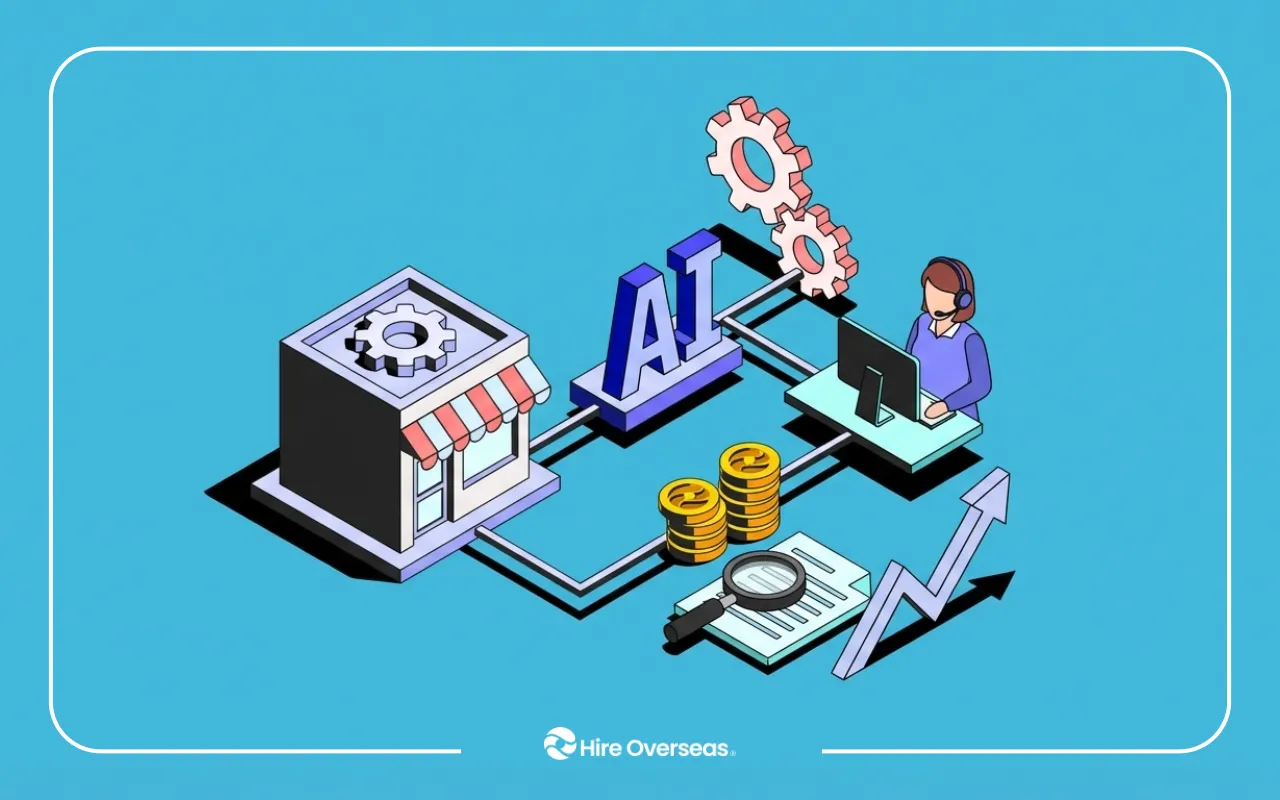
AI for small business is no longer about experimenting with tools. It is about implementing real systems that remove manual work and improve how businesses operate.
At Hire Overseas, we work closely with growing companies. The pattern is clear. The businesses that succeed with artificial intelligence in business are the ones focused on practical automation, not theory.
Here are the real ways our clients use AI for business to automate operations without an enterprise budget.
What AI for Small Business Really Means in Practice
AI for small business is not just about using tools. It is about building systems that automate operations, reduce manual work, and improve efficiency across marketing, customer support, and administration.
In practice, AI is a set of connected workflows that run across your business.
Our clients in small businesses use artificial intelligence to:
- automate customer communication
- streamline internal processes
- reduce admin workload
- improve decision-making
Instead of hiring more people, they build systems that handle repetitive work automatically.
At a high level, AI helps small businesses:
- automate repetitive tasks
- reduce costs
- improve response times
- scale without increasing headcount
The Shift: AI Is No Longer Just for Enterprises
AI is no longer limited to large companies with big budgets.
Today:
- tools are affordable
- SMB-friendly pricing is common
- integrations are easier to implement
The real barrier is no longer access. It is execution.
Small teams now use AI as a force multiplier. A team of 5 can operate like a much larger team by automating workflows across operations, marketing, and support.
At the same time, competitive pressure is increasing. Larger companies are already using AI to respond faster and operate more efficiently, so small businesses need to adopt AI to stay competitive.
The businesses that succeed are not the ones with the biggest budgets, but the ones that implement AI correctly.
If you've identified the workflows to automate but aren't sure where to start, this guide on how to implement AI in your business walks through the phased rollout approach that keeps small teams from overcommitting in the first 30 days.
How Our Small Business Clients Actually Use AI to Automate Operations
AI for small business works best when tools, workflows, and the right people come together. At Hire Overseas, we see small businesses succeed with AI not because of the tools they use, but because of how those tools are implemented and managed.
Our clients combine AI systems with skilled remote talent to turn automation into real, reliable operations.
Here is how they do it in practice.
If you're mapping out where AI fits across departments, this breakdown of AI automation for business covers the specific workflow categories — from lead routing to invoice processing — where small teams see the fastest ROI.
Customer communication automation (AI receptionist and answering systems)
Client profile: Local service business (3–8 employees) with high inbound inquiries
Use case: Handle inquiries, qualify leads, and book appointments automatically.
Tools used:
- ChatGPT
- Intercom AI or Zendesk AI
Our clients typically pair these tools with a remote AI virtual assistant who sets up conversation flows, refines responses, and ensures the system runs smoothly day to day.
Result: 24/7 communication coverage without hiring in-house staff, while maintaining consistent and accurate responses.
If you're evaluating whether to bring on a remote AI assistant like the ones managing these conversation flows, this breakdown of virtual assistant cost compares monthly rates across skill levels so you can budget for a dedicated operator without overpaying.
Marketing automation (AI for small business marketing)
Client profile: Startup or small online business without a full marketing team
Use case: Generate content, schedule campaigns, and personalize messaging.
Tools used:
- ChatGPT, Jasper, or Copy.ai
- Zapier or Make
In most cases, a remote AI marketing assistant manages content workflows, optimizes prompts, and keeps campaigns running consistently.
Result: Reliable marketing output without needing multiple hires or agencies.
Workflow automation (core operations automation)
Client profile: Small SaaS or service business managing leads manually
Use case: Automate lead capture, CRM updates, and follow-ups.
Example workflow: Lead enters → CRM updates → email sent → task assigned
Tools used:
- Zapier, Make, or n8n
- CRM platforms (HubSpot, Salesforce)
These systems are usually built and maintained by an AI automation specialist who ensures everything is connected and running without manual intervention.
Result: Fully automated lead handling that improves speed, consistency, and conversion rates.
If you're a small online business without a dedicated marketing team, this guide to scaling marketing teams with remote talent explains how to build a 2–3 person remote marketing unit that handles content, ads, and reporting from day one.
Admin automation (internal operations)
Client profile: Founder-led business handling admin manually
Use case: Reduce time spent on reporting, documentation, and coordination.
Tools used:
- ChatGPT
- Zapier or Make
A remote AI-powered virtual assistant typically manages these workflows, ensuring tasks are completed consistently and systems stay organized.
Result: Founders save hours weekly and can focus on higher-value work.
Customer support automation
Client profile: Ecommerce or SaaS business with growing support volume
Use case: Answer FAQs, route tickets, and handle first-line support.
Tools used:
- Intercom AI
- Zendesk AI
- ChatGPT integrations
Clients often rely on trained support VAs who work alongside AI systems, handling edge cases and improving response quality over time.
Result: Faster response times and reduced workload without expanding the support team.
AI accounting for small business
Client profile: Small business owner managing finances manually
Use case: Automate bookkeeping, expense tracking, and reporting.
Tools used:
- QuickBooks AI
- Xero
In many cases, a remote accounting assistant reviews outputs, maintains accuracy, and ensures financial workflows stay reliable.
Result: Accurate financial tracking with significantly less manual effort.
The Hire Overseas Approach to Implementing AI for Small Business
One of the biggest mistakes small businesses make with AI is starting with tools instead of workflows.
At Hire Overseas, we see a consistent pattern. The businesses that succeed with AI follow a structured approach. They first understand how their operations run, then apply AI to improve those systems.
Here is the exact approach our clients use.
Step 1: Identify repetitive work across operations
The starting point is not AI. It is identifying where time and effort are being spent repeatedly.
Our clients look for tasks that:
- happen daily or weekly
- follow the same process each time
- require manual input but little decision-making
Common examples include responding to inquiries, updating CRM records, scheduling tasks, or preparing reports.
If a task is repeated and predictable, it is a strong candidate for automation.
Step 2: Map workflows before choosing tools
Before introducing any tools, our clients map out how the work currently flows.
They break down processes into:
- what triggers the task (e.g. form submission, new email)
- what steps follow
- where manual work or delays occur
This step creates clarity. It ensures AI is applied to fix real inefficiencies, not just added on top of existing problems.
Step 3: Build simple AI workflows first
Instead of trying to automate everything at once, our clients start with one high-impact workflow.
A typical example:
- a lead submits a form
- AI qualifies the lead based on criteria
- the CRM updates automatically
- a follow-up email is triggered
- a task is assigned to the team
This removes multiple manual steps and immediately improves speed and consistency.
Starting small allows businesses to test, refine, and build confidence in their systems.
Step 4: Connect systems for end-to-end automation
For AI to work effectively, tools need to be connected.
Our clients integrate:
- CRM platforms (for data and lead management)
- email systems (for communication)
- automation tools like Zapier or Make
- AI tools like ChatGPT
The goal is to create a continuous flow of information across systems so tasks move automatically from one step to the next without manual input.
Step 5: Use skilled operators to manage and improve systems
This is where most businesses struggle.
AI systems require ongoing management. Our clients work with remote specialists who:
monitor workflows for errors
- adjust automation logic as needed
- refine AI outputs for accuracy and tone
- ensure systems stay aligned with business changes
This human layer keeps automation reliable and prevents breakdowns over time.
Step 6: Expand automation across the business
Once one workflow is stable, our clients gradually expand automation into other areas such as:
- marketing campaigns
- customer support
- internal reporting and admin
This step-by-step expansion allows businesses to scale operations without overwhelming their team or systems.
What Our Most Successful Clients Do Differently
AI for small business is not just about tools. It is about how systems are built and managed over time.
Our most successful clients:
- start with workflows, not tools
- focus on high-impact automation first
- connect systems into one process
- continuously improve their workflows
Most importantly, they do not do it alone.
They work with dedicated remote contractors who build, manage, and optimize their AI systems daily.
This is what turns AI from a tool into a reliable, scalable part of their operations.
Why Small Businesses Are Turning to AI Specialists to Scale Faster
As AI for small business becomes more common, many founders realize that using tools is not the hard part.
The challenge is turning those tools into systems that actually work in daily operations.
This is why more small businesses are working with AI specialists instead of trying to build everything internally.
DIY AI implementation often fails
Many businesses start by testing AI tools but struggle to get real results.
Common issues include:
- tools not being properly connected
- workflows breaking under real usage
- inconsistent or low-quality outputs
- automation requiring constant manual intervention
Without a clear system and ongoing management, AI becomes more work instead of less.
Hiring AI specialists for small businesses accelerates results
AI specialists focus on building systems, not just setting up tools.
They:
- design workflows that match how the business operates
- connect tools into one continuous process
- ensure automation runs reliably
- improve performance over time
This allows businesses to move from trial and error to structured, working automation much faster.
AI experts are now accessible to small teams
In the past, AI talent was limited to large companies.
Today, small businesses can access:
- remote AI specialists
- automation experts
- dedicated AI operators
This shift allows even small teams to implement advanced AI systems without large budgets.
Partnering with AI specialists reduces cost and complexity
Building AI systems internally requires time, hiring, and technical expertise.
By working with experienced AI specialists, businesses can:
- launch systems faster
- reduce hiring costs
- avoid long onboarding processes
- access proven expertise immediately
This simplifies implementation and allows businesses to focus on results instead of building capabilities from scratch.
Combining AI with skilled operators drives real efficiency
AI tools cannot manage themselves.
The most successful businesses combine:
- AI systems that automate tasks
- workflows that connect operations
- skilled operators who manage and improve those systems
This ensures automation stays accurate, reliable, and aligned with the business as it grows.
Most Businesses Use AI. Few Actually Benefit From It
AI for small business is everywhere. Most businesses are already using tools.
But very few are seeing real results.
The difference is simple: using AI is not the same as implementing it.
The businesses that benefit from AI:
- build workflows, not just use tools
- connect systems across operations
- rely on skilled operators to manage and improve automation
That is what turns AI into something reliable and scalable.
At Hire Overseas, we help small businesses move beyond trial and error.
We connect you with AI specialists who build, manage, and optimize your systems so they actually work.
If you want AI to reduce workload and help you scale, the next step is not another tool.
It is proper implementation.
Book a discovery call with Hire Overseas and start building AI systems that deliver real results.
