



Most companies want to scale marketing fast but hit the same wall. Local talent pools are thin or expensive, hiring cycles drag, and skill gaps slow execution. This is why more organizations now scale marketing teams with remote talent to move faster, reach global audiences, and unlock specialized capabilities on demand.
Remote work is no longer a workaround. It is the most efficient way to grow your marketing team with remote talent while staying lean and competitive.
Why Remote Talent Is Now the Core Engine of Scalable Marketing
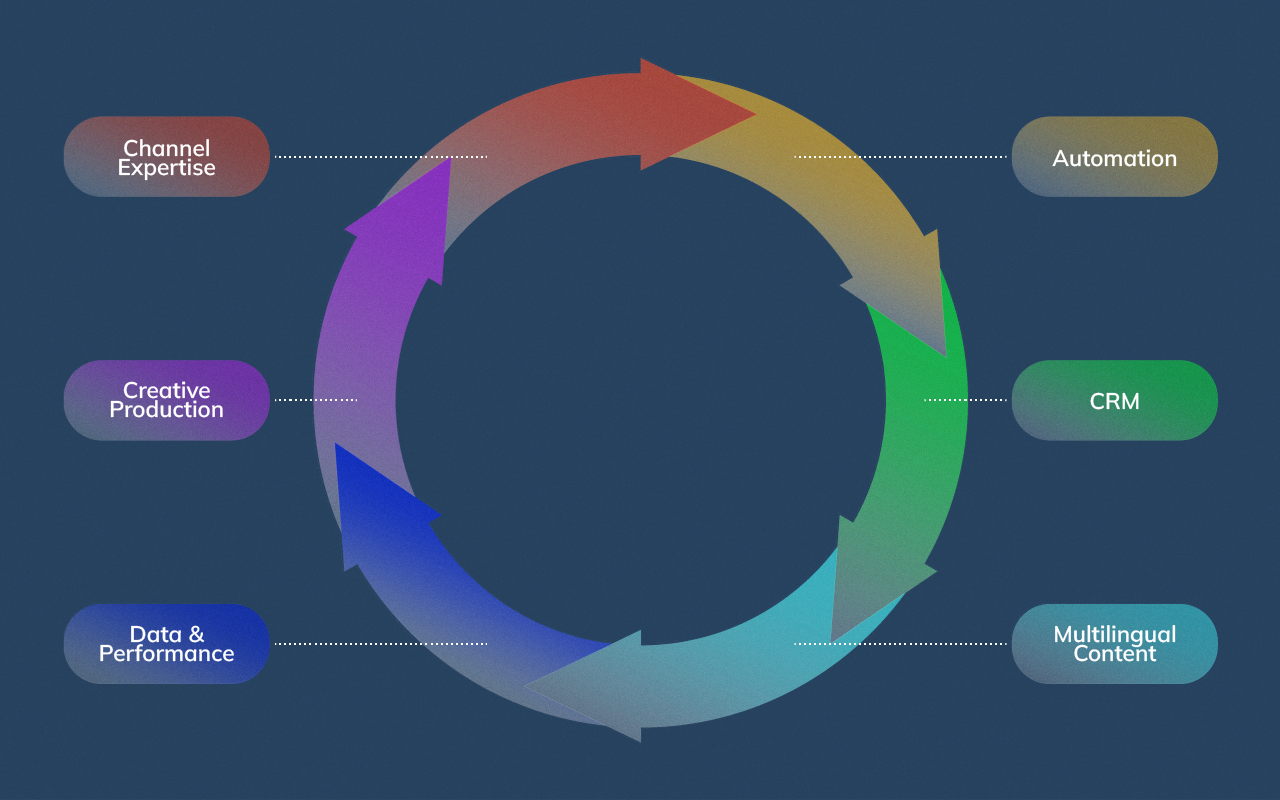
Marketing today moves too fast for traditional hiring models. Channels evolve monthly, creative demand keeps rising, and teams are expected to produce more output with fewer resources. Remote talent solves these problems by giving companies the speed, depth, and flexibility modern marketing requires.
Below are the specific, marketing-driven reasons remote talent is now essential.
Marketing Requires Specialized Skills That Change Every 6–12 Months
The days of hiring “one marketer who can do everything” are long gone.
Growth now requires:
- channel experts
- creative specialists
- performance analysts
- automation and CRM operators
- multilingual content creators
- But these skills shift constantly as platforms evolve.
When companies hire remote marketing professionals, they gain immediate access to specialists in:
- content marketing remote staff who can publish at high velocity
- performance marketing specialists (remote) who understand Google, Meta, TikTok, and LinkedIn deeply
- paid ads specialists overseas who optimize campaigns daily, not weekly
- social media management outsourcing teams who track trends in real time
- remote creative team outsourcing and offshore creative talent for nonstop production
Local markets rarely supply all of these skills at once, especially at the speed marketing teams need.
Remote talent fills the gaps instantly, letting teams adapt to algorithm changes, platform shifts, and new growth opportunities without waiting months to hire.
Discover: How Google VEO-3 is reshaping modern marketing workflows.
Marketing Costs Are Rising—But Output Requirements Are Rising Faster
Marketing budgets are under pressure. Creative volume expectations have doubled, and ad platforms now require constant iteration to stay efficient.
This puts founders in a bind: they need more output, but internal salaries keep climbing.
Remote teams solve this by enabling:
- an offshore marketing team that dramatically lowers cost-per-output
- marketing outsourcing in the Philippines, where companies access world-class talent at sustainable rates
- cost-effective marketing team scaling without reducing quality
The result:
Brands produce 2–5× more content, creatives, and experiments for the same budget.
This is why performance teams, content departments, and creative pods increasingly rely on specialists overseas — not as a cost-cutting measure, but as a competitive advantage.
Modern Marketing Is a 24/7 Operation — and Local Teams Can’t Cover It
Marketing now touches every timezone, platform, and language. Growth depends on being present where your customers are, not just where your office is.
- A distributed team enables:
- global marketing team expansion without geographic limitations
- multilingual content for region-specific campaigns
- round-the-clock production, revisions, reporting, and community engagement
For example: Social media does not sleep. Paid ads require daily tuning. Content calendars require constant publishing. Customer segments across regions behave differently.
Remote talent allows marketing teams to:
- test international markets faster
- run campaigns while the in-house team sleeps
- localize messaging for diverse audiences
- respond quickly to platform opportunities or sudden trends
- A local-only team simply cannot provide this level of speed or coverage.
Summary: Remote Talent Solves the Core Marketing Bottlenecks
Remote talent isn’t valuable “because it’s remote.”
It’s valuable because it solves the actual bottlenecks marketing leaders face today:
- a shortage of specialized skills
- rising creative and campaign costs
- the need for continuous execution
- global audiences and global growth
- higher demands for experimentation and iteration
- the pressure to deliver more output with leaner budgets
This is why remote talent has become the engine of modern, scalable marketing — not an auxiliary option, but the foundation that drives volume, speed, and adaptability.
How to Build Remote Marketing Teams That Scale
Scaling isn’t about hiring more people. It is about designing a system that compounds output every quarter. At Hire Overseas, we learned this ourselves. Before we helped clients scale their distributed marketing teams, we had to build our own. What worked for us now shapes how we advise founders to scale fast without breaking their budget or their workflow.
Below is the exact playbook we use internally and with clients.
1. Start With Role Clarity and a Two-Hire Foundation
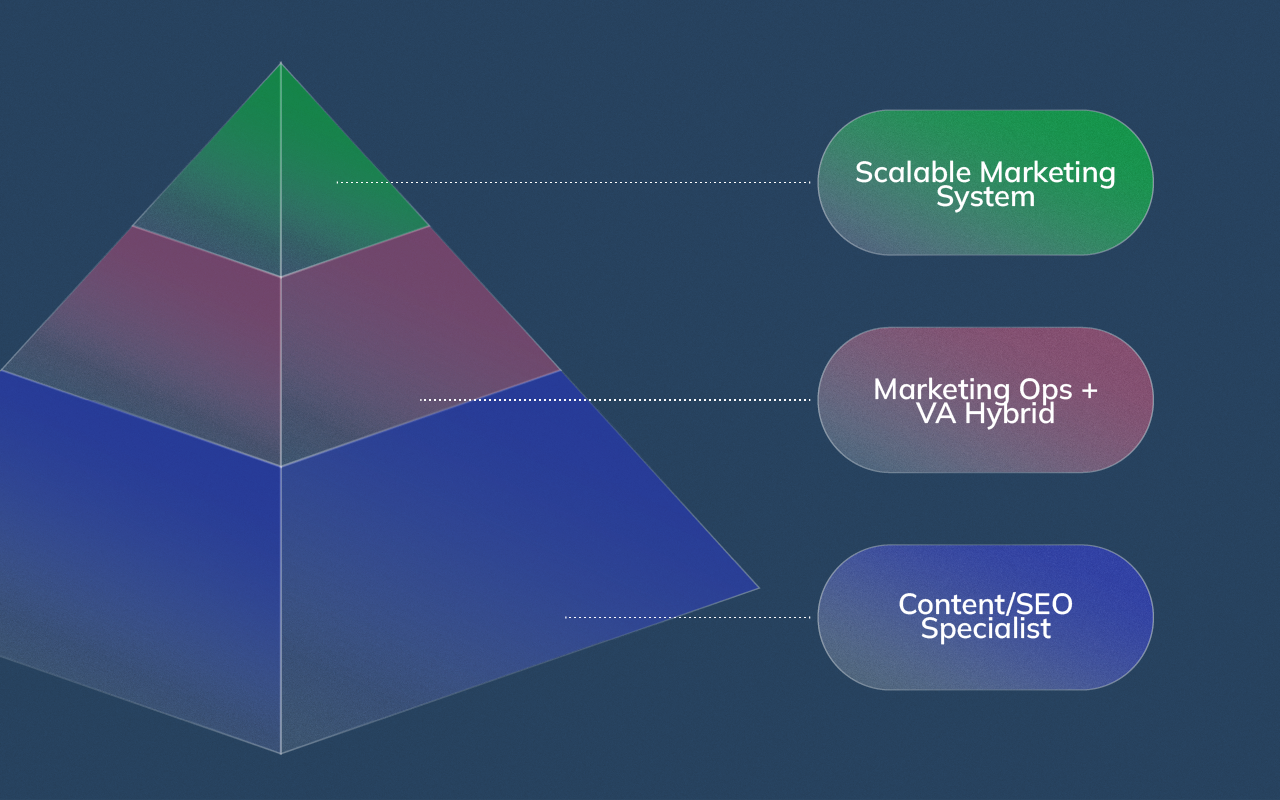
Before adding headcount, founders should identify the first two hires that create leverage. Most teams fail because they start by hiring too many generalists or the wrong specialists in the wrong order.
At Hire Overseas, we found that high-growth teams scale best when they begin with:
Hire #1: A Content/SEO Specialist
This person owns organic acquisition, technical SEO fixes, and publishing velocity.
Your content engine becomes your compounding advantage.
Hire #2: A Marketing Ops + VA Hybrid
This role manages scheduling, publishing, CRM hygiene, workflow coordination, and reporting.
Execution accelerates because founders stop bottlenecking the system.
Once these two roles work smoothly, everything else layers on top without chaos.
This is exactly how we validated our own breakout channel: SEO + AEO.
We hired a dedicated SEO specialist early. Within two months, traffic grew, inbound calls increased, and the channel proved itself. That single hire generated the earliest compounding ROI in our marketing stack.
From there, global talent sourcing for marketing made it easy to expand into:
- email and lifecycle strategy
- SEO and content pods
- analytics and growth roles
- design and multimedia production
- virtual marketing assistants to run operations and admin
Clear role scopes prevent duplicated work, unclear expectations, and long onboarding cycles.
Additional Roles Different Startups Should Consider
Not every company is an SEO-first business or runs the same growth strategy we did. Different marketing motions require different specialist hires.
Below are the most common scenarios we see and the remote roles that accelerate each path.
1. If your growth model is content-heavy (SaaS, services, niche products). You’ll need:
- long-form content writers
- on-page SEO specialists
- technical SEO support
- content editors and publishers
- keyword research analysts
- AEO (Answer Engine Optimization) specialists
Why: Content-driven companies rise or fall on search visibility, topical authority, and publishing velocity. Remote content pods allow you to scale content 3–10× faster at a sustainable cost.
2. If your company relies on performance marketing. Hire:
- paid ads specialists overseas (Meta, Google, TikTok, LinkedIn)
- CRO (conversion rate optimization) specialists
- landing page designers
- data and performance analysts
- creative strategists for ad iteration
Why: Performance channels require constant creative testing, fast turnaround time, and daily optimization. Remote teams make this affordable.
3. If your product requires community, social, or brand marketing. Bring in:
- social media management outsourcing teams
- community managers
- video editors and short-form content creators
- brand designers
- copywriters
Why: Community-driven growth is content-intensive and trend-responsive. Offshore creative talent allows you to maintain daily output without burning out your team.
4. If your sales team needs enablement and outbound support. Consider:
- SDR enablement writers
- email automation specialists
- sales funnel builders
- HubSpot or CRM automation experts
- research VAs for ideal customer profile (ICP) lists
Why: Outbound consistency suffers when marketing can’t support sales with content, sequences, and automation. Remote talent closes that operational gap quickly.
5. If your company depends on partnerships or ABM. Hire:
- account-based marketing coordinators
- ABM campaign designers
- personalization copywriters
- microsite or landing page builders
- gifting and outreach operations support
Why: ABM requires detailed execution, personalized creative, and repetitive coordination — perfect for remote specialists.
6. If your product requires heavy marketing automation. Add:
- marketing automation support team
- HubSpot/Marketo/Pardot specialists
- segmentation and lifecycle experts
- data hygiene and CRM analysts
Why: Automation multiplies efficiency, but only if the back end is set up correctly. Remote specialists keep systems running without requiring a full-time internal team.
2. Expand Your Team Through Proven Remote Markets
Once the foundation is stable, you scale by tapping high-performing remote markets.
Our clients consistently outperform when they hire overseas marketing specialists in regions with deep digital talent pools.
What we’ve seen across 100+ client builds:
- Southeast Asia delivers elite creative work and marketing operations support
- Eastern Europe excels in growth, analytics, and technical marketing
- The Philippines leads globally in content operations, design, social media, and virtual marketing assistance
For creative-heavy needs, digital marketing outsourcing and offshore creative talent accelerate output without expanding in-house cost structures.
This global model gives brands access to exactly the right specialist at exactly the right time, something local hiring rarely provides.
3. Build a Virtual Marketing Department That Can Actually Scale
A scalable remote team doesn’t look like a traditional team. It looks like a modular virtual marketing department where each function operates as a pod.
From our internal playbook, the structure that scales best includes:
- content creators and editors
- designers and video editors
- paid ads strategists
- social media managers
- a marketing automation support team
- operations and project coordinators
- a fractional strategist or head of marketing
Startups benefit most from this configuration because it mirrors a full marketing team but costs a fraction of in-house hiring.
Why this works
When we ran the Bullseye testing process at Hire Overseas, this structure allowed us to test channels rapidly:
- Meta ads failed fast
- Podcast and newsletter sponsorships failed
- X/Twitter produced nothing
- Micro-events and LinkedIn content produced some signal
- SEO/AEO became our breakout engine
- Referrals delivered the highest ROI
- ABM gifting unlocked high-value accounts
- LinkedIn webinars became a repeatable pipeline generator
We were only able to test quickly because the team structure supported rapid execution rather than slowing it down.
This model is what enabled us to test widely, cut aggressively, and double down once we found signal.
Founder Insight: You Don’t Scale by Guessing. You Scale by Testing.
Most founders try to “pick” their channels before their team is ready to execute.
That is why they burn money.
The teams that scale — including ours — do four things well:
- test widely
- kill quickly
- follow the signal
- focus relentlessly
Remote teams amplify this process because you can bring in specialists for short, focused experiments without permanent headcount.
Your first two hires create leverage.
Your global talent pool fills the gaps.
Your virtual department structure enables speed.
Your testing process reveals the channels that really scale.
This isn’t theory. This is how we built Hire Overseas.
And it’s the same system we use to help founders build remote marketing teams that scale predictably.
If you want a deeper look at how startups can find their first real growth channel, read our full Growth Playbook.
Additional Tips to Scale Marketing Teams With Remote Talent Without Losing Control
Growing a remote marketing team is not difficult. Losing control of quality, deadlines, and coherence is. The teams that scale smoothly are the ones that build operational discipline into their workflow from day one.
Below are the practical systems we recommend (and use internally) to maintain quality while increasing volume.
Standardize Workflows Early to Avoid Chaos Later
Remote teams break when every person works from a different playbook.
The fix is simple: create one shared operating system before you scale.
Use standardized:
- project boards
- naming conventions
- briefs and creative templates
- channel playbooks
- review and approval steps
Add remote marketing workflow tools to keep tasks visible and eliminate ambiguity.
Standardization removes friction, prevents rework, and keeps output predictable even as headcount grows.
Centralize Strategy but Distribute Execution
One of the biggest mistakes founders make is letting execution dictate strategy.
Your strategic brain must stay internal, but your production muscle can be global.
This hybrid model ensures:
- messaging stays consistent
- campaigns align with company priorities
- creative and operational work moves fast
You hold the direction. Your remote specialists bring the horsepower.
This is exactly how we run our own SEO, content, creative production, and ABM execution at Hire Overseas. Strategy stays with leadership. Execution is distributed to the remote pods that specialize in speed and volume.
Maintain High-Quality Output With Rhythms, Not Micromanagement
Remote teams don’t need more meetings. They need the right ones.
The cadence that works across hundreds of teams:
- Weekly syncs: alignment, blockers, priorities
- Daily async updates: status, focus items, quick check-ins
This rhythm gives founders visibility without hovering, and it gives specialists uninterrupted deep work time.
Async-first teams scale with less friction, fewer meetings, and higher output per person.
Why These Tips Matter
Every company wants to scale its marketing team with remote talent, but very few maintain control over:
- consistency of voice
- campaign quality
- predictable timelines
- channel performance
- creative cohesion
These operational guardrails are what keep velocity high while preventing the team from drifting off-course.
Scaling is not just about hiring more people. It is about creating a system where more people improve output instead of complicating it.
The Best Use Cases for Scaling With Remote Marketing Teams
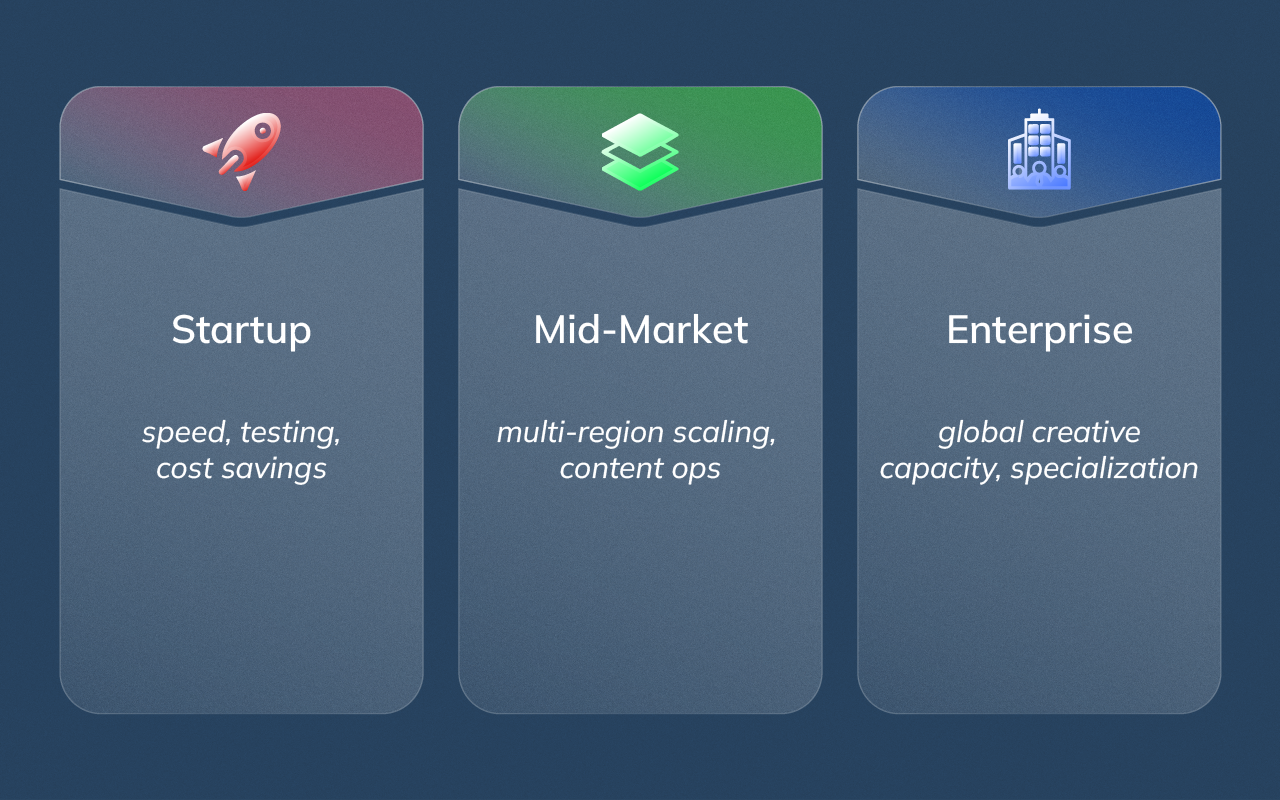
Whether you’re a founder, a marketing leader, or an enterprise team owner, remote talent becomes most valuable when it removes bottlenecks and accelerates execution. Below are the scenarios where companies consistently see the strongest ROI.
Startups: Build a Full Marketing Engine Before You Can Afford One
Startups use remote specialists to move faster than their budget normally allows. Hiring a remote marketing team for startups helps founders:
- validate growth channels quickly
- ship content and creative assets at production-level velocity
- maintain momentum without full-time headcount
- keep burn rate low while increasing output
Many early-stage companies in YC, 500 Global, and Antler portfolios supplement their core teams with Filipino marketing talent for exactly these reasons.
Mid-Market Brands: Scale Output Across Multiple Regions or Channels
Growing brands benefit from global marketing operations that support rapid expansion. Remote teams allow them to:
- increase content volume without overloading internal staff
- localize assets for multiple markets
- run more paid campaigns and experiments simultaneously
- extend creative and operational bandwidth during peak seasons
Everest Group reports that mid-market firms see the strongest efficiency gains when combining in-house strategy with offshore execution pods.
Enterprise Teams: Expand Creative and Performance Capacity Without Adding Headcount
Large companies use cross-border creative collaboration to enhance their in-house marketing structures. Remote teams provide:
- specialized skills not available locally
- always-on production across time zones
- diversified creative exploration
- lower-cost execution layers that support global campaigns
Fortune 500 companies have long relied on the Philippines for CX and digital operations; the shift to marketing, creative, and performance functions is a natural extension of that proven model.
Your Next Marketing Advantage Will Come From Global Talent
The companies scaling the fastest today aren’t the ones hiring the most people. They’re the ones tapping into the world’s deepest talent markets and building flexible, distributed marketing engines that outperform traditional teams.
Each region brings a unique advantage:
- Philippines: content operations, design, social media, marketing VA talent
- Latin America: performance marketers, bilingual creatives, growth operators
- Sri Lanka: analytics, data operations, and marketing automation support
- India: technical marketing, SEO, CRM, lifecycle, and paid acquisition
- South Africa: multimedia production, content, and enterprise-level campaign support
- Nigeria: creative strategy, research, social media, and emerging-gen AI workflows
These markets aren’t “alternatives.” They are now the global hubs of modern marketing execution. But finding the top 1% in these regions is hard unless you have deep on-the-ground sourcing, technical screening, and operational expertise.
That’s where we come in.
Hire Overseas helps founders and marketing leaders build remote teams that scale predictably. We source, test, and deliver elite marketing talent across these global regions — specialists who plug directly into your workflows and accelerate output from day one.
Ready to build the marketing team that can actually match your growth ambitions?
Book a demo with Hire Overseas and build your top-tier remote marketing team.
FAQs on Scaling Marketing Teams With Remote Talent
How do I know if my company is ready to scale marketing with remote talent?
You’re ready when your internal team is consistently overloaded, growth experiments stall due to bandwidth issues, or you need specialized skills you can’t find—or afford—locally. Early-stage startups typically qualify once they have a validated offer, while mid-market teams adopt remote talent to expand output and reduce operational bottlenecks.
What marketing roles are easiest to offshore or outsource first?
The simplest roles to transition remotely are content creation, social media management, design, paid media operations, and marketing assistants. These functions have clearly defined workflows, high documentation availability, and can be measured with tangible output-based KPIs.
What KPIs should I track when scaling with a remote marketing team?
Common KPIs include: content velocity, campaign turnaround time, cost per deliverable, paid ads ROAS, SQL volume, and workflow efficiency. Additional remote-specific KPIs include revision cycles per project, SLA adherence, and async communication responsiveness.
How do companies maintain brand voice and messaging consistency with remote teams?
A brand guide and messaging framework are essential. Successful teams use centralized strategy, detailed briefs, approval workflows, and content QA processes. Many companies designate one internal “brand owner” who signs off on messaging while remote specialists execute the production workload.
How do I calculate the ROI of scaling with remote marketing talent?
ROI typically comes from three areas:
Lower cost per deliverable (creative, content, campaigns)
Higher output velocity that speeds up growth experiments
Reduced hiring costs vs. local full-time salaries
Teams often see 2–5× more output for the same budget within the first 90 days.
How do I ensure remote marketing hires are truly skilled and not just good interviewers?
The most reliable way to validate remote marketing talent is to test for real execution ability, not interview performance. Use a multi-step vetting process that includes:
- Work-sample testing based on the exact tasks they’ll own
- Async project assignments that reveal their thinking, speed, and attention to detail
- Real campaign audits or breakdowns (e.g., “Show me how you would improve this ad account”)
- Practical tool assessments inside platforms like Meta Ads Manager, Google Ads, HubSpot, or Figma
- Reference checks from previous remote employers to confirm reliability, communication, and output quality
- Technical screening by experts who understand the channel deeply enough to separate true specialists from generalists
If you don't have the time or in-house expertise to run these assessments, partnering with Hire Overseas streamlines the entire process. Their team sources, tests, and technically screens candidates using role-specific assessments—ensuring you only see remote marketers who can actually deliver, not just interview well.
