


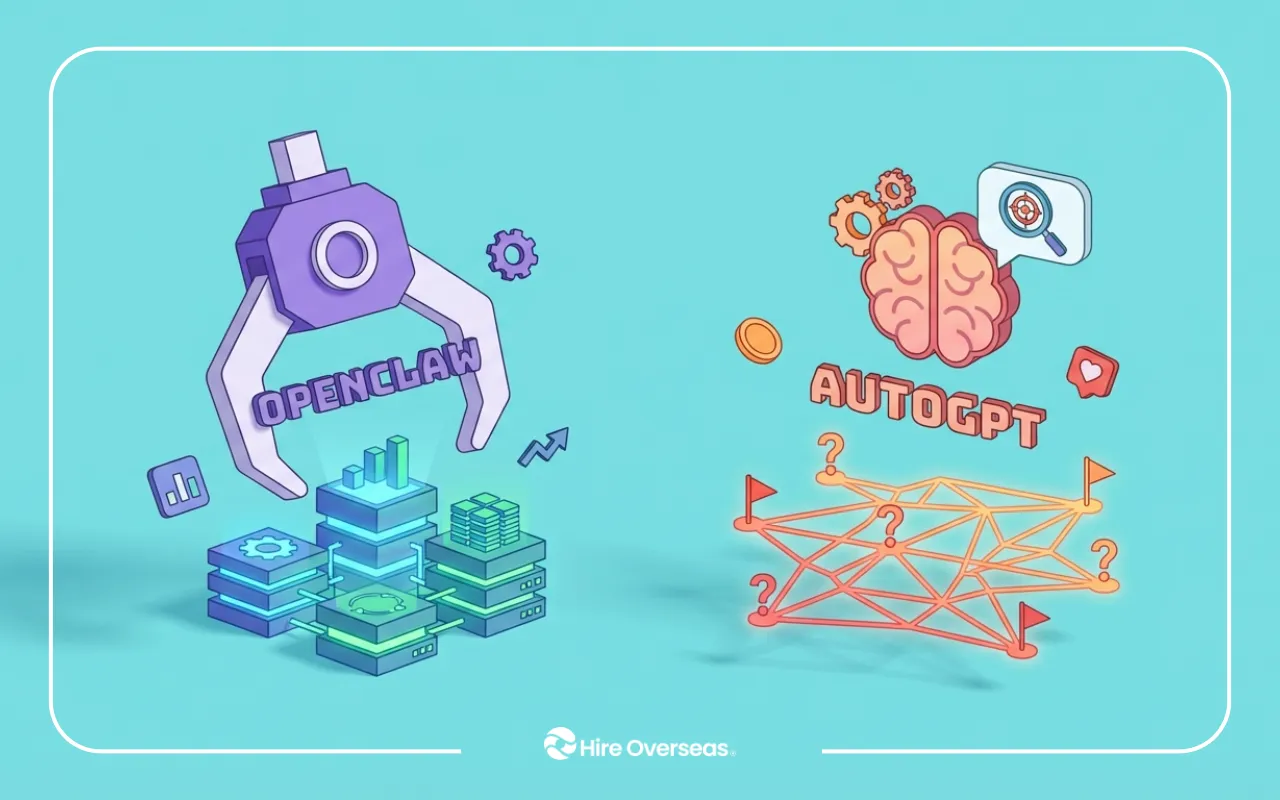
When comparing OpenClaw vs AutoGPT, founders and technical teams usually ask one core question:
Should I use OpenClaw or AutoGPT?
The answer is not about which is more advanced.
It is about architectural intent.
At a high level:
- AutoGPT builds autonomous, goal-driven AI agents.
- OpenClaw executes structured automation across business systems.
They solve different problems at different layers of the stack.
Understanding that difference prevents costly architectural mistakes.
Why OpenClaw vs AutoGPT Is Often Confused
Both tools frequently appear in conversations about:
- AI agents
- Task execution
- Tool usage
- Multi-step reasoning
- Automation workflows
- Autonomous systems
At first glance, that overlap makes them seem interchangeable. If both can “run tasks” and “use tools,” it is natural to assume they compete in the same category.
But the difference between OpenClaw and AutoGPT lies in their execution philosophy and architectural intent:
- AutoGPT is built around autonomous reasoning loops. It sets a goal, breaks it into subtasks, iterates, evaluates progress, and continues recursively until the objective is met. Its strength is independent decision-making and exploratory problem-solving.
- OpenClaw, on the other hand, is built around structured workflow orchestration. It connects business systems and executes predefined automation logic with monitoring, retry rules, and governance. Its strength is predictable, repeatable execution across operational environments.
In simple terms:
- AutoGPT iterates toward a goal through AI-driven reasoning.
- OpenClaw enforces controlled automation across real-world systems.
One optimizes for autonomy and flexibility. The other optimizes for reliability and control.
Because both involve “agents” and “execution,” the comparison feels natural. But architecturally, they solve different problems. They are not direct substitutes. To understand that distinction clearly, we need to define what each system is designed to do at its core.
If you’re trying to separate “autonomous agents” from “execution infrastructure,” this explainer shows what OpenClaw actually is and why it’s built for controlled workflow automation—not exploratory reasoning loops.
What Is OpenClaw?
OpenClaw (formerly ClawDBot / MoltBot) is a production-ready workflow automation system designed for structured, deterministic execution across business environments.
It is built to:
- Connect CRMs, ERPs, SaaS tools, and internal systems
- Execute predefined automation workflows
- Enforce governance and control
- Monitor system activity
- Retry failed processes
- Maintain operational reliability
OpenClaw is not an experimental AI agent framework.
It is an automation infrastructure layer.
Its core strength lies in predictability. Workflows are defined explicitly, triggers are structured, and execution follows controlled logic paths.
OpenClaw becomes critical when:
- AI decisions must update multiple systems
- Revenue workflows require reliability
- Audit trails are required
- Automation must scale safely
- Business operations depend on consistency
OpenClaw answers:
“Now that we know what action to take, how do we execute it reliably across systems?”
It is built for business execution, not autonomous exploration.
What Is AutoGPT?
AutoGPT is an open-source self-running AI agent framework designed for autonomous, goal-driven task completion.
It enables:
- Autonomous agents that pursue defined objectives
- Recursive task decomposition
- Iterative reasoning loops
- Dynamic tool usage via LLM logic
- Self-evaluation and refinement
AutoGPT operates primarily inside AI-driven environments and relies heavily on large language models to determine next actions.
Its core strength lies in autonomy.
Instead of following predefined workflows, AutoGPT:
- Sets a goal
- Breaks it into subtasks
- Executes actions
- Evaluates results
- Iterates until completion
This makes AutoGPT powerful for:
- Prototyping AI systems
- Research environments
- Autonomous task experimentation
- Multi-step reasoning exploration
However, because its execution is model-dependent, behavior can vary depending on prompt design, model quality, and runtime constraints.
AutoGPT answers:
“Given this goal, what should I do next?”
It prioritizes autonomous reasoning over structured orchestration.
OpenClaw vs AutoGPT Architecture
Once definitions are clear, the next step is understanding how OpenClaw and AutoGPT fit into modern AI architecture.
Most scalable AI systems include distinct layers:
- Data layer
- Autonomous reasoning layer
- Execution and orchestration layer
- Monitoring and governance layer
AutoGPT and OpenClaw sit in different positions within that structure.
Understanding this placement resolves most confusion instantly.
AutoGPT: The Autonomous Agent Layer
AutoGPT operates in the reasoning layer.
It handles:
- Goal interpretation
- Recursive task decomposition
- Iterative multi-step reasoning
- Dynamic tool selection
- Context continuation across loops
This is where the AI “thinks.”
AutoGPT determines:
- What the objective requires
- What subtasks must be created
- Which tools should be used
- What step should happen next
It is responsible for autonomous decision-making.
However, it does not inherently manage enterprise system governance, integration monitoring, or deterministic workflow enforcement.
OpenClaw: The Workflow Automation System Layer
OpenClaw operates in the execution layer.
It handles:
- API integrations
- Trigger-based automation
- Cross-system workflows
- CRM and ERP updates
- Retry logic and failure handling
- Observability and audit trails
This is where structured business execution happens.
OpenClaw ensures:
- Systems update correctly
- Data remains synchronized
- Failures are logged and retried
- Automation remains predictable under scale
If AutoGPT determines what should happen, OpenClaw ensures it actually happens safely across systems.
Visualizing the Flow
Here is a simplified layered execution model:
- A business goal is defined.
- AutoGPT decomposes the goal into subtasks.
- AutoGPT selects appropriate tools.
- Structured outputs are generated.
- OpenClaw receives the action instructions.
- OpenClaw executes updates across CRM, ERP, and SaaS tools.
- OpenClaw logs activity and monitors system health.
Without AutoGPT, reasoning is limited.
Without OpenClaw, execution becomes unpredictable at scale.
Together, they form a layered AI execution architecture.
OpenClaw vs AutoGPT Comparison Matrix
Below is a structured OpenClaw vs AutoGPT comparison to clarify their capabilities, architecture, and ideal use cases.
How to Read This Matrix Correctly
This matrix is not designed to declare a winner.
It highlights architectural specialization.
- AutoGPT optimizes for autonomy and exploratory reasoning.
- OpenClaw optimizes for reliability and operational control.
If you are building experimental autonomous agents, AutoGPT may be appropriate.
If you are running revenue-impacting automation workflows, OpenClaw provides stronger safeguards.
Autonomy and automation solve different problems.
Understanding that distinction is what prevents architectural misuse.
When to Use OpenClaw vs. AutoGPT
Instead of asking:
“Which is better?”
Ask:
“What problem are we solving?”
The right choice depends on whether your priority is autonomy or operational control.
Choose AutoGPT When…
AutoGPT is the stronger option when your primary objective is autonomous reasoning.
Use AutoGPT when you need:
- Goal-driven agents
- Recursive multi-step reasoning
- AI experimentation
- Self-directed task completion
- Prototyping autonomous systems
- Iterative problem-solving
AutoGPT works best for:
- Research environments
- AI-native internal tools
- Experimental product features
- Developer-led exploration
If your system’s biggest challenge is how the AI decides what to do next, AutoGPT is the right layer.
This is where OpenClaw vs AutoGPT for autonomous agents becomes clear:
AutoGPT is purpose-built for autonomy.
Choose OpenClaw When…
OpenClaw is the stronger option when your primary objective is reliable automation.
Use OpenClaw when you need:
- CRM automation
- ERP integration
- Cross-platform workflow orchestration
- Production-ready automation
- Monitoring and audit trails
- Operational scalability
OpenClaw works best for:
- Business workflows
- SaaS operations
- Revenue-impacting processes
- Internal automation systems
If your system’s biggest challenge is how decisions execute safely and consistently across platforms, OpenClaw is the correct foundation.
This clarifies OpenClaw vs AutoGPT for automation and OpenClaw vs AutoGPT for business workflows.
Choose Both When…
In mature AI systems, autonomy and orchestration often coexist.
Use both when:
- AI reasoning must trigger structured workflows
- Autonomous agents feed into revenue systems
- You need goal-driven intelligence plus governance
- You are building layered AI infrastructure
In this model:
AutoGPT handles reasoning loops.
OpenClaw handles execution control.
This separation reduces risk while preserving flexibility.
In Practice: Should You Use OpenClaw or AutoGPT?
If your use case involves:
- AI exploration → AutoGPT
- Business automation → OpenClaw
- Full-stack AI systems → Both
The best AI agent framework, OpenClaw or AutoGPT, depends entirely on architectural goals.
Autonomy without control increases risk.
Control without intelligence limits flexibility.
The strongest systems balance both.
If your AutoGPT experiments are starting to touch CRMs, billing, or onboarding, this explains what a remote OpenClaw developer sets up—integrations, monitoring, retries, and governance—so execution stays reliable as volume scales.
Hire Overseas Insight: OpenClaw vs AutoGPT for Startups, SaaS & Enterprise
At Hire Overseas, we’ve seen a consistent pattern when companies evaluate OpenClaw vs AutoGPT for AI agents and automation.
The decision rarely depends on which tool is more powerful.
It depends on business maturity, risk tolerance, and operational complexity.
Here’s how the choice typically evolves in real-world environments.
Startup Stage: Autonomy First, Structure Later
Profile:
- Small engineering team
- Rapid experimentation
- Limited system integrations
- AI-heavy product focus
Early-stage startups often experiment with AutoGPT self-running AI agents because they prioritize speed and flexibility.
AutoGPT is attractive for:
- Prototyping autonomous features
- Testing multi-step reasoning
- Exploring goal-driven agents
- Building AI-native internal tools
At this stage, execution risk is lower because workflows are still isolated.
However, as soon as AI begins touching:
- CRM updates
- Billing systems
- Customer onboarding
- Revenue workflows
Structured orchestration becomes critical.
This is where OpenClaw vs AutoGPT for startups shifts.
Insight: Startups can experiment with AutoGPT, but once automation touches business systems, OpenClaw provides the reliability layer that prevents fragile integrations.
SaaS Growth Stage: Orchestration Becomes Essential
Profile:
- Established product
- CRM, billing, onboarding, support integrations
- Revenue-sensitive workflows
- Cross-department coordination
At this stage, AI decisions directly affect business operations.
An autonomous agent might:
- Classify leads
- Predict churn
- Assign support tickets
- Trigger onboarding sequences
If AutoGPT executes these directly without guardrails, unpredictability increases.
This is where OpenClaw vs AutoGPT for automation and business workflows becomes clear.
OpenClaw ensures:
- Structured task execution
- Monitoring and logging
- Retry logic
- Cross-system consistency
AutoGPT may drive reasoning.
OpenClaw enforces execution.
Insight: SaaS companies often need both layers, but OpenClaw becomes the operational backbone.
Enterprise Stage: Governance and Reliability Dominate
Profile:
- ERP systems
- Compliance requirements
- High operational volume
- Audit trails and rollback policies
Enterprises prioritize:
- Observability
- Governance
- Failure recovery
- System consistency
- Risk minimization
In these environments, autonomous systems must be bounded.
AutoGPT can assist with reasoning, but enterprise automation requires:
- Deterministic execution
- Structured monitoring
- Controlled integrations
This is where OpenClaw vs. AutoGPT scalability and reliability matters most.
OpenClaw becomes infrastructure.
AutoGPT operates in controlled contexts, often behind safeguards.
Insight: At enterprise scale, reliability outweighs autonomy. OpenClaw typically leads, with AutoGPT layered carefully when needed.
The Maturity Pattern We Consistently See
Across industries, the pattern is predictable:
- Early-stage → Autonomy is exciting.
- Growth-stage → Execution stability becomes necessary.
- Enterprise-stage → Governance is mandatory.
The OpenClaw vs AutoGPT decision evolves with architectural maturity.
Autonomy drives innovation.
Structure protects operations.
The strongest AI systems intentionally separate these layers.
Additional Insight: The Autonomy vs Reliability Maturity Curve
The OpenClaw vs AutoGPT decision is not static.
It evolves as companies scale.
AI architecture typically follows a maturity curve:
Stage 1: Autonomy First
Early-stage teams prioritize experimentation.
They want:
- Goal-driven agents
- Recursive reasoning
- Fast iteration
AutoGPT excels here.
Risk exposure is low, and autonomy drives innovation.
Stage 2: Reliability Becomes Critical
As AI begins affecting:
- CRM systems
- Billing workflows
- Customer operations
- Revenue processes
Execution accuracy becomes essential.
Now teams ask:
- Can we guarantee consistency?
- What happens if a tool call fails?
- Can we monitor system behavior?
This is where OpenClaw’s structured workflow automation system becomes necessary.
Reliability starts to matter more than autonomy.
Stage 3: Governance Is Mandatory
At enterprise scale, AI becomes infrastructure.
Organizations require:
- Audit trails
- Monitoring
- Retry logic
- Controlled execution
AutoGPT may still power reasoning, but OpenClaw enforces operational discipline.
Governance becomes non-negotiable.
The Pattern
Early stage → Autonomy drives growth.
Growth stage → Reliability protects revenue.
Enterprise stage → Governance protects the organization.
The OpenClaw vs AutoGPT decision reflects architectural maturity, not superiority.
Choose Autonomy Wisely. Build Reliability Intentionally.
The OpenClaw vs AutoGPT debate is not about which framework is better.
It is about architectural clarity.
AutoGPT is powerful for autonomous reasoning, recursive task execution, and goal-driven AI agents. OpenClaw is critical when those AI decisions must execute reliably across CRM systems, ERPs, and operational workflows.
Autonomy without orchestration increases risk.
Structure without intelligence limits flexibility.
Startups experiment with autonomy.
Scaling companies require execution stability.
Enterprises demand governance and control.
The strongest AI systems separate intelligence from execution.
If you are deciding between OpenClaw and AutoGPT, the right architectural choice early prevents costly rebuilds later.
Ready to design AI systems that scale?
Book a strategy call with Hire Overseas and get expert guidance on:
AI systems scale safely when autonomy and reliability are engineered deliberately.
