


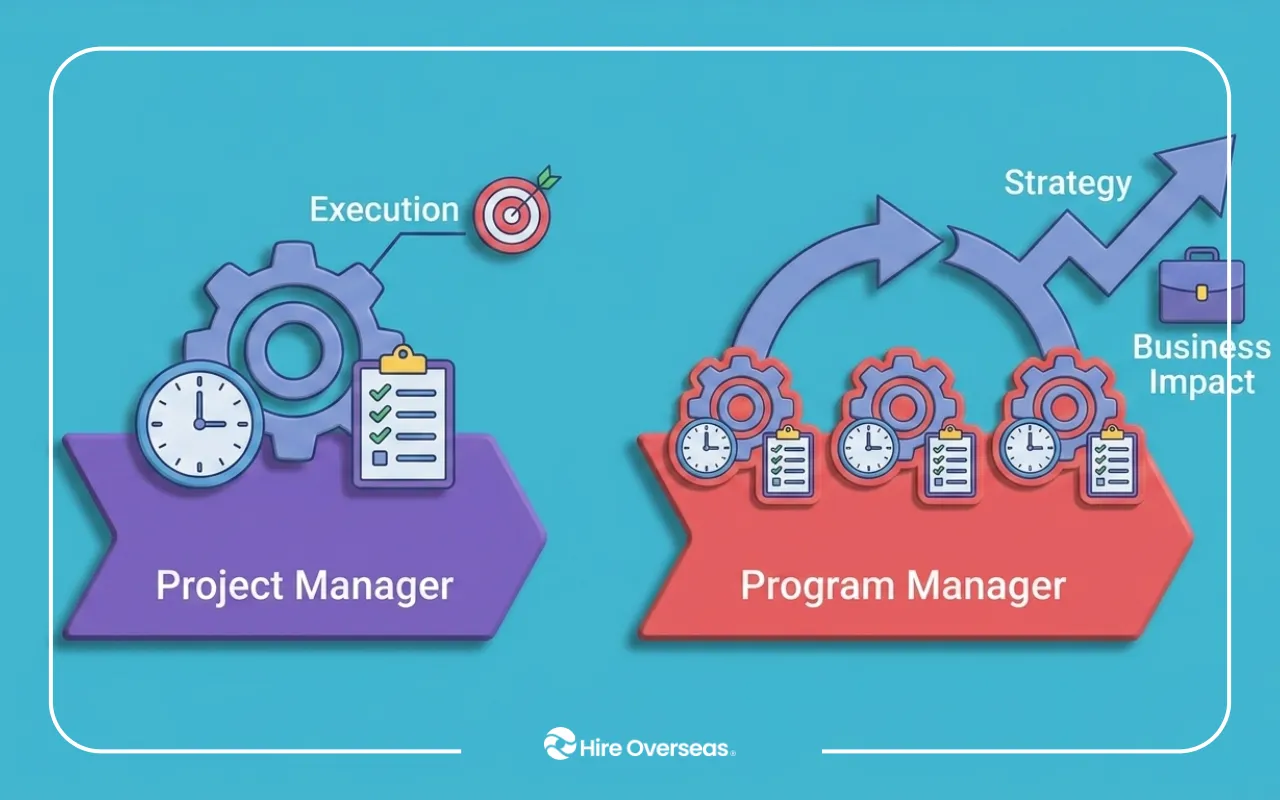
Choosing between a project manager vs. program manager is not always straightforward.
Both roles deal with execution, but they solve different problems.
This guide breaks down the difference simply so you can:
- understand what each role actually does
- identify what your business needs right now
- make the right hiring decision with confidence
Because hiring the wrong role does not fix execution.
It creates more complexity.
What Is a Project Manager vs Program Manager?
The easiest way to understand the project manager vs. program manager difference is this:
- A project manager ensures a specific project gets completed
- A program manager ensures multiple projects work together toward a larger outcome
But when hiring, you need more than definitions.
You need to understand what each role actually owns.
Core Function
Project Manager
- focused on executing a defined project
- ensures timelines, deliverables, and scope are met
- works within a clear start and end point
Program Manager
- focused on aligning multiple projects
- ensures they contribute to broader business goals
- operates across ongoing initiatives, not just one timeline
This is the core difference between program manager and project manager.
What They Own Daily
Project Manager Responsibilities
- tracking tasks and deadlines
- coordinating team members
- managing scope and deliverables
- reporting progress and status
This is what a project manager actually does on a day-to-day basis.
They are focused on keeping a single project moving forward.
Program Manager Responsibilities
- aligning projects across different teams
- managing dependencies between initiatives
- setting priorities across multiple efforts
- resolving cross-team blockers before they escalate
This is what a program manager actually does in business.
They are focused on how work connects, not just how it gets done.
Scope and Focus
Project Manager
- focused on one project at a time
- works within a clearly defined scope
- responsible for execution and delivery
Program Manager
- oversees multiple related projects
- works within a broader and evolving scope
- responsible for outcomes across initiatives
This is one of the key project manager vs. program manager differences.
Authority and Decision-Making
Project Manager
- operates within a defined project scope
- makes decisions related to timelines and delivery
- escalates issues beyond the project level
Program Manager
- influences decisions across teams and projects
- manages trade-offs between competing priorities
- owns outcomes that impact the business as a whole
This explains the program manager vs. project manager hierarchy and decision-making.
What Changes When You Hire Each Role
The real difference becomes clear after the hire.
When you hire a Project Manager:
- projects become more organized
- timelines become more predictable
- tasks get completed more consistently
This is the right solution when:
- work is already defined
- projects are independent
- execution is the main issue
When you hire a Program Manager:
- priorities across projects become clearer
- teams align around shared goals
- dependencies between projects are managed
This is the right solution when:
- multiple projects are connected
- teams need coordination
- priorities compete with each other
Both roles improve execution.
But they improve different layers of the business.
A project manager strengthens how work gets done.
A program manager strengthens how work connects and scales.
Which Role Do You Actually Need to Hire Right Now?
From working with hundreds of growing businesses at Hire Overseas, we see the same pattern repeatedly.
Companies don’t struggle to understand roles.
They struggle to identify the problem they’re actually facing.
And because of that, they hire the wrong one.
These are the most common scenarios we see across different types of businesses.
Scenario 1: An Ecommerce Brand Struggling to Launch Campaigns on Time
The situation:
- product launches are delayed
- marketing campaigns miss deadlines
- tasks pile up across design, ads, and operations
- the team is busy, but execution is inconsistent
What’s actually happening:
There is no clear ownership of execution.
Work exists, but no one is driving it forward consistently.
The right hire: Project Manager
A project manager solves this by:
- structuring campaign timelines
- coordinating between teams
- ensuring deliverables are completed
Why this works:
The problem is execution within a project.
Not coordination across multiple initiatives.
Scenario 2: A SaaS Startup Scaling Across Product, Marketing, and Sales
The situation:
- multiple teams are running projects simultaneously
- priorities shift constantly
- launches overlap or conflict
- teams are productive, but not aligned
What’s actually happening:
Execution is happening.
But it is not connected.
The right hire: Program Manager
A program manager solves this by:
- aligning initiatives across teams
- managing dependencies between launches
- setting clear priorities
Why this works:
The problem is not getting work done.
It is getting work to move in the same direction.
Scenario 3: A Creative Agency Where Founders Are Still Managing Everything
The situation:
- founders are coordinating across client work
- they connect teams and resolve conflicts
- they track timelines and priorities
- execution slows when they step away
What’s actually happening:
The founders have become the coordination layer.
The right hire: Program Manager
A program manager replaces this by:
- owning cross-team coordination
- managing priorities across projects
- removing founders from day-to-day alignment
Why this works:
The bottleneck is not execution.
It is dependency on leadership.
Scenario 4: A Service Business Where Work Stalls Without Follow-Ups
The situation:
- tasks require constant follow-up
- team members wait for direction
- projects stall between steps
- progress depends on reminders
What’s actually happening:
No one is actively driving execution forward.
The right hire: Project Manager
A project manager solves this by:
- tracking deliverables
- ensuring accountability
- maintaining execution momentum
Why this works:
The problem is consistency in execution.
Not strategy or coordination.
The Pattern We See Across Businesses
Across all industries and stages, the pattern is consistent:
- If work is not getting done → you need a project manager
- If work is not working together → you need a program manager
Most businesses don’t need both at the same time.
They need the right one for their current bottleneck.
What This Means for Your Hiring Decision
Before choosing between a project manager vs. program manager, ask:
Where is work breaking down?
- inside projects → project manager
- between teams and initiatives → program manager
From what we’ve seen, this one question is what separates effective hires from wasted ones.
If you've already decided a project manager is the right fit, this breakdown of what makes a good project manager covers the 6 core competencies to screen for before you write a single job description.
How Project Manager vs. Program Manager Needs Change From Startups to Enterprises
The difference between a project manager vs. program manager is not just about roles.
It changes depending on how your business operates at each stage.
From what we see, the same role can either unlock execution or create unnecessary complexity depending on when you hire it.
For Startups: Execution Comes First
In early-stage companies:
- teams are small
- roles are flexible
- priorities shift quickly
At this stage, the main problem is not alignment.
It is getting work done consistently.
Projects exist, but they rely heavily on founders or a few key people to move forward.
What you need: Project Manager
A project manager helps by:
- organizing tasks into clear timelines
- assigning ownership across the team
- ensuring consistent follow-through
This creates structure where there was previously dependency on individuals.
Hiring a program manager too early can:
- introduce unnecessary layers
- slow down decision-making
- create confusion around who owns what
This is why for most startups a project manager is the right first hire.
For Growing Teams: Coordination Becomes the Bottleneck
As the business grows:
- more people are involved
- more projects run at the same time
- different teams start working in parallel
At this stage, execution may still be strong within each team.
But issues begin to appear between teams.
For example:
- marketing launches before product is ready
- sales pushes features that are not aligned with delivery
- priorities shift without clear communication
What you need: Program Manager
A program manager helps by:
- aligning teams around shared priorities
- managing dependencies between projects
- creating visibility across the business
This ensures that work does not just get done, but moves in the same direction.
This is when a program manager role in a growing business team becomes necessary.
For Enterprises: Both Roles Become Essential
In larger organizations:
- teams operate independently
- projects scale in volume and complexity
- coordination becomes a full-time function
At this level:
- project managers ensure projects are delivered
- program managers ensure projects align with business goals
Each role operates at a different layer.
And both are required to maintain speed and consistency.
What Most Businesses Get Wrong
- Startups hire too early for coordination
- Growing teams wait too long to fix it
- Enterprises assume one role can do both
This is why understanding how these roles evolve with your business is critical.
How Project Managers and Program Managers Work Together in a Scaling Business
Once your business reaches a certain level of complexity, this is no longer a choice between roles.
It becomes about how they work together.
Project Managers Own Execution
Project managers are responsible for:
- delivering specific projects
- managing timelines and tasks
- ensuring work gets completed as planned
They focus on turning plans into completed work.
Without them, projects tend to stall or lose momentum.
Program Managers Own Alignment
Program managers are responsible for:
- connecting multiple projects
- aligning priorities across teams
- resolving conflicts before they slow execution
They focus on how work fits together at a business level.
Without them, projects may succeed individually but create friction collectively.
How the Roles Interact in Practice
In a well-structured business:
- project managers focus on execution within their projects
- program managers ensure those projects are aligned
For example:
- a project manager runs a product launch timeline
- another manages a marketing campaign rollout
- the program manager ensures both timelines, messaging, and priorities are coordinated
This prevents:
- misaligned launches
- duplicated work
- conflicting priorities
Why This Structure Works
Without a program manager:
- projects move forward
- but teams may work in silos
- coordination depends on leadership
Without project managers:
- priorities may be clear
- but execution becomes inconsistent
Each role solves a different layer of the same problem.
The Transition Most Businesses Miss
Many companies:
- hire project managers early
- delay hiring a program manager
As a result:
- founders become the coordination layer
- cross-team issues increase
- execution slows as complexity grows
This is often the point where businesses feel “busy but not efficient.”
What This Means for You
If you are deciding between roles:
- early stage → start with a project manager
- as complexity increases → introduce a program manager
Eventually:
- both roles work together to support scale
Because that is what allows your business to grow without relying on constant oversight.
Project Manager vs. Program Manager: Full Comparison Matrix
If you want to see how the right project management hire transforms operations, the Golden Egg case study shows how they eliminated founder bottlenecks and reclaimed 20+ hours a week by bringing on an offshore project manager.
Your Final Check Before Hiring a Project or Program Manager
Most businesses don’t get this wrong because they lack options.
They get it wrong because they misidentify the problem.
Use this as your final decision check.
You Need a Project Manager If:
- projects are delayed or not finishing
- tasks require constant follow-up
- timelines are unclear or inconsistent
- your team knows what to do but struggles to execute
Your bottleneck is execution.
You Need a Program Manager If:
- multiple projects are running at the same time
- teams are misaligned or working in silos
- priorities constantly shift or conflict
- you are the one coordinating everything
Your bottleneck is coordination.
You Might Need Both If:
- you have multiple teams and ongoing initiatives
- execution is strong, but alignment is weak
- you are still involved in connecting everything
Your business is entering a scaling phase.
What This Tells You
If you’re still:
- managing timelines
- aligning teams
- pushing work forward
Then the issue is not capacity. It is structure.
And the right hire is the one that removes you from that layer of work.
If you’re hiring soon, the risk is not hiring too late. It’s hiring the wrong role.
Start with a quick discovery call and we’ll help you get that decision right the first time.
