


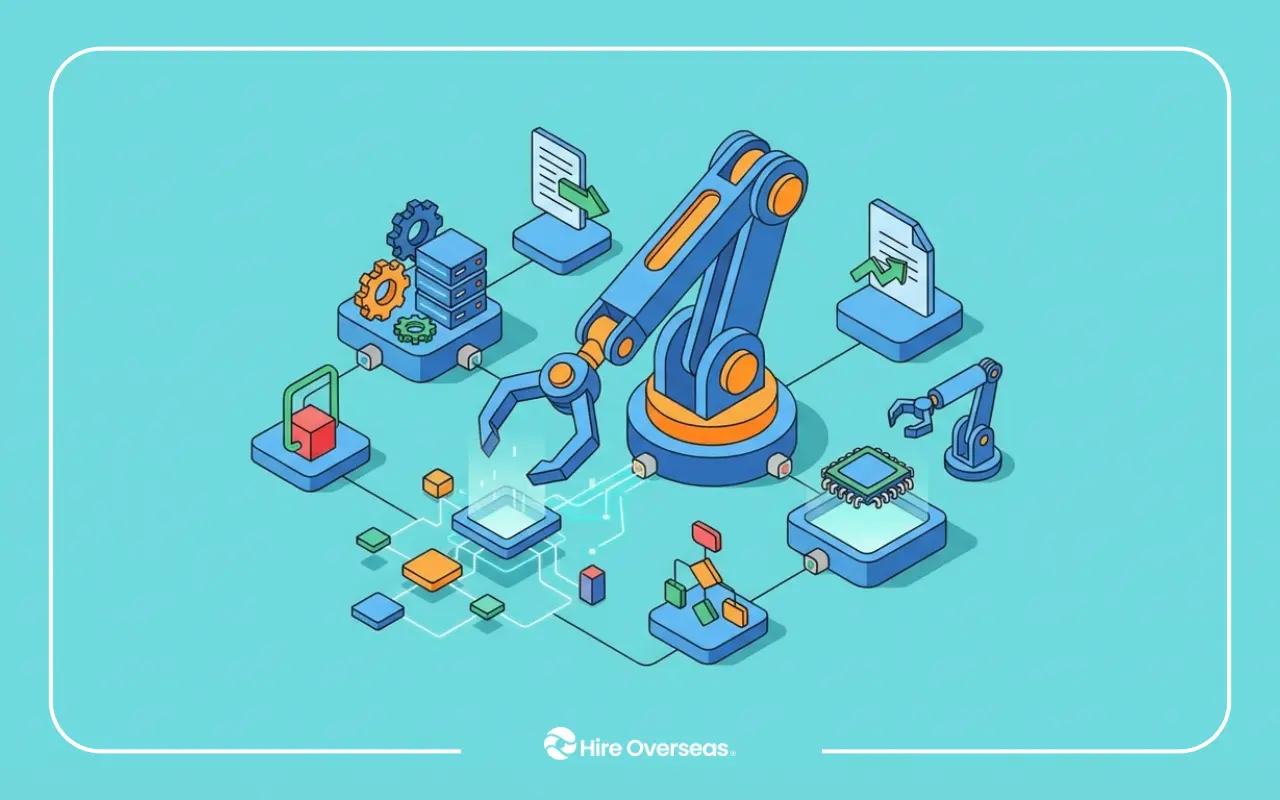
AI is no longer just about generating content or answering prompts. Companies are now asking a more serious question:
How do we move from AI tools to AI operators?
If you are exploring what is OpenClaw, you are likely thinking beyond chatbots. You are looking at autonomous execution, workflow automation, and AI systems that actually run parts of your operations.
At Hire Overseas, we help companies build AI-powered operations teams. Understanding platforms like OpenClaw is essential because tools alone do not scale businesses. Structured human-in-the-loop teams do.
This guide explains OpenClaw through an operational lens, not just a technical one.
What Is OpenClaw? A Clear Explanation for Business Leaders
What Is an AI Agent?
Before answering what OpenClaw is, it is important to understand what an AI agent actually is.
An AI agent is a software system designed to complete tasks autonomously. Instead of simply responding to a prompt, it receives a goal and works toward achieving it through structured execution.
An AI agent typically:
- Receives a defined objective
- Breaks that objective into smaller steps
- Plans actions
- Uses tools or APIs
- Executes tasks
- Evaluates outcomes
- Adjusts its approach based on results
The defining characteristic is autonomy. The system is not waiting for constant prompts. It can reason through multi-step workflows within defined boundaries.
For example:
- A chatbot answers: “What were our sales last month?”
- An AI agent logs into your CRM, retrieves the data, analyzes trends, generates a summary, and emails a report to your leadership team.
This is why AI agents are becoming central to modern AI-powered operations.
At Hire Overseas, we see this shift firsthand. Companies are no longer asking how to use AI for writing. They are asking how to operationalize AI across workflows. That conversation always begins with understanding what an AI agent truly is.
AI Agent vs. Chatbot
Many business leaders confuse AI agents with chatbots. They are not the same.
An AI agent works.
This distinction is critical when evaluating platforms like OpenClaw.
If you're moving from chatbot experiments to real execution systems, this breakdown of AI workflow operators in the Philippines explains how businesses supervise autonomous agents without adding internal headcount.
What Is OpenClaw?
Now that the category is clear, we can define the platform.
OpenClaw is an open source AI agent framework designed to build and deploy autonomous AI agents capable of planning, executing, and managing multi-step tasks across real business systems.
It was previously known as ClawDBot, then MoltBot, before evolving into OpenClaw.
The progression looks like this:
ClawDBot → MoltBot → OpenClaw
This was not a complete rebuild, but an evolution. As the platform expanded beyond database-driven automation into broader AI-powered workflow orchestration, the original names no longer reflected its scope.
The rebrand to OpenClaw represents:
- Expanded automation capabilities
- Improved integration architecture
- Greater scalability for production environments
- A unified system identity
In short, OpenClaw is the matured version of earlier AI automation frameworks, redesigned for structured, goal-driven execution.
What Does OpenClaw Do?
OpenClaw enables AI agents to move beyond conversation and into execution.
Instead of simply responding to prompts, an OpenClaw agent can:
- Break down complex goals into structured tasks
- Call APIs and external tools
- Interact with CRMs, dashboards, and databases
- Execute automated workflows
- Evaluate results
- Iterate until completion
Its core purpose is automation, integration, and AI-enhanced workflow execution.
For businesses, this means moving from AI-assisted thinking to AI-driven operational action.
OpenClaw does not just generate answers.
It orchestrates processes.
OpenClaw vs ChatGPT, AutoGPT, LangChain, and Other Tools
Once you understand what OpenClaw is, the next logical question is:
How does it compare to other AI tools and agent frameworks?
This comparison is important because many executives mistakenly evaluate OpenClaw as if it were just another chatbot. It is not.
OpenClaw operates in the agentic AI infrastructure layer, which is very different from conversational AI tools.
Let’s break it down clearly.
OpenClaw vs. ChatGPT
This is the most common comparison.
ChatGPT is a conversational AI tool.
It is designed to generate responses to prompts.
OpenClaw is an execution framework.
It is designed to build autonomous AI agents that complete multi-step workflows.
In simple terms:
- ChatGPT answers
- OpenClaw acts
ChatGPT can draft a report if you ask for it.
OpenClaw can retrieve data, analyze it, generate the report, format it, and deliver it automatically.
They are complementary, not competitors.
In fact, ChatGPT or similar models can be used inside OpenClaw as the reasoning engine. OpenClaw simply adds execution, memory, and tool orchestration around the model.
OpenClaw vs. Traditional Chatbots
OpenClaw vs traditional chatbots is primarily about scope.
Traditional chatbots:
- Handle FAQs
- Follow predefined scripts
- Respond within limited logic trees
OpenClaw-powered agents:
- Break down complex goals
- Call APIs
- Access business systems
- Execute structured workflows
- Iterate toward completion
A chatbot answers questions.
An OpenClaw agent completes objectives.
For businesses building AI-powered operations, that distinction is critical.
OpenClaw vs. Prompt-Based AI Tools
Prompt-based AI tools focus on generating outputs from text instructions.
They are reactive.
OpenClaw, by contrast, orchestrates processes.
It:
- Maintains task memory
- Connects multiple tools
- Executes multi-step logic
- Monitors intermediate results
Prompt tools are ideal for content generation.
OpenClaw is built for operational automation.
OpenClaw vs. AutoGPT
AutoGPT was one of the first frameworks to popularize autonomous AI loops.
OpenClaw vs AutoGPT can be understood this way:
- AutoGPT introduced goal-driven execution concepts
- OpenClaw emphasizes modular architecture
- OpenClaw is structured for cleaner production deployment
- OpenClaw offers more control over tool integration and monitoring
AutoGPT helped define the category.
OpenClaw focuses on operational maturity within that category.
For businesses concerned with stability and governance, architecture matters.
OpenClaw vs. LangChain
LangChain is a framework for building LLM-based pipelines.
OpenClaw vs LangChain differs in focus:
- LangChain builds chains of model interactions
- OpenClaw builds autonomous agents
- LangChain is component-focused
- OpenClaw is goal-focused
LangChain is often used to construct workflows and tool integrations.
OpenClaw is used to create agents that autonomously drive those workflows toward completion.
They can overlap, but they solve different layers of the stack.
OpenClaw vs CrewAI
CrewAI specializes in multi-agent collaboration.
OpenClaw vs CrewAI:
- CrewAI focuses on coordinating multiple agents with assigned roles
- OpenClaw focuses on structured task autonomy within a single agent framework
If your goal is orchestrating multiple specialized AI agents, CrewAI may be relevant.
If your goal is building reliable, structured autonomous execution pipelines, OpenClaw may be the cleaner fit.
OpenClaw vs. Anthropic Agents
Anthropic agents are typically integrated tightly within Anthropic’s ecosystem.
OpenClaw vs Anthropic agents:
- OpenClaw is open source
- Anthropic agents are ecosystem-specific
- OpenClaw offers model flexibility
- Anthropic agents may be limited to Claude-based integrations
For companies that want model-agnostic infrastructure and greater control, OpenClaw provides more architectural independence.
How OpenClaw Works and What It Means for AI-Driven Operations
Understanding what OpenClaw is gives you the definition.
Understanding how it operates inside real business systems determines whether it belongs in your infrastructure.
OpenClaw functions as a structured execution engine for autonomous AI agents. It is not simply generating outputs. It is coordinating actions across systems.
The Structured Execution Model
At its core, OpenClaw operates through a goal-driven loop:
- A high-level objective is defined
- The agent decomposes that objective into structured tasks
- It selects and calls relevant tools or APIs
- It executes actions step by step
- It evaluates intermediate results
- It iterates until the objective is completed
This allows the system to function autonomously within defined operational boundaries.
Unlike prompt-based tools that stop after producing text, OpenClaw agents continue working until the assigned goal is achieved.
This is what makes it an execution framework rather than a conversational layer.
The Integration Layer: Where OpenClaw Gains Power
OpenClaw’s real leverage comes from its ability to integrate directly with business infrastructure.
It can connect to:
- CRMs
- Databases
- Analytics dashboards
- Internal reporting systems
- Communication platforms
- Project management tools
This transforms AI from an assistant into a workflow operator.
However, the deeper the integration, the greater the responsibility.
Execution capacity increases.
So does operational exposure.
From Experimentation to Production
Many AI tools perform well in isolated demos.
Production environments introduce new variables:
- Live customer data
- Financial reporting systems
- Compliance requirements
- Access control constraints
- API changes
- System outages
Deploying OpenClaw in production often requires:
- Secure authentication and API governance
- Role-based access controls
- Containerized runtime environments
- Monitoring and logging systems
- DevOps integration
- Automation pipeline optimization
At this stage, OpenClaw is no longer a tool.
It becomes infrastructure.
Infrastructure requires ownership.
The Overlooked Layer: Autonomous Does Not Mean Self-Sufficient
An OpenClaw agent can:
- Execute workflows
- Call APIs
- Generate outputs
- Iterate toward completion
But it still requires:
- Performance monitoring
- Exception handling
- Prompt and logic refinement
- Integration maintenance
- Governance oversight
- Continuous optimization
This is where many companies miscalculate.
They assume autonomy equals independence.
In reality, autonomy increases the need for structured oversight.
We see organizations successfully implement agentic AI systems only when they pair them with AI-ready operations teams who:
- Monitor system behavior
- Manage edge cases
- Maintain integrations
- Review outputs for accuracy
- Continuously improve workflows
Autonomous AI increases execution capacity.
AI-powered operations teams ensure reliability, accountability, and long-term scale.
If you’re deploying autonomous AI systems but lack internal technical oversight, this guide to hiring AI talent in the Philippines shows how companies build cost-efficient monitoring and integration teams for agent-based infrastructure.
The Strategic Question Leaders Should Be Asking
When evaluating OpenClaw, the conversation often centers on capability.
A more important question is ownership:
- Who monitors the agent daily?
- Who maintains system connections?
- Who handles exceptions?
- Who ensures compliance?
- Who improves performance over time?
OpenClaw enables execution.
Operational maturity determines sustainable ROI.
And that intersection — execution frameworks supported by structured AI operations teams — is where businesses move from AI experimentation to scalable AI-driven operations.
How to Use, Install, and Deploy OpenClaw in Production
Understanding how OpenClaw works conceptually is one step. Deploying it in a real environment is another.
If you are researching how to use OpenClaw, here is a simplified operational breakdown.
How to Install OpenClaw
Typical OpenClaw installation steps include:
- Cloning the repository
- Installing required dependencies
- Configuring API keys
- Setting environment variables
- Initializing the runtime environment
This phase represents your OpenClaw local setup. It allows teams to test functionality before introducing live data or production systems.
OpenClaw Local Runtime Environment
During local testing, teams validate:
- Task execution loops
- Tool and API connectivity
- Prompt and logic structure
- Error handling behavior
- Output accuracy
This stage is critical. Autonomous execution should always be validated in a controlled environment before OpenClaw cloud deployment.
Local testing reduces operational risk and reveals integration gaps early.
OpenClaw Cloud-Based Configuration
For production use, OpenClaw cloud deployment often includes:
- Containerized AI agent environments
- Deployment via Docker or Kubernetes
- Secure API routing and credential management
- Logging and monitoring infrastructure
- Scalable runtime configuration
At this level, OpenClaw shifts from tool to infrastructure.
And infrastructure requires governance.
If your OpenClaw deployment requires containerization, API hardening, or DevOps support, this guide to outsourcing web development explains how companies extend their technical bench without increasing fixed payroll.
OpenClaw Implementation Guide for Enterprises
Enterprise-grade OpenClaw production deployment typically requires:
- Role-based access control
- Governance tracking and audit layers
- Runtime monitoring and logging
- Performance scaling strategies
- DevOps integration
- Structured automation pipeline optimization
This is where many companies underestimate complexity.
AI agents interacting with CRMs, financial dashboards, and internal systems introduce new operational risk if not properly supervised.
Autonomous AI agents require:
- Ongoing monitoring
- Integration maintenance
- Exception handling
- Continuous optimization
Many companies underestimate the complexity of production deployment.
When AI agents operate across live business systems, operational risk increases.
The difference between experimentation and scalable AI execution is structured oversight.
For enterprises that need specialized oversight beyond general VAs, this overview of Filipino AI experts explains how companies hire integration specialists, automation engineers, and AI operations managers without building full internal teams.
Hire Overseas Strategic Insight: AI Execution Requires Operational Ownership
OpenClaw enables businesses to move from AI-assisted thinking to AI-driven execution. It can orchestrate workflows, integrate with business systems, and automate multi-step tasks across your infrastructure.
But autonomous does not mean self-sufficient.
AI agents still require monitoring, optimization, governance, and integration maintenance. Without structured oversight, automation introduces operational risk instead of leverage.
The companies that succeed with agentic AI systems are not just adopting better tools. They are building AI-ready operations teams to manage them.
At Hire Overseas, we help businesses scale responsibly by providing remote AI operations specialists who:
- Supervise autonomous AI agents
- Maintain API and system integrations
- Handle exceptions and edge cases
- Refine execution logic
- Ensure compliance and quality control
AI increases execution capacity.
Dedicated operators ensure reliability and long-term ROI.
If you’re implementing OpenClaw or other AI agent frameworks, the most important question is not which tool to use — it’s who will run it.
Book your AI operations strategy call with Hire Overseas today and build a team that turns automation into scalable growth.
