


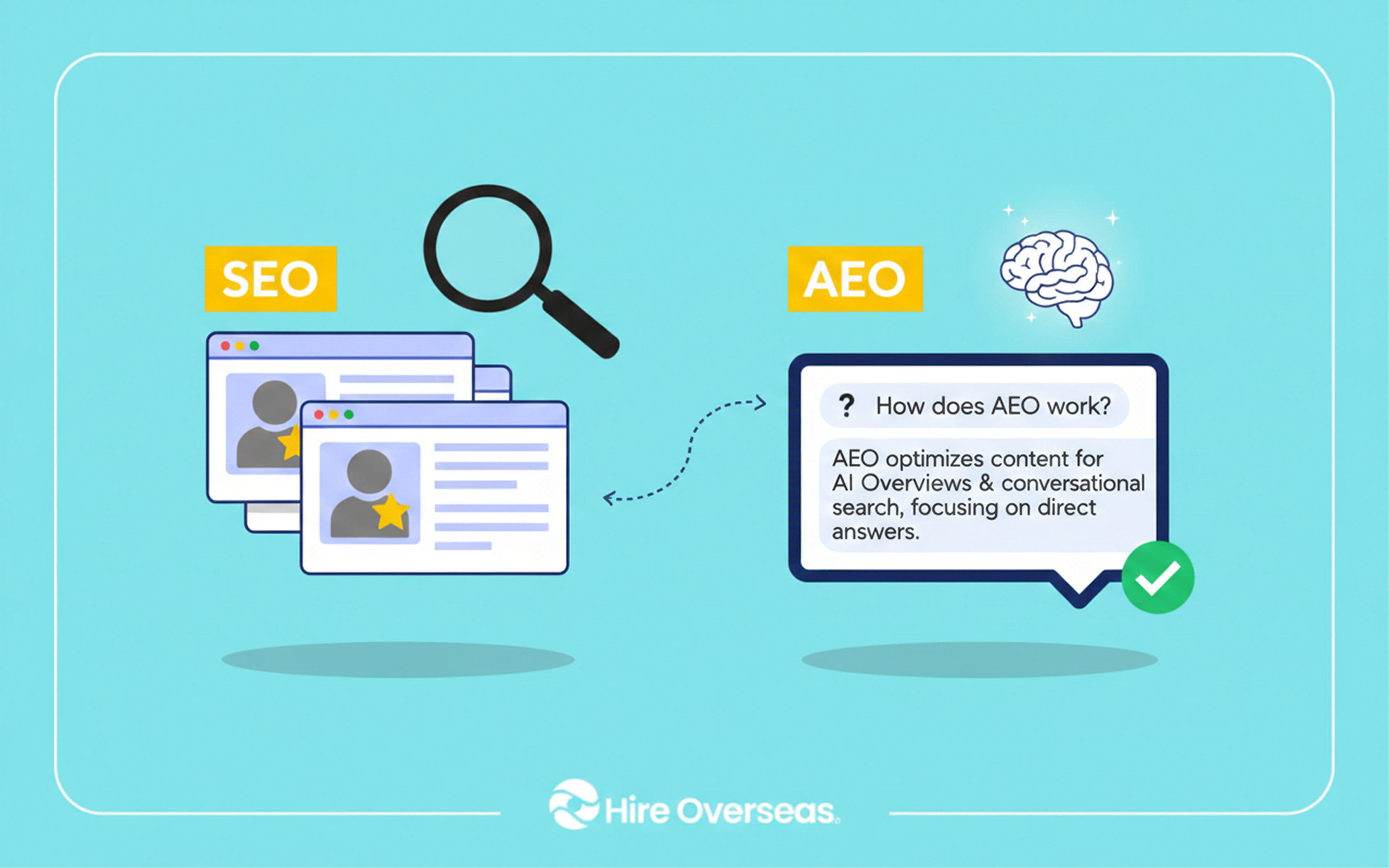
Search is no longer just about ranking web pages. It is about being selected as the answer.
As AI-powered search, conversational interfaces, and zero-click searches reshape how users find information, startups are being forced to rethink how visibility works. The rise of AI overviews and AI chat tools has changed the rules, but not in the way many founders assume.
This guide breaks down AEO vs. SEO, explains what has actually changed, and shows how startups should adapt without abandoning what already works.
What Is Search Engine Optimization (SEO)?
Search engine optimization (SEO) is the practice of improving a website’s visibility in traditional search engine results, where users are presented with a list of links and choose which page to click.
SEO helps search engines understand what a page is about, assess its credibility, and determine where it should rank compared to competing content. The focus is on making pages discoverable, relevant, and authoritative.
SEO typically involves optimizing:
- Keywords and topical relevance so pages align with search intent
- Backlinks and authority signals to establish trust and credibility
- Technical structure and crawlability to ensure efficient indexing
- Content depth and quality to demonstrate expertise and usefulness
The primary goal of SEO is to rank pages high enough that users click through, engage with the content, and continue deeper into the website.
What IS Answer Engine Optimization (AEO)?
Answer engine optimization (AEO) is the practice of structuring content so AI-powered systems can interpret, extract, and deliver it as a direct answer to a user’s question.
Instead of optimizing for a list of links, AEO optimizes content for AI overviews, conversational search, and AI chat interfaces, where information is summarized or quoted without requiring a click.
AEO focuses on enabling AI systems to:
- Extract direct, unambiguous answers
- Understand context and intent clearly
- Trust the source enough to reuse its content
- Satisfy user intent immediately, even in zero-click searches
AEO vs. SEO comes down to ranking versus answering. SEO makes content discoverable within search results. AEO makes content usable by AI-powered search systems that increasingly function as the user’s primary interface to information.
What Is the Difference Between AEO vs. SEO in Today’s Search Landscape
Search engine optimization (SEO) was built for a search engine that returned links. Answer engine optimization (AEO) exists because search engines now return answers.
As AI-powered search, AI overviews, and conversational search become standard, the difference between AEO vs. SEO is no longer abstract. It directly affects how content is written, structured, and surfaced.
SEO Optimizes Pages, AEO Optimizes Answers
Traditional SEO is page-centric. It treats a page as the unit of value and optimizes it holistically around a topic. Rankings are influenced by how well the entire page performs across relevance, authority, and engagement signals.
AEO is answer-centric. It treats individual answer blocks as the unit of value. AI systems do not evaluate an article from top to bottom. They extract specific sections that clearly and confidently resolve a question.
If a key concept is buried inside long paragraphs, surrounded by filler, or explained indirectly, it is far less likely to be selected. Clear definitions, structured headings, and concise explanations dramatically increase extractability.
Key difference: SEO rewards comprehensive pages. AEO rewards precise answers inside those pages.
SEO Competes for Rankings, AEO Competes for Selection
SEO is a competitive ranking model. Multiple pages can rank for the same query, and users choose which result to click.
AEO operates on a selection model. AI systems choose one or two trusted sources to quote, summarize, or synthesize into an answer.
In AI-driven environments, the question is no longer who ranks first, but which source the system trusts enough to represent the truth. This trust is shaped by:
- Consistency of explanations across the site
- Clarity and lack of contradiction
- Topical authority over time
- Clean structure that reduces ambiguity
Key difference: SEO competes on visibility. AEO competes on trust and clarity.
SEO Assumes Clicks, AEO Assumes Zero-Click Searches
SEO was designed around user behavior that involves clicking, browsing, and navigating deeper into a website. Traffic and engagement metrics became the primary measures of success.
AEO assumes that many searches will be resolved instantly. In zero-click searches, AI overviews and conversational search tools answer the question directly, often without sending the user anywhere.
In this environment, success looks different. Influence, authority, and brand recall replace raw pageviews as primary value drivers. Being cited or summarized by AI systems shapes perception earlier in the decision cycle, even if no visit occurs.
Key difference: SEO measures performance through traffic. AEO measures performance through presence and influence.
SEO Targets Keywords, AEO Targets Intent
SEO traditionally groups keywords into clusters and builds content to cover those variations. This works well when users type short, fragmented queries.
AEO targets explicit intent expressed as full questions, especially in conversational search. AI systems prioritize content that directly mirrors how users ask questions, such as:
- What is the difference between AEO vs. SEO
- How does AEO work in AI overviews
- Does SEO still matter for AI chat
Content that answers these questions directly, early, and clearly is far more likely to be reused.
This explains why many pages rank well yet never appear in AI-driven results. They are optimized for keyword coverage, not intent resolution.
Key difference: SEO matches queries. AEO resolves questions.
SEO Emphasizes Discovery, AEO Emphasizes Comprehension
SEO is optimized for discovery. Its job is to help users find content.
AEO is optimized for comprehension. Its job is to help AI systems understand, interpret, and reuse content accurately.
This shifts how content should be written. Logical sequencing, explicit definitions, and unambiguous phrasing become more important than stylistic flair or narrative buildup.
Key difference: SEO helps content get found. AEO helps content get understood.
SEO Is a Channel, AEO Is an Interface Strategy
SEO historically functioned as a traffic channel. It fed users into websites.
AEO operates at the interface level. It influences what users see inside AI-powered search, voice assistants, and chat-based systems that increasingly sit between brands and users.
This makes AEO more tightly connected to brand positioning and trust than traditional SEO ever was.
Key difference: SEO drives users to your site. AEO shapes how your brand speaks when AI speaks for you.
In regulated industries where AI accuracy matters more than traffic, this healthcare SEO playbook shows how AEO and traditional SEO must work together.
AEO vs. Traditional SEO in AI-Powered Search
AI-powered search changes how information is selected, not just how it is ranked. Understanding how AI systems consume, interpret, and reuse content is the key to understanding the difference between AEO and traditional SEO.
Search is no longer just a discovery mechanism. It is becoming an answer delivery system. That shift affects every decision about how content should be written and structured.
How AI-Powered Search Actually Works
Traditional search engines ranked pages and left the final choice to the user. AI-powered search systems operate differently.
Instead of presenting a list of links, AI systems:
- Identify sources that consistently demonstrate expertise
- Extract specific sections that directly answer a question
- Interpret context to avoid misrepresentation
- Synthesize information into a single response
AI does not “read” pages the way humans do. It evaluates whether content can be safely summarized and reused without distorting meaning. This is why clarity and structure now matter as much as authority.
Why Traditional SEO Alone Is No Longer Enough
Traditional SEO focuses on discoverability. It ensures pages are crawlable, indexable, and competitive in rankings.
This foundation is still essential, but it stops short of what AI-powered search requires.
SEO performs best when:
- Users click into pages
- Information is explored gradually
- Answers are discovered through reading
AI-powered search bypasses this process. It does not browse pages or scan for interesting sections. It evaluates whether content can be understood quickly and reused accurately.
Traditional SEO creates access.
It does not guarantee selection.
How AEO Fits Into AI-Powered Search
Answer engine optimization exists to bridge this gap.
AEO focuses on structuring content so AI systems can:
- Recognize intent immediately
- Identify clear, self-contained answers
- Validate context and accuracy
- Reuse information with minimal interpretation
This is why AEO prioritizes explicit headings, direct definitions, and concise explanations. Content written primarily for human scanning or narrative flow often underperforms because it forces AI to infer meaning.
AI systems do not infer well.
They prefer clarity.
For teams moving beyond theory, this AEO ranking playbook breaks down how to structure answers so AI systems can reliably extract and reuse them.
How AI Overviews Change Optimization Priorities
AI overviews reward content that removes uncertainty.
They prioritize content that is:
- Logically structured and easy to segment
- Direct in its explanations without unnecessary buildup
- Simple to summarize without losing accuracy
- Reinforced by consistent topical authority
Content optimized only for word count or keyword saturation often introduces ambiguity, which increases the risk of misinterpretation. AI systems avoid this risk by selecting clearer alternatives.
In AI overviews, precision consistently beats comprehensiveness.
How Conversational Search Changes Content Structure
Conversational search mirrors how people naturally ask questions, not how they type fragmented queries.
Because of this, AI systems favor content that:
- Uses question-led headings aligned with intent
- Places definitions and answers near the top
- Breaks ideas into short, complete explanations
- Maintains a clean logical progression
Traditional SEO allowed users to hunt for answers by scrolling. Conversational search requires the answer to be immediately obvious.
If an answer cannot stand alone, it is unlikely to be reused.
Why Traditional SEO Still Matters
AEO does not replace SEO. It depends on it.
Technical health, crawlability, backlinks, internal linking, and topical authority still determine whether content is even eligible for AI-powered search.
Without strong SEO foundations:
- Content may not be indexed
- Authority signals remain weak
- AI systems may ignore the source entirely
SEO gets you considered.
AEO determines whether you are used.
Startups that skip SEO fundamentals in favor of surface-level AEO tactics often lose visibility across both systems.
How AEO vs. SEO Works in AI Overviews and AI Chat
AI chat systems do not rank pages. They select sources.
They reference, paraphrase, or synthesize from a small number of trusted inputs. This selection process favors content that is consistent, unambiguous, and easy to interpret.
If content requires heavy interpretation or contains conflicting explanations, it is unlikely to be used, regardless of how well it ranks traditionally.
In AI chat environments, structure and clarity directly influence whether a source is reused repeatedly.
Visibility Without Traffic Is Still Influence
In AI-powered search, visibility often occurs without a click.
Appearing in AI overviews or AI chat responses influences:
- Brand recall before evaluation begins
- Trust during early decision-making
- Perceived authority across repeated exposures
For startups, this means traffic alone is no longer a reliable measure of search performance. Influence increasingly happens earlier, quieter, and upstream of conversion.
Ignoring this layer creates blind spots where rankings appear stable while real influence declines.
The Mental Model to Keep
If there is one framework to remember:
- SEO helps you get found
- AEO helps you get chosen
- AI-powered search decides who gets repeated
That distinction is the difference between visibility and authority in modern search.
AEO vs. SEO: A Practical Comparison for Startups
Note: SEO and AEO are complementary, not competing. SEO makes content eligible to appear. AEO determines whether it is chosen and reused by AI-powered search systems.
Hire Overseas Insider: How Startups Should Approach AEO vs. SEO Moving Forward
The biggest mistake founders make is treating AEO vs. SEO as a fork in the road.
It is not a choice. It is a sequencing problem.
After helping startups build and scale remote teams across growth, content, and operations, one pattern shows up consistently: search strategies fail less because of bad thinking and more because of broken execution.
Founders usually understand what needs to happen. What breaks is ownership.
Here is how we advise teams to approach it.
SEO as the Foundation
Search engine optimization still drives discoverability, authority, and long-term compounding value. It is not obsolete, and it should not be deprioritized.
Strong SEO fundamentals ensure:
- Your content is crawlable and indexable
- Your site builds topical authority over time
- AI systems recognize your domain as a credible source
Without this foundation, AEO efforts struggle to gain traction. You cannot be selected as an answer if you are not first considered as a source.
At Hire Overseas, we consistently see teams run into trouble when SEO becomes “someone’s side project” instead of owned infrastructure. When ownership is unclear, execution becomes inconsistent, and authority erodes quietly.
Layer Answer Engine Optimization on Top
Answer engine optimization is not a replacement for SEO. It is a refinement layer.
AEO reshapes existing content so it performs inside:
- AI-powered search experiences
- Conversational search interfaces
- AI overviews and summaries
- Generative search optimization (GEO) systems
This work is less about producing more content and more about restructuring what already exists. Explanations are tightened. Intent is made explicit. Answers are surfaced clearly.
The goal is to make high-quality content usable by AI systems, not just readable by humans.
This is an evolution, not a reset. Teams that try to start over usually lose momentum and the authority they have already built.
For startups that need continuous SEO + AEO execution without rebuilding teams, this guide to outsourcing SEO services explains how long-term ownership actually works.
Assign Ownership, Not Just Strategy
This is where most startups break down.
AEO requires:
- Consistent execution
- Ongoing content updates
- Clear accountability for performance
Founders often understand the strategy, but no one owns the work end-to-end. SEO lives with marketing. Content lives with growth. AEO lives nowhere.
Our advice is simple: assign a dedicated operator who understands SEO vs. AEO differences and is responsible for both execution and upkeep. When ownership is unified, search stops being fragile.
Many founders solve this by hiring remote SEO specialists or content operators through Hire Overseas. This makes long-term execution more cost-effective and accessible.
If budget pressure is the reason SEO ownership keeps breaking, these benefits of outsourcing SEO services show why remote execution is often more durable than early in-house hires.
Build Search as Infrastructure, Not a Campaign
One of the most effective shifts startups can make is treating search as infrastructure instead of a series of disconnected initiatives.
When SEO and AEO are executed through short-term projects, agencies, or rotating contributors, consistency breaks. Content drifts. Updates stall. And authority erodes quietly over time.
The teams that perform best assign long-term ownership to search. They rely on operators who understand how traditional SEO and answer engine optimization work together and who can maintain structure, clarity, and intent across every update.
This is often where remote-first models outperform early in-house builds. A dedicated SEO or content operator can stay focused on execution, maintenance, and iteration without the overhead or churn that comes with hiring too early.
At Hire Overseas, we see this model work repeatedly. Founders embed experienced SEO and AEO-capable operators directly into their workflows, giving search a single point of ownership. Pricing typically starts around $2,000 per month, which makes long-term consistency achievable without stretching early-stage budgets.
The result is not louder marketing. It is a search infrastructure that compounds quietly and becomes harder to displace over time.
When SEO and AEO fail because no one truly owns execution, this in-house vs outsourcing breakdown shows which model actually survives shifting startup priorities.
Search Is Becoming Infrastructure, Not a Tactic
The shift from SEO to AEO is not about chasing algorithms or reacting to AI trends. It is about recognizing how search actually works now.
Search is no longer just a traffic channel. It is an influence layer. AI-powered search, AI overviews, and conversational interfaces increasingly decide which brands are seen, trusted, and remembered before a buyer ever clicks a link.
The startups that win in this environment do not ask whether they should focus on SEO or AEO. They focus on building durable execution. They assign ownership. They maintain clarity. And they treat search as infrastructure that compounds quietly over time.
If your growth depends on organic discovery, the real question is not what strategy to choose. It is who is responsible for executing it consistently.
If you want to see what a durable SEO + AEO execution model looks like in practice, you can schedule a demo with Hire Overseas to talk through your goals, current setup, and where AI-powered search fits into your growth plan.
No pitches. Just a clear conversation about how to build search that holds up as the landscape keeps changing.
