


For first-time founders, hiring rarely starts with legal theory. It starts with a need. Work is piling up. The team is stretched. You need help fast.
That is where the independent contractor vs. employee question appears. And for startups, this is often the first real compliance decision you make as a company.
Most early teams choose based on speed or cost. Regulators evaluate based on structure and control. When those two views do not align, misclassification risk begins.
This guide explains employee vs. independent contractor classification in plain terms, shows how regulators actually decide status, and helps startups make the right call from day one.
Why Independent Contractor vs. Employee Matters for First-Time Hiring
For a startup, employee classification is not just HR paperwork. It determines:
- Payroll taxes vs. contractor taxes
- Eligibility for benefits employees vs. contractors
- Labor law classification obligations
- Long-term compliance exposure
Misclassifying even one worker can trigger audits, back taxes, and penalties that early-stage companies are least equipped to handle.
This is why worker classification rules matter before you make your first hire, not after.
Independent Contractor vs. Employee: The Real Structural Difference
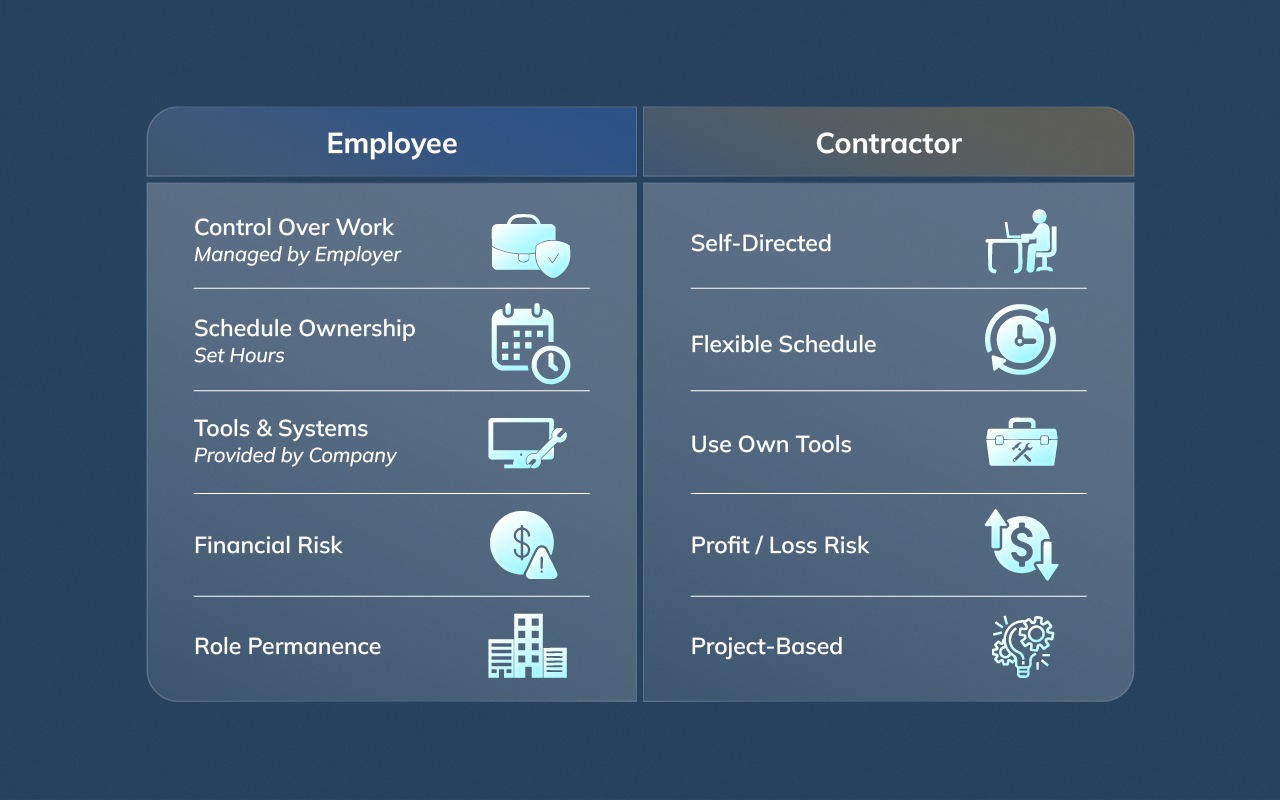
The difference is not where someone works or how they are paid. It is about control and dependency.
What Makes Someone an Employee
An employee operates inside your business.
They follow your schedule, use your tools, report to your managers, and perform work that is central to how your company runs.
Employees trigger:
- Withheld payroll taxes
- Employer tax contributions
- Benefits and labor protections
- Employment law compliance obligations
What Makes Someone an Independent Contractor
An independent contractor operates outside your organization.
They control how the work is done, often work with multiple clients, and deliver defined outcomes instead of ongoing labor.
Contractors require:
- Proper independent contractor classification
- A clear contractor agreement vs. employment contract
- No benefits or tax withholding
- Limited behavioral control
This distinction is the foundation of independent contractor classification.
How the IRS and Department of Labor Decide If a Worker Is an Employee
How the IRS and Department of Labor Decide If a Worker Is an Employee
When startups get worker classification wrong, it is rarely because they ignored the law. It is because they misunderstood how regulators evaluate real working relationships.
The IRS and the Department of Labor do not rely on job titles, contracts, or payment methods. They look at how the relationship operates day to day.
Each agency asks different questions, but both are trying to answer the same thing:
Is this person operating an independent business, or are they functioning as part of your company?
How the IRS Evaluates Worker Classification
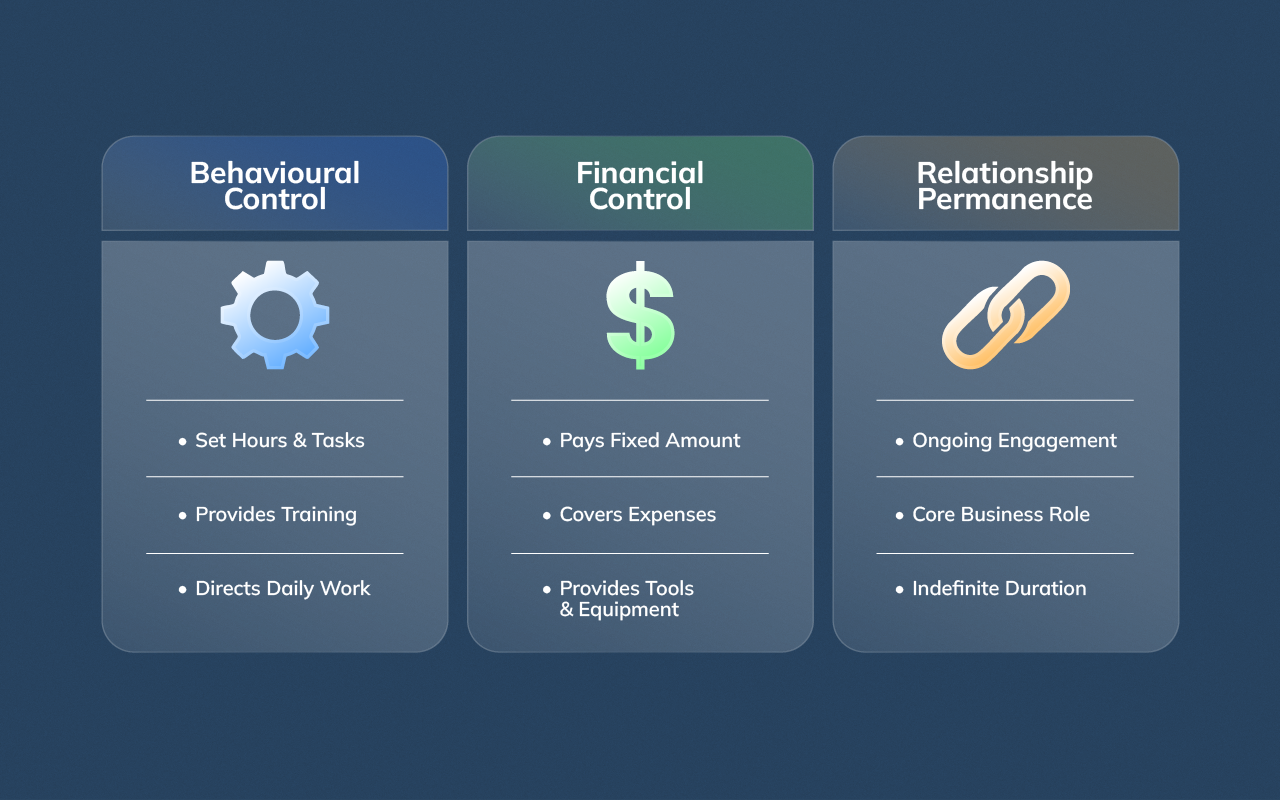
The IRS focuses on control and financial structure. Their goal is to determine whether your startup is paying a separate business or compensating labor.
They evaluate three practical areas.
1. Behavioral Control: Who Controls How the Work Is Done?
This is where most startups unintentionally cross the line.
If your startup:
- Sets working hours
- Requires daily availability
- Directs how tasks are completed
- Trains the worker on internal systems and workflows
- Reviews work the same way you review employees
Then you are exercising behavioral control.
What Behavioral Control Looks Like in Practice
Independent Contractor
- Controls how the work gets done
- Chooses their own methods, tools, and process
- Works toward defined deliverables and deadlines
- Is evaluated on outcomes, not daily activity
Employee
- Follows company-defined workflows and processes
- Uses internal tools and systems
- Receives task-level direction and ongoing oversight
- Is managed based on how work is performed, not just results
Founder Rule of Thumb
When you manage outcomes, the role leans to contractual.
When you manage the person’s day-to-day work, the role starts to resemble employment.
2. Financial Control: Who Carries Risk and Opportunity?
The IRS also evaluates whether the worker operates like a separate business or functions like paid labor with no financial exposure.
This is not about how much you pay. It is about who absorbs risk.
If your startup:
- Pays a fixed amount regardless of output
- Covers routine work expenses
- Provides all tools, software, and systems
- Treats pay as ongoing and guaranteed
Then the IRS sees the company carrying the financial risk.
What Financial Control Looks Like in Practice
Independent Contractor
- Has the ability to make more or less money based on efficiency
- Prices work by project, milestone, or scope
- Pays for their own tools, software, or assistants
- Can incur profit or loss on the work
Employee
- Receives predictable, guaranteed pay
- Has no meaningful profit or loss exposure
- Relies on company-provided tools and resources
- Is paid for time or availability rather than results
Founder Rule of Thumb
When the worker can increase earnings by working smarter, the role leans contractual.
When pay is guaranteed regardless of output, the role leans employment.
3. Relationship: How Permanent and Central Is the Role?
The IRS also looks at how embedded the worker is in your startup.
This is where many first-time founders drift into misclassification without realizing it.
If your startup:
- Expects the work to continue indefinitely
- Uses language implying long-term commitment
- Assigns work that is central to the core business
- Treats the role as part of ongoing operations
Then the relationship begins to resemble employment.
What Relationship Structure Looks Like in Practice
Independent Contractor
- Engaged for a defined project or scope
- Has a clear start and end point
- Provides services that support the business but are not foundational
- Is not positioned as a long-term internal role
Employee
- Works in an open-ended or ongoing role
- Performs core functions the business depends on daily
- Is expected to grow with the company
- Becomes operationally difficult to replace
Founder Rule of Thumb
When a role is temporary and scoped, contractor classification can fit.
When a role becomes permanent and essential, employee classification is safer.
How the Department of Labor Evaluates Worker Classification
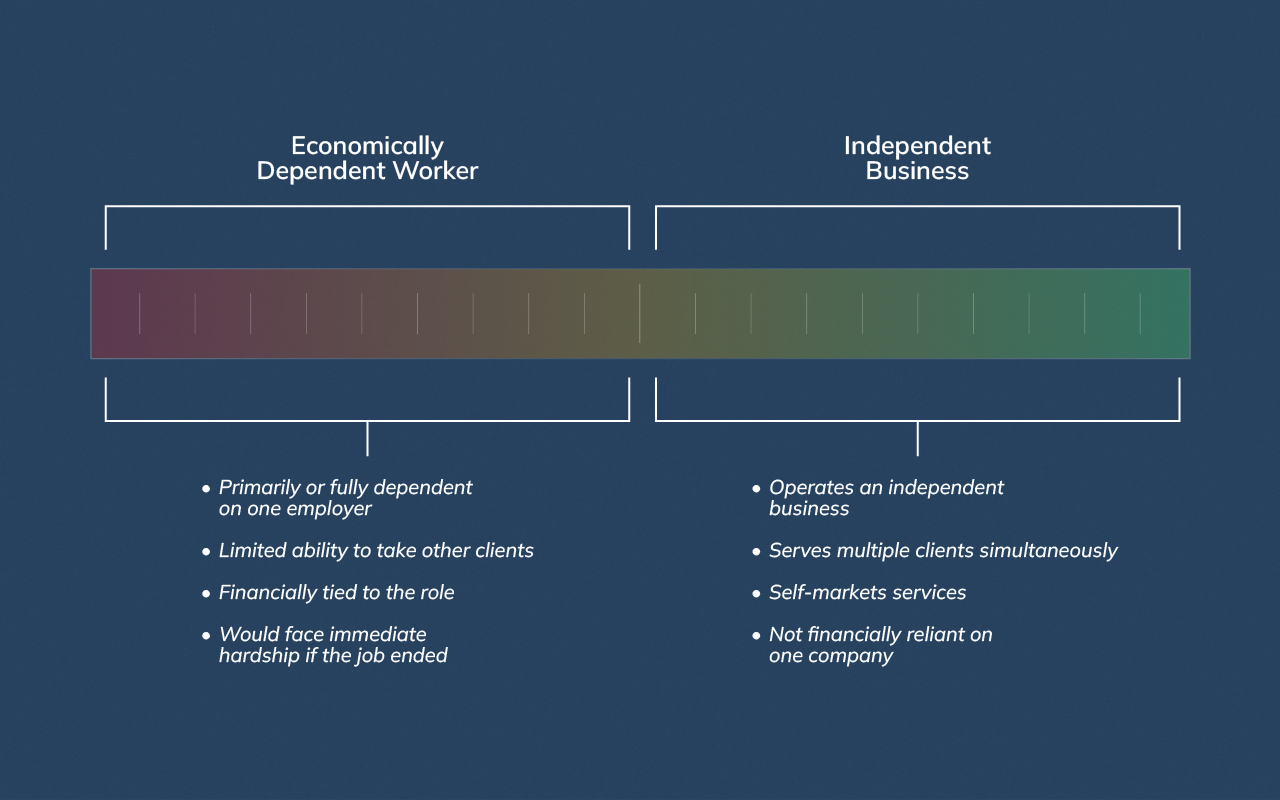
While the IRS focuses on taxes, the Department of Labor focuses on economic dependence.
Their goal is to determine whether the worker is truly in business for themselves or economically reliant on your startup.
If the worker:
- Relies on your company as their primary or sole income
- Has limited ability to replace your work with other clients
- Performs work that is essential to daily operations
- Takes direction similar to an internal team member
Then the Department of Labor is more likely to view the role as employment.
What Economic Dependence Looks Like in Practice
Independent Contractor
- Works with multiple clients at the same time
- Markets their services independently
- Can replace your startup’s work without financial stress
- Operates as a distinct business entity
Employee
- Depends on your startup for most or all income
- Has little time or freedom to take other clients
- Becomes financially tied to the role
- Would experience immediate hardship if the role ended
Founder Rule of Thumb
When the worker could walk away and replace the income, contractor status is more defensible.
When losing the role would materially disrupt their livelihood, employee classification is likely.
Why This Matters for First-Time Hiring
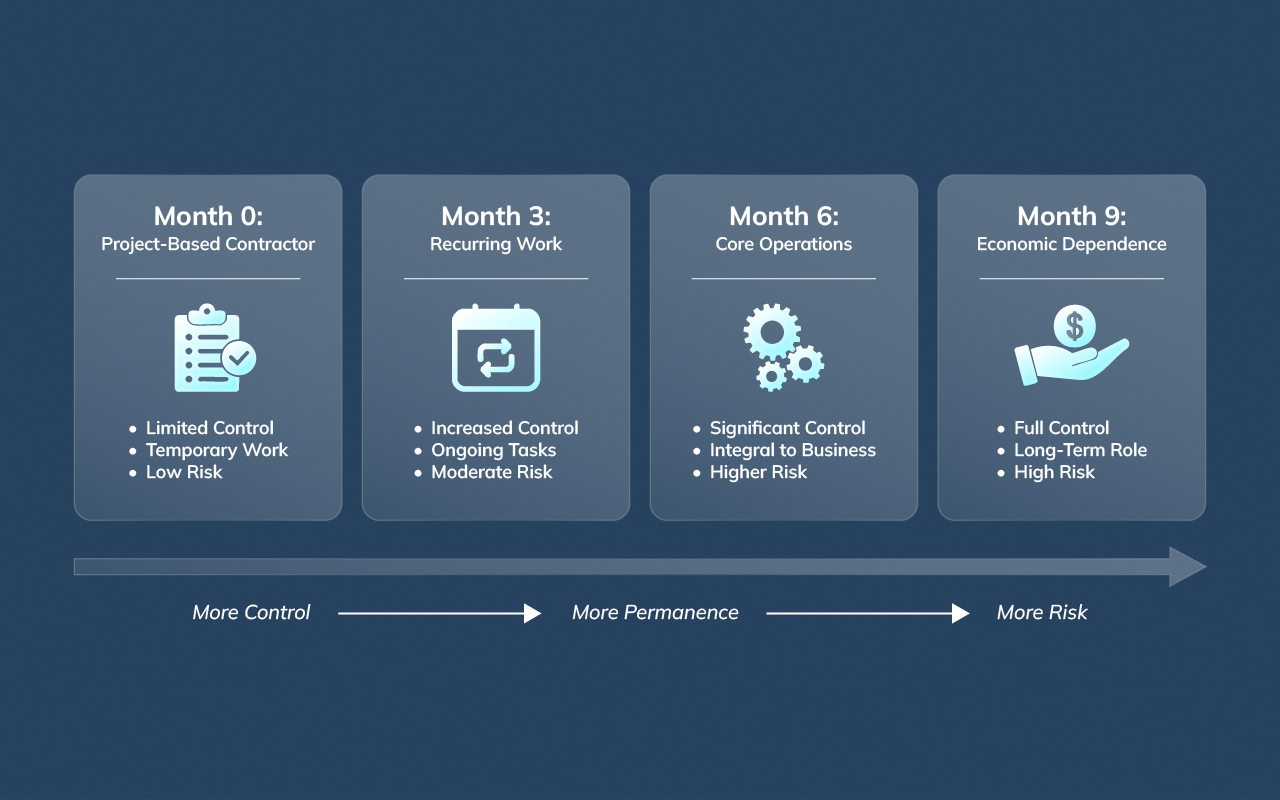
Misclassification rarely happens at hiring. It happens as startups grow.
A role starts flexible. Control increases. Work becomes ongoing. Dependence builds.
The label stays the same, but the relationship changes.
These IRS and Department of Labor frameworks exist to identify exactly that moment.
Founders who understand these signals can restructure roles early and avoid misclassification risk before it compounds.
How Startups Should Use These Standards in Practice
Founders do not need to memorize regulations. They need to evaluate reality.
Ask three practical questions:
- Are we managing this person, or are we managing outcomes?
- Could this person realistically replace us with other clients tomorrow?
- Would our operations break if this role disappeared suddenly?
If the answers point toward control, dependence, and permanence, employee classification is safer.
If the answers point toward independence, replaceability, and defined scope, contractor classification may be appropriate.
Independent Contractor vs. Employee Pros and Cons for Startups
After understanding how the IRS and Department of Labor evaluate worker classification, the next question founders usually ask is practical:
Which model actually makes sense for my startup?
Both employees and independent contractors can work well, but they solve different problems. The risk comes from using the wrong model for the role.
Employee Model: Pros and Cons
Employees are designed for ownership, continuity, and internal execution. This model works best when the role is core to daily operations.
Pros
- Strong accountability and control
Employees can be directed day to day. Founders can assign priorities, change workflows, and integrate the role tightly into how the company operates. - Long-term role stability
Employees provide continuity. As the business evolves, employees accumulate context, institutional knowledge, and ownership that compounds over time. - Easier team integration
Employees naturally fit into internal communication, planning, and decision-making. This is especially important for early teams where collaboration is constant.
Cons
- Payroll taxes vs. contractor taxes
Employees trigger employer payroll taxes and ongoing tax reporting obligations. - Benefits administration
Depending on size and location, employees may require benefits, paid time off, and statutory protections. - Termination and labor law exposure
Ending an employment relationship carries legal requirements and risk that startups must be prepared to manage.
Contractor Model: Pros and Cons
Independent contractors are designed for flexibility and defined output, not long-term internal ownership.
Pros
- Flexibility
Contractors are easier to engage for short-term, experimental, or highly specific work. This is useful when roles are not yet clearly defined. - Lower fixed costs
There are no payroll taxes, benefits, or long-term commitments, which can help early-stage startups manage cash flow. - Faster onboarding
Contractors can often start quickly without the infrastructure required for employment.
Cons
- Limited control
Contractors control how work is done. Startups cannot legally manage them the same way they manage employees without increasing misclassification risk. - Misclassification risk
When contractors are used in employee-like roles, compliance exposure increases, especially as work becomes ongoing and central to operations. - Lower long-term continuity
Contractors are not designed for deep ownership or institutional knowledge. They may leave with little notice and are not obligated to grow with the business.
How Founders Should Think About the Trade-Off
The key decision is not cost. It is role design.
Contractors work best when:
- Work is scoped and outcome-based
- Flexibility matters more than continuity
- The role supports the business but does not run it
Employees work best when:
- Work is ongoing and operational
- Daily collaboration and direction are required
- The role becomes foundational to growth
This is why startups must align the hiring model to the role, not the budget.
Short-term savings disappear quickly when misclassification risk or operational friction appears later.
Independent Contractor vs. Employee Checklist for First-Time Founders
After weighing the pros and cons of employees and independent contractors, the next step is to evaluate how the role is actually structured.
This independent contractor vs. employee checklist helps founders validate whether the hiring model they are considering truly fits the role — before misclassification risk appears.
Use it before your first hire and revisit it as roles evolve.
Leans Employee if the Worker:
- Has set hours assigned by you
You expect consistent availability during defined working hours or alignment with your internal team schedule.
- Works exclusively or near-exclusively for your startup
The role consumes most of their working capacity, leaving little realistic opportunity for other clients.
- Uses your internal systems and tools
They operate inside your task managers, CRMs, documentation, and communication tools as part of normal daily workflow.
- Performs core, ongoing operations
The work is central to how your product or service is delivered, not limited to a defined project.
- Reports to a manager daily or weekly
They receive ongoing direction, prioritization, and feedback similar to an internal employee.
- Is expected to grow with the company
The role deepens over time with increasing responsibility, ownership, and business context.
Leans Contractor if the Worker:
- Controls their own schedule and availability
You care about deadlines and outcomes, not when or how work is completed.
- Works with multiple clients simultaneously
Your startup is one of several clients, not the primary source of income.
- Uses their own tools, systems, and processes
They determine how work is organized and which tools are used to deliver results.
- Delivers project-based or outcome-based work
Success is defined by completion of specific deliverables, not ongoing participation.
- Operates as an independent business
They market their services, set pricing, and can replace your work without disruption.
- Can disengage at the end of scope without operational fallout
If the relationship ends, the business continues without immediate internal disruption.
Founder Signal to Watch For
The highest risk does not come from one factor. It comes from accumulation over time.
Many startup roles begin as contractor-leaning and drift toward employment as:
- Work becomes recurring
- Availability expectations increase
- Control over execution grows
- Economic dependence forms
When multiple employee indicators stack up, misclassification risk increases, even if the contract never changes.
What Misclassification Triggers for Startups
Misclassification is not a technical issue. It becomes a tax, legal, and compliance problem quickly.
Taxes Shift Back to the Company
When workers are classified correctly, employees trigger payroll taxes and reporting, while contractors handle their own taxes.
When classification is wrong, unpaid payroll taxes, employer contributions, penalties, and interest shift back to the startup retroactively.
Remote and Global Hiring Raises Risks
Managing remote or offshore contractors like internal staff increases exposure.
Global hiring adds additional risk through local labor laws, contractor enforceability, and permanent establishment concerns. What works domestically may fail when hiring internationally.
Contracts Stop Being Decisive
A contractor agreement does not override reality. Regulators evaluate daily control, economic dependence, and how the work actually happens. If the relationship functions like employment, labels do not matter.
Penalties Compound Fast
Misclassification penalties can include back wages, retroactive benefits, tax penalties, and fines. Audits often expand beyond a single role, which is why even small mistakes can become existential for startups.
Bottom line: Misclassification appears when roles evolve without being restructured. Classification should be revisited as responsibilities, control, and dependence change.
Hiring Contractors Legally: Hire Overseas Tips for First-Time Startups
At Hire Overseas, we work with startups at the exact moment they make their first contractor hire. The patterns are consistent. Risk does not come from bad intent, it comes from roles evolving faster than structure.
These are the practical steps we recommend to reduce misclassification risk when hiring contractors legally.
- Define work by outcomes, not hours
Contractors should be measured by deliverables and scope, not daily activity or availability. When work is managed like time, classification starts to break. - Keep contractors outside internal management structures
Contractors should not sit inside employee reporting lines, daily standups, or internal performance systems. We help startups structure roles so independence is preserved. - Limit exclusivity whenever possible
Requiring full-time availability or single-client dependence often signals employee classification. When exclusivity becomes necessary, the model should be reassessed. - Use role-specific agreements, not generic templates
Agreements should reflect how the role actually operates, the country involved, and the engagement model. One-size-fits-all contracts increase risk. - Reassess classification as roles evolve
The highest risk appears months after hiring. When a role becomes ongoing, operational, and business-critical, classification should be reviewed immediately.
Hire Overseas rule of thumb:
Contractors deliver defined outcomes.
Employees run parts of the business.
The moment a role crosses that line, reassessment is required.
Your First Hiring Decision Shapes How You Scale
For first-time startups, the independent contractor vs. employee decision feels urgent, not strategic. You need help and you need it fast.
But early hiring choices compound. Roles evolve. Control increases. What begins as a flexible contractor arrangement can quietly become an operational dependency with real compliance risk attached.
Startups that scale cleanly make this distinction early.
When that line holds, teams grow with stability. When it blurs, risk follows.
Build Your First Team the Right Way
Hire Overseas helps startups structure compliant contractor and employment models from day one. We support founders in hiring globally, avoiding misclassification risk, and adapting workforce models as roles evolve.
If you are making your first hire or reassessing how contractors fit into your operations, you can talk to us to see how we help startups get it right before problems appear.
FAQs About Independent Contractor vs. Employee
Can a startup switch a contractor to an employee later?
Yes. Startups can legally convert an independent contractor into an employee at any time. In fact, this is common as roles become more permanent or business-critical. The key is timing. The conversion should happen before the role becomes ongoing, tightly managed, or economically dependent. Delaying the switch increases misclassification exposure for the period before conversion.
Can founders be classified as independent contractors?
In most cases, no. Founders who actively work in the business, make decisions, or perform core operational roles are generally treated as employees or officers for tax and labor purposes. Attempting to classify founders as contractors often creates tax and compliance issues rather than savings.
Are part-time workers automatically contractors?
No. Part-time status has no bearing on classification. A worker can be part-time and still be an employee if the company controls how the work is done and relies on the role operationally. Misclassification often happens when founders assume reduced hours equal contractor eligibility.
What happens if a startup gets classification wrong unintentionally?
Intent does not protect against penalties. Misclassification often happens when founders assume reduced hours or outsourcing employees automatically qualifies a role as contractual. If this happends, startups may owe back payroll taxes, employer contributions, interest, and fines. In some cases, companies must also retroactively provide benefits or pay unpaid wages, even if the mistake was unintentional.
Do independent contractors need to be registered as a business?
Not always, but it strengthens contractor classification. Contractors who operate as registered businesses, invoice clients, market services, and work with multiple companies appear more independent to regulators. That said, business registration alone does not override day-to-day control or economic dependence.
Is it harder to terminate an employee than a contractor?
Yes. Ending a contractor relationship is generally simpler because it is governed by contract terms. Employee termination is subject to labor laws, notice requirements, and potential claims depending on jurisdiction. This difference is one reason startups favor contractors early—but it must align with how the role actually functions.
Is it safer to hire contractors through an agency or platform?
An agency or staffing partner can reduce risk only if they properly structure the engagement and handle compliance. Simply hiring through a freelance marketplace does not remove misclassification risk. Regulators still assess how much control your startup has and how dependent the worker is on your business.
Partners like Hire Overseas reduce risk by designing compliant contractor models and helping startups reassess roles as they evolve—because structure matters more than sourcing.
