


OpenClaw implementation is not a simple software setup.
It is the structured process of designing, integrating, deploying, and scaling automation infrastructure across your organization. When executed correctly, OpenClaw becomes the execution layer behind your sales workflows, customer onboarding, internal reporting, AI agents, and multi-system integrations.
When executed poorly, it creates broken workflows, silent automation failures, duplicated data, and long-term technical debt.
This expanded guide explains how to implement OpenClaw properly, using a structured OpenClaw implementation roadmap that prioritizes stability, clarity, and long-term scalability.
What Is OpenClaw Implementation?
OpenClaw implementation refers to the complete lifecycle of deploying OpenClaw as infrastructure, not just as a workflow tool.
It includes:
- System architecture design
- API and multi-system integration
- AI agent orchestration
- Data migration and validation
- Workflow automation mapping
- Testing and rollout governance
- Post-deployment monitoring and optimization
Many teams confuse setup with implementation.
Setup means installing and configuring OpenClaw.
Implementation means designing a scalable automation ecosystem that supports business growth.
Understanding this distinction is critical.
OpenClaw Implementation Roadmap
Once you understand that implementation is infrastructure, not setup, the next step is structure.
A structured OpenClaw implementation roadmap reduces risk, prevents fragile automation, and ensures that every workflow supports real business outcomes. Without a roadmap, teams tend to:
- Automate isolated tasks instead of complete workflows
- Connect systems without validating data dependencies
- Launch automation without testing failure scenarios
- Scale before stability is proven
The result is short-term activity but long-term instability.
An OpenClaw implementation roadmap creates sequencing. It forces teams to move in the correct order:
- Design before building
- Stabilize before integrating
- Validate before deploying
- Monitor before scaling
This phased approach ensures OpenClaw becomes reliable infrastructure rather than experimental automation.
Below is a clear, structured OpenClaw implementation plan designed for:
- Startups building their first automation layer
- SaaS companies integrating OpenClaw into CRM, billing, and onboarding systems
- Scaling teams expanding into AI agent orchestration and multi-system automation
Each phase builds operational integrity. When followed sequentially, this roadmap transforms OpenClaw from a workflow tool into a stable execution engine that supports growth without creating technical debt.
If you’re moving from experimentation to production infrastructure, this breakdown of what a remote OpenClaw developer actually handles explains how to avoid fragile builds and silent automation failures.
Key Phases of an OpenClaw Implementation Roadmap
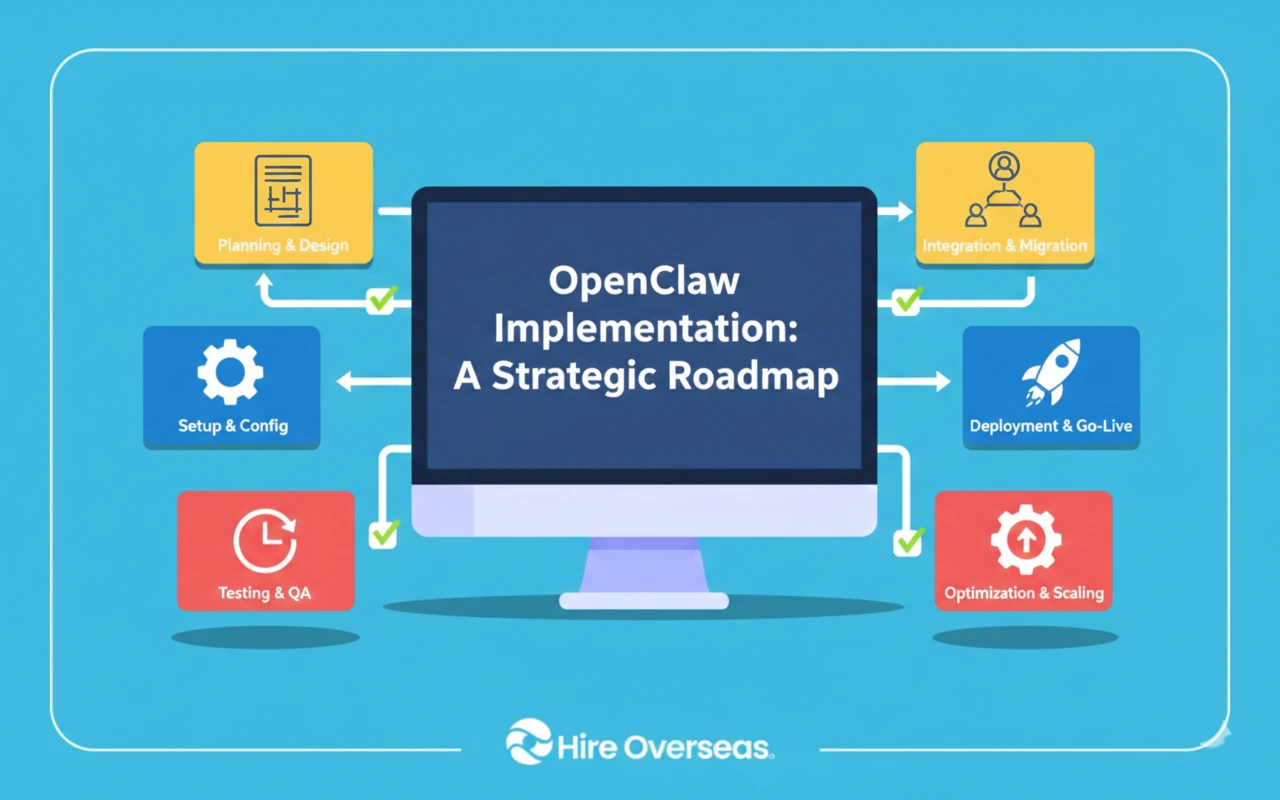
A successful OpenClaw execution roadmap typically includes seven structured phases. These phases exist for one reason: OpenClaw implementations fail when teams try to build automation before the foundation is stable.
Here are the seven phases and what each one actually means in practice:
- Planning and system design
- Setup and configuration
- Integration and migration
- Workflow automation alignment
- Testing and QA
- Deployment and go-live
- Optimization and scaling
Each phase builds on the previous one.
If you skip phases, you usually do not save time. You just delay problems until they become harder and more expensive to fix.
Phase 1: Strategy and Architecture Design
Every successful OpenClaw implementation framework begins with clarity.
Before touching the system, define:
- What specific business problems OpenClaw will solve
- Which workflows directly impact revenue
- Which systems must integrate
- Where AI agents will operate
- What success metrics look like
This phase is about intentional design, not technical configuration.
For example:
- Is the goal to automate inbound lead routing and reduce response time?
- Reduce manual CRM updates that create data inconsistencies?
- Orchestrate AI-driven outbound workflows across sales and marketing?
You should also identify:
- Where failures would create business risk
- Which processes require human oversight
- What data accuracy thresholds are acceptable
For startups, this often becomes an OpenClaw MVP implementation, focused on one critical automation loop with measurable ROI.
For growing companies, this phase becomes the foundation of a broader OpenClaw automation roadmap for startups or SaaS operations, where automation touches multiple departments.
Skipping strategic design is the number one reason OpenClaw deployments fail.
Automation without architectural clarity creates complexity instead of leverage.
Phase 2: OpenClaw System Setup Process
Once architecture is defined, the OpenClaw system setup process begins.
This stage focuses on building structural stability before automation goes live.
Core OpenClaw setup workflow tasks include:
- Configuring environments (dev, staging, production)
- Defining user roles and permissions
- Setting authentication rules
- Designing workflow architecture layers
- Activating structured logging
- Establishing monitoring baselines
This is where you prevent future chaos.
Environment separation ensures that experimentation does not affect production.
Role definition prevents unauthorized changes.
Logging ensures that when something breaks, you can trace why.
This phase ensures your OpenClaw deployment roadmap starts from a stable foundation rather than reactive experimentation.
Without proper setup, every future change becomes risky.
Phase 3: OpenClaw Integration Roadmap
OpenClaw is integration-heavy by design. It connects systems.
Your OpenClaw integration roadmap should clearly outline:
- CRM connections
- ERP integrations
- Payment processor links
- API authentication setup
- Webhook configuration
- Data mapping and schema validation
- Rate-limit and error handling
Integration is not just about making systems talk to each other.
It is about ensuring:
- Data flows accurately and consistently
- Sync failures are detected quickly
- API downtime does not cascade into system-wide issues
- Schema changes do not silently break workflows
Strong OpenClaw integration steps focus on two things:
- Successful data flow
- Failure recovery logic
Most automation failures occur not when workflows succeed, but when APIs fail or data formats change.
A structured OpenClaw deployment checklist must include integration resilience.
If integration is fragile, automation is fragile.
Phase 4: Workflow Automation and Execution Alignment
This is where OpenClaw becomes operational.
The OpenClaw rollout process translates business logic into automation rules.
This includes:
- Trigger definition
- Conditional logic branches
- Escalation paths
- Human override mechanisms
- KPI alignment
Automation must mirror how the business actually operates, including exceptions.
For example:
- What happens if required data is missing?
- What happens if a workflow triggers twice?
- When should a human intervene?
For early-stage companies, a lean OpenClaw implementation strategy is critical.
Do not automate everything at once.
Start with:
- One revenue workflow
- One support automation loop
- One internal reporting pipeline
This creates stability before expansion and reduces the risk of compounding errors.
Phase 5: OpenClaw Deployment Steps and Testing
Testing is not optional.
Structured OpenClaw deployment steps must include:
- Sandbox simulations
- Workflow validation
- Data accuracy checks
- Load testing
- Permission validation
- Edge-case scenario testing
Testing should simulate failure, not just success.
You should intentionally test:
- API timeouts
- Duplicate triggers
- Invalid data formats
- Permission conflicts
- Unexpected workflow sequences
An incomplete OpenClaw deployment roadmap often results in:
- Duplicate CRM entries
- Missed notifications
- Misrouted leads
- Broken AI agent responses
Testing protects business continuity.
It ensures that when automation fails, it fails safely and predictably.
Phase 6: OpenClaw System Rollout Plan
Your OpenClaw system rollout plan determines how automation enters production.
Common rollout approaches include:
- Department-based rollout
- Workflow-by-workflow activation
- Controlled feature flags
- Gradual AI agent enablement
Avoid large-scale, all-at-once launches.
A phased OpenClaw rollout strategy reduces disruption and builds internal trust in automation.
For startups, OpenClaw rollout for early-stage companies should be measured and reversible.
Always maintain:
- Rollback procedures
- Clear incident ownership
- Real-time monitoring during launch
The goal of rollout is operational continuity, not speed.
Phase 7: OpenClaw Post-Deployment Optimization
OpenClaw implementation does not end at go-live.
A strong OpenClaw continuous improvement strategy includes:
- Monitoring workflow success rates
- Tracking automation speed
- Reviewing error logs weekly
- Updating documentation
- Expanding automation coverage carefully
- Refining escalation thresholds
- Improving integration efficiency
This becomes your OpenClaw system optimization lifecycle.
At this stage, OpenClaw transitions from a project to infrastructure.
Optimization ensures:
- Automation performance improves over time
- Technical debt does not accumulate
- New workflows are added with discipline
- AI agents operate with controlled autonomy
Automation compounds when refined consistently.
It becomes fragile when left unattended.
For teams formalizing architecture ownership and governance, this guide on how to hire an OpenClaw developer explains what skills prevent long-term automation debt.
Hire Overseas Insight: What Makes OpenClaw Implementation Succeed or Fail
At Hire Overseas, we’ve seen OpenClaw implementations succeed at scale and we’ve seen them quietly collapse under growth pressure. The difference is rarely technical capability. It is almost always structure, ownership, and execution discipline.
OpenClaw implementation outcomes vary for a simple reason: OpenClaw is infrastructure. It touches revenue workflows, customer data, and production systems. That means success depends less on “setting it up” and more on whether your team executes with clear ownership, governance, testing discipline, and ongoing optimization.
Below are the core factors that determine whether OpenClaw becomes scalable automation infrastructure or long-term technical debt.
Clear Ownership and Role Definition
OpenClaw implementations break when responsibility is shared but not owned.
At minimum, define who is accountable for:
- Architecture (system design standards, workflow patterns, guardrails)
- Integrations (APIs, auth, schemas, sync logic, rate limits)
- Automation delivery (workflow builds, releases, iteration cycles)
- Monitoring (dashboards, alerting, failure categorization, escalation)
- Documentation (SOPs, runbooks, workflow maps, change logs)
When roles are unclear, teams ship automation but no one owns reliability. That is how silent failures persist and technical debt grows.
From our experience supporting distributed automation teams, clearly defined ownership is the single strongest predictor of long-term system stability.
Governance Before Scale
Scaling OpenClaw without governance is the fastest route to automation drift.
Governance includes:
- Change control for workflow edits
- Naming conventions and versioning
- Approval and rollback standards
- Documentation requirements per workflow
- Production release rules (what gets deployed and when)
This is not bureaucracy. It is how distributed teams prevent inconsistent builds, conflicting workflows, and unexpected production behavior.
The companies that treat governance as optional tend to spend more time fixing automation than benefiting from it.
Monitoring and Incident Response Discipline
Automation that is not monitored becomes a liability.
A stable OpenClaw deployment includes:
- Workflow success and failure tracking
- Log visibility with traceable run IDs
- Alerts for failure spikes, latency, or data sync breaks
- Defined escalation and response ownership
- Regular reliability reviews (weekly or biweekly)
The most expensive failures are not dramatic outages. They are the quiet ones, where automation “runs” but produces incorrect or incomplete outcomes.
In our experience, teams that assign formal monitoring ownership early avoid months of reactive debugging later.
Testing Depth and Failure Recovery Logic
Most teams test the happy path. Production fails on the unhappy path.
Testing should prove that workflows:
- Handle missing or unexpected inputs
- Recover from API timeouts or rate limits
- Prevent duplicate triggers and double writes
- Fail safely with clear human handoff
- Maintain data integrity across systems
If failure handling is not designed upfront, teams end up patching automation reactively after business impact occurs.
Structured failure testing is what separates experimentation from production-ready infrastructure.
Realistic Timelines and Sequencing
Teams often compress timelines by skipping phases. That rarely saves time.
Typical ranges:
- OpenClaw MVP implementation: 4 to 8 weeks
- Mid-sized SaaS deployment: 8 to 12 weeks
- Enterprise-scale orchestration: 3 to 6+ months
Integrations, migrations, compliance requirements, and cross-team training all expand the timeline. A phased rollout usually ships value earlier because it avoids rework.
We consistently see that disciplined sequencing delivers faster stable outcomes than rushed deployment.
The Most Common OpenClaw Implementation Mistakes
These mistakes show up repeatedly in startups and SaaS teams:
- Over-automating too early (complexity grows faster than stability)
- Skipping integration validation (APIs work until they change or hit load)
- No rollback plan (teams hesitate to ship or panic when issues arise)
- Weak documentation (knowledge lives in one person’s head)
- No monitoring owner (failures surface only after damage)
A lean implementation strategy prevents most of these by focusing on one high-impact workflow, proving stability, then expanding.
When to Use an MVP, Pilot, or Full Rollout
The right implementation path depends on business stage and risk tolerance.
- OpenClaw MVP implementation: best for startups proving one automation loop with measurable ROI
- OpenClaw pilot program setup: best for teams validating reliability across one department or system cluster before full rollout
- Full rollout: best when governance, monitoring, and integration maturity already exist
Choosing the wrong rollout model creates predictable failure. Start too big and you create fragility. Start too small and you fail to capture meaningful impact.
From our perspective, disciplined pilots consistently outperform aggressive full-scale launches.
Post-Deployment Optimization as a Requirement, Not a Bonus
OpenClaw becomes infrastructure only when post-deployment optimization is treated as part of implementation.
That means:
- Reviewing workflow performance regularly
- Refining triggers, thresholds, and escalation logic
- Improving data mapping and integration resilience
- Expanding automation coverage with discipline
- Updating documentation as workflows evolve
Automation compounds when refined consistently. It becomes technical debt when left unattended.
At Hire Overseas, we treat optimization as ongoing infrastructure stewardship, not a final step after launch.
If you’re budgeting for implementation support, this cost breakdown shows what startups and SaaS teams typically invest to hire an OpenClaw developer for infrastructure-level execution.
Structure Turns OpenClaw Into a Competitive Advantage
OpenClaw implementation is not about activating automation.
It is about engineering stable, scalable infrastructure that supports revenue workflows, customer operations, AI agents, and multi-system orchestration without creating fragility.
When implemented with structure:
- Workflows execute reliably
- Data flows cleanly across systems
- AI agents operate under governance
- Scaling does not introduce chaos
- Automation compounds instead of breaking
When implemented without structure, OpenClaw becomes another tool that adds complexity instead of reducing it.
The difference is not the platform.
The difference is execution discipline, architectural clarity, and experienced oversight.
If you are planning an OpenClaw implementation, migrating from legacy systems, or scaling AI-driven workflows across your organization, the right strategy at the beginning will save months of rework later.
Ready to implement OpenClaw the right way?
Book a strategy call with Hire Overseas and get expert guidance on architecture design, integration planning, phased rollout, and scalable automation governance.
