


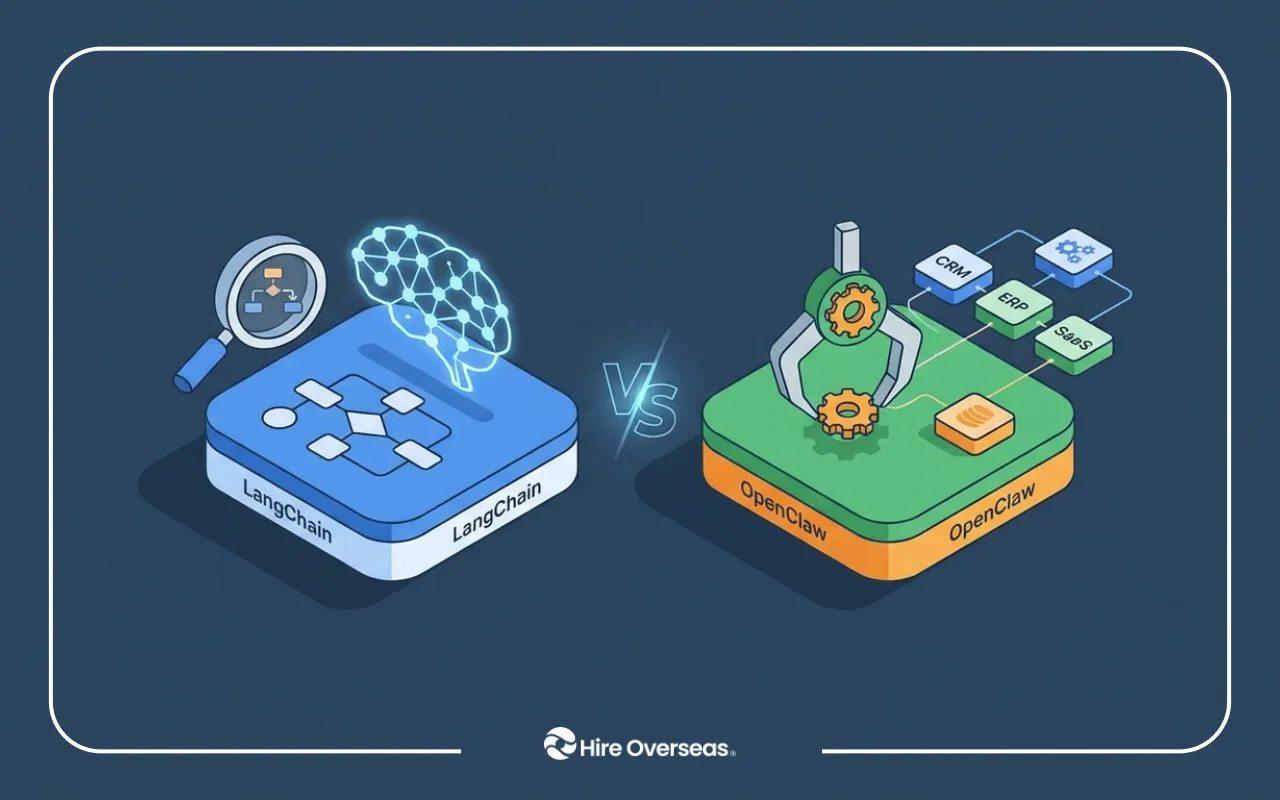
When comparing OpenClaw vs LangChain, founders, CTOs, and AI teams usually ask one core question: Which is the best framework for AI agents — OpenClaw or LangChain?
The answer is not simply “one is better.”
It depends entirely on what layer of the AI stack you are building.
At a high level:
- LangChain builds AI reasoning systems.
- OpenClaw executes automation across real-world business systems.
They solve different problems.
Understanding this architectural distinction is what prevents misaligned builds, wasted engineering cycles, and fragile AI deployments.
Why OpenClaw vs LangChain Is Often Confused
Both tools frequently appear in discussions about:
- AI agents
- Tool invocation
- Workflow automation
- LLM orchestration
- Multi-agent systems
That overlap creates surface-level similarity.
When teams hear phrases like “agent orchestration” or “tool calling,” both OpenClaw and LangChain may show up in documentation, tutorials, or architecture diagrams. From a distance, it can seem like they compete in the same category. But architecturally, they operate at very different abstraction layers.
Comparing OpenClaw and LangChain directly is like comparing:
- An application development framework
- With an execution infrastructure layer
One defines how intelligence is built. The other defines how decisions are operationalized.
The confusion typically happens when teams conflate:
- AI reasoning with system execution
- Tool selection logic with real-world automation
- Agent cognition with enterprise workflow reliability
OpenClaw and LangChain can both “orchestrate” — but they orchestrate different things.
LangChain orchestrates reasoning steps inside an AI application. OpenClaw orchestrates actions across real business systems. They are complementary. They are not substitutes.
Understanding that separation eliminates most architectural missteps.
What Is OpenClaw?
OpenClaw (formerly ClawDBot / MoltBot) is an automation and integration platform designed for production-scale orchestration.
It focuses on:
- Workflow automation
- API integrations
- Cross-system triggers
- Business process execution
- Operational reliability
- Monitoring and failure recovery
OpenClaw connects CRMs, ERPs, billing systems, internal databases, support tools, and SaaS platforms. It then executes automation workflows based on defined triggers, logic conditions, escalation rules, and retry policies.
It does not build AI reasoning systems.
It ensures that once a decision is made, the correct systems update consistently, reliably, and at scale.
OpenClaw becomes critical when:
- A CRM must update automatically after an AI classification
- Multiple systems must sync in real time
- Workflows span departments
- Logging and auditability are required
- Automation must remain stable under high volume
It is infrastructure-focused and designed for operational resilience.
OpenClaw answers:
“Now that the AI decided, how do we make it happen across systems safely and reliably?”
It turns AI output into business execution.
If you're still clarifying where OpenClaw fits in your AI stack, this breakdown explains what OpenClaw actually does at the execution layer and how it differs from application-level AI frameworks.
What Is LangChain?
LangChain is a developer-first framework for building LLM-powered applications and AI agents.
It enables:
- AI agent development
- Prompt chaining
- Memory systems
- Tool-calling logic
- Multi-agent reasoning
- Retrieval-augmented generation pipelines
- Context persistence and vector database integration
LangChain is code-heavy and built for engineers developing AI-native applications.
Its primary strength lies in reasoning orchestration — controlling how large language models think, decide, and select tools based on context.
LangChain handles:
- Internal state management
- Memory persistence across interactions
- Complex multi-step reasoning
- Dynamic tool selection
- Context-aware decision loops
It does not manage cross-system business automation infrastructure.
It manages AI cognition.
LangChain answers:
“Given this context, memory, and available tools — what should happen next?”
It determines the action. It does not execute enterprise-level system orchestration.
The Clarifying Summary
LangChain decides what action makes sense. OpenClaw ensures that action is executed correctly across systems.
LangChain manages intelligence. OpenClaw manages operational execution.
That distinction is the key to choosing correctly.
OpenClaw vs LangChain: Architecture-Level Comparison
Once you separate definitions, the next step is understanding how these systems fit into real-world AI architecture.
Modern AI systems typically include multiple layers:
- Data layer
- Intelligence layer
- Execution layer
- Monitoring and governance layer
LangChain and OpenClaw sit in different positions within that structure.
Understanding their placement resolves most confusion instantly.
LangChain: The Intelligence Layer
LangChain operates inside the application layer.
It handles:
- Prompt design and chaining
- Agent reasoning loops
- Context management
- Memory persistence
- Retrieval from vector databases
- Tool selection logic
This is where the AI “thinks.”
It determines:
- What the user intent is
- What data to retrieve
- What reasoning steps to execute
- Which tool should be called
- What response should be generated
LangChain manages cognition, not enterprise execution.
It is responsible for structured decision-making inside AI applications.
OpenClaw: The Execution Layer
OpenClaw operates in the orchestration layer.
It handles:
- API integrations
- Trigger-based automation
- Cross-platform workflows
- CRM updates
- ERP actions
- Task assignments
- Logging and monitoring
- Retry logic and failure handling
This is where the business action actually happens.
OpenClaw ensures:
- Systems update consistently
- Data remains synchronized
- Failures are retried or escalated
- Workflows are observable
- Automation remains stable under scale
If LangChain determines what to do, OpenClaw ensures it actually gets done across systems.
Visualizing the Flow
Here is a simplified production example:
- User submits a request.
- LangChain analyzes context and history.
- LangChain determines next best action.
- LangChain calls a trigger endpoint.
- OpenClaw receives the trigger.
- OpenClaw updates CRM fields.
- OpenClaw creates internal tasks.
- OpenClaw sends notifications.
- OpenClaw logs events for monitoring.
Without LangChain, the AI lacks structured reasoning.
Without OpenClaw, the execution layer becomes fragile and inconsistent.
Together, they form a complete AI stack.
Why This Architectural Separation Matters
If you attempt to:
- Use LangChain for cross-department enterprise workflow automation
→ You risk building fragile, over-engineered application logic. - Use OpenClaw to manage advanced reasoning or agent memory
→ You hit limitations because it is not built for cognitive orchestration.
Understanding where each tool belongs prevents architectural misuse.
And in AI systems, architectural misuse is expensive.
OpenClaw vs LangChain: Comparison Matrix
Below is a structured comparison to clarify where each framework fits in modern AI architecture.
How to Read This Matrix Correctly
The matrix is not meant to declare a winner.
It highlights specialization.
LangChain specializes in thinking.
OpenClaw specializes in doing.
LangChain determines:
- What decision should be made
- Which tool to call
- What logic to execute
OpenClaw ensures:
- The right systems update
- Workflows trigger correctly
- Failures are retried or escalated
- Cross-platform automation remains stable
If your system requires both intelligence and execution at scale, the strongest architecture typically includes both layers.
For teams turning AI decisions into production workflows, this explains how a remote OpenClaw developer architects reliable integrations, monitoring, and failure recovery at scale.
When to Choose OpenClaw vs. LangChain
Instead of asking “Which is better?”, ask:
What problem are we solving right now?
Below is a practical decision framework based on business objective, team capability, and architectural maturity.
Choose LangChain When…
You should prioritize LangChain if your primary challenge is building AI cognition.
Choose LangChain when you need to:
- Build AI agents with memory and contextual awareness
- Implement complex multi-step reasoning workflows
- Develop retrieval-augmented generation (RAG) systems
- Create AI-native SaaS products
- Experiment with agent-based decision systems
- Dynamically select tools based on LLM logic
LangChain is best suited for teams that:
- Have experienced backend engineers
- Need flexibility in prompt pipelines
- Are building AI applications from scratch
- Require deep control over agent behavior
If your system’s biggest challenge is how the AI thinks, LangChain is the correct foundation.
Choose OpenClaw When…
You should prioritize OpenClaw if your primary challenge is operational automation and system execution.
Choose OpenClaw when you need to:
- Automate CRM workflows
- Orchestrate ERP + SaaS integrations
- Scale cross-department business automation
- Implement trigger-based execution pipelines
- Improve monitoring and workflow reliability
- Operationalize AI decisions across systems
OpenClaw is best suited for teams that:
- Need production-grade reliability
- Manage multiple integrated business systems
- Care about observability and logging
- Want structured automation without heavy experimentation
If your system’s biggest challenge is how the decision gets executed reliably, OpenClaw is the correct foundation.
Choose Both When…
The strongest AI infrastructures combine both layers.
Choose both when:
- You are building production AI agents that affect revenue systems
- AI outputs must trigger real-world workflows
- You need reasoning + execution + monitoring
- Scaling requires stability across multiple platforms
In production environments, AI systems rarely stop at cognition. They must translate intelligence into operational action.
LangChain provides intelligence.
OpenClaw provides durability.
That combination is what turns AI experimentation into AI infrastructure.
Hire Overseas Insight: OpenClaw vs. LangChain Real-World Scenarios (Startup vs. SaaS vs. Enterprise)
At Hire Overseas, we’ve seen how different company stages approach the OpenClaw vs. LangChain decision. The correct architecture depends heavily on business maturity and operational complexity.
Here is how the decision typically plays out in practice.
Startup Scenario: Early AI Product or Internal Automation
Profile:
- Small engineering team
- AI experimentation phase
- Limited system complexity
- Focused on product differentiation
If the startup is building:
- An AI-native SaaS product
- A conversational assistant
- An internal AI tool
- A reasoning-heavy application
LangChain is usually the starting point.
Startups often need:
- Rapid iteration
- Agent experimentation
- Prompt refinement
- Memory-based logic
However, as soon as the AI begins touching:
- CRM systems
- Customer billing
- Sales workflows
- Customer data pipelines
OpenClaw becomes necessary to avoid fragile, hardcoded integrations.
Hire Overseas Pro Tip: “Startups should begin lean with LangChain for cognition, then introduce OpenClaw once AI decisions begin affecting operational systems.”
SaaS Company Scenario: Scaling AI Across Revenue Systems
Profile:
- Established SaaS product
- CRM, billing, onboarding, support integrations
- Revenue-sensitive workflows
- Multi-department coordination
In SaaS environments, AI rarely exists in isolation.
An AI agent might:
- Classify leads
- Prioritize support tickets
- Predict churn risk
- Trigger onboarding steps
Here is where OpenClaw becomes critical.
LangChain can handle reasoning and prediction.
OpenClaw ensures that predictions update systems reliably.
Without orchestration:
- CRM records desync
- Workflows break
- Alerts fail silently
- Teams lose trust in automation
Hire Overseas Pro Tip: “SaaS companies almost always need both layers. AI cognition without orchestration leads to brittle systems under scale.”
Enterprise Scenario: Multi-System, Compliance-Heavy Environment
Profile:
- ERP systems
- Internal databases
- Compliance requirements
- Cross-functional automation
- Large operational volume
Enterprises care about:
- Observability
- Audit trails
- Rollback capability
- Failure recovery
- Governance
In these environments:
- LangChain handles reasoning layers
- OpenClaw handles operational control
OpenClaw becomes especially critical for:
- Monitoring
- Logging
- Retry logic
- Integration governance
- System-level consistency
Enterprise AI cannot rely on application logic alone. It requires structured orchestration.
Hire Overseas Pro Tip: “At enterprise scale, OpenClaw is rarely optional. It becomes infrastructure. LangChain handles intelligence, but OpenClaw ensures institutional reliability.”
Additional Insight: AI Architecture Evolves With Business Maturity
The deeper truth we’ve seen across companies:
- Early-stage companies prioritize intelligence.
- Growth-stage companies require execution stability.
- Enterprise organizations require governance and orchestration.
The OpenClaw vs LangChain decision is not about superiority.
It is about architectural maturity.
As systems scale, execution discipline becomes as important as AI reasoning.
And that is where orchestration layers separate experiments from infrastructure.
Choose the Right Layer, Build the Right Infrastructure
The OpenClaw vs. LangChain debate is not about which tool is superior.
It is about architectural clarity. LangChain is powerful when you need AI cognition, memory, reasoning, and dynamic tool selection. OpenClaw is critical when those AI decisions must execute reliably across CRM systems, ERPs, billing platforms, and operational workflows.
If you choose the wrong layer, you create friction.
If you combine the right layers, you build durable AI infrastructure.
Startups often begin with intelligence. Scaling SaaS companies require orchestration.
Enterprises demand governance and execution stability. The strongest AI systems are not built on experimentation alone. They are built on structured architecture.
If you are deciding between OpenClaw and LangChain, or designing a full-stack AI system that touches revenue and operations, the right architectural strategy from the beginning will save months of rework and instability later.
Ready to architect your AI stack the right way?
Book a strategy call with Hire Overseas and get expert guidance on:
- AI agent architecture
- Orchestration and automation design
- Integration planning
- Scalable implementation frameworks
- Production-ready AI infrastructure
AI systems scale safely when structure comes first.
