


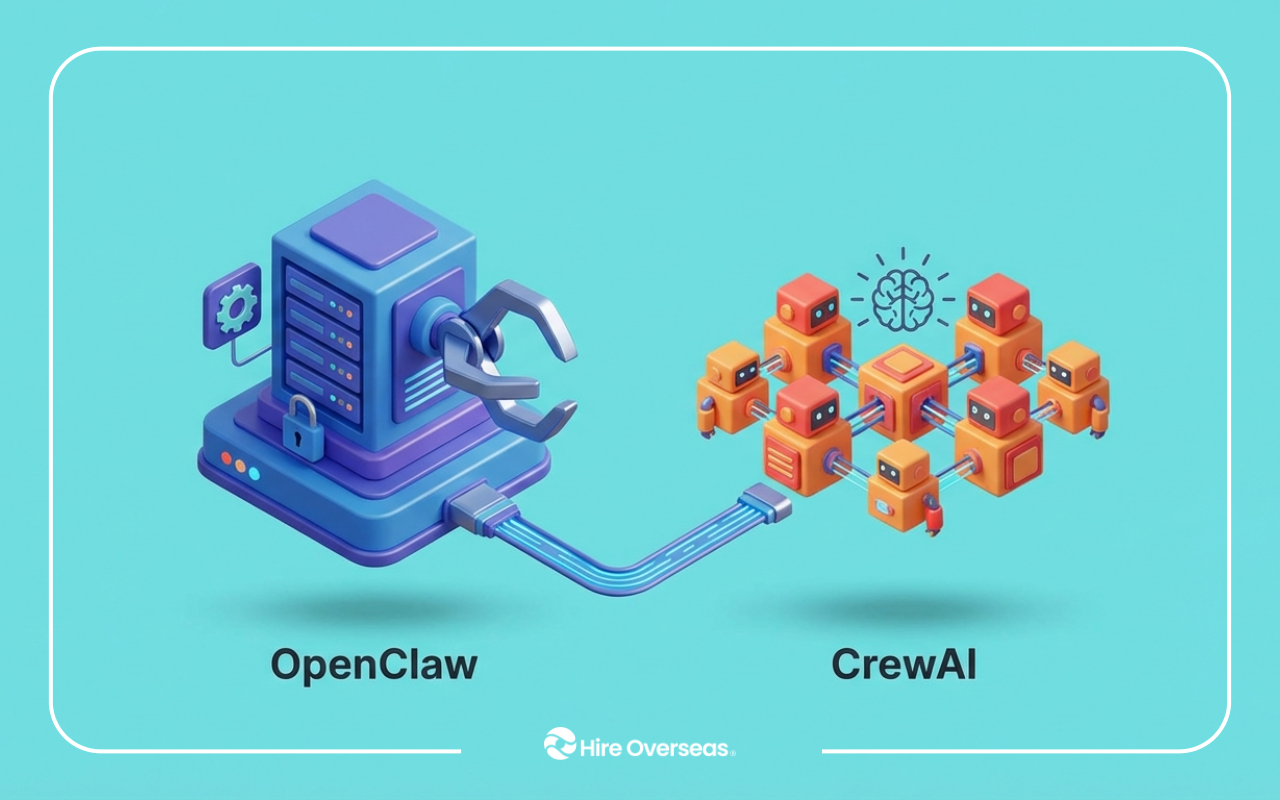
When teams compare OpenClaw vs. CrewAI, they usually ask one question: should I use OpenClaw or CrewAI?
The answer is not “one is better.”
It depends on what you are building.
- CrewAI helps agents collaborate, delegate, and coordinate.
- OpenClaw helps workflows execute across real systems safely and consistently.
If you pick the wrong layer, you create fragile automation or over-engineered agent systems. If you pick the right layer, you build durable AI infrastructure.
Why OpenClaw vs. CrewAI is often confused
The OpenClaw vs. CrewAI comparison shows up often because both tools are discussed in the same types of conversations:
- AI agents
- agent orchestration
- workflow automation
- tool calling
- multi-agent systems
At a surface level, that overlap makes them look similar. Both appear in architecture diagrams. Both can be involved when agents call tools. Both are mentioned in discussions about automation.
The confusion usually comes from the word orchestration. It sounds like the same function, but it refers to two very different layers.
CrewAI orchestration means coordinating multiple AI agents. It manages roles, delegation, collaboration, and reasoning flow inside a multi-agent system. It focuses on how agents work together to complete complex tasks.
OpenClaw orchestration means coordinating workflows across business systems. It manages triggers, integrations, execution rules, logging, retries, and safe system updates. It focuses on how decisions get executed reliably in production.
A simple way to think about the difference between OpenClaw and CrewAI:
- CrewAI helps agents decide and refine what should happen.
- OpenClaw ensures that decision becomes reliable, traceable action across real-world tools and infrastructure.
To understand that distinction clearly, we need to define what each system is designed to do at its core.
What Is OpenClaw?
OpenClaw (formerly ClawDBot / MoltBot) is a production-ready workflow automation system built for structured, deterministic execution across business environments.
It is designed to:
- Connect CRMs, ERPs, SaaS tools, and internal systems
- Execute predefined automation workflows
- Enforce governance and access controls
- Monitor activity and log execution runs
- Retry failures safely
- Maintain operational reliability at scale
OpenClaw is not a multi-agent collaboration framework. It is an automation infrastructure layer.
Its strength lies in predictability. Workflows are explicitly defined, triggers are structured, and execution follows controlled logic paths. Once a decision is made, OpenClaw ensures it is applied consistently across systems.
OpenClaw becomes critical when:
- AI outputs must update multiple platforms
- Revenue workflows require reliability
- Audit trails and compliance matter
- Automation must scale safely
OpenClaw answers:
“Now that we know what action to take, how do we execute it reliably across systems?”
It is built for business execution, not agent collaboration.
If you're evaluating OpenClaw for production automation, this breakdown of what OpenClaw is and how it evolved from ClawDBot into a structured execution layer explains its architecture, governance model, and why it’s built for deterministic business workflows.
What Is CrewAI?
CrewAI is a collaborative multi-agent orchestration framework designed to coordinate role-based AI agents.
It enables:
- Role-based agent definitions
- Task delegation across agents
- Agent-to-agent communication
- Structured multi-agent collaboration
CrewAI focuses on how agents work together to complete complex tasks. Instead of predefined workflows, it organizes reasoning through roles and delegation.
Agents can:
- Break goals into subtasks
- Distribute responsibilities
- Refine and validate each other’s outputs
CrewAI is well suited for:
- Multi-agent research systems
- Analysis and content pipelines
- AI-native experimentation
- Collaborative reasoning workflows
Because execution is model-driven, outcomes can vary based on prompt design, role structure, and configuration.
CrewAI answers: “Given this goal, how should our agents collaborate to solve it?”
It prioritizes coordinated intelligence over operational system control.
OpenClaw vs. CrewAI: Architecture-Level Comparison
Once definitions are clear, the next step in the OpenClaw vs. CrewAI comparison is understanding where each framework sits in a modern AI stack.
Most production AI systems include multiple layers:
- Data layer
- Intelligence layer
- Coordination layer (sometimes multi-agent)
- Execution layer
- Monitoring and governance layer
CrewAI and OpenClaw operate in different parts of that stack.
Understanding this placement eliminates most confusion.
CrewAI: The Multi-Agent Coordination Layer
CrewAI operates inside the intelligence and coordination layers.
It is responsible for:
- Role-based agent orchestration
- Delegation across specialized agents
- Agent collaboration workflows
- Structured reasoning loops
- Task refinement through teamwork
This is where agents “think together.”
CrewAI determines:
- Which agent handles which subtask
- How outputs are refined or validated
- How context flows between agents
- When a task is complete
It is optimized for collaborative reasoning and structured teamwork.
But CrewAI does not specialize in enterprise-grade execution across business systems. Its orchestration is internal to the agent environment.
OpenClaw: The Execution and Workflow Layer
OpenClaw operates in the execution and governance layers.
It is responsible for:
- Trigger-based workflow automation
- API integrations across business tools
- Deterministic task execution
- Logging, monitoring, and observability
- Retry logic and failure recovery
- Escalation and permission control
This is where decisions become actions.
OpenClaw ensures:
- CRM fields update correctly
- ERPs sync without data corruption
- Support tickets route accurately
- Dashboards refresh consistently
- Automation scales safely
It is optimized for operational reliability and structured workflow automation.
Visualizing the Flow: CrewAI + OpenClaw in Production
Here is how the two layers typically work together.
Step 1: Multi-Agent Collaboration (CrewAI)
A system needs to produce structured insights.
- Agent 1 gathers raw data
- Agent 2 analyzes trends
- Agent 3 synthesizes findings
- Agent 4 validates quality
CrewAI coordinates this teamwork.
Step 2: Workflow Execution (OpenClaw)
Once the output is finalized:
- CRM records are updated
- Slack notifications are sent
- Reports are archived
- Dashboards are refreshed
- Logs are recorded for auditing
OpenClaw executes these actions safely and predictably.
Without CrewAI, collaborative reasoning may be weaker.
Without OpenClaw, operational execution may be fragile.
Together, they form a layered system.
Why This Architectural Separation Matters
The mistake companies make in the OpenClaw vs. CrewAI framework debate is trying to force one tool to do both jobs.
If you use CrewAI alone for business-critical workflows:
- You risk unpredictable behavior touching production systems.
- Monitoring and retry logic become custom engineering burdens.
- Governance can become inconsistent.
If you use OpenClaw alone for complex collaborative reasoning:
- You limit agent flexibility.
- You over-constrain exploratory tasks.
- You lose the benefits of multi-agent coordination.
The strongest AI infrastructures separate:
- Intelligence and coordination (CrewAI)
- Execution and operational reliability (OpenClaw)
That separation is what turns experimentation into scalable infrastructure.
If you're planning to deploy this in a live SaaS or enterprise stack, this OpenClaw implementation guide outlines integration planning, workflow structuring, and the common mistakes teams make when moving from experimentation to production automation.
OpenClaw vs. CrewAI: Performance, Reliability, Scalability, and Decision Framework
Once you understand the architectural difference, the real question becomes practical:
- Which performs better in production?
- Which is more reliable under scale?
- When should you choose one over the other?
Performance: Reasoning Depth vs. Deterministic Execution
CrewAI performance is strongest when tasks benefit from multi-agent collaboration, role-based reasoning, and iterative refinement. It excels in research pipelines, structured analysis, and AI-native workflows. However, performance is model-dependent and can vary based on prompts, role design, and coordination logic.
CrewAI optimizes for reasoning quality.
OpenClaw performance is strongest in repeatable operational workflows such as CRM updates, billing triggers, routing logic, and cross-system synchronization. Because workflows are predefined and rule-based, execution remains consistent under scale.
OpenClaw optimizes for predictable throughput.
Reliability: Governance vs. Variability
CrewAI reliability depends on governance. Clear role definitions, guardrails, monitoring, and fallback logic are required when agent outputs affect real systems. Without discipline, variability increases.
OpenClaw reliability is infrastructure-driven. It enforces structured triggers, retry logic, failure recovery, logging, and permission boundaries. It is built assuming production environments and operational risk.
CrewAI supports collaborative thinking.
OpenClaw enforces execution control.
Scalability: Scaling Intelligence vs. Scaling Operations
CrewAI scalability increases agent count and coordination complexity. As more agents and roles are added, governance requirements grow.
OpenClaw scalability increases workflow coverage and system integrations. Because workflows are deterministic, scaling increases throughput without increasing reasoning variance.
CrewAI scales intelligence.
OpenClaw scales operations.
Pros and Cons
OpenClaw Advantages:
- High operational reliability
- Strong integration discipline
- Built-in monitoring and logging
- Safer for production workflows
OpenClaw Limitations:
- Less suited for exploratory multi-agent collaboration
CrewAI Advantages:
- Powerful multi-agent coordination
- Flexible, role-based reasoning
- Strong fit for AI-native systems
CrewAI Limitations:
- Higher execution variability
- Requires stronger governance for production use
When to Use OpenClaw vs. CrewAI
Choose CrewAI when:
- You are building multi-agent systems
- Tasks require role-based collaboration
- Output refinement and reasoning quality matter most
Choose OpenClaw when:
- Automation touches business systems
- Workflows must be predictable
- Monitoring, retries, and compliance are required
Use both when:
- Agents collaborate before triggering real workflows
- AI decisions impact revenue or customer systems
- You need intelligence plus execution stability
The strongest AI systems separate coordination from infrastructure.
CrewAI → intelligence coordination
OpenClaw → operational execution
That separation prevents fragile builds and reduces technical debt.
If you've decided execution reliability is the priority, this guide to hiring OpenClaw developers explains what skill sets matter, how to evaluate automation experience, and how to avoid costly architectural rewrites later.
OpenClaw vs. CrewAI Comparison Matrix
If you're comparing orchestration frameworks more broadly, this OpenClaw vs. LangChain analysis explains where execution-first automation differs from agent-first chaining architectures in real production environments.
Hire Overseas Insight: How Companies Actually Choose Between OpenClaw vs. CrewAI
At Hire Overseas, we’ve seen the OpenClaw vs. CrewAI decision play out across startups, SaaS companies, and enterprise environments.
The mistake most teams make is treating this as a tool comparison. In practice, it is a maturity and risk decision. The right framework depends less on features and more on what your AI system is touching.
Early-Stage Startups: Intelligence First, Execution Later
Profile:
- Small technical team
- AI experimentation phase
- Limited operational complexity
- Few mission-critical integrations
In early stages, teams are focused on:
- improving output quality
- testing multi-agent collaboration
- iterating quickly
- validating product ideas
This is where CrewAI often makes sense.
Its role-based agent coordination model allows startups to:
- structure reasoning workflows
- experiment with collaboration patterns
- refine outputs through multi-agent teamwork
At this stage, execution risk is usually low because the AI system is not yet deeply integrated into revenue or compliance-sensitive systems.
But here is the inflection point.
Once the AI begins touching:
- CRM records
- customer onboarding flows
- billing systems
- operational dashboards
Execution reliability becomes more important than experimentation flexibility.
This is where OpenClaw enters the architecture.
The Pattern We See: Startups begin with CrewAI for intelligence. They introduce OpenClaw when automation starts affecting real business systems.
Scaling SaaS Companies: Intelligence + Revenue Systems
Profile:
- Established SaaS product
- CRM, billing, support, and onboarding integrations
- Revenue-sensitive automation
In SaaS environments, AI rarely lives in isolation.
An agent might:
- classify inbound leads
- prioritize support tickets
- score churn risk
- trigger lifecycle workflows
CrewAI can manage the reasoning layer.
But if those decisions directly modify:
- CRM records
- subscription states
- support routing
- internal task assignments
You need structured execution discipline.
Without it:
- workflows break silently
- systems desynchronize
- teams lose trust in automation
The Pattern We See: SaaS companies almost always require both layers. CrewAI handles collaborative reasoning. OpenClaw enforces operational reliability.
The separation protects revenue workflows from agent variability.
Enterprise Organizations: Governance Is Infrastructure
Profile:
- Multi-system environments
- Compliance and audit requirements
- Cross-department automation
- High operational volume
Enterprise AI decisions affect:
- financial systems
- regulated data
- internal controls
- customer records
In these environments, governance is not optional.
CrewAI may power:
- research layers
- summarization pipelines
- internal AI copilots
But OpenClaw becomes infrastructure.
It provides:
- structured workflow execution
- permission boundaries
- retry and escalation logic
- observability and audit trails
- deterministic system updates
The Pattern We See At Hire Overseas: In enterprise environments, OpenClaw is rarely optional once AI touches operations. Agent collaboration can remain flexible. Execution cannot.
If you're evaluating OpenClaw against other autonomous agent systems, this OpenClaw vs. AutoGPT comparison breaks down why unsupervised autonomy creates operational risk when workflows touch revenue systems.
The Real Risk: Blurring Intelligence and Execution
The biggest risk in the OpenClaw vs. CrewAI decision is not choosing the wrong framework.
It is blurring intelligence and execution.
CrewAI is powerful for multi-agent collaboration and coordinated reasoning. OpenClaw is built for structured workflow automation and production-grade execution. When collaborative agents directly control revenue systems without execution guardrails, variability becomes operational risk. When deterministic workflows are forced to handle complex reasoning, innovation slows.
The cost of getting this wrong is real:
- Silent data drift across systems
- Broken automations under scale
- Governance gaps in revenue workflows
- Expensive architectural rebuilds later
The companies that scale AI successfully separate layers early:
CrewAI for intelligence.
OpenClaw for operational execution.
Clear boundaries create durable systems.
Design for scale before scale exposes your weaknesses.
If you're evaluating OpenClaw vs. CrewAI and want to architect your stack correctly from the start, book a strategic AI consultation with Hire Overseas today.
