


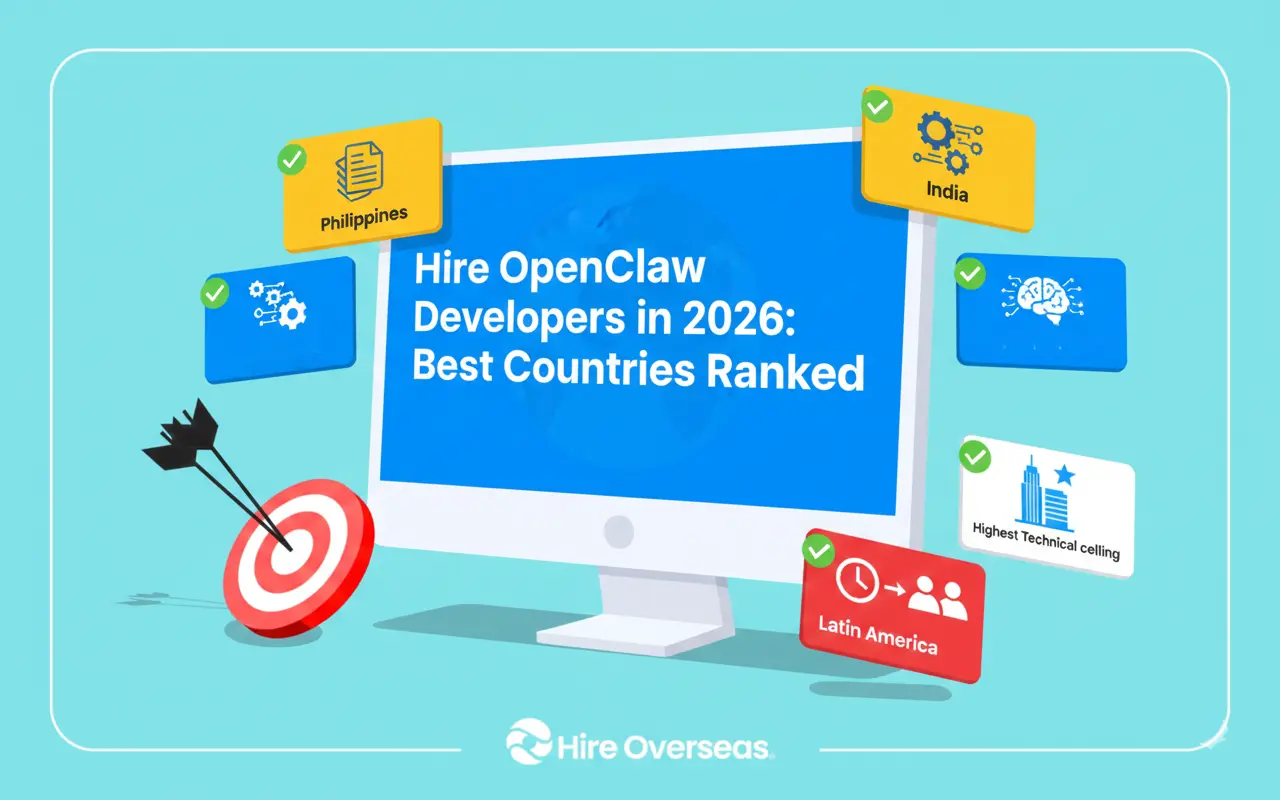
If you plan to hire OpenClaw developers in 2026, geography directly affects cost, system quality, and scalability.
OpenClaw involves automation architecture, API integrations, AI components, and legacy migrations. The country you choose can determine whether your implementation becomes stable infrastructure or fragile experimentation.
This guide ranks the top countries for OpenClaw developers, compares rates by region, and explains how to build distributed teams without losing control.
If you need a production-readiness hiring framework, here is a guide on hiring an OpenClaw Developer for when you are ready to scale with AI agents.
Quick Snapshot: Best Countries to Hire OpenClaw Developers
- Best overall offshore value: Philippines
- Largest integration-focused talent pool: India
- Strongest AI architecture depth: Eastern Europe
- Best nearshore option for US startups: Latin America
- Highest technical ceiling: United States
- Best countries for startup OpenClaw teams: Philippines, Latin America
Now let’s break down each region in detail.
OpenClaw Developer Talent Pool Comparison by Country
After reviewing the quick snapshot, the next step is understanding why each region ranks the way it does.
When evaluating OpenClaw developer talent by country, salary should not be your primary filter. OpenClaw implementations touch automation infrastructure, APIs, AI agents, and production systems. A lower monthly rate does not compensate for unstable architecture or weak documentation.
Instead, assess each region based on:
- API and multi-system integration depth
- Workflow automation architecture experience
- AI agent orchestration exposure
- Documentation and governance discipline
- Remote collaboration maturity
- Retention and long-term scalability
Below is a structured breakdown of the top OpenClaw developer hotspots and how they align with different business needs.
OpenClaw Developers in the Philippines
Positioning: Best overall offshore value for automation-heavy roles
Model fit: Offshore OpenClaw developers
The Philippines consistently ranks as one of the most balanced markets for companies that want cost efficiency without sacrificing structure.
Unlike freelance-heavy ecosystems, the Philippines has a mature remote staffing infrastructure. Many engineers operate within long-term employment models rather than short contracts, which improves retention and documentation consistency.
Why it works
- Strong English proficiency reduces integration friction
- Deep SaaS operations exposure, especially CRM and workflow tools
- High familiarity with distributed team environments
- Stable long-term staffing culture
Filipino OpenClaw engineers are particularly strong in:
- Workflow orchestration across SaaS stacks
- CRM and API integrations
- Operations-driven automation builds
- Ongoing system monitoring and maintenance ownership
This makes the Philippines ideal for execution-layer OpenClaw builds where reliability and structured rollout matter.
OpenClaw developer rates (Philippines)
- Automation developer: $3,000–$6,000/month
- Integration specialist: $4,500–$7,500/month
- AI-integrated engineer: $6,000–$9,000/month
Best for: Companies building distributed OpenClaw teams that require documentation discipline, cost control, and long-term ownership.
OpenClaw Developers in India
Positioning: Largest OpenClaw developer talent pool globally
Model fit: Offshore OpenClaw developers
India offers one of the most scalable OpenClaw engineering ecosystems in the world. The volume of engineers available makes it attractive for companies planning multi-role expansion.
India is particularly strong in technically complex builds.
Core strengths
- Massive engineering capacity
- Deep backend and API integration expertise
- Strong database-level architecture exposure
- Competitive pricing at scale
Indian engineers are especially effective for:
- Complex API orchestration
- Backend-heavy OpenClaw infrastructure
- Data pipeline and schema integrations
- Enterprise-grade system builds
However, quality variance is wider due to sheer market size. Structured vetting and clear role definitions are critical.
OpenClaw engineering salary comparison (India)
- Automation developer: $3,500–$7,000/month
- Integration engineer: $5,000–$8,500/month
- AI architect: $7,000–$11,000/month
Best for: Companies needing scalable backend integration power with structured hiring oversight.
OpenClaw Developers in Eastern Europe
Countries: Poland, Romania, Ukraine, Bulgaria
Positioning: Premium AI and systems architecture depth
Model fit: Offshore or hybrid remote teams
Eastern Europe consistently ranks among the best countries for OpenClaw talent when architectural reliability is the top priority.
The region has a strong mathematics and engineering tradition, which translates into disciplined system design and cleaner documentation standards.
Strength profile
- Strong AI and algorithmic foundation
- Enterprise-grade documentation habits
- Compliance and data governance awareness
- Structured system design thinking
Eastern European engineers are particularly effective in:
- Multi-agent OpenClaw orchestration
- AI-integrated infrastructure builds
- Regulated or compliance-heavy environments
- Performance optimization and debugging
OpenClaw developer affordability (Eastern Europe)
- Automation engineer: $6,000–$9,000/month
- Integration architect: $7,000–$11,000/month
- AI-heavy systems engineer: $9,000–$13,000/month
Costs are higher than Asia but significantly lower than US equivalents.
Best for: Enterprise deployments, regulated industries, and complex AI-driven OpenClaw implementations.
OpenClaw Developers in Latin America
Countries: Mexico, Colombia, Argentina, Brazil
Positioning: Best nearshore OpenClaw developers for US companies
Model fit: Nearshore OpenClaw developers
Latin America has emerged as a strategic nearshore option for US startups that prioritize collaboration speed.
The biggest advantage is time zone alignment. Daily standups, real-time debugging, and integration reviews happen without async delays.
Why US startups prefer LATAM
- Real-time collaboration
- Cultural alignment
- Faster iteration cycles
- Growing SaaS engineering ecosystem
Latin American engineers are particularly strong in:
- Integration-heavy SaaS builds
- CRM and automation platform orchestration
- Startup-scale OpenClaw deployments
- Product-driven experimentation
OpenClaw developer rates (LATAM average)
- Automation developer: $4,500–$8,000/month
- Integration engineer: $6,000–$9,000/month
- AI engineer: $8,000–$12,000/month
Best for: US startups building cross-border OpenClaw hiring strategies that require daily alignment and product collaboration.
OpenClaw Developers in the United States
Positioning: Highest technical ceiling
Model fit: Onshore or remote US-based teams
US OpenClaw engineers typically offer the strongest architectural ceiling, especially in AI-first or product-native companies.
They are often strongest in:
- AI-first OpenClaw architecture
- Multi-agent orchestration systems
- Complex production debugging
- High-velocity startup experimentation
US monthly cost range
- Automation engineer: $9,000–$14,000
- Integration architect: $11,000–$16,000
- AI systems engineer: $13,000–$20,000
Tradeoff: Highest cost, but highest proximity and direct oversight.
Best used for:
- Core architecture leadership
- Hybrid distributed OpenClaw teams
- Compliance-heavy or security-sensitive deployments
Many scaling companies use US-based leads with offshore execution layers to balance control and cost.
Emerging OpenClaw Engineering Hubs
Vietnam & Southeast Asia
- Strong for clearly defined automation tasks
- Competitive rates
- Smaller OpenClaw-specific ecosystem
Best for modular builds rather than architecture leadership.
South Africa
- English-native environment
- Growing automation engineering presence
- Well suited for operations-focused roles
These regions can work well but require tighter scope definition and structured onboarding.
OpenClaw Talent Cost Differences by Region
Below is a simplified cost comparison aligned with the earlier country rankings:
These savings are meaningful, but only when structured correctly.
Important: OpenClaw remote talent cost advantages only materialize when onboarding, monitoring, documentation standards, and governance are designed intentionally. Poor structure erodes savings through rework, integration failures, and technical debt.
Country selection is a leverage point. Role clarity and execution discipline determine the outcome.
Where to Find OpenClaw Developers
Once you’ve identified the right country, the next decision is where to actually source OpenClaw talent.
Because OpenClaw is still a relatively new and specialized role, not every hiring channel produces qualified candidates. Many engineers list “AI” or “automation” on their resume, but few have real experience with workflow orchestration, multi-system integrations, and execution-layer infrastructure.
Below are the most common sourcing paths, and when each makes sense.
Specialized AI Staffing Partners
This is often the most reliable path for companies that want speed and reduced hiring risk.
Specialized AI staffing firms focus specifically on automation engineers, AI system builders, and OpenClaw-adjacent roles. They understand:
- The difference between a prompt engineer and an OpenClaw infrastructure engineer
- How to test for integration depth
- What production-level experience actually looks like
- How to filter out “demo builders” from real execution engineers
Because OpenClaw is not a generic developer role, expert pre-vetting matters significantly.
Strategic advantage:
You avoid weeks of misaligned interviews and reduce the risk of hiring someone who can build prototypes but not stable systems.
At Hire Overseas, we understand that OpenClaw is an emerging execution infrastructure, not a generic developer role. That’s why our vetting goes beyond tool familiarity.
OpenClaw hiring starts at $5,000 per month with no hidden fees, and every candidate undergoes structured pre-vetting tailored to automation and AI infrastructure roles. We assess integration ownership, workflow architecture thinking, documentation discipline, and real production experience.
We also act as an end-to-end partner, handling payroll, compliance, contracts, and ongoing team support. You focus on building scalable OpenClaw systems while we ensure operational stability behind the scenes.
Remote Engineering Firms
Some companies hire through remote engineering agencies that provide project-based teams.
This model works best when:
- Scope is tightly defined
- You need short-term implementation support
- You do not require long-term ownership
However, agency teams may rotate engineers, which can reduce continuity in OpenClaw systems that require ongoing maintenance.
Best for: Short-term builds or experimental deployments.
Offshore OpenClaw Developers via Dedicated Staffing Models
Dedicated staffing models allow you to hire full-time offshore OpenClaw developers who operate as embedded team members.
This approach provides:
- Long-term ownership
- Stable documentation practices
- Lower turnover compared to freelance platforms
- Clear cost structure
For companies building distributed OpenClaw teams, this model typically delivers the strongest ROI over time.
Hire Overseas specializes in this model, pairing companies with pre-vetted OpenClaw engineers in offshore and nearshore markets. Because this role is still emerging, our screening focuses on real automation architecture exposure rather than keyword matching.
Distributed Global OpenClaw Talent Platforms
Freelance marketplaces and global talent platforms can offer access to a wide pool of engineers.
The tradeoff:
- Lower entry cost
- Higher screening burden
- Increased quality variance
- Limited long-term accountability
These platforms work best for:
- Small experiments
- Isolated integration tasks
- Debugging support
They are less suited for building core OpenClaw infrastructure that touches production systems.
Direct Sourcing in OpenClaw Engineering Hubs
Some companies recruit directly in established OpenClaw engineering hubs such as:
- The Philippines
- India
- Eastern Europe
- Latin America
Direct sourcing gives maximum control but requires:
- Deep technical screening capability
- Time-intensive evaluation
- Understanding of local salary benchmarks
- Structured onboarding processes
Without internal expertise in OpenClaw architecture, this approach can create misalignment between job description and real system needs.
Hire Overseas Insight: Geography Is a Lever, Not the Outcome
Country selection influences cost, collaboration speed, and scalability. But geography does not guarantee execution quality.
The real determinant of success is:
- Role clarity
- Production-level screening
- Structured onboarding
- Governance and monitoring ownership
Role clarity determines stability. Geography optimizes cost and scale.
Because OpenClaw is still an emerging role, expert pre-vetting is not optional. It is the difference between building durable infrastructure and deploying fragile automation that fails under pressure. Most hiring mistakes happen when companies treat OpenClaw like a generic AI or developer position.
This is exactly where structured support matters. Our goal at Hire Overseas is not just to fill a role but to reduce execution risk from day one.
Automation is leverage. The person you hire determines whether that leverage compounds over time or collapses under production stress.
Building Distributed OpenClaw Teams Correctly
Most companies assume distributed hiring is primarily a cost decision. In OpenClaw infrastructure, it is an operating model decision.
From a Hire Overseas insider perspective, distributed OpenClaw teams fail when companies replicate local team assumptions across borders. Informal alignment, undocumented decisions, and shared accountability might work in one office. They break down quickly across time zones.
This section focuses on team structure at scale, not candidate evaluation. If you are hiring your first OpenClaw engineer or want a detailed breakdown of how to define 30-day outcomes, run architecture tests, and validate resilience through a 14-day pilot before scaling, this production-focused hiring framework walks through the exact evaluation process we use.
Here is how distributed OpenClaw teams should be structured for stability and scale.
1. Design the Team in Infrastructure Layers
Do not structure distributed teams purely by title. Structure them by system responsibility.
A stable OpenClaw team typically includes:
- Execution layer → Implements workflows, connects APIs, deploys updates
- Integration layer → Owns authentication, schemas, rate limits, and system compatibility
- Architecture layer → Designs orchestration logic, scaling strategy, and guardrails
- Oversight layer → Monitors runtime performance and manages escalation
When these layers are blurred, accountability dissolves. Distributed teams require sharper responsibility boundaries than centralized teams because alignment is intentional, not automatic.
2. Centralize Architectural Authority
In distributed OpenClaw environments, architecture must have a single accountable owner.
Without centralized authority:
- Logging standards drift
- Integration patterns become inconsistent
- Documentation fragments
- Failure handling becomes reactive
A designated architecture lead sets system standards that all engineers follow. This protects long-term infrastructure integrity, especially when scaling across offshore and nearshore regions.
3. Engineer for Asynchronous Resilience
Distributed OpenClaw teams operate across time zones. That means systems must explain themselves.
Infrastructure should include:
- Structured, searchable logs
- Clear run IDs and traceability
- Self-documenting workflow maps
- Predefined escalation thresholds
If automation fails at 2 a.m., the system should degrade safely and provide enough visibility for the next team member to diagnose quickly.
Asynchronous resilience is not optional. It is core to global OpenClaw execution.
4. Assign Monitoring as a Formal Role
Monitoring cannot be informal or shared casually across distributed engineers.
Someone must explicitly own:
- Runtime health dashboards
- Failure categorization
- Drift detection
- Alert configuration
- Escalation management
When monitoring is treated as secondary, failures surface only after business impact.
5. Predefine Escalation and Rollback Protocols
Cross-border OpenClaw hiring succeeds when operational playbooks are defined before incidents occur.
Your distributed team should know:
- Who responds first to system failure
- When escalation reaches leadership
- What triggers rollback
- Which workflows require human override
Escalation clarity builds confidence in automation across departments.
The Hire Overseas Insider Perspective
The difference between a cost-optimized distributed team and a resilient global OpenClaw infrastructure team is governance clarity.
At Hire Overseas, we help companies structure distributed OpenClaw teams intentionally by:
- Defining infrastructure ownership layers
- Clarifying architectural authority
- Embedding monitoring discipline early
- Supporting payroll, compliance, and long-term retention
- Aligning offshore and nearshore execution with leadership oversight
Geography expands leverage. Structure protects it.
Cross-border OpenClaw hiring works when accountability is engineered from day one.
Our final Insight: OpenClaw Is Infrastructure. Hire Like It.
OpenClaw is no longer a side experiment. It is becoming the execution layer behind sales workflows, reporting systems, CRM updates, support routing, and internal operations.
That means your hiring decision is not tactical. It is structural.
The right OpenClaw developer creates stable automation that compounds efficiency every month. The wrong one creates silent failures, fragile integrations, and long-term technical debt that costs far more than salary savings.
Geography gives you leverage. Structure protects it. Vetting determines durability.
At Hire Overseas, we help startups and scaling companies hire pre-vetted OpenClaw engineers with the goal of long-term team continuity. We do not just fill roles. We help you build execution infrastructure designed to last.
If OpenClaw is becoming core to your operations, hire with that level of seriousness.
Book your OpenClaw hiring strategy call today.
Automation is infrastructure so hire accordingly.
