


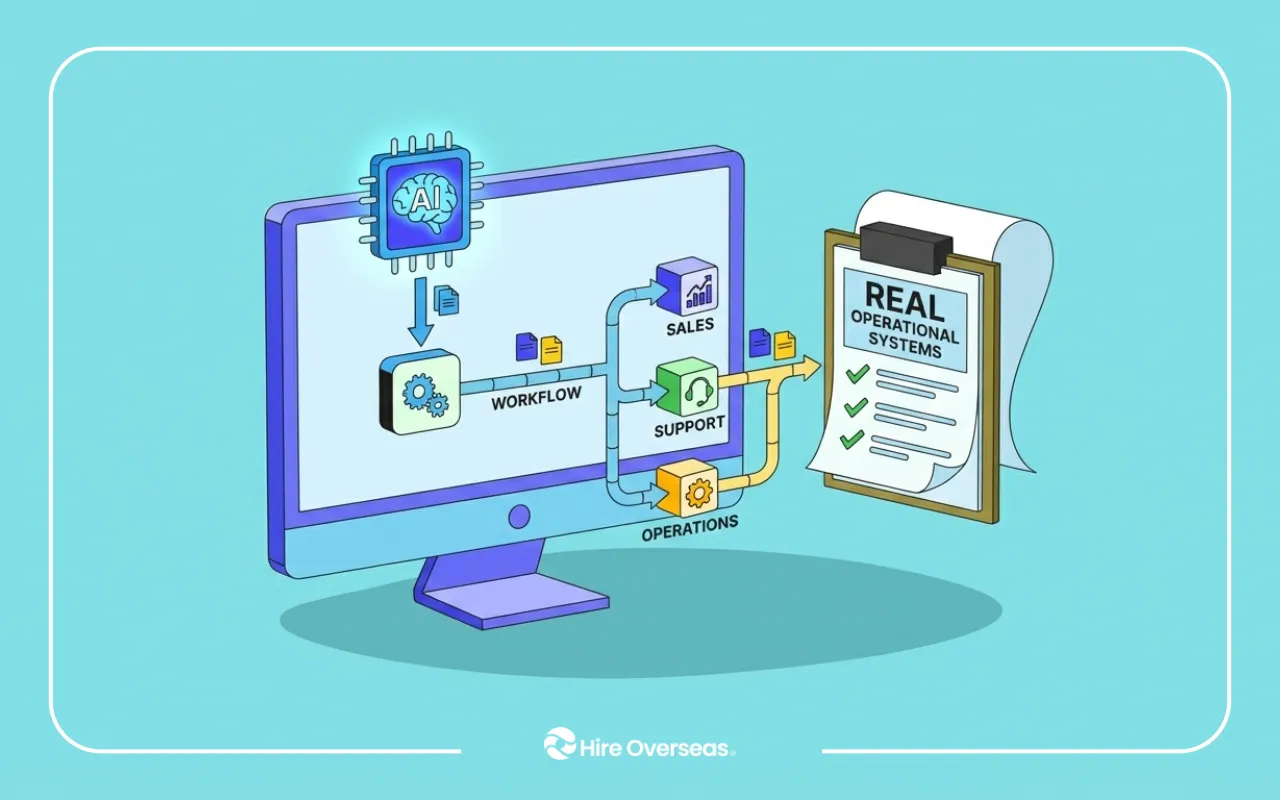
Many startup founders know AI can improve productivity. The challenge is knowing how to implement AI in your business without overcomplicating operations.
Many startups experiment with AI tools, but these tools rarely connect to the workflows that actually run the company.
This guide explains how startups implement AI step by step, with practical tools and use cases that turn AI from experimentation into real operational systems.
What Implementing AI in Your Startup Actually Means
Implementing AI in your startup means integrating artificial intelligence into everyday workflows so it improves efficiency, decision-making, and operational speed.
Many founders begin by using AI tools for writing or research. While useful, this does not create meaningful operational impact. Real AI implementation happens when AI becomes part of the systems that run the business.
Startups commonly use AI to:
- automate repetitive tasks
- analyze customer and product data
- generate marketing content
- support customer service
- streamline internal workflows
For example, instead of manually reviewing inbound leads, AI can analyze lead information, prioritize prospects, and trigger follow-up actions automatically.
When AI is integrated into these processes, startups can operate faster with smaller teams, which is one of the biggest advantages early-stage companies can achieve.
If your team is still using ChatGPT or Claude as standalone tools, this guide to what OpenClaw is shows how startups turn AI outputs into real workflows with triggers, logging, and system-level execution
How to Implement AI in Your Startup: A Step-by-Step Framework
Startups that successfully adopt artificial intelligence—often with guidance from an experienced AI development company—usually follow a structured implementation process rather than introducing many tools at once. The goal is to begin with a few high-impact workflows that quickly improve productivity.
Step 1: Identify High-Impact Workflows
Start by identifying areas where your team spends the most time on repetitive tasks.
Common startup workflows that benefit from AI include:
- customer support inquiries
- lead qualification and CRM updates
- marketing content creation
- reporting and analytics
- administrative coordination
Focus on processes that are repetitive, data-heavy, or prone to manual errors. These areas usually deliver the fastest improvements.
Step 2: Choose AI Tools That Fit Your Startup Stack
Most startups already use tools such as CRMs, communication platforms, and project management software. The most effective AI implementation strategy is selecting tools that integrate with your existing systems.
Examples include:
- ChatGPT or Claude for writing, research, and analysis
- HubSpot AI for CRM automation and lead insights
- Zapier or Make for workflow automation
- Notion AI for documentation and internal knowledge management
- Intercom Fin AI for automated customer support
Choosing compatible tools reduces implementation complexity and speeds up adoption.
If you’re choosing tools right now and want to avoid adopting the wrong model for the wrong job, this best AI model for business comparison breaks down which systems are strongest for writing, analytics, coding, and automation support
Step 3: Design AI-Powered Workflows
The biggest productivity gains occur when AI tools are connected across systems.
For example, a startup lead workflow might look like this:
Website lead captured → CRM automatically updated → AI evaluates lead quality → automated email follow-up launches → AI summarizes engagement for the sales team.
This removes manual handoffs and allows teams to focus on higher-value work.
If you’ve identified the workflows but aren’t sure how to connect CRM updates, AI scoring, and follow-up actions into one system, this OpenClaw implementation guide walks through the rollout sequence most startups need before automation becomes reliable
Step 4: Train Your Team to Work With AI
AI systems require employees to understand how to interact with them effectively.
Teams should learn:
- how to structure prompts clearly
- how to evaluate AI outputs
- when human oversight is necessary
Organizations that train their teams early tend to see stronger adoption and better results.
Step 5: Monitor and Improve AI Systems
AI implementation should evolve as your startup grows.
Track metrics such as:
- time saved through automation
- marketing output and campaign performance
- response times for customer support
- lead conversion improvements
These insights help founders refine workflows and gradually expand AI adoption across the business.
When Startups Need AI Implementation Specialists
Many startups begin using AI tools independently. However, as AI expands across multiple systems and workflows, implementation becomes more complex.
At this stage, AI is no longer just a productivity tool. It becomes part of the operational infrastructure of the startup.
Signs Your Startup Needs AI Implementation Support
Startups typically need AI implementation specialists when:
- multiple AI tools must integrate across platforms
- automation workflows span marketing, sales, and operations
- AI systems require monitoring and optimization
- internal teams lack time or technical expertise to manage automation
Without proper implementation, AI tools often remain disconnected and fail to deliver meaningful operational improvements.
If your startup has the ideas but no one owning the day-to-day automation layer, this guide to AI workflow operators in the Philippines explains who manages prompt logic, workflow maintenance, and exception handling once AI moves into operations
Common AI Implementation Roles
As AI adoption grows, startups often introduce specialized roles responsible for managing automation and integrations.
These roles may include:
- AI implementation agents who design and deploy AI workflows
- automations managers who oversee automation infrastructure
- AI workflow operators who maintain and optimize AI-powered systems
These specialists ensure AI tools connect effectively across systems such as CRMs, communication platforms, marketing tools, and internal dashboards.
Building AI-Powered Operations Teams
Many startups eventually build AI-powered operations teams responsible for maintaining automation across the organization.
These teams support workflows such as:
- marketing automation
- lead qualification and CRM management
- customer support operations
- internal workflow coordination
Some startups accelerate this process by working with Filipino AI experts or building AI-powered operations teams in the Philippines, allowing them to implement AI systems quickly while maintaining cost efficiency.
Hire Overseas helps startups scale these capabilities by embedding experienced AI specialists directly into their teams, enabling founders to focus on growth while experts manage automation infrastructure.
If you’re deciding whether to hire one implementation specialist or build broader execution capacity, this AI-powered operations team in the Philippines breakdown shows how startups structure automation, integration, and monitoring roles without overbuilding too early.
Real AI Use Cases Startups Are Implementing Today
Understanding how to implement AI in your startup becomes much clearer when looking at practical examples. Many early-stage companies are already using AI to automate repetitive work, improve customer experience, and scale operations with smaller teams.
Below are several real workflows startups commonly implement.
Ecommerce Startup: AI Product Descriptions and Customer Support
Ecommerce startups often spend significant time writing product descriptions and answering repetitive customer inquiries. AI can automate both processes and allow small teams to manage growing product catalogs.
Tools:
- ChatGPT
- Shopify Magic
- Gorgias AI
Workflow:
- Export the product catalog from Shopify.
- Use ChatGPT or Shopify Magic to generate optimized product descriptions in bulk.
- Upload the descriptions back into Shopify.
- Train Gorgias AI using previous customer support tickets.
- Deploy an AI chatbot to answer common questions about shipping, returns, and product details.
Result:
- faster product catalog launches
- reduced customer support workload
- faster response times for customers
Marketing Startup: AI Content and SEO Production
Content marketing is essential for startup growth, but many teams lack the resources to produce content consistently. AI tools allow small marketing teams to scale production.
Tools:
- Jasper AI
- SurferSEO
- Notion AI
Workflow:
- Identify target keywords using SurferSEO.
- Generate an initial draft using Jasper AI.
- Edit and structure the content inside Notion AI.
- Optimize the article based on SurferSEO recommendations.
- Publish the article to the company website or blog.
Result:
- faster content creation
- consistent publishing schedule
- improved search engine visibility
If content is one of the first areas where your startup is applying AI, this AEO playbook explains how to turn faster AI-assisted publishing into visibility across answer engines instead of just producing more articles
Service Startup: AI Lead Qualification
Service-based startups often struggle to respond quickly to incoming leads. AI can automate the early stages of the sales funnel.
Tools:
- Intercom Fin AI
- HubSpot AI CRM
- Calendly
Workflow:
- Add an AI chatbot to the startup website.
- Configure the chatbot to answer basic service questions.
- Capture lead information inside HubSpot CRM.
- AI qualifies leads by asking automated questions about project scope or needs.
- Qualified leads automatically schedule meetings through Calendly.
Result:
- faster response times to inbound leads
- better lead qualification
- reduced manual sales coordination
SaaS Startup: Hiring an AI Workflow Specialist
Some startups reach a stage where using individual AI tools is no longer enough. They need someone who can design and manage AI-powered workflows across multiple systems.
A SaaS startup managing inbound leads and customer onboarding hired an AI workflow specialist to automate operations.
Tools:
- HubSpot AI CRM
- Zapier
- Slack
- OpenAI API (ChatGPT)
Workflow implemented:
- Website visitors submit lead forms.
- HubSpot automatically captures lead data.
- Zapier sends the lead information into an AI workflow.
- AI analyzes the company profile and product interest.
- High-priority leads are routed to the sales team through Slack.
- AI generates a summary briefing before the sales call.
Result:
- faster lead qualification
- improved sales productivity
- reduced manual coordination between teams
By hiring a specialist to design and manage these workflows, the startup moved from experimenting with AI tools to operating a structured AI-powered system.
Moving From AI Experiments to AI-Powered Startup Operations
There is a clear difference between startups experimenting with AI tools and startups integrating AI into their operations.
Using AI occasionally for tasks like writing emails or generating ideas can save time. However, the real value of AI appears when it becomes part of core business workflows.
For example, a customer inquiry can trigger an AI chatbot response, automatically categorize the request, assign it to the right team member, and generate a summary for the support team. Workflows like this reduce manual coordination and allow small teams to operate more efficiently.
When AI is integrated into everyday systems, startups benefit from faster decision-making, improved response times, and reduced administrative work. These efficiencies allow startups to scale operations without increasing headcount at the same pace.
The key is treating AI as an operational system, not just a collection of tools. Startups that design structured workflows and connect AI across their business often gain a long-term advantage through greater efficiency and scalability.
If you're exploring how to implement AI in your startup, Hire Overseas can help you find experienced AI specialists or deploy AI implementation agents who design and manage automation workflows for your business.
Book a discovery call to start planning your AI implementation strategy today.
