


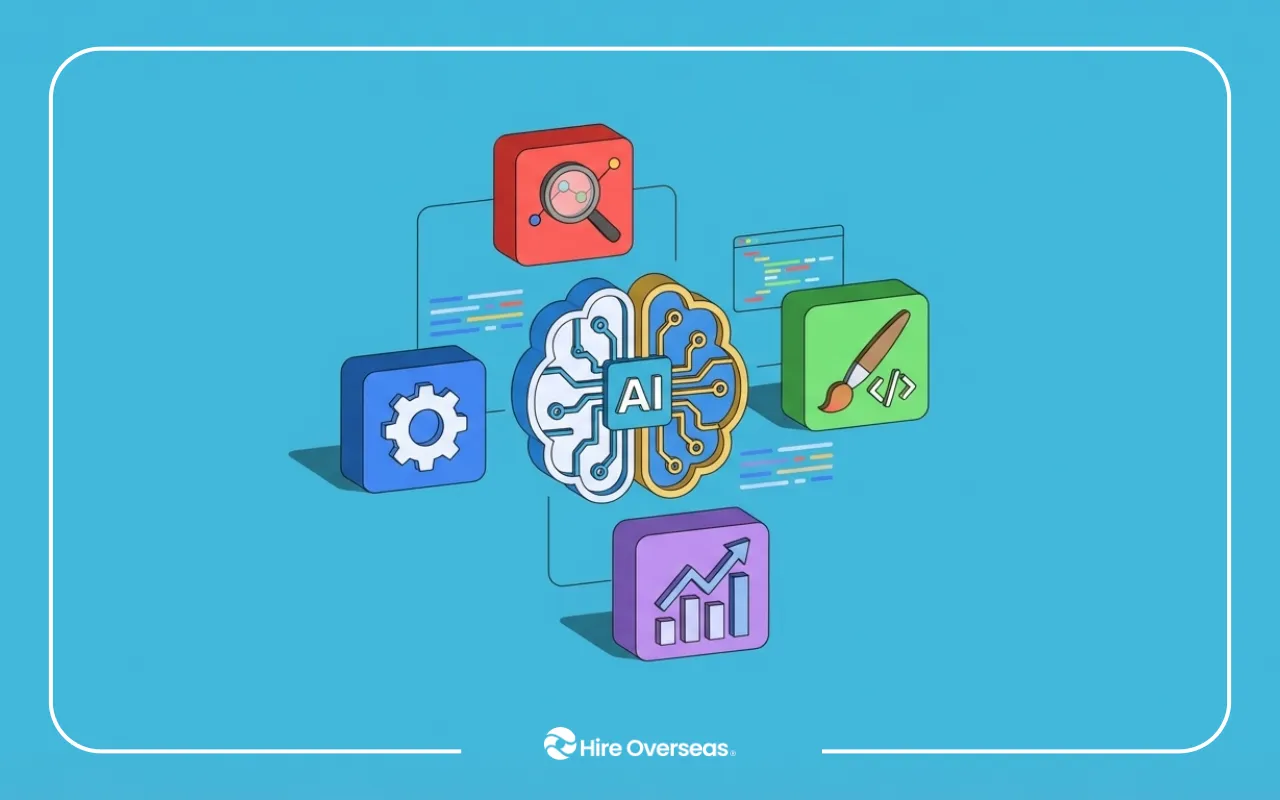
The best AI model for business depends on the problem you want to solve.
Large language models like OpenAI GPT, Anthropic Claude, Google Gemini, and Meta Llama are currently the most versatile for business automation. However, specialized AI models often perform better for tasks such as coding, analytics, video generation, or design.
Because AI models are optimized for different capabilities, businesses should evaluate models based on use case, integration requirements, scalability, and cost rather than popularity alone.
Understanding the Main AI Model Categories
When companies ask “what’s the best AI model for business?”, they are usually comparing different types of AI systems.
Most modern AI tools fall into four main categories. Understanding these categories helps businesses choose technology based on purpose rather than hype.
Large Language Models (Best AI Language Model for Business)
Large language models, often called LLMs, are currently the most versatile AI systems available.
Some of the most widely used models today include:
- OpenAI GPT models (ChatGPT)
- Anthropic Claude
- Google Gemini
- Meta Llama
These systems are designed to understand and generate human language, which makes them useful across many business functions.
Companies use them for:
- marketing content creation
- customer support automation
- internal knowledge assistants
- research and summarization
- workflow support
Because they can support multiple departments, large language models are often considered the best AI model for business use for companies starting their AI journey.
However, they still require careful integration and oversight to deliver reliable results.
Open-Source AI Models
Open-source AI models provide companies with greater control over their infrastructure and data.
Popular open-source models include:
- Meta Llama
- Mistral AI models
- Falcon LLM
These models allow companies to:
- run AI on private infrastructure
- customize training data
- maintain full control of sensitive information
However, deploying open-source models typically requires a technical team to manage infrastructure, security, and optimization.
For companies that need strict data governance or highly customized systems, open-source models can be a strong option.
Enterprise AI Platforms
Large organizations often adopt enterprise AI platforms designed for scalability and compliance.
Examples include:
- Microsoft Azure OpenAI
- Google Vertex AI
- Amazon AWS Bedrock
These platforms combine AI models with enterprise-grade infrastructure and governance tools.
They provide:
- high security standards
- compliance frameworks
- scalable infrastructure
- integrations with enterprise software
Industries such as finance, healthcare, and large SaaS companies often rely on enterprise AI platforms to deploy AI responsibly across teams.
Specialized AI Models
While large language models are versatile, specialized models often perform better for specific tasks.
Examples include:
- GitHub Copilot and coding models for software development
- Midjourney and Stable Diffusion for image generation
Runway AI for video creation - ElevenLabs for text-to-speech voice generation
These tools are optimized for narrow functions, which allows them to produce higher-quality results in their domain.
Many businesses combine specialized models with general-purpose AI systems to build a complete AI workflow.
If your team is comparing model capabilities but still lacks a rollout plan, this guide to what OpenClaw is explains how to turn model outputs into governed workflows with logging, retries, and access controls.
Best AI Model 2026 Comparison: Matching AI Models to Business Use Cases
Many companies compare models based on benchmarks or hype. In practice, the most important factor is model fit for the operational task. A model that performs well in reasoning may not generate strong visual assets. A model optimized for coding may struggle with structured analytics.
The key is understanding which AI capability maps to which business workflow.
Below is how leading organizations typically match AI models to practical business use cases.
If you’re deciding whether to run one general model or a layered stack, this OpenClaw vs. LangChain comparison maps intelligence vs execution responsibilities so architecture decisions don’t create hidden reliability debt.
Best AI Model for Business Strategy
For strategy work, the most valuable AI models are those with strong reasoning and contextual analysis capabilities.
Popular models used by executives and analysts include:
- OpenAI GPT models (GPT-4 / GPT-5 class systems)
- Anthropic Claude
- Google Gemini
These models become most valuable when connected to internal knowledge sources such as CRM data, customer feedback, market research, and financial dashboards.
With access to this information, AI can help leadership teams:
- identify emerging market signals across large datasets
- synthesize competitor insights from multiple sources
- generate structured strategic scenarios for planning sessions
- summarize operational risks across departments
In practice, the best AI model for business strategy functions as a research assistant that processes large volumes of information faster than manual analysis.
Companies seeing the greatest results embed AI into decision-support workflows, not just brainstorming sessions.
Best AI Model for Business Planning
Business planning requires AI models that can structure complex information, evaluate trade-offs, and translate strategic goals into operational plans.
Instead of relying on a single model, many organizations use AI systems designed for planning and data interpretation, including:
- Microsoft Copilot (built on OpenAI models) for integrating planning with Microsoft business tools such as Excel, Power BI, and Teams
- Google Gemini integrated with Workspace for analyzing documents, spreadsheets, and internal planning materials
- Open-source reasoning models such as Llama or Mistral for companies running private AI planning systems
When connected to internal systems such as analytics dashboards, CRM platforms, or financial data, these models can support planning by:
- translating strategic goals into step-by-step operational plans
- identifying dependencies between departments or projects
- evaluating resource allocation options
- stress-testing growth assumptions
For example, a SaaS company may use AI to analyze CRM and product analytics data to determine which customer segments generate the most revenue before planning marketing or product investments.
In practice, the best AI model for business planning acts as a structured planning assistant that helps teams organize complex data and explore different operational scenarios quickly.
Organizations see the most impact when AI planning tools are connected directly to business data systems rather than used as standalone brainstorming tools.
Best AI Model for Business Analysis
Business analysis requires AI models that can interpret structured data and translate metrics into actionable insights.
Many organizations now use AI alongside analytics platforms to accelerate reporting and decision-making.
Common AI tools used for analysis include:
- Microsoft Copilot for Power BI for interpreting dashboards and generating executive summaries
- Google Vertex AI analytics tools for analyzing large datasets and machine learning models
- Databricks AI and analytics models for enterprise-scale data processing
When integrated with analytics systems, these models can support analysts by:
- summarizing large datasets and performance dashboards
- identifying anomalies in operational or financial metrics
- generating explanations for sudden changes in KPIs
- translating complex analytics into executive-ready reports
For example, a marketing team might use AI connected to its analytics stack to automatically generate a weekly report explaining which campaigns drove the highest conversions and why.
In this context, the best AI model for business analysis acts as an assistant that speeds up data interpretation while analysts focus on validation and strategic decisions.
Best AI Model for Coding in 2026
Software engineering is one of the areas where AI is already delivering measurable productivity gains.
Instead of writing every line of code manually, developers now rely on AI coding assistants to accelerate development workflows.
Leading coding AI tools include:
- GitHub Copilot for real-time coding suggestions inside development environments
- Codeium for AI-powered code completion and refactoring
- Replit Ghostwriter for rapid prototyping and debugging support
These models help engineering teams:
- generate boilerplate code faster
- debug unfamiliar codebases
- write documentation and test cases
- prototype new features quickly
However, the biggest benefit is workflow acceleration. AI reduces repetitive tasks so developers can focus on architecture and problem-solving.
In practice, the best AI model for coding works as a developer assistant embedded directly inside the tools engineers already use.
Best AI Model for Math and Technical Reasoning
Certain industries rely heavily on mathematical modeling and quantitative analysis.
In these environments, AI models must perform multi-step reasoning and structured calculations with a high level of accuracy.
Tools used for technical reasoning often include:
- Wolfram AI systems for symbolic mathematics and complex calculations
- DeepMind AlphaFold and research models for scientific and biological analysis
- Mathematica AI integrations for engineering and quantitative modeling
These systems help professionals with tasks such as:
- validating complex formulas or models
- reviewing large financial spreadsheets
- supporting scientific research simulations
- performing advanced statistical analysis
The best AI model for math does not replace experts. Instead, it acts as a computational assistant that reduces manual calculation time and highlights potential inconsistencies in data.
Best Text to Speech AI Model
Voice AI has advanced significantly in realism and quality.
Companies now use text-to-speech technology to power conversational experiences and multimedia content.
Leading platforms include:
- ElevenLabs for highly realistic voice synthesis
- PlayHT for voice generation and narration
- Amazon Polly for scalable voice infrastructure
Businesses use these tools for:
- automated customer support systems
- voice assistants and chatbots
- video narration and podcast production
- accessibility features for digital platforms
When combined with conversational AI models, voice systems allow companies to build AI-powered customer experiences that operate continuously without large support teams.
Generative AI Models: Video, Art, 3D, and Voice Applications
Generative AI is changing how businesses create digital assets. Marketing teams, designers, and media companies use these tools to test ideas quickly, produce early concepts, and reduce the time required for creative production.
Best AI Art Model
AI image tools help teams explore visual concepts for campaigns and product designs.
Examples include:
- Midjourney for high-quality artistic visuals
- Stable Diffusion for customizable image generation
- DALL·E for concept and design ideation
These tools are most effective for rapid visual experimentation before final design production.
Best AI Video Model
AI video platforms allow businesses to produce marketing and training content faster.
Examples include:
- Runway AI for generative video creation
- Pika AI for short-form video generation
- Synthesia for AI presenters and training videos
Teams often use these tools to create product demos, explainers, and social media content before investing in full video production.
Best AI 3D Model Generator
AI-powered 3D tools accelerate concept development in industries such as product design, architecture, and gaming.
Examples include:
- NVIDIA Omniverse for simulation and 3D design
- Spline AI for web-based 3D modeling
- Luma AI for photorealistic 3D capture and generation
These platforms help teams prototype ideas and build digital environments much faster than traditional modeling workflows.
Best AI Model for Business Use Cases (Comparison Matrix)
How to Choose an AI Model: The Hire Overseas Insider AI Model Selection Framework
Many businesses ask which AI model should I use.
After working with companies implementing AI automation, analytics systems, and AI-driven operations, the team at Hire Overseas developed a practical method for evaluating AI technologies.
We call this the Hire Overseas Insider AI Model Selection Framework.
This framework helps companies identify the best AI model for business applications without getting distracted by hype, benchmarks, or marketing claims.
Step 1: Define the Business Use Case
Every AI project should begin with a clearly defined problem.
Common business use cases for AI models include:
- customer support automation
- marketing content generation
- lead qualification and sales support
- financial analysis and reporting
- internal workflow automation
Companies that skip this step often experiment with AI tools without measurable outcomes.
Step 2: Evaluate AI Model Fit by Use Case
Once the use case is clear, businesses can determine which category of AI model fits the task.
For example:
- language models for communication, research, and documentation
- coding models for software development support
- analytics models for data interpretation and reporting
- generative models for visual, video, or media creation
Understanding AI model fit by use case helps organizations avoid adopting tools that look impressive but do not support real operational needs.
Step 3: Evaluate Integration Requirements
AI becomes significantly more powerful when connected to existing business systems.
Successful AI deployments often integrate with:
- CRM platforms such as HubSpot or Salesforce
- analytics dashboards such as Power BI or Looker
- marketing automation platforms
- internal databases and workflows
Integration allows AI to interact with real operational data rather than producing generic responses.
If your roadmap includes AI automation across CRM, support, and operations, this OpenClaw implementation walkthrough covers integration sequencing and the failure points most teams hit in the first production sprint.
Step 4: Assess Cost, Scalability, and Governance
Companies must also evaluate the operational realities of deploying AI systems.
Important considerations include:
- API usage costs
- infrastructure requirements
- monitoring and quality assurance processes
- security and data governance policies
Many organizations underestimate how complex AI systems become once they scale across teams and departments.
Step 5: Plan Implementation and Operational Ownership
Selecting the best AI model for business strategy is only the starting point.
Companies must also determine how the AI system will operate and who will manage it.
This typically requires specialists who can design workflows, integrate systems, and maintain AI performance over time.
Common AI roles businesses hire include:
- AI Engineer
Designs the AI architecture, manages APIs, and integrates AI systems into company infrastructure.
- AI Automation or Workflow Specialist
Builds automated processes and prompt logic systems that allow AI to perform repeatable operational tasks.
- AI Implementation Expert
Aligns AI capabilities with business goals and ensures AI solutions support real operational outcomes.
- AI Integration Specialist
Connects AI tools with existing platforms such as CRM systems, ERP software, and analytics tools.
If you need specialists who can connect LLMs to real business systems, this guide on hiring AI talent in the Philippines outlines screening criteria for integration-heavy roles and realistic capability bands by experience.
Companies must also plan how AI will operate within their organization.
This includes:
- designing workflows
- integrating systems
- monitoring performance
- optimizing outputs over time
Without proper ownership and implementation, even the most powerful AI models deliver limited business value.
If you already chose tools but ownership is unclear, this guide on hiring an AI operations team in the Philippines breaks down which roles handle workflow design, monitoring, and optimization so your AI system doesn’t stall after launch.
AI Model vs. AI System: Why Implementation Determines Business Value
Many organizations focus heavily on choosing the best AI model, but the model alone rarely delivers meaningful business impact. The real value comes from how AI is implemented inside operational systems.
An AI model by itself can generate text, analyze data, or answer questions. But it does not improve business performance unless it becomes part of a working system used in daily workflows.
A production-ready AI system usually includes:
- the AI model that performs reasoning or generation
- automation workflows that trigger actions or responses
- integrations with business software such as CRM platforms, analytics tools, or internal databases
- monitoring systems that track performance, accuracy, and reliability
- operational processes that ensure teams use the system consistently
When these elements are connected, AI begins influencing real operations rather than acting as an isolated tool.
For example, a language model used alone may simply generate marketing copy. But when integrated with a CRM and marketing automation platform, the same model can:
- analyze customer segments from CRM data
- generate personalized campaign messages
- trigger automated outreach sequences
- update campaign analytics dashboards
In this scenario, the business value comes from the system design, not just the AI model.
This is why many AI initiatives stall after experimentation. Companies test models in isolated tools but never integrate them into production workflows.
Organizations that succeed with AI approach it differently. They treat AI as operational infrastructure, designing systems that connect models to internal data, automate repetitive work, and support teams across departments.
This shift from AI tools to AI systems is what ultimately determines whether AI delivers measurable business value.
How Hire Overseas Helps Businesses Implement AI
Choosing the best AI model is only the first step. The real value comes from implementing AI systems that integrate with daily operations.
Many companies experiment with AI tools but struggle to turn them into scalable solutions. This usually happens because AI models still need workflows, integrations, and ongoing optimization to create real business impact.
Hire Overseas helps businesses bridge that gap by connecting them with the top 1% of remote AI implementation specialists, automation experts, and integration engineers who turn AI models into working systems.
These specialists help companies:
- integrate AI with CRM platforms, analytics dashboards, and internal tools
- build automation workflows that reduce repetitive work
- deploy AI for customer support, marketing, and operations
- monitor and optimize AI performance over time
Instead of experimenting with isolated tools, businesses can implement AI systems that improve productivity and decision-making across teams.
If your organization is exploring AI adoption, the right expertise makes the difference between a small experiment and a scalable advantage.
Book a strategy call with Hire Overseas to discuss how AI specialists can help implement AI systems in your business.
