


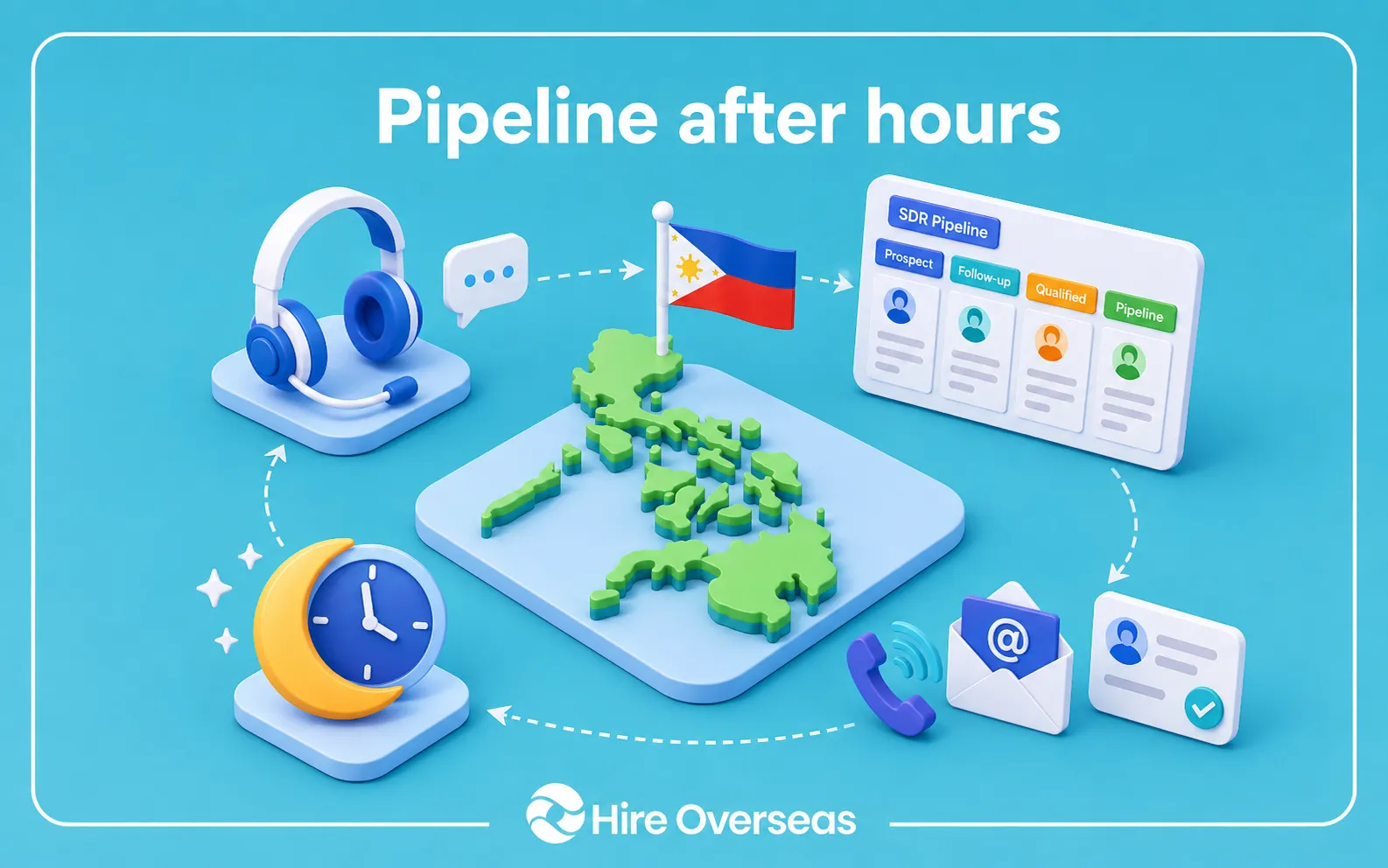
Building more pipeline often creates a simple capacity problem: your sales team needs more prospecting, follow-up, and qualification, but another U.S. SDR can be expensive to add. That is why more companies are looking at the Philippines. The country already has a mature outsourcing workforce built around supporting international businesses. But hiring a Philippines-based SDR successfully takes more than finding someone with good English and sales experience. You still need the right sales profile, U.S.-aligned schedule, compensation, vetting process, and management structure.
At Hire Overseas, we source and vet offshore sales talent for U.S. companies. This guide explains what we have learned about hiring SDRs in the Philippines, including costs, night-shift scheduling, candidate evaluation, and how to structure the hire.
Why Hire an SDR From the Philippines?
The Philippines offers U.S. companies access to a large, experienced outsourcing workforce with strong English proficiency and established infrastructure for supporting overseas clients. In 2025, the country's IT-BPM industry employed approximately 1.9 million people and generated more than $40 billion in export revenue, according to IBPAP figures reported by BusinessWorld.
That maturity matters for SDR hiring.
A Mature BPO Talent Market
The Philippines has spent decades building an outsourcing industry around customer-facing and business-process work.
That does not mean every BPO employee will make a strong SDR. It does mean companies are recruiting from a market where working remotely with international clients, following structured processes, using business software, and supporting U.S. working hours are already familiar concepts.
The industry has also moved beyond basic voice support. IBPAP has described Philippine IT-BPM work as becoming increasingly complex, with the sector continuing to invest heavily in talent development and upskilling.
For SDR hiring, that gives you a broader starting talent pool than a market without an established outsourcing ecosystem.
Strong English Communication, But Still Test Sales Ability
The Philippines ranked 28th globally in EF's 2025 English Proficiency Index, with an overall score of 569 compared with a global average of 488. Its sales-function score was 572.
But English proficiency should never replace sales assessment.
An SDR needs to do more than speak clearly. They need to understand a prospect, communicate value without sounding scripted, handle objections, qualify opportunities, and know when to stop pushing.
At Hire Overseas, this is why we evaluate sales communication rather than English fluency alone.
Access Talent Without Restricting the Search to Your City
Hiring locally limits your SDR search to the people available within your market or willing to relocate. Remote hiring changes that. You can search the Philippines for SDRs with experience in SaaS, appointment setting, B2B prospecting, cold calling, CRM management, and U.S.-facing sales environments without requiring them to live near your office.
The objective should not be to find the cheapest Filipino SDR.
It should be to use a larger talent market to find the strongest person available within your budget.
If you're weighing whether this kind of remote hiring is the same as traditional offshore staffing, this breakdown of how offshore hiring differs from remote hiring explains why the two are actually distinct workforce strategies with different structures and trade-offs.
new-blog-cta_component-1]
How Much Does an SDR Cost in the Philippines?
Remote SDRs in the Philippines typically earn about $800 to $2,000+ per month in base compensation, while experienced SaaS, enterprise, or full-cycle sales talent can cost more. Current remote job listings show a wide range based on experience and responsibilities.
The pattern is straightforward: proven U.S. or international outbound experience costs more. An SDR who can cold-call decision-makers, work inside HubSpot or Salesforce, use Apollo or Sales Navigator, and consistently book qualified meetings should command more than someone entering sales development.
Local SDR Salary vs. Your Total Hiring Cost
When comparing SDR rates in the Philippines, separate base compensation from the total cost of finding, hiring, and supporting the rep.
Depending on how you hire, additional costs can include:
- Recruiting and candidate screening
- Payroll and employer obligations
- EOR and international compliance
- Equipment and sales software
- Commission and night-shift compensation
- HR support
- Replacement and rehiring costs
This is why comparing a Filipino SDR's salary directly with a managed staffing fee is not an apples-to-apples comparison.
Hire Overseas starts at $2,000 per month, depending on the talent, role, and location. We operate as an offshore headhunter and HR department, handling the requirements-driven search, screening, EOR, payroll, international compliance, and ongoing HR support.
The relevant comparison is not simply salary vs. monthly fee, but the total cost and operational responsibility required to make the hire work.
For a fuller picture of everything that factors into total hiring cost beyond base salary, this look at what remote employees really cost from recruitment through long-term ROI walks through recruitment, payroll, compliance, and infrastructure spend companies often underestimate.
Can Philippines-Based SDRs Work U.S. Hours?
Yes. Philippines-based SDRs can work U.S. business hours through night-shift schedules, which are already common across the country’s BPO and outsourcing industry. For SDR roles involving live cold calling, meetings, and real-time collaboration, we recommend making the required U.S. schedule part of the hiring criteria from the beginning.
How U.S.-Aligned Scheduling Works in Practice
For outbound sales, time-zone overlap is usually non-negotiable. Your SDR needs to call prospects when they are actually available and coordinate with AEs when qualified opportunities are ready for handoff.
At Hire Overseas, we define the required schedule before sourcing candidates. Depending on the client, that may mean aligning the SDR with Eastern, Central, Mountain, or Pacific business hours.
We typically confirm:
- Required working hours and prospect calling windows
- Previous experience working night shifts
- Long-term availability for the schedule
- Overlap with sales managers and AEs
- Internal meeting and handoff requirements
- Daylight-saving time changes
Philippine labor rules also provide eligible employees with a night-shift differential of at least 10% for work performed between 10 p.m. and 6 a.m., so employment structure and compensation should be considered when setting the schedule.
The important part is to solve time-zone alignment during hiring, not after it. A strong SDR who cannot sustainably work your required prospecting hours is still the wrong hire.
What We Look for When Hiring Filipino SDR Talent
When we hire SDRs in the Philippines, we look beyond English proficiency and general BPO experience. The strongest candidates can demonstrate the actual work: prospect research, cold outreach, objection handling, qualification, CRM discipline, and coachability. For U.S.-facing roles, we also prioritize experience communicating with American buyers.
Cold Calling and Objection Handling
If cold calling is part of the role, we want to hear the candidate sell. A live role-play shows whether they can open naturally, establish relevance, ask useful questions, handle resistance, and move the conversation forward without relying too heavily on a script.
We also give feedback and run part of the exercise again. The second attempt often tells us more about coachability than the first.
Prospect Research and Qualification
We may give candidates a target account and ask them to identify the right prospect, explain why the account fits, and build an outreach approach. This shows whether they can think beyond a call list. We also test qualification judgment. Booking meetings is not enough if those meetings consistently waste an AE's time.
CRM and Sales Tool Experience
Experience with tools such as HubSpot, Salesforce, Apollo, LinkedIn Sales Navigator, Outreach, or Salesloft can shorten ramp time.
But we care just as much about operational discipline. Strong SDRs document conversations, maintain clean CRM records, follow up consistently, and give AEs enough context to continue the opportunity.
Evidence Matters More Than the Resume
At Hire Overseas, we run a requirements-driven search rather than treating every Philippines sales candidate as interchangeable.
The goal is to find someone who matches the client's actual sales motion, buyer, tools, working hours, and experience requirements.
A polished resume can get someone into the process. Demonstrating that they can do the job is what should move them through it.
For the fuller hiring framework this section draws from, this eight-step guide to finding SDRs who can actually build pipeline breaks down how to evaluate candidates on real sales ability rather than resumes.
How to Hire an SDR in the Philippines
To hire an SDR in the Philippines successfully, define the sales motion before you start sourcing. The best candidate is not simply someone with SDR experience. They should match your buyer, outreach channels, sales tools, U.S. working hours, and the level of ownership the role requires.
At Hire Overseas, this is why we start with the requirements of the role and build the search around them.
Step 1: Define the Sales Motion
Before reviewing candidates, clarify:
- ICP and buyer persona
- Inbound, outbound, or both
- Cold calling expectations
- Outreach channels
- Qualification criteria
- Average deal size and sales cycle
- CRM and sales tools
- U.S. working hours
- AE handoff process
An SDR prospecting SMB owners for a straightforward service needs a different profile from someone selling enterprise SaaS to CFOs.
Step 2: Source for the Role, Not Just the Title
Do not search for a generic "Philippines sales development rep."
Look for candidates whose previous work resembles what they will actually do for you. Relevant signals might include U.S. cold calling, SaaS prospecting, appointment setting, specific CRM experience, or selling into your target industry.
This is where a larger candidate pool becomes valuable. At Hire Overseas, we run a requirements-driven search and narrow candidates against the client's specific role rather than relying on a fixed bench of available SDRs.
Step 3: Screen for Evidence of Performance
Push beyond statements such as "exceeded quota" or "generated qualified leads."
Ask:
- What was your quota?
- How was it measured?
- What percentage did you achieve?
- How many meetings did you generate? Who were you targeting?
- Which channels produced results?
Candidates with genuine outbound experience can usually explain what happened inside their funnel.
Step 4: Test the Actual SDR Work
Use practical assessments before making the hire.
Have candidates research a target account, identify the right prospect, write a short outreach message, and complete a cold-call role-play.
Then give them feedback and let them try again.
You are testing prospecting judgment, communication, objection handling, qualification, and coachability, not how well someone prepared for an interview.
Step 5: Let Your Sales Team Interview the Finalists
Once the fundamental skills have been validated, your team should make the final decision.
At Hire Overseas, clients interview vetted candidates directly. That final conversation can focus on the factors only your company can properly judge: product fit, team chemistry, sales philosophy, communication style, and whether you want that person representing your brand.
Step 6: Set Up Employment and Onboarding
Before the SDR starts, establish the appropriate employment structure, payroll, compliance, working hours, commission plan, tools, and performance expectations.
Then give the rep a structured ramp covering your product, ICP, messaging, CRM, qualification criteria, call process, and AE handoff.
Hiring gets someone through the door. A clear sales system is what gives them a realistic chance of producing pipeline.
Hiring Directly vs. Using an Offshore Headhunter
You can hire an SDR in the Philippines directly or use an offshore headhunter to manage the search and employment infrastructure. Direct hiring gives you full responsibility for sourcing, screening, payroll, compliance, and replacement. An offshore headhunter removes much of that work while your team retains control over who gets hired and how the SDR is managed.
Hire Overseas operates as an offshore headhunter and HR department for U.S. companies. We source and vet candidates against your role, budget, experience requirements, and time zone, then let your team interview the strongest matches directly.
You retain control over your sales strategy, CRM, and how the SDR fits into your organization, while Hire Overseas handles recruiting, EOR, payroll, international compliance, and ongoing HR. We can also support day-to-day management when needed, giving companies the flexibility to choose between a more hands-on or fully managed arrangement.
For companies that already know how they want their SDR function to operate, this means you can build a dedicated sales team without having to build the recruiting, HR, and management infrastructure around it yourself.
If you're still deciding whether an offshore partner is the right structure at all, this framework for building scalable global teams through an offshore staffing partner covers which roles to hire first and how to scale execution without losing control.
When Hiring an SDR in the Philippines Makes Sense
Hiring an SDR in the Philippines makes sense when your sales team already knows how to generate opportunities but does not have enough people consistently executing the work. The clearest signal is usually not “we need cheaper salespeople.” It is that prospecting is becoming a bottleneck.
You may be at that point if:
- Your AEs are spending too much time prospecting. If closers are building lists, sending first-touch emails, and making cold calls instead of working active opportunities, an SDR can take that work off their plate.
- Your are still doing outbound. Founder-led selling can validate the motion, but it becomes difficult to scale when the founder remains responsible for every new conversation.
- Good leads are sitting untouched. You have enough accounts to pursue, but follow-ups are inconsistent because nobody owns prospecting full-time.
- Your first SDR is already at capacity. Rather than immediately adding another comparable U.S. salary, a Philippines-based SDR can expand coverage at a lower cost.
- You know which messaging works. Your ICP, offer, scripts, qualification criteria, and handoff process are established enough for another person to learn and execute.
- You need more U.S.-hour calling capacity. A Philippines-based SDR working an aligned shift can provide dedicated coverage for cold calls, follow-ups, qualification, and appointment setting.
The model is less effective when you are still trying to figure out who to sell to, what to say, or whether the offer works. More SDR activity will not fix an unproven sales motion.
That is how we think about SDR hiring at Hire Overseas: offshore when execution has become the constraint, not when strategy is still the problem.
If outbound calling capacity specifically is the bottleneck rather than full-cycle SDR ownership, this comparison of leading cold calling providers by pricing and service model is worth reviewing alongside a dedicated hire to see which model fits your stage.
Turn the Philippines Into an Extension of Your U.S. Sales Team
The Philippines gives U.S. companies access to experienced, English-speaking talent that can work U.S.-aligned hours and integrate directly into existing sales operations.
We saw this model work with Sunrise Toyota. The dealership scaled from two to five offshore team members handling inbound calls and outbound appointment setting. Within 1–2 months, the team helped increase service appointments while costing $13,000/month versus an estimated $25,000–$30,000+ locally.
The same principle applies to SDRs. Keep your sales strategy and pipeline ownership in-house, then add dedicated Filipino talent to execute prospecting, follow-up, qualification, and appointment setting consistently.
Hire Overseas handles the requirements-driven search, vetting, EOR, payroll, international compliance, and ongoing HR support.
Ready to build your sales team in the Philippines? Speak With a Global Hiring Expert at Hire Overseas.
Philippines IT-BPM employment and export figures are from IBPAP data reported by BusinessWorld. English proficiency figures are from the EF English Proficiency Index 2025. SDR compensation estimates are based on current Philippines-based remote job listings and salary data cited in this guide.
