


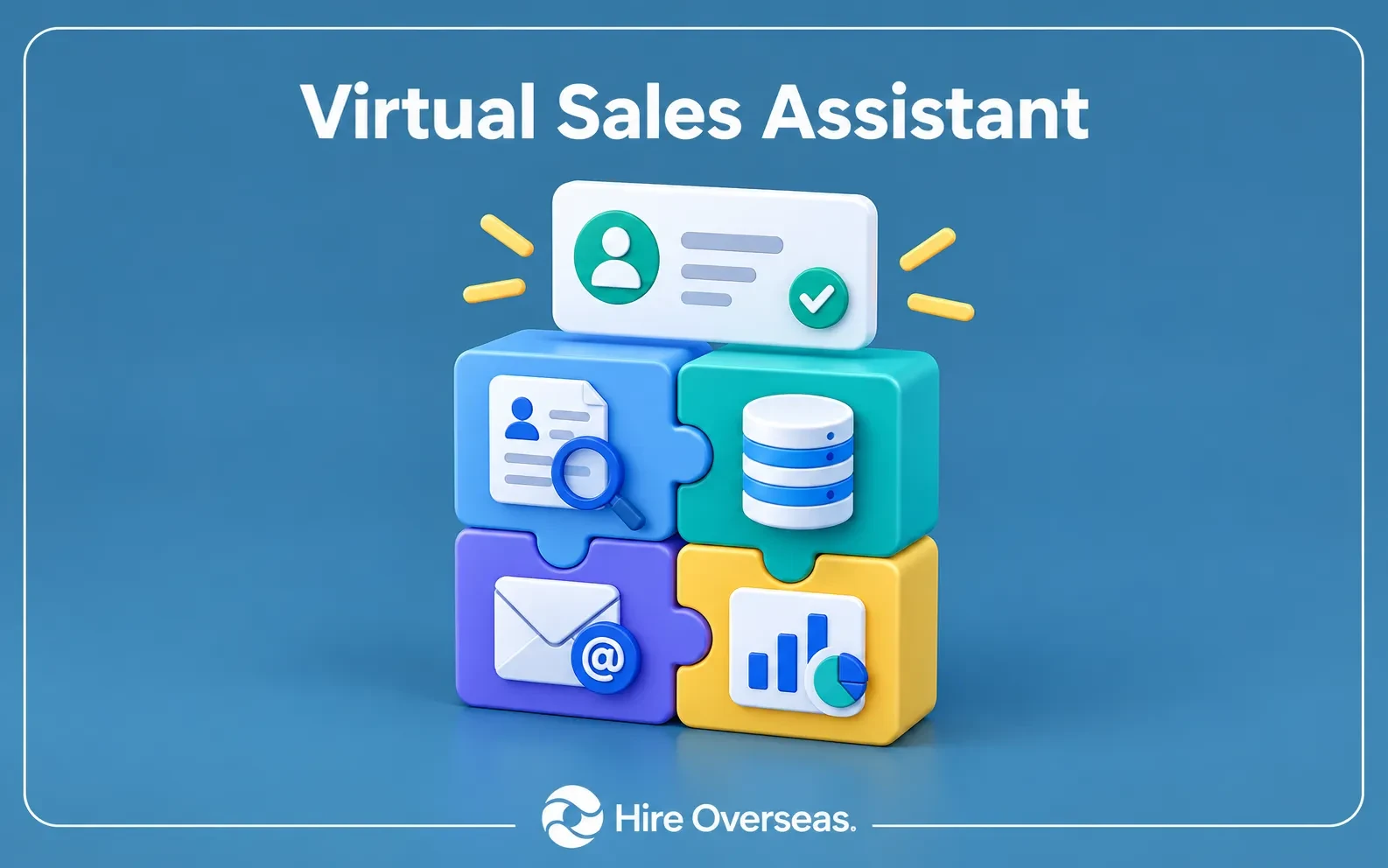
Salespeople lose a surprising amount of time to work that is necessary but does not actually require a salesperson.
Someone still has to research accounts, clean up the CRM, track follow-ups, coordinate calendars, prepare prospect lists, and make sure opportunities have a clear next step. As sales activity grows, that work compounds.
A virtual sales assistant takes ownership of that support layer.
The role is different from hiring an SDR, cold caller, or appointment setter. A sales VA generally helps keep the sales process organized and moving. They may support outreach, but they are not automatically responsible for generating pipeline or carrying a sales quota.
That distinction matters when deciding who to hire.
What Is a Virtual Sales Assistant?
A virtual sales assistant is a remote professional who handles recurring administrative and operational work around a sales team. They may work with a founder, sales manager, account executive, SDR team, or several salespeople at once.
Typical responsibilities include researching prospects, updating CRM records, organizing lead lists, scheduling meetings, managing routine follow-ups, and preparing pipeline reports.
The easiest way to think about the role is this:
Your salesperson owns the conversation. The virtual sales assistant helps keep everything around that conversation organized.
For example, an account executive may run discovery calls, answer product questions, prepare proposals, negotiate pricing, and close the deal. Their sales VA might research the account before the meeting, make sure the contact information is complete, schedule the call, update the CRM afterward, create the next task, and flag the opportunity when a follow-up is due. That separation gives the salesperson more time to spend on work that actually requires selling.
What Does a Virtual Sales Assistant Do?
There is no universal virtual sales assistant job description. The right responsibilities depend on where your existing sales process is creating unnecessary work for higher-cost team members. For most companies, the role falls into five areas.
1. Lead Research and Prospect List Building
Sales prospecting often starts well before anyone sends an email or makes a call. A virtual sales assistant can handle the research required to prepare accounts for outreach.
That can include:
- Finding companies that match your ideal customer profile
- Identifying relevant contacts within target accounts
- Researching company size, industry, location, or other qualification criteria
- Finding publicly available information for personalization
- Checking whether an account already exists in the CRM
- Removing duplicate or irrelevant leads
- Organizing prospects by campaign, territory, or sales rep
The important part is having clear criteria. A sales VA should not have to guess what a qualified account looks like. Give them an ICP, targeting rules, and examples of strong and weak prospects. That turns prospect research into a repeatable process instead of a judgment call made from scratch every day.
2. CRM Management and Pipeline Administration
CRM upkeep is one of the clearest use cases for virtual assistant sales support. Salespeople are rarely hired because they enjoy updating Salesforce fields. But when nobody owns CRM hygiene, records become incomplete, deal stages stop reflecting reality, follow-ups disappear, and managers lose confidence in pipeline reporting.
A virtual sales assistant can handle recurring tasks such as:
- Creating and updating contact records
- Logging activities and notes
- Updating opportunity stages
- Setting follow-up tasks
- Assigning lead owners
- Correcting missing fields
- Removing duplicates
- Tracking opportunities without a next step
- Maintaining tags and lists
- Checking that sales activity is recorded consistently
This is not glamorous work, but it has a direct impact on how well the sales process runs. A CRM only helps the team when the information inside it can be trusted.
3. Sales Follow-Up Support
A surprising amount of pipeline gets lost between conversations. Someone says, “Follow up next month,” and nobody creates the task. A prospect requests information but the rep gets pulled into another call. An old opportunity becomes relevant again but remains buried in the CRM. A sales support virtual assistant can help prevent those gaps. Depending on your process, they might:
- Monitor leads that require follow-up
- Send approved follow-up emails
- Trigger existing nurture sequences
- Re-engage older leads using established messaging
- Record responses in the CRM
- Route interested prospects to the correct salesperson
- Flag conversations that require personal attention
The VA does not have to own the entire sales conversation. Their job is often to make sure the conversation does not quietly disappear.
4. Scheduling and Meeting Coordination
Calendar administration becomes expensive when salespeople handle every scheduling detail themselves. A virtual sales assistant can manage:
- Calendar links
- Meeting coordination
- Rescheduling
- Confirmations
- Reminders
- Basic pre-meeting research
- Internal calendar coordination
- Follow-up scheduling
5. Sales Reporting and Administrative Support
A sales virtual assistant can also help managers get better visibility into what is happening in the pipeline. They may prepare:
- Weekly pipeline summaries
- Lead activity reports
- Follow-up reports
- Lists of stalled opportunities
- Meeting trackers
- Prospecting spreadsheets
- Sales dashboards
- CRM cleanup reports
- Campaign preparation files
For a smaller sales organization, this can provide much of the basic administrative support the team needs without adding a dedicated sales operations position. As the organization gets more complex, forecasting, systems administration, compensation analysis, and process design typically move into a dedicated sales operations or revenue operations function.
Virtual Sales Assistant vs. SDR vs. Cold Caller vs. Appointment Setter
This is where companies most often define the role incorrectly. A virtual sales assistant can work inside a sales team, but that does not automatically make them a salesperson.
There will always be some overlap. A sales VA may send follow-up emails. An SDR still needs to update the CRM. An appointment setter may research an account before contacting it.
The more useful distinction is what the person owns.
- If you need someone to keep prospect data clean, manage routine follow-ups, prepare lists, organize the CRM, and support existing sellers, a virtual sales assistant is probably the right role.
- If you need someone whose main job is creating new conversations and pipeline, hire the corresponding outbound sales role.
Trying to combine both into one vague “sales VA” position often creates unrealistic expectations.
How Much Does a Virtual Sales Assistant Cost?
The cost of a virtual sales assistant depends heavily on location, experience, hours, specialization, and how close the role gets to actual selling. A VA responsible for prospect research and CRM administration will usually cost less than someone expected to work U.S. hours, use several prospecting platforms, speak directly with leads, and manage more complex sales workflows. Location also changes the economics.
These are broad labor-market ranges, not fixed prices. Experience with tools such as Salesforce, HubSpot, Apollo, Sales Navigator, Outreach, or Salesloft can increase compensation. So can night shifts, direct customer communication, industry specialization, or previous B2B sales experience. The hiring model matters too.
Direct Hire vs. Managed Virtual Sales Assistant Services
If you hire independently, you may only see the worker's salary or freelance rate. With managed virtual sales assistant services, the monthly cost may also include recruiting, screening, contracts, payroll, international compliance, HR support, and replacements. That is why comparing a contractor's direct salary with a staffing company's client rate is rarely an apples-to-apples comparison.
At Hire Overseas, managed placements start at $2,000 per month, with pricing varying by role, talent level, geography, and requirements. The more useful question is not simply, “Where is the cheapest VA?” It is whether the total hiring model gives you the level of talent, working hours, support, and accountability the role requires.
How to Hire a Virtual Sales Assistant
The best way to hire a virtual sales assistant is to start with your sales process, not the job title. “Virtual sales assistant” is broad enough that two companies can use the same title for completely different jobs. Here is how to narrow it down.
1. Identify What Is Taking Your Salespeople Away From Selling
Look at what your sales team actually did over the last week or two. Separate the work into two categories:
Work that requires selling
- Discovery
- Qualification
- Objection handling
- Product conversations
- Negotiation
- Closing
Work that supports selling
- Research
- CRM updates
- List preparation
- Scheduling
- Follow-up administration
- Reporting
- Data cleanup
The second category gives you the foundation for the VA's role. This exercise is especially useful for founder-led sales teams. Founders often realize they spend several hours each week doing work another person could own with a clear process.
2. Decide Whether You Actually Need a Sales VA
If your CRM is clean, follow-ups are organized, and your real problem is simply that not enough prospects are being contacted, adding administrative support will not solve the bottleneck. You may need an SDR or cold caller instead. Likewise, if you already generate strong inbound demand but leads are not turning into scheduled conversations, an appointment setter may be more appropriate. Define the bottleneck before defining the title.
3. Write the Job Description Around Ownership
Avoid generic responsibilities such as:
“Assist the sales team.”
“Help with lead generation.”
“Perform administrative duties as needed.”
Those descriptions leave too much room for interpretation. A better virtual sales assistant job description might say:
Role objective: Keep our sales pipeline organized and ensure every active lead has accurate information and a clear next action.
Core responsibilities:
- Research target accounts and contacts
- Maintain complete HubSpot records
- Prepare prospect lists for sales campaigns
- Schedule and confirm sales meetings
- Track follow-ups and overdue actions
- Send approved routine follow-up emails
- Prepare a weekly pipeline summary
Success measures:
- CRM accuracy
- Percentage of open opportunities with a next step
- Follow-ups completed on time
- Research accuracy
- Scheduling accuracy
- Turnaround time on assigned sales-support tasks
That tells candidates what they will actually own.
It also makes interviewing much easier.
4. Test Candidates on the Work They Will Actually Perform
Sales support roles lend themselves well to practical assessments. Instead of relying entirely on interviews, give shortlisted candidates a small paid task that resembles the job. For example, provide five sample accounts and ask them to:
- Identify the likely decision-maker.
- Find the required account information.
- Organize the information in a spreadsheet.
- Flag incomplete or questionable data.
- Draft a simple follow-up using your instructions.
- Explain how they would record the activity in your CRM.
You can learn a lot from a relatively small assignment.
- Does the candidate follow instructions?
- Do they verify information?
- Is the spreadsheet clean?
- Do they notice missing data?
- Can they communicate what they did without overexplaining it?
These details tend to matter more in day-to-day sales support than polished interview answers.
5. Screen for the Tools You Actually Use
A candidate does not need experience with every sales platform on the market. They need enough familiarity with your stack to ramp quickly. Common tools include:
- Salesforce
- Pipedrive
- LinkedIn Sales Navigator
- ZoomInfo
- Outreach
- Salesloft
- Calendly
- Google Workspace
- Microsoft 365
- Slack
Ask candidates to explain how they have used the tools rather than simply asking whether they know them. Someone who says they have “HubSpot experience” may have logged in twice. A stronger candidate can explain how they maintained contacts, updated lifecycle stages, created tasks, handled duplicates, or supported reporting.
6. Decide How Much Time-Zone Overlap the Role Needs
Not every sales VA needs to work the same hours as the U.S. team. Research, CRM cleanup, list preparation, and reporting can often be completed asynchronously. Scheduling, inbound lead response, live sales support, and same-day follow-up may require much more overlap. This should influence where you recruit.
At Hire Overseas, we recruit across the Philippines, Latin America, and Africa and can match the search to the hours the client actually needs rather than forcing every role into the same market.
7. Give the VA a Defined Ramp Period
Even an experienced sales VA still needs to learn your process. The first month should gradually expand ownership.
- Week 1: Learn the product, ICP, CRM, sales stages, tools, terminology, and SOPs.
- Week 2: Begin handling defined research, CRM, scheduling, and administrative workflows.
- Week 3: Take ownership of recurring follow-up processes and routine reporting.
- Week 4: Review quality, turnaround time, workload, and which additional responsibilities make sense to delegate.
Do not measure the first week by how many tasks you can hand over. Measure whether the person understands the process well enough to handle those tasks consistently without creating additional cleanup.
When Should You Hire a Virtual Sales Assistant?
The clearest sign is when your sales team has enough selling work but too much work around the selling. That can show up in several ways:
- Salespeople are spending hours updating the CRM.
- Follow-ups are frequently late.
- Prospect research happens manually before every outreach block.
- CRM records are incomplete or outdated.
- Nobody owns lead-list cleanup.
- Meetings require excessive coordination.
- Founders are still doing basic sales administration.
- Opportunities regularly sit without a next step.
- Weekly reporting requires significant manual work.
In these cases, adding another quota-carrying salesperson may not fix the underlying problem. It can actually create more administrative work. A virtual sales assistant gives the existing team more operating capacity.
When Should You Hire a Specialized Outbound Rep Instead?
- You need more outbound prospecting.
- Your team is not making enough calls.
- You need someone actively opening new accounts.
- Qualified meetings are the primary target.
- The job requires frequent objection handling.
- The person will own a pipeline number or quota.
- Your sales infrastructure already works, but not enough prospects are entering it.
The distinction becomes more important as a company grows. A small company may initially combine research, follow-up, and light outreach into one sales VA role. Once outbound volume increases, separating support from direct selling usually creates clearer responsibilities and more useful performance metrics.
What Should a Virtual Sales Assistant Own for a Small Business?
For a small business, the best virtual sales assistant is usually the person who removes a specific bottleneck from the founder or existing sales team. That role doesn't need to include twenty responsibilities. A founder may simply need someone to keep HubSpot current, research every new opportunity, organize follow-ups, and manage sales scheduling. A small B2B team may need one sales VA supporting several representatives with prospect data, CRM administration, meeting preparation, and weekly reporting. Another business may need more direct outreach than a generalist VA should reasonably own. Forcing everything into one job title offers no advantage.
A virtual assistant for sales should take over the repeatable support work that keeps your revenue process running. If you also need someone to consistently create conversations, qualify prospects, or book new meetings, define that as a separate sales responsibility and hire accordingly.
Build the Role Around the Sales Process
A virtual sales assistant should create more selling time, not simply add another person to manage. The best starting point is to look at what happens between one sales conversation and the next.
- Who researches the prospect?
- Who updates the CRM?
- Who notices the missing follow-up?
- Who schedules the meeting?
- Who prepares the report?
- When those responsibilities are spread across founders and salespeople, small tasks start consuming expensive hours.
Give each task a clear owner, and the entire sales process becomes easier to run.
Hire Overseas helps U.S. companies recruit dedicated offshore sales talent based on the actual role, budget, working hours, and sales motion. That can mean a virtual sales assistant handling pipeline support or a more specialized SDR, cold caller, or appointment setter when the business needs direct outbound capacity.
