
Employer of Record vs Staffing Agency: What's the Difference & Which Is Right in 2026?
Quick Answer
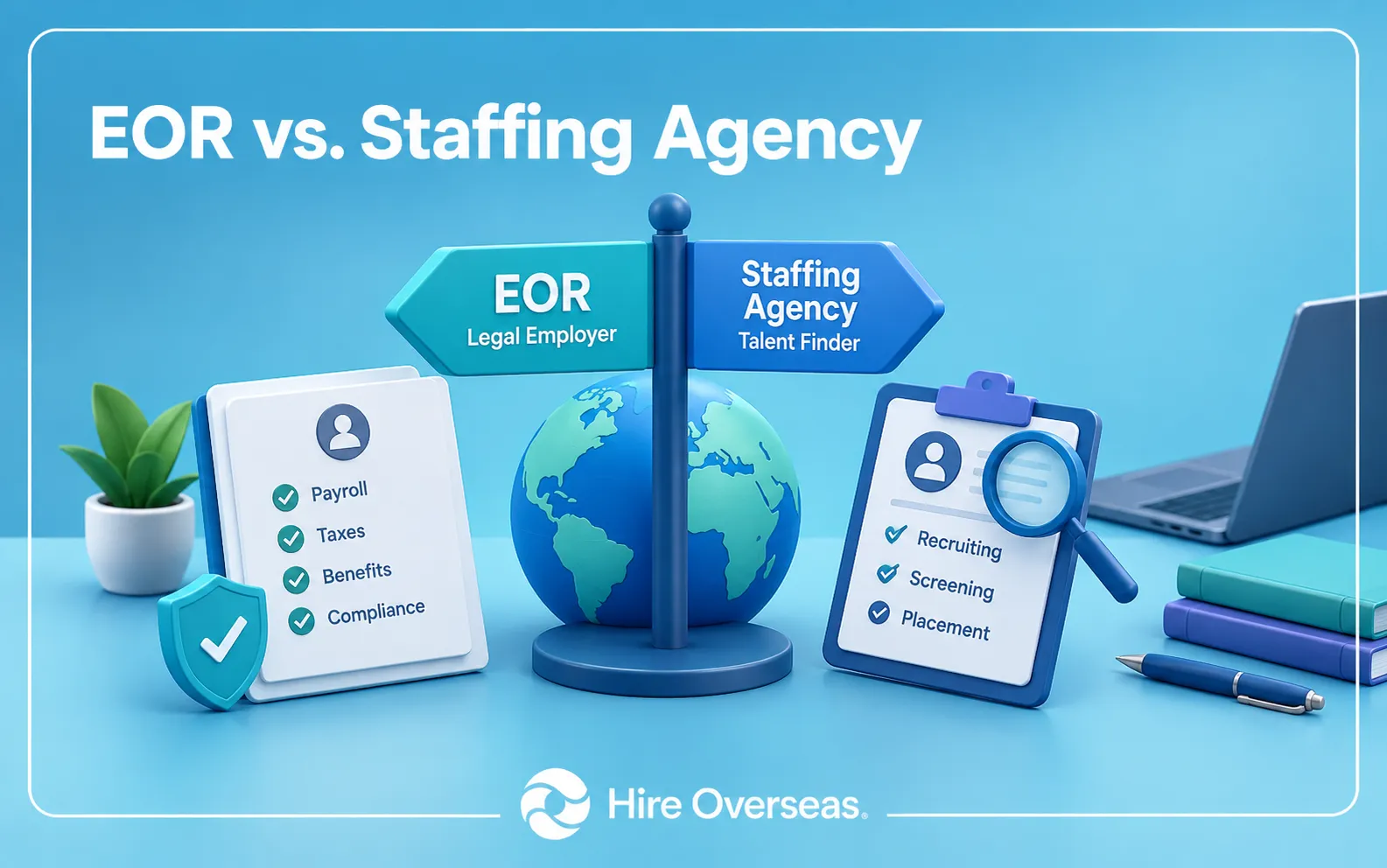
An employer of record (EOR) legally employs workers on your behalf and manages payroll, taxes, benefits, and employment compliance. A staffing agency primarily recruits and places talent, while employment responsibilities depend on the staffing model. If you're hiring internationally without a legal entity, an EOR is usually the right choice. If you primarily need help finding qualified candidates, a staffing agency is often enough.
Hiring internationally has never been easier, but choosing the right hiring model has become more confusing. Businesses expanding overseas often come across terms like Employer of Record (EOR), staffing agency, PEO, and staff augmentation, and many assume they all provide the same service. They don't.
Choosing the wrong model can lead to unnecessary costs, compliance risks, or hiring delays. A staffing agency may help you find exceptional talent but leave employment responsibilities to you. An employer of record, on the other hand, becomes the legal employer and manages payroll, taxes, benefits, and labor law compliance on your behalf.
This guide explains the difference between an employer of record and a staffing agency, when each model makes sense, how they compare on cost and compliance, and which approach is best for hiring globally in 2026.
What Is an Employer of Record (EOR)?
An employer of record (EOR) is a third-party organization that legally employs workers on behalf of another company, taking responsibility for payroll, tax filings, statutory benefits, employment contracts, and local labor law compliance while the client manages the employee's day-to-day work. This definition aligns with guidance from Deel's Employer of Record glossary and the U.S. Department of Labor, which distinguishes between the legal employer and the organization directing an employee's daily work.
Unlike a recruitment agency, an EOR becomes the employee's legal employer. That means the EOR is responsible for meeting local employment requirements, including payroll processing, tax withholding, mandatory benefits, employment agreements, and compliant termination procedures. Your business directs the employee's daily responsibilities, performance, and goals, while the EOR manages the legal employment relationship.
Companies typically use an EOR when expanding into countries where they don't have a registered legal entity. Instead of spending months establishing a local subsidiary, they can hire employees quickly while remaining compliant with local employment laws.
For example, global providers such as Deel, Remote.com, and Oyster HR offer employer of record services across dozens of countries.
Getting the legal side right matters just as much as finding the person, and this five-step compliance guide for international hiring covers the requirements companies need to satisfy before an offer ever goes out.
What Is a Staffing Agency?
A staffing agency is an organization that recruits, screens, hires, and places workers for client companies, helping businesses fill temporary, contract, or permanent positions. This definition aligns with the American Staffing Association (ASA), which describes staffing firms as employers for temporary workers and recruiting partners for direct-hire placements.
Unlike an employer of record, a staffing agency's primary role is finding and placing qualified talent. It helps businesses source candidates, manage the recruitment process, and fill open positions faster, while employment responsibilities vary depending on the staffing model.
The employment relationship depends on the type of staffing service provided:
- Temporary staffing: The staffing agency is typically the legal employer and manages payroll, taxes, and benefits for the duration of the assignment.
- Contract staffing: The agency generally employs the worker while they are assigned to the client.
- Permanent placement: The staffing agency recruits and vets candidates, but the client becomes the legal employer after the hire is made.
Businesses commonly use staffing agencies when they need to fill roles quickly, access specialized talent, or outsource recruiting without expanding their internal hiring team. This model is widely used for seasonal hiring, executive search, healthcare staffing, IT recruitment, and difficult-to-fill technical roles.
For example, Hire Overseas operates as a staffing agency that specializes in sourcing, vetting, and placing dedicated offshore professionals across functions such as virtual assistance, customer support, software development, accounting, and healthcare support. Unlike sourcing marketplaces such as OnlineJobs.ph or Upwork, which primarily connect businesses with candidates or freelancers, Hire Overseas provides structured recruitment, onboarding, and ongoing client support. Depending on the client's hiring needs and country of employment, it can also provide compliance-backed employment solutions when an employer of record model is appropriate.
If you're weighing whether a staffing partner can actually replace the recruiting legwork of building a team from scratch, this founder's framework for offshore staffing agencies breaks down which roles to hire first and how to structure a scalable global team without losing oversight.
[new-blog-cta_component-1]
Employer of Record vs Staffing Agency: What's the Difference?
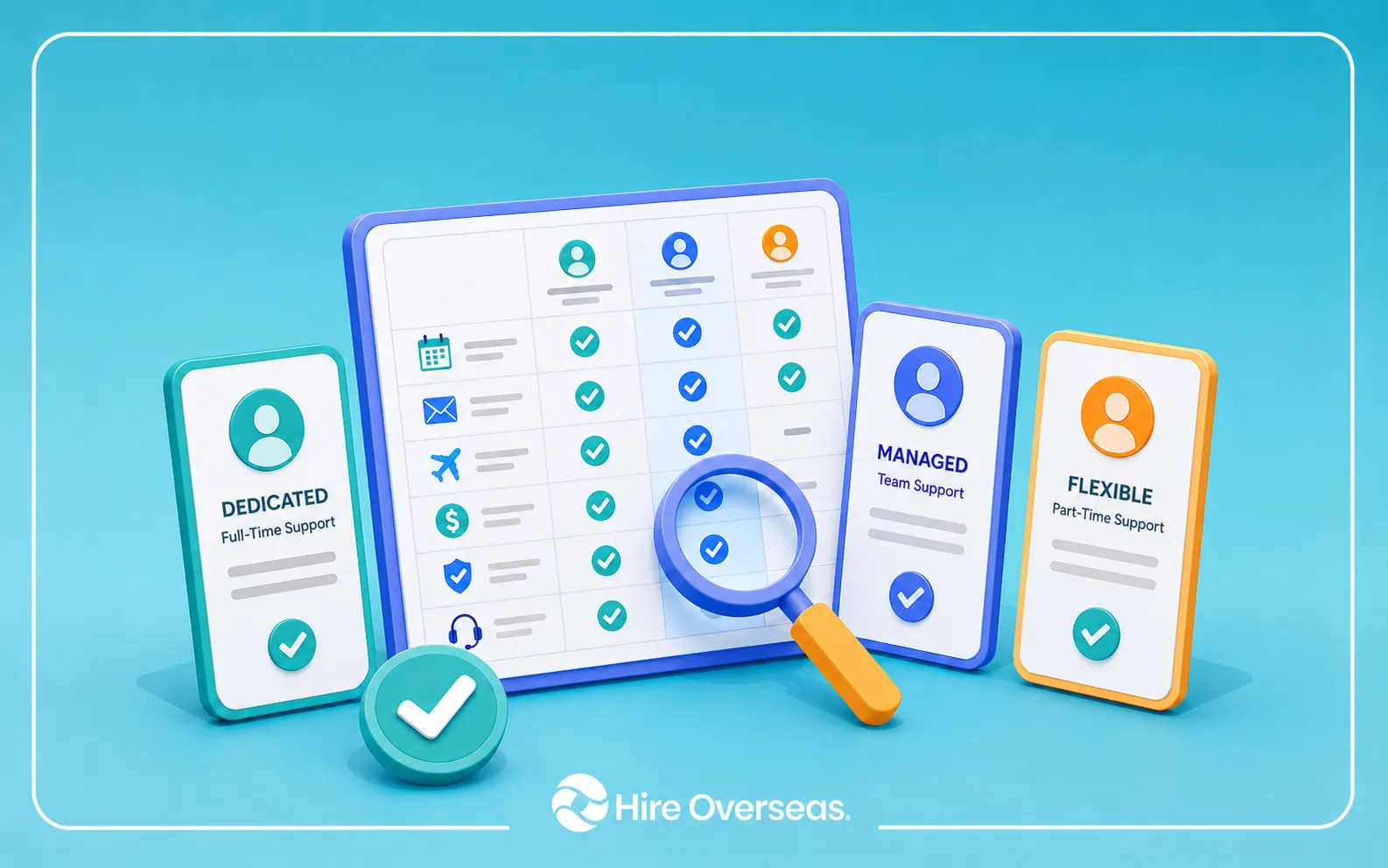
The biggest difference between an employer of record and a staffing agency is who assumes responsibility for employment. An employer of record becomes the legal employer and manages payroll, taxes, benefits, and labor law compliance, while a staffing agency primarily recruits and places talent, with employment responsibilities varying depending on the staffing arrangement.
Although both models help businesses build teams, they solve different problems. An EOR is designed to help companies employ workers compliantly, especially across international borders. A staffing agency focuses on finding qualified candidates and accelerating the hiring process.
Here's a side-by-side comparison.
Legal Employer
The biggest difference is who legally employs the worker.
With an employer of record, the EOR is the legal employer. It handles employment contracts, payroll, taxes, statutory benefits, and labor law compliance, while your business manages the employee's daily work.
With a staffing agency, the legal employer depends on the engagement. For temporary staffing, it's often the agency. For permanent hires, your business typically becomes the legal employer.
Compliance Responsibility
An EOR assumes responsibility for employment compliance.
It manages payroll, taxes, statutory benefits, employment contracts, and country-specific labor laws. This is especially valuable when hiring internationally without a local entity.
A staffing agency primarily focuses on recruitment. For permanent hires, ongoing employment compliance usually becomes the client's responsibility.
Cost Structure
An EOR and a staffing agency charge differently because they provide different services.
An EOR typically charges a monthly fee per employee or a percentage of payroll, covering employment administration and compliance.
A staffing agency usually charges a one-time placement fee for permanent hires or an hourly markup for temporary staffing.
If you only need help finding talent, a staffing agency is often enough. If you also need payroll, compliance, and legal employment support, an EOR provides broader coverage.
When Should You Use an Employer of Record?
Use an employer of record when you need to hire employees in another country without setting up a local legal entity or managing local employment compliance yourself.
An EOR is often the better choice if you:
- You're hiring internationally for the first time and don't have a registered business in the target country.
- You want to expand into a new market quickly without the cost and time of establishing a local entity.
- You need payroll, tax, and labor law compliance managed by a local employment expert.
- You're hiring long-term remote employees rather than freelancers or short-term contractors.
- You want to reduce worker misclassification risk and comply with local employment laws.
For example, businesses hiring remote software developers, medical scribes, or other full-time professionals across multiple countries often use an EOR to simplify employment while remaining compliant with local regulations.
Whether you're considering offshore hiring in the Philippines, EOR services in Latin America, or expanding into Eastern Europe, an EOR can help you hire legally without establishing a local subsidiary in each country.
For a closer look at why this distinction matters, this comparison of freelance and dedicated remote support explains how reliability and ownership diverge once a role moves from task-based help to a long-term commitment.
When Should You Use a Staffing Agency?
Use a staffing agency when your biggest challenge is finding qualified talent rather than managing employment compliance.
A staffing agency is often the better choice if you:
- You need to fill positions quickly, especially for temporary or seasonal demand.
- You don't have the time or resources to recruit and screen candidates.
- You're hiring for specialized or hard-to-fill roles that require access to a broader talent network.
- You already have a legal entity and can manage payroll, taxes, and employment compliance internally.
- You need recruitment support without outsourcing ongoing employment responsibilities.
For example, businesses hiring administrative staff, customer support representatives, software developers, or healthcare professionals often work with staffing agencies to speed up recruitment while retaining control over employment once the hire is made.
If you're hiring internationally, however, it's important to understand that many staffing agencies stop at recruitment. If you don't have a legal entity in the employee's country, you'll likely need an employer of record or a staffing partner that also provides employment and compliance support.
How Much Does an Employer of Record vs a Staffing Agency Cost?
Employer of record providers typically charge a flat monthly fee of $200–$1,200 per employee or 8–20% of payroll, while staffing agencies usually charge a 25–75% markup for temporary workers or a 15–30% placement fee based on a permanent employee's first-year salary. The right option depends on your hiring goals, not just the price.
Employer of Record (EOR) Costs
Most EOR providers use one of two pricing models:
- Flat monthly fee: Typically $200–$1,200 per employee per month, with most businesses paying $400–$700.
- Percentage of salary: Usually 8–20% of payroll, depending on the provider and country.
Keep in mind that the EOR fee is separate from the employee's salary and statutory employer costs, such as payroll taxes, mandatory benefits, and social contributions. Some providers also require a refundable security deposit of one to three months' salary.
An EOR is generally more cost-effective than setting up your own legal entity until you have approximately 10–25 employees in the same country.
Staffing Agency Costs
Staffing agencies price their services differently depending on the hiring model:
- Temporary or contract staffing: Typically 25–75% above the worker's hourly pay rate, with many agencies averaging 35–41%.
- Permanent placements: Usually 15–30% of the employee's first-year salary, with higher fees for executive and highly specialized roles.
These fees generally cover recruiting, candidate screening, payroll administration for temporary workers, employment taxes, workers' compensation insurance, and agency overhead.
Quick Cost Comparison:
- For long-term international employees, an EOR often becomes the more economical option because its fee is a predictable monthly cost on top of salary and statutory contributions.
- For short-term, seasonal, or project-based hiring, a staffing agency usually offers greater flexibility and faster hiring, making the higher markup worthwhile.
Note: Pricing varies by provider, country, role, and service level. Always verify current pricing and contract terms before selecting an EOR or staffing partner.
Since these fees are only one piece of the total spend, this breakdown of the full cost of hiring remote employees walks through how recruitment, payroll, compliance, and infrastructure add up over the life of the hire.
[new-blog-cta_component-2]
But What if There's a Better Way to Build a Global Team?
An employer of record and a staffing agency aren't always mutually exclusive. Many growing businesses need the recruiting capabilities of a staffing agency alongside the employment support typically associated with an EOR. That's where Hire Overseas fits.
As a staffing agency, Hire Overseas helps businesses source, vet, and hire dedicated offshore professionals. But we also support many of the situations where companies traditionally turn to an employer of record.
Hiring Internationally for the First Time
Many businesses initially think they need an EOR because they're unfamiliar with hiring overseas. In reality, they also need help finding qualified candidates.
Hire Overseas combines professional recruitment with guidance on onboarding, payroll, HR, and country-specific employment requirements, helping first-time international employers hire with confidence.
Expanding Into a New Market
An EOR is often the preferred solution when you want to hire employees in a country where you don't have a legal entity.
Hire Overseas supports businesses entering markets such as the Philippines, Latin America, India, and Eastern Europe by recruiting dedicated professionals while helping clients navigate local employment requirements when EOR support is needed.
If the Philippines is on your shortlist for that expansion, this data-backed look at where U.S. companies are finding virtual assistant talent breaks down which countries deliver the strongest mix of reliability, skill, and time-zone fit.
Hiring Long-Term Remote Employees
Traditional staffing agencies often focus on filling vacancies, while many EOR providers focus on employment compliance after a candidate has already been identified.
Hire Overseas brings both together. We recruit full-time offshore professionals who become long-term members of your team, then continue supporting payroll, HR, and employment compliance throughout the employment relationship when required.
This distinction gets easy to blur in practice, so this breakdown of offshore hiring versus remote hiring is worth a look if you want to be precise about which workforce strategy you're actually building.
Hire Overseas Is The Best of Both Models
If your only goal is recruiting, a staffing agency may be enough. If your only challenge is employing someone compliantly in another country, an EOR may be the right fit.
But many growing businesses need both.
That's why Hire Overseas combines staffing agency expertise with compliance-backed employment support, giving businesses one partner to source, hire, onboard, and support international employees as they grow.
Your Global Growth Shouldn't Stop at Recruitment
Finding the right person is only the beginning. Building a successful global team requires the right hiring model, the right employment support, and a partner who can grow with your business.
That's exactly why Hire Overseas exists. Book a free consultation to learn how we help businesses recruit dedicated offshore professionals while providing the employment support needed to scale internationally with confidence.
Information in this guide is based on publicly available resources from the U.S. Department of Labor, American Staffing Association, Deel, Remote.com, Oyster HR, Native Teams, Remote People, Second Talent, and provider pricing pages reviewed in 2026. Pricing and service offerings may change over time.
[new-blog-cta_component-3]
Unlock Global Talent with Ease
Hire Overseas streamlines your hiring process from start to finish, connecting you with top global talent.
FAQs About Employer of Record vs Staffing Agencies
Is an Employer of Record more expensive than a staffing agency?
It depends on your hiring goals. EOR providers typically charge a monthly fee per employee or a percentage of payroll because they manage ongoing employment and compliance. Staffing agencies usually charge a one-time placement fee or an hourly markup for temporary workers. While staffing agencies may have lower upfront costs, an EOR can provide greater long-term value when hiring internationally without a local entity.
Do I need an Employer of Record if I'm hiring contractors?
Not always. If you're engaging genuine independent contractors, an EOR may not be necessary. However, if the role resembles full-time employment or local worker classification laws create misclassification risks, an EOR can help ensure compliance by acting as the legal employer and managing local employment obligations.
Can a staffing agency also provide Employer of Record services?
Some staffing agencies partner with or offer Employer of Record services, while others focus solely on recruitment. Providers like Hire Overseas combine professional recruiting with compliance-backed employment support when required, allowing businesses to source, hire, onboard, and support international employees through a single partner.
When should I choose a staffing agency instead of an Employer of Record?
A staffing agency is typically the better choice when your biggest challenge is finding qualified candidates and you already have a legal entity that can manage payroll, taxes, and employment compliance. It's also a strong option for temporary staffing, seasonal hiring, or specialized recruitment projects.
Can I switch from an Employer of Record to my own legal entity later?
Yes. Many businesses use an EOR as a temporary solution while expanding into a new market. Once they've established a local legal entity, employees can often be transferred from the EOR to the company's own payroll, subject to local employment laws and the provider's transition process.
Unlock Global Talent with Ease
Hire Overseas streamlines your hiring process from start to finish, connecting you with top global talent.
