


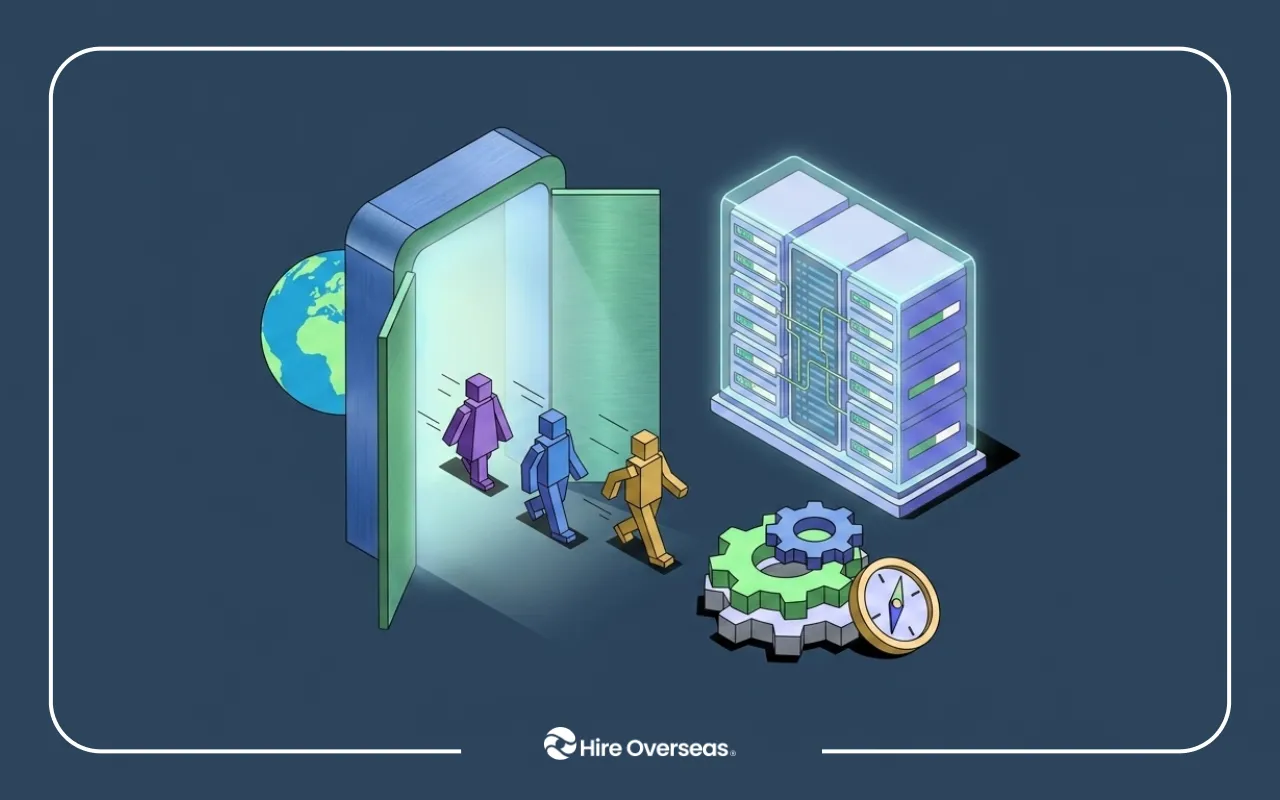
For years, offshore development services were primarily viewed as a way to reduce development costs. Today, we're seeing a different reason companies are building offshore teams. Since launching Hire Overseas in late 2024, we've spoken with founders, CTOs, and engineering leaders who are no longer asking whether offshore developers can do the work. They are asking how quickly they can access the talent needed to execute their roadmap. As remote work, distributed collaboration, and global hiring become standard, the challenge has shifted from finding developers to accessing them. This evolution is changing how companies build engineering teams, scale development capacity, and compete for technical talent in a global market.
The Hiring Challenge Has Changed From Finding Talent to Accessing Talent
One of the biggest misconceptions about software development hiring is that companies cannot find qualified developers. In reality, global engineering talent has never been more accessible. Technology hubs in India, the Philippines, Vietnam, Poland, Ukraine, and Latin America continue producing highly skilled software engineers across disciplines such as full-stack development, cloud engineering, DevOps, quality assurance, and mobile development.
The challenge many companies face today is not whether talent exists.
The challenge is accessing the right talent quickly enough to support business growth.
Geography Used to Define the Talent Pool
Historically, engineering hiring was largely constrained by location. A company in San Francisco competed for developers in San Francisco. A business in London hired primarily from London. Building an engineering team often meant recruiting within commuting distance of an office. As a result, talent availability was closely tied to geography.
If the local market lacked specialized expertise or experienced developers, companies had limited options beyond lengthy recruiting cycles or relocation efforts.
For engineering leaders ready to move beyond that geographic constraint, this guide on building remote software development teams that stay aligned post-hire covers how distributed teams are structured to maintain execution velocity and accountability across time zones.
Remote Work Changed How Companies Think About Hiring
While offshore software development services have existed for decades, the widespread adoption of remote work accelerated a much larger shift. Engineering teams became comfortable collaborating through platforms such as GitHub, Jira, Slack, Zoom, and Microsoft Teams. Workflows adapted. Processes evolved. Distributed collaboration became normal. Once companies realized developers could work effectively from different cities, it became easier to imagine them working from different countries as well.
The question gradually changed from: "Can remote developers work effectively?" to: "Why should we limit our hiring to one location?"
What We've Learned at Hire Overseas: Access Has Become a Competitive Advantage
Since launching Hire Overseas in late 2024, one of the clearest patterns we've seen is that companies are approaching hiring differently.
Early conversations about offshore development often focused heavily on cost.
Today, many of the founders and engineering leaders we speak with are focused on something else entirely: access. Instead of asking how much they can save, they are asking how quickly they can find:
- React developers
- DevOps engineers
- QA specialists
- WordPress developers
- Full-stack engineers
These companies need talent that can help execute roadmap priorities without waiting months for local hiring processes to play out. Several companies we've worked with had already identified qualified local candidates. Their challenge was competing in highly competitive hiring markets where timelines stretched and demand consistently outpaced supply. The issue was not talent availability. It was talent accessibility.
This shift may seem subtle, but it changes how engineering teams are built. Companies are no longer asking: "Where is the talent located?" They are asking: "How quickly can we access the skills we need?"
That is one reason offshore development services are becoming increasingly strategic. Businesses are expanding their search beyond geographic boundaries and building engineering teams around talent availability rather than office location. In many ways, this marks the beginning of a larger transition.
The companies building the strongest engineering organizations today are often not those with access to the biggest local talent pools but with access to the broadest global talent networks.
If you want to see how this works in practice, the BlandLabs case study shows how they scaled from a solo founder to acquisition using offshore forward-deployed engineers — without ever building a U.S.-based engineering team.
For founders working through that access challenge directly, this step-by-step system for hiring remote developers without guesswork breaks down how to move from identifying the right global talent to onboarding developers who ship with consistency.
Companies Are Moving From Project-Based Outsourcing to Integrated Engineering Teams
For much of the early offshore development industry, companies typically engaged external developers for specific projects. A business needed a website built, an application developed, or a software product maintained. The offshore team completed the work, delivered the project, and the engagement ended.
That model still exists today, but it is no longer how many companies use offshore development services.
Increasingly, organizations are building long-term engineering capacity through dedicated offshore development teams that function as part of the broader company rather than as separate vendors.
Offshore Development Used to Be Project-Centric
Historically, offshore software development was often treated as an external service.
Companies outsourced:
- website development projects
- software application builds
- maintenance work
- short-term development initiatives
Success was measured by project completion.
Once the work was delivered, the relationship often ended.
As a result, offshore teams frequently operated outside the day-to-day engineering organization.
Modern Offshore Teams Are Becoming Embedded Teams
One of the biggest shifts we've observed at Hire Overseas is that companies increasingly want offshore developers integrated into existing workflows rather than operating separately. Instead of outsourcing a project, they are adding engineering capacity.
Developers participate in:
- sprint planning
- daily standups
- code reviews
- product discussions
- long-term roadmap execution
They work inside the same systems, attend the same meetings, and contribute to the same objectives as the rest of the engineering team. The expectation is no longer simply delivering tasks. The expectation is ownership.
Companies Are Prioritizing Continuity Over Temporary Capacity
Another pattern we've seen is that businesses are becoming less interested in temporary development support and more interested in long-term team building. As software products mature, engineering knowledge becomes increasingly valuable.
Architecture decisions, technical debt, customer requirements, and product history accumulate over time. When developers remain involved for longer periods, that knowledge stays within the organization. This is one reason dedicated offshore development services have become increasingly popular.
Companies are not simply looking for developers to complete work.
They are looking for developers who can grow with the product.
The Definition of an Engineering Team Is Expanding
This shift ultimately reflects a larger change in how engineering organizations are built.
A decade ago, companies often viewed offshore developers as external resources.
Today, many of the most successful organizations view them as part of the team itself.
The distinction matters because it changes how businesses hire, onboard, collaborate, and scale. The question is no longer: "Which projects should we outsource?"
The question is: "How do we build the strongest engineering team possible regardless of location?"
That evolution is one of the clearest ways offshore development services are changing how companies build engineering teams.
What We've Learned at Hire Overseas: The Best Offshore Teams Stop Feeling Offshore
One of the clearest patterns we've observed since launching Hire Overseas is that the most successful offshore development engagements stop feeling like outsourcing relationships. Developers participate in the same standups, sprint planning sessions, code reviews, and product discussions as the rest of the engineering team. Over time, location becomes far less important than integration. We've worked with companies that initially hired offshore developers to add capacity quickly. Months later, those same developers were viewed as core members of the product team rather than external resources.
The difference was ownership. The strongest developers do more than complete assigned tasks. They contribute ideas, solve problems, and develop a deeper understanding of the product and business goals. This is why many companies are moving away from project-based outsourcing and toward integrated offshore teams. The greatest success often comes when offshore developers are treated as part of the engineering organization, not separate from it.
For companies trying to hire across disciplines, this guide on how startups source hard-to-find technical roles overseas explains how specialized engineering talent in areas like DevOps, cloud infrastructure, and QA is accessed through global hiring rather than local search.
Offshore Development Services Have Evolved From Cost Savings to Capacity Building
For many years, offshore development services were primarily associated with lower labor costs. The logic was straightforward. Companies could hire developers in countries with lower salary expectations and reduce overall development expenses. While cost efficiency remains one advantage of offshore development, it is no longer the primary reason many companies build offshore teams. Increasingly, organizations are using offshore development services to expand engineering capacity.
Cost May Start the Conversation
Cost is often what initially introduces companies to offshore development. Developer salaries can vary significantly across regions. According to multiple industry benchmarks, experienced software developers in markets such as the Philippines, India, and parts of Eastern Europe often command lower compensation than comparable talent in major U.S. technology hubs. For growing companies, this can create opportunities to build larger engineering teams within the same budget. However, focusing exclusively on cost often overlooks the larger strategic value of offshore development.
Capacity Determines How Fast a Company Can Execute
One challenge we've seen repeatedly is that product roadmaps often grow faster than engineering teams:
- new feature requests emerge
- customers ask for additional functionality
- technical debt accumulates
- infrastructure becomes more complex
Meanwhile, local hiring timelines remain slow. As a result, many companies find themselves with more work than their existing engineering team can realistically complete.
The issue is not budget. The issue is capacity.
Organizations need more engineering bandwidth to support business growth.
More Capacity Creates More Options
Additional engineering capacity affects far more than development output.
It influences:
- feature delivery timelines
- product innovation
- customer responsiveness
- platform stability
- technical debt reduction
When engineering teams have sufficient capacity, companies can pursue opportunities that might otherwise remain stuck on the roadmap for months.
This is one reason offshore development services have become increasingly important for startups and growing technology companies.
The goal is often not simply spending less.
It is creating the ability to execute more.
What We've Learned at Hire Overseas: Capacity Is Usually the Real Constraint
One of the most consistent observations we've made since launching Hire Overseas is that companies rarely approach us because they lack ideas. In most cases, they already know what they want to build. The challenge is having enough engineering capacity to execute those plans within a reasonable timeframe. We've spoken with founders who had months of product improvements waiting for development resources. We've also worked with companies that identified opportunities for new features, platform improvements, and customer requests but lacked the bandwidth to move quickly.
In nearly every case, the bottleneck was not strategy. It was execution capacity.
This is why many businesses eventually stop evaluating offshore development services solely through a cost lens and begin evaluating them through a growth lens.
The ability to add engineering capacity often has a greater impact on business outcomes than the cost savings themselves. For many companies, offshore development is no longer about building software more cheaply.
It is about building software faster, more consistently, and at a scale that supports long-term growth.
For companies specifically evaluating the Philippines as part of their offshore development strategy, this insider guide to sourcing and vetting Filipino engineering talent covers how the recruitment process, compensation benchmarks, and long-term performance differ from other global hiring markets.
Offshore Development Services Are Compressing the Time Between Ideas and Execution
While offshore development services are often discussed in terms of talent and capacity, another important shift is happening at the product level. Companies are finding ways to move from planning to execution faster. Historically, launching a new initiative often required significant preparation before development could begin. Teams needed to secure resources, balance competing priorities, and determine whether they had enough bandwidth to take on additional work. As product roadmaps became more ambitious, execution often became the limiting factor.
Product Opportunities Don't Wait
Modern software companies operate in environments that change quickly. New customer requests emerge. Competitors release new features. Market conditions shift. Technologies evolve. In many cases, the challenge is not identifying opportunities but acting on them before they lose momentum. When engineering teams are already focused on core priorities, new initiatives can remain on the roadmap for months before development begins.
Additional Capacity Creates Execution Flexibility
Offshore development services give companies more flexibility in how they approach execution. Rather than forcing teams to choose between maintaining existing products and pursuing new initiatives, organizations can create additional capacity to support both.
This flexibility can help companies:
- accelerate feature development
- tackle technical debt sooner
- support parallel projects
- respond more quickly to customer needs
- pursue strategic opportunities without disrupting core operations
The result is often a shorter path from decision-making to delivery.
Execution Speed Matters More Than Ever
In competitive markets, timing can be just as important as strategy.
The ability to launch improvements, release features, and respond to changing conditions quickly can influence:
- time-to-market
- customer retention
- product adoption
- innovation cycles
- competitive positioning
Companies that execute efficiently are often better positioned to capitalize on opportunities as they emerge.
What We've Learned at Hire Overseas: Execution Bottlenecks Often Limit Growth
One pattern we've observed is that many companies already have a clear roadmap for growth. They know which features customers want. They understand where the product needs improvement. They have identified opportunities worth pursuing.
What slows progress is often limited execution bandwidth. We've worked with organizations that had important initiatives waiting in the queue—not because the ideas lacked value, but because internal teams were fully committed to existing priorities.
In these situations, offshore development services helped create the capacity needed to move forward. The advantage wasn't simply adding developers.
It was reducing the delay between deciding what to build and actually delivering it.
As software development becomes increasingly global, the companies that execute efficiently will often be the ones that turn opportunities into results the fastest.
What Would Your Company Build With More Engineering Capacity?
Most founders already know what needs to be built next. The roadmap exists. Customer requests have been documented. Product improvements have been identified. New opportunities are waiting to be pursued. Yet many of these initiatives remain delayed, not because the strategy is unclear, but because engineering capacity is limited.
This is one of the biggest shifts driving the growth of offshore development services. The conversation is becoming less about reducing costs and more about increasing a company's ability to execute.
For founders, the most important question may not be whether offshore development works. It may be whether limited engineering capacity is slowing opportunities that could move the business forward. The companies that gain the most value from offshore development services are often not looking for the cheapest developers. They are looking for a way to build faster, respond quicker, and execute more consistently.
Because growth is rarely limited by a lack of ideas. More often, it is limited by the capacity to turn those ideas into reality.
If you're ready to expand your engineering capacity and accelerate execution, book a discovery call with Hire Overseas to explore how dedicated offshore developers can help your team move faster and scale with confidence.
Data and industry insights referenced in this article were sourced from Gartner IT outsourcing research, Deloitte Global Outsourcing Survey reports, NASSCOM, IBPAP, global software engineering compensation benchmarks, and academic research on distributed software development and remote engineering collaboration.
