


Local hiring markets are drying up. AI specialists, blockchain engineers, product-ready SaaS developers, and other high-skill profiles are scarce and expensive. This gap slows down roadmaps and pushes teams to search beyond their borders.
This is why more companies now hire niche developers overseas to access deeper talent pools, reduce hiring friction, and ship products faster. Global hiring is no longer about cost arbitrage but about accessing specialized skills that are nearly impossible to find at home.
Why Hiring Niche Developers Overseas Works Better Today
Global hiring has become faster, easier, and more reliable, giving startups direct access to specialized talent that used to be hard or impossible to hire locally.
Access to Rare and Hard-to-Find Skills
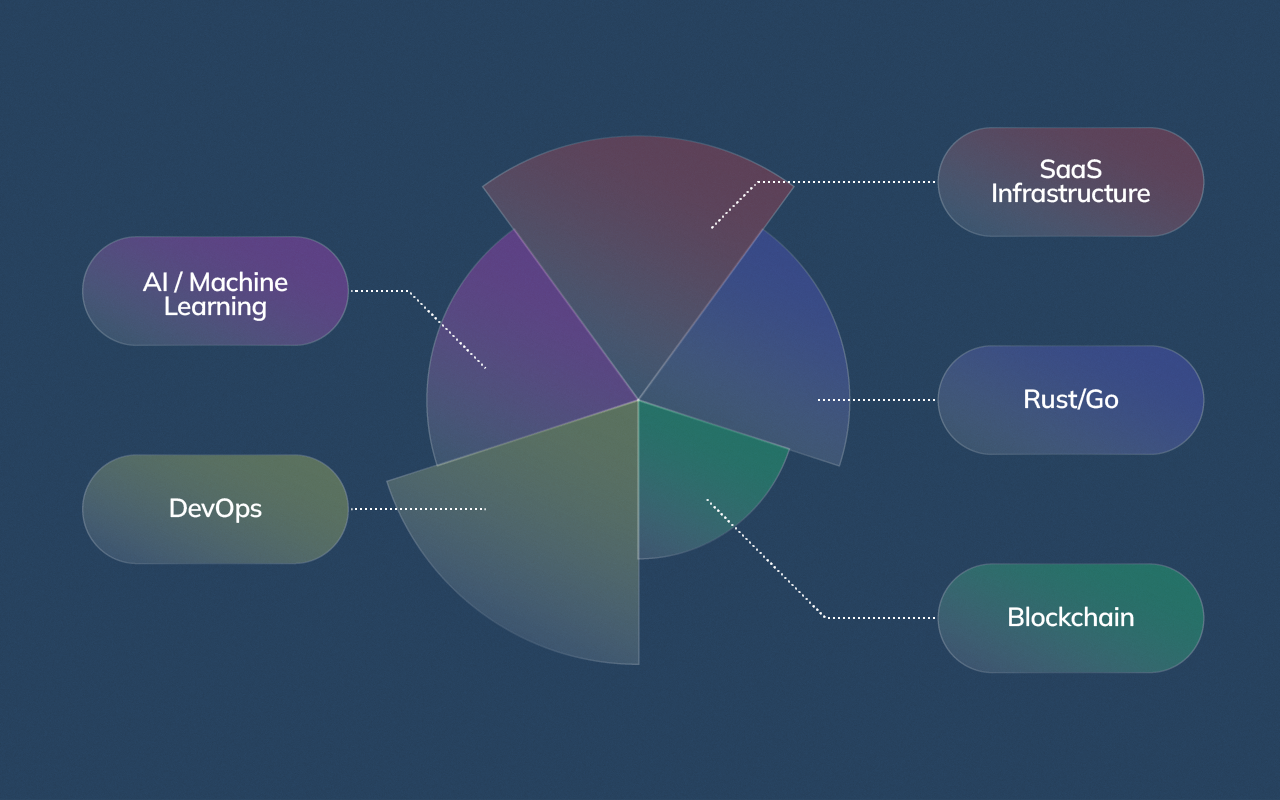
When you hire specialized developers overseas, you unlock immediate access to:
- AI and ML specialists
- Blockchain and smart contract developers
- SaaS engineers with multi-tenant architecture experience
- Cloud, DevOps, and infrastructure experts
- Backend specialists in Rust, Go, Elixir, or niche frameworks
This global search dramatically increases the odds of finding the right niche programming expertise for high-stakes features.
Faster Tech Team Scalability
Startups can scale from 1 to 10 engineers without waiting months for local candidates. Overseas hiring markets have deeper senior talent pools and better availability across time zones.
Higher Seniority for Lower Cost
When you hire overseas software engineers, you often get senior-level capability at mid-level prices, giving startups stronger operational leverage without increasing burn.
If you want a deeper breakdown of salary differences and regional benchmarks, read more in the Developer Hiring Cost Comparison Guide
Better Fit for Modern Product Development
Shifting roadmaps require dynamic staffing:
- Need AI features → hire AI developers overseas
- Need Web3 components → hire blockchain developers overseas
- Need SaaS billing, integrations, or scaling → hire SaaS developers overseas
- Need mobile or cross-platform delivery → hire overseas app developers
Global hiring gives founders flexibility that local markets cannot.
Why Startups Struggle to Find Niche Developers Locally
Even strong teams with solid funding face persistent limitations when hiring niche specialists. Local talent markets simply cannot keep up with the demand for advanced engineering roles, which is why startups expand to global talent pools.
Even well-funded teams hit the same obstacles:
- Limited supply of specialized software engineers
- Long hiring cycles for rare skills
- Rising competition from bigger companies
- Salary inflation for senior technical roles
- Slow product velocity due to skill bottlenecks
This is why startups increasingly rely on global niche developer hiring, cross-border tech hiring, and remote developer recruitment to access the expertise they need.
How Offshore Hiring Actually Works
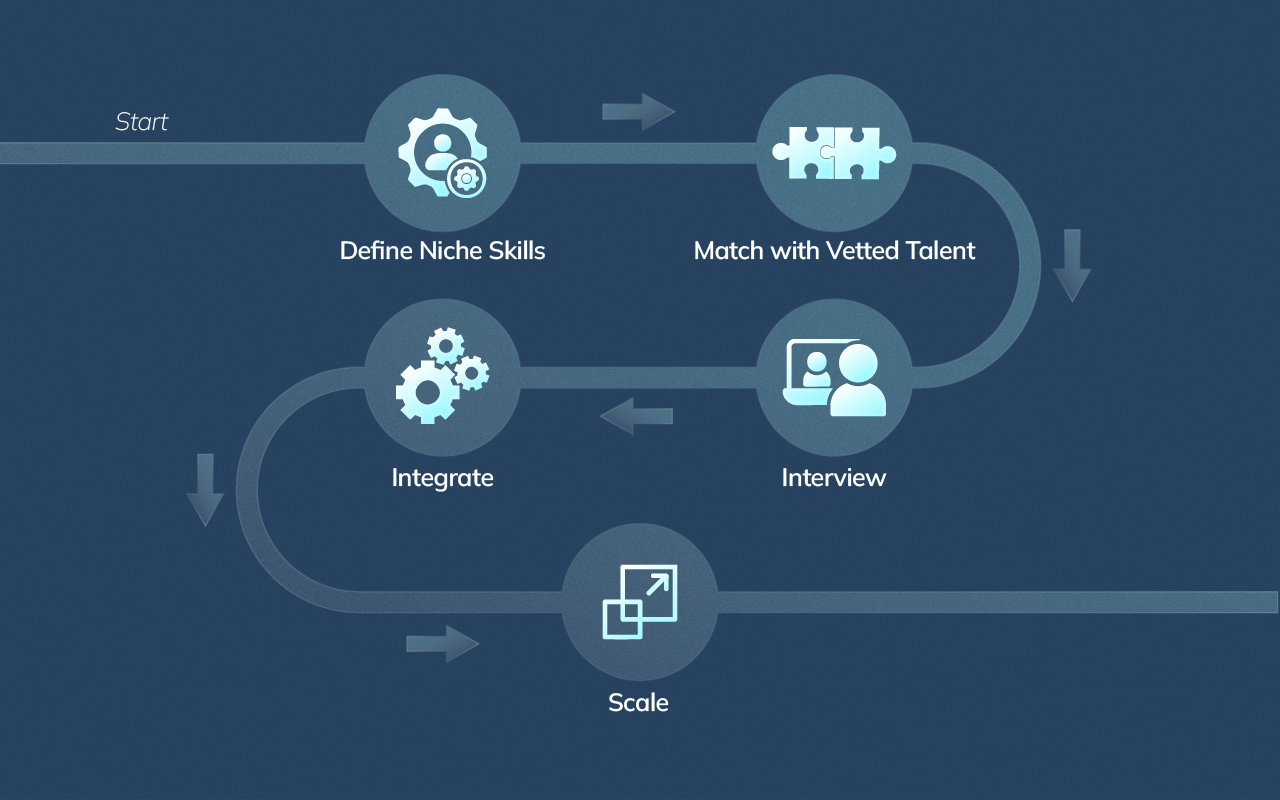
Most founders understand the benefits of global hiring but not the operational flow behind it. Modern offshore processes remove the uncertainty traditionally associated with outsourcing and replace it with clear steps, predictable timelines, and structured vetting. This makes hiring niche developers overseas as straightforward as local recruitment, but faster and far more flexible.
1. Define niche skills and role requirements
You identify the exact expertise you need, whether AI, blockchain, SaaS, DevOps, or niche backend stacks. Clear requirements ensure platforms and agencies source only relevant specialists.
2. Match with vetted, pre-screened global candidates
Instead of sorting through hundreds of resumes, you receive a short list of qualified developers already vetted for technical ability, communication, remote readiness, and timezone alignment.
3. Conduct targeted technical interviews
You interview only candidates who fit your stack, experience level, and industry needs. This shortens the hiring cycle dramatically and improves match accuracy.
4. Integrate engineers into existing workflows
Developers join your standups, sprint cycles, code reviews, and release pipelines just like full-time team members. Modern collaboration tools make cross-border integration seamless.
5. Scale your overseas software development team as needs evolve
You can add or reduce engineers based on new product demands, fundraising cycles, or market opportunities—without long-term commitments or local hiring constraints.
This streamlined model makes it far easier to hire remote niche developers, onboard rare specialists quickly, and maintain consistent product velocity.
When to Choose Full Stack vs Specialized Developers
Teams often struggle to decide whether to hire full-stack developers or niche specialists. Choosing the wrong type slows progress or creates technical debt. A simple framework helps you match the right developer profile to the right stage of your product.
Full stack developers fit early-stage needs
They’re ideal for MVP builds, rapid prototyping, and general product development. One engineer can cover frontend, backend, and basic integrations, which keeps early operations lean and fast.
Specialized developers fit complexity and scale
As soon as your product requires AI features, blockchain logic, complex SaaS architecture, heavy backend optimization, or security and compliance work, generalists are no longer enough. This is when companies benefit most from hiring dedicated niche developers who bring depth in a specific domain.
How to decide quickly
- Choose full stack → broad needs, early builds, undefined requirements
- Choose specialists → deep technical needs, performance risks, scaling challenges
Most scaling startups succeed with a blended team: generalists for flexibility and specialists for technical precision.
Top 10 Platforms to Hire Niche Developers Overseas
Most hiring platforms can supply general developers, but only a handful consistently deliver niche specialists—AI engineers, blockchain developers, SaaS architects, low-level systems programmers, DevOps experts, and other hard-to-find roles.
This updated list highlights the 10 best places for US startups to hire highly specialized overseas developers without sorting through low-quality marketplaces.
1. Hire Overseas (Best for Startup-Focused Niche Developer Teams)
Specialty Roles: AI/ML engineers, LLM integrators, blockchain developers, SaaS architects, Rust/Go backend engineers, DevOps + cloud specialists
Hire Overseas helps US startups hire niche developers overseas by tapping into one of Asia’s most advanced developer ecosystems. Their focus is not volume but precision: every candidate is vetted for seniority, remote readiness, communication, and product-thinking capability.
Why Hire Overseas Stands Out
- Designed for fast-moving US startups
- Strong supply of senior niche engineers (AI, blockchain, SaaS, data)
- Product-focused vetting instead of generic skill checks
- Recruiting, screening, HR, payroll, and compliance included
- Ideal for building end-to-end, distributed engineering teams
This is the top choice for founders needing high-skill specialists for complex features or long-term product development.
2. Toptal (Best for Enterprise-Grade Niche Specialists)
Specialty Roles: Algorithm engineers, security experts, quantitative developers, advanced DevOps/SRE
Toptal’s rigorous screening ensures access to elite engineers capable of handling mission-critical systems, high-scale infrastructure, and enterprise-level backend complexity.
3. Arc.dev (Best for Fast Global Matching of Advanced Engineers)
Specialty Roles: React/Next.js specialists, Node.js performance engineers, AI/ML practitioners, Web3 smart-contract developers
Arc.dev uses automation plus human review to deliver pre-vetted engineers quickly, making it ideal for teams needing niche skills on short notice.
4. Near (Best for US-Based Teams Wanting LATAM Time-Zone Alignment)
Specialty Roles: Senior full-stack engineers, DevOps for CI/CD automation, cloud-native backend developers
Near focuses on LATAM talent, giving US startups strong collaboration overlap and culturally aligned specialists for long-term engineering roles.
5. BairesDev (Best for Large, Structured Teams With Deep Technical Coverage)
Specialty Roles: Data engineers, enterprise-level .NET engineers, industry-specific backend developers (healthcare, fintech, logistics)
Best suited for teams needing comprehensive, managed development squads with agile frameworks and enterprise governance.
6. Upwork (Best for Short-Term Niche Contract Roles)
Specialty Roles: API integration specialists, mobile developers, legacy system experts (PHP/Laravel, Java), one-off algorithm builders
Upwork works well for testing developers or hiring specialists for narrowly defined tasks, proof-of-concepts, or rapid fixes.
7. Limeup (Best for Design-Led Engineering and Frontend Specialists)
Specialty Roles: Frontend specialists (React, Vue), UX-centric developers, UI-heavy web engineers
Limeup excels when a startup needs polished user interfaces backed by reliable engineering, especially for consumer apps or SaaS frontends.
8. Onix Systems (Best for Regulated Industry Software Needs)
Specialty Roles: HIPAA-compliant healthcare developers, fintech security engineers, banking-grade backend specialists
Onix is ideal when you need developers who understand industry-specific workflows, compliance requirements, and high-security systems.
9. LinkedIn (Best for Direct Sourcing of Senior Niche Talent)
Specialty Roles: Staff-level architects, senior AI researchers, engineering managers, protocol-level blockchain engineers
Direct outreach is still effective for high-seniority roles where culture fit and long-term commitment matter.
10. YouTeam (Best for Pre-Vetted Offshore Engineering Teams Across Emerging Tech)
Specialty Roles: Embedded systems developers, hardware-integrated software engineers, industrial IoT specialists, cross-border R&D engineers
YouTeam gives startups access to boutique offshore development firms that specialize in advanced and unconventional technical domains—ideal for complex R&D-heavy projects.
Why This List Matters for US Startups: US-based startups face some of the world’s highest talent competition and salary inflation. These 10 platforms offer alternatives with deeper specialization, faster hiring cycles, and stronger cost-to-capability ratios—without sacrificing engineering quality.
Comparison Table: Best Places to Hire Niche Developers Overseas
A quick overview so founders can understand how each platform differs in strengths, niche expertise, and ideal use cases.
Hire Overseas Insider: The Startup Guide to Choosing a Niche Developer Hiring Platform
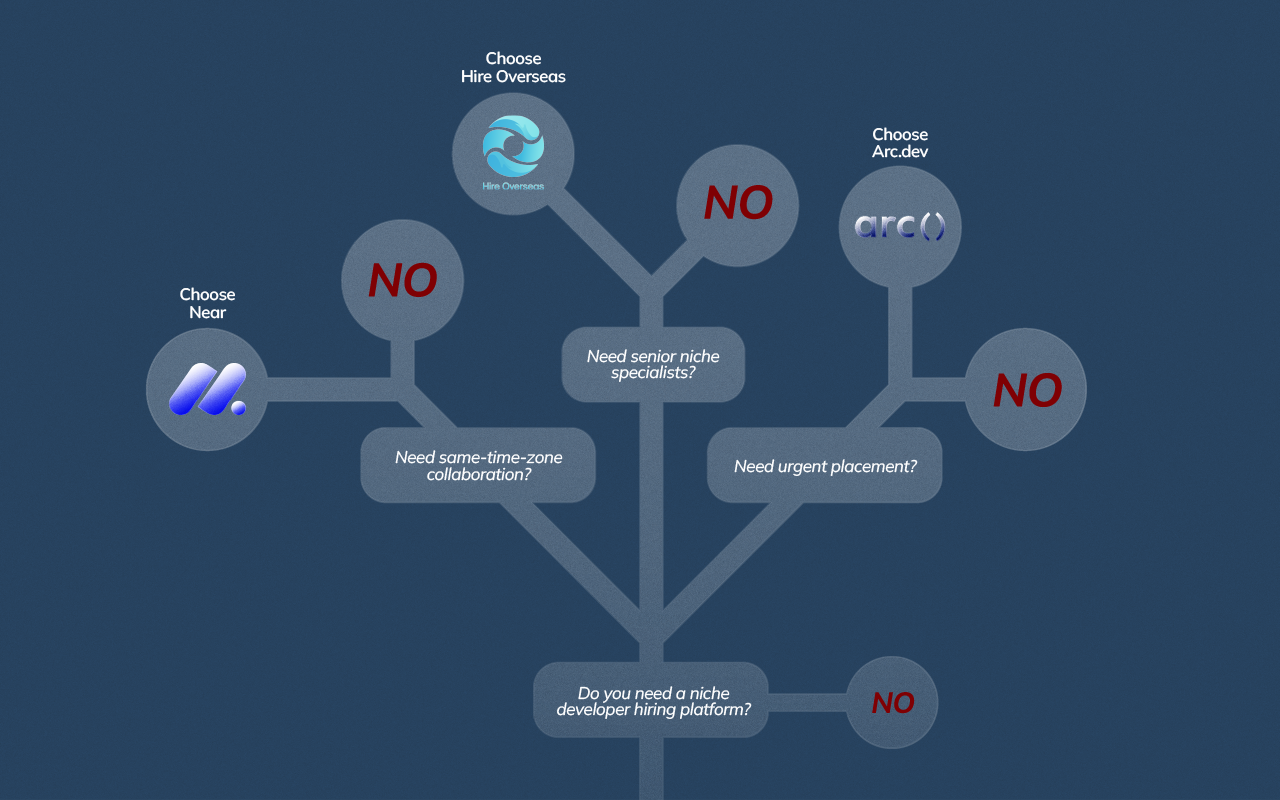
Most founders don’t struggle with finding platforms. They struggle with understanding which one actually fits their current situation—their hiring urgency, their stage of growth, and the level of niche expertise their product demands. This insider guide breaks down how US startups should choose the right platform for hiring specialized developers overseas, based on the real scenarios founders face.
When You Need High-Skill Specialists Who Can Contribute Immediately — Choose Hire Overseas
You’re facing a technical bottleneck—AI, SaaS scaling, backend re-architecture, DevOps automation—and you need senior engineers who can plug into your roadmap without hand-holding. This happens when founders realize local hiring is too slow or too expensive.
Hire Overseas sources from top emerging tech regions—the Philippines, LATAM, India, and Sri Lanka—where niche engineering talent is deep, cost-effective, and startup-experienced.
Unique Insight:
These regions now rival Silicon Valley and Eastern Europe in specialized skills. Their strongest engineers come with backgrounds in AI operations, SaaS infrastructure, blockchain engineering, and high-performance backend systems—plus the communication and remote-first habits US startups depend on.
Where Hire Overseas gives you a real edge:
You get senior-level engineers at startup-friendly cost, with far more reliability than freelancer models. This is the closest thing to hiring a full-time, in-house specialist—without the US hiring timeline or salary inflation.
Read more about hiring remote developers in the Philippines for a closer look at the Philippines as a strategic base for remote engineering teams.
When You Need Niche Roles Filled Fast — Choose Arc.dev
You’re racing a deadline. A feature is blocked. A sprint needs more hands. Or you suddenly need a React, Node, AI/ML, or blockchain specialist this week, not next quarter.
Arc.dev’s superpower is speed—without dropping quality.
Unique Insight:
Arc.dev’s matching platform places strong emphasis on engineers who thrive in high-iteration, fast-moving startup environments. These are devs who can adapt quickly, pick up partial specs, and execute.
Where Arc.dev gives you a real edge:
You get vetted specialists in days, not weeks. For teams facing sprint pressure or investor milestones, this speed is the difference between hitting roadmap targets or slipping.
When Time-Zone Alignment Matters — Near (LATAM)
Your product workflow depends heavily on synchronous collaboration. You’re running daily standups, rapid review cycles, cross-functional discussions—and you need engineers awake when you are.
Near specializes in pulling talent from LATAM, where engineering ecosystems are booming with React, Node.js, DevOps, and cloud-native developers.
Unique Insight:
LATAM engineers often work with US tools, frameworks, and communication norms, making onboarding friction low and collaboration natural.
Where Near gives you a real edge:
Real-time communication. No overnight delays. Seamless integration into fast-moving agile teams. Ideal for founders who want deeper collaboration—not just code delivery.
Insider Summary: Which One Should You Choose?
Startup situations determine the platform:
- You’re facing a technical bottleneck → Pick Hire Overseas
Best all-around choice for senior specialists, stable long-term contributors, and teams needing depth in AI, SaaS, DevOps, or backend engineering.
- You need a niche role filled this week → Pick Arc.dev
Strongest platform for rapid placement in JS, AI, blockchain, or modern backend stacks.
- You need real-time collaboration and cultural alignment → Pick Near
Best for US teams that rely on synchronous workflows and full-stack/cloud engineers.
These three platforms give startups everything they need to build and scale engineering teams across AI, SaaS, backend, cloud, and Web3—without wasting time on low-signal marketplaces or slow enterprise outsourcing models.
Your Next Engineering Advantage Starts Overseas
The next generation of successful startups will be built by teams who tap into global talent markets—where niche expertise, senior capability, and cost-efficient scaling come together. Hire Overseas stands at the center of this shift, giving US startups access to engineers ready for the future of AI, SaaS, cloud, and emerging technologies.
If you want a team built for where tech is going—not where it’s been—Hire Overseas is your most strategic path forward.
Reach us today to build your specialized global engineering team.
FAQs About Hiring Niche Developers Overseas
What makes a developer “niche” or specialized?
A niche developer is a specialist with deep expertise in a narrow technical domain—such as AI, blockchain, SaaS architecture, Rust/Go backend, or DevOps for distributed systems. They’re different from generalists because they bring domain-level mastery required for complex or high-risk product features.
How do I know if my startup truly needs a niche developer instead of training an existing engineer?
If the feature involves high complexity, security implications, performance optimization, or advanced algorithms, training an internal generalist is slower and riskier. Hiring a niche developer overseas gives you immediate access to hard-earned expertise that would take months or years to build internally.
Is it safe to hire niche developers overseas for sensitive code or proprietary tech?
Yes, when following standard safeguards:
- NDAs and IP-transfer agreements
- Source-control permissioning (least-privilege access)
- Clear security policies for local environments
Vetting platforms that verify identity, work history, and reliability
Top overseas engineers already work with US SaaS startups, fintech companies, and AI teams, so IP protection is standard practice.
Should I hire freelance niche developers or full-time overseas specialists?
- Use freelancers when the work is:
- low-risk
- short-term
- experimental or task-based
Use full-time overseas specialists when the work is:
- core to your roadmap
- security-sensitive
- part of long-term product development
- requiring deep system knowledge or ongoing ownership
Freelancers deliver output. Full-time overseas specialists deliver continuity.
What red flags should I watch for when interviewing niche developers abroad?
Common warning signs include:
- Overly broad skill claims (“I do AI, blockchain, mobile, DevOps…”)
- No real product examples or portfolio
- Weak communication or slow responses
- Inability to explain complex technical decisions clearly
- Vague answers about prior teams, contributions, or system architecture
Strong niche developers speak in specifics, not generalities.
How do I evaluate the true seniority of a niche developer overseas?
Look for:
- Code ownership in real products
- Experience solving system-level problems
- Architecture-level decision-making
- Ability to teach or guide junior developers
- Understanding of trade-offs, not just syntax
Senior engineers talk about why they built something—not just what they built.
What’s the biggest mistake founders make when hiring overseas niche developers?
Hiring platforms or freelancers too quickly without defining the role deeply enough.
For niche roles, clarity matters: frameworks, architecture context, data flows, performance expectations, and success metrics.
Precise requirements produce dramatically better matches.
