


Hiring remote developers is no longer the hard part.
Keeping them aligned, productive, and moving in the same direction after the hire is where most teams fail.
Post-hire drift is subtle. Code still gets written, tickets move, and meetings happen, but velocity slows, ownership blurs, and founders quietly step back into day-to-day oversight.
This guide explains how to hire a remote team of software developers without post-hire drift by designing the operating model before the first line of code is written.
1. Understand What Post-Hire Drift Actually Looks Like
Post-hire drift rarely shows up as obvious failure. It shows up as friction that accumulates quietly over time. Work continues, but progress feels heavier than it should.
Common signs of drift in a remote software development team
- Features stall in review with no clear owner pushing them across the line
- Engineers ask for clarification late instead of flagging uncertainty early
- Work remains “in progress” across multiple sprints without clean closure
- Founders slowly become default decision-makers again
- Quality issues surface only after release instead of during development
These signals often appear even when individual developers are strong. That is why drift is rarely a talent issue. It is a systems issue that emerges when expectations and ownership are not explicit.
Why remote teams are more exposed to drift
In colocated teams, misalignment is corrected informally through hallway conversations and ad-hoc clarification. In a distributed software development team, ambiguity compounds silently. When ownership, quality standards, and communication rules are not written and reinforced, each person fills the gaps differently.
That divergence is what creates drift. Not failure, but slow erosion of alignment.
2. Hire Into a Defined Operating Model, Not Just Open Roles
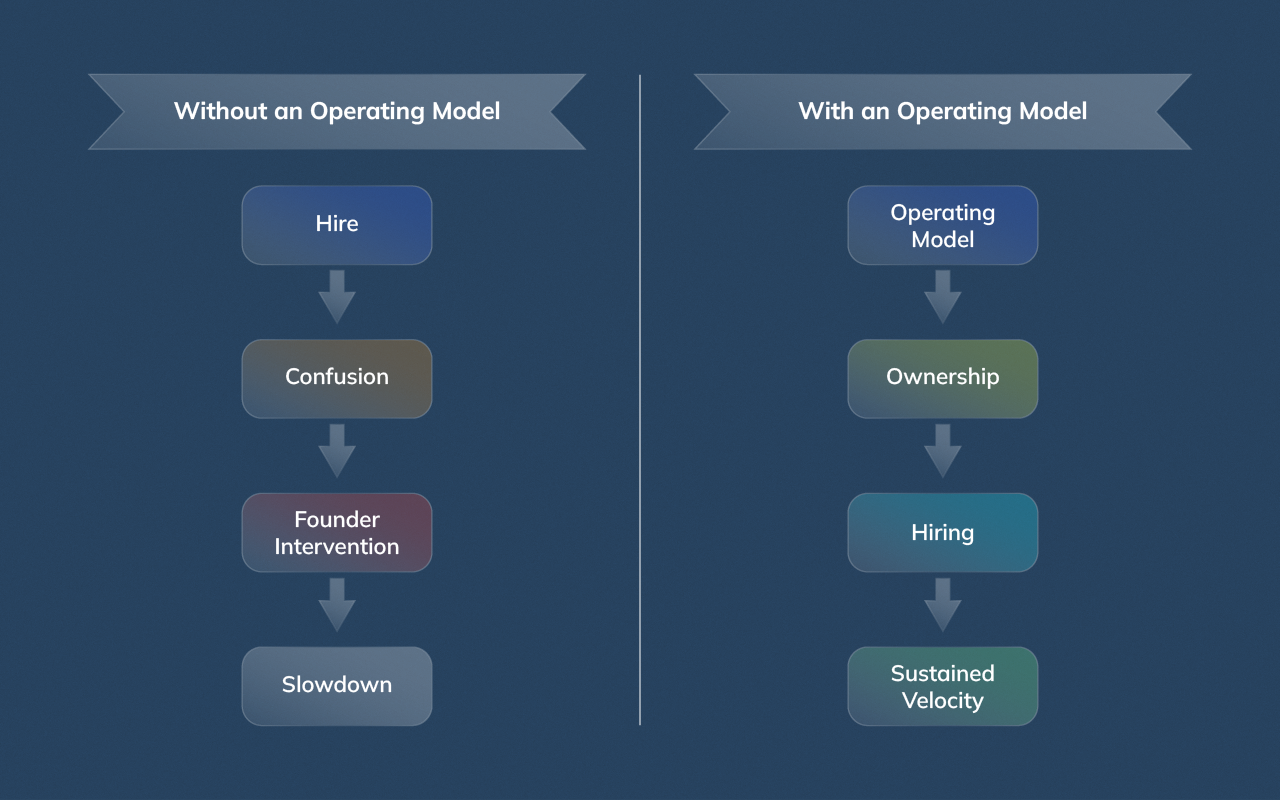
Most teams focus heavily on who to hire and postpone how the team will operate together. That sequence almost always guarantees drift after the hire.
Decide what you are building before you hire
Before you hire remote software developers, answer one foundational question:
Are you building:
- a short-term delivery team meant to complete defined work
- or a long-term product team expected to own systems and improve them over time
If the product will evolve, you need continuity. That usually means you should hire a dedicated remote development team, not rotate freelancers or short-term contractors who lack long-term ownership.
Once you’ve decided whether you’re building short-term delivery capacity or long-term ownership, this step-by-step breakdown shows how to hire remote developers in a way that aligns roles, expectations, and accountability from day one.
Software development outsourcing vs. in-house vs embedded remote teams
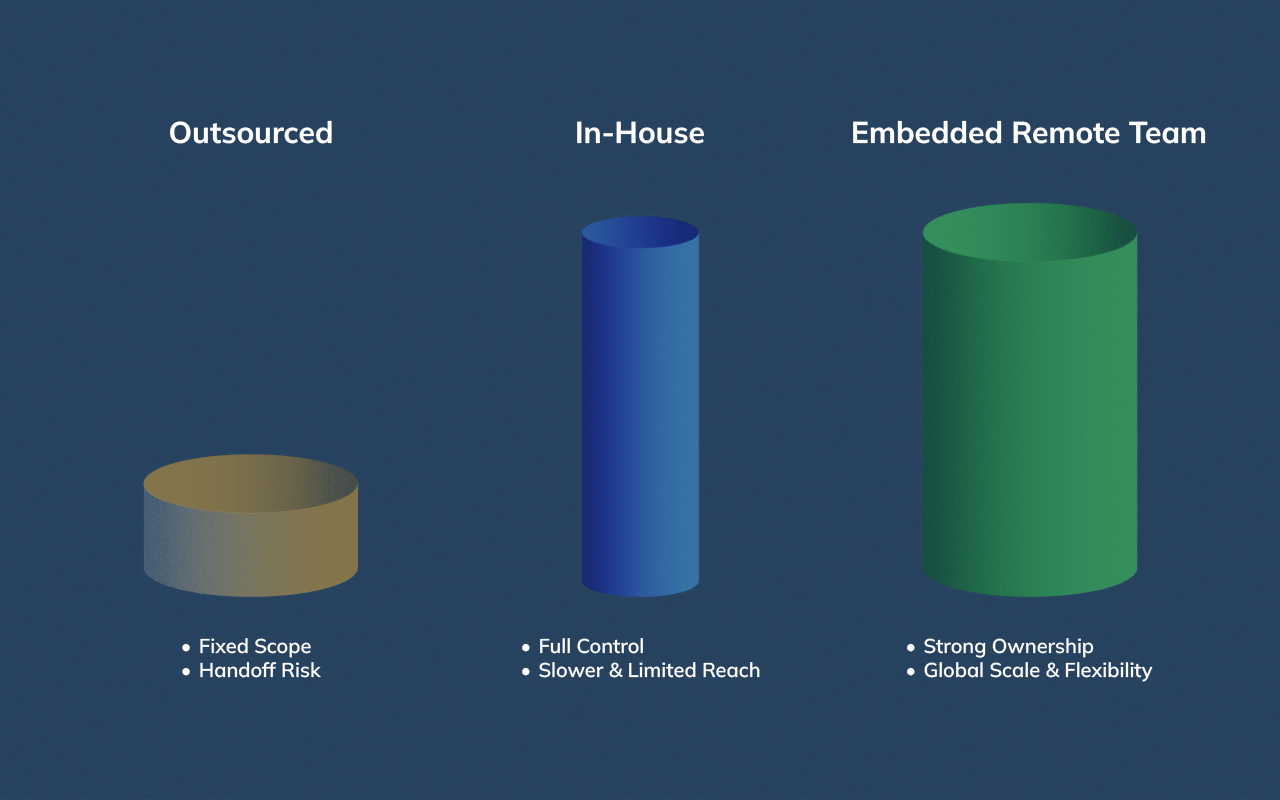
Each model solves a different problem:
- Outsourcing works for fixed scope but introduces handoff risk and shallow ownership
- In-house reduces drift but limits speed, reach, and flexibility
- Embedded remote teams combine ownership with global leverage
This embedded model is where many high-performing teams now operate because it balances control, speed, and continuity.
For teams considering the embedded model, this guide explains when hiring offshore development teams creates ownership and when it silently introduces handoff risk.
Hiring developers overseas requires clearer structure, not looser rules
When hiring developers overseas, you cannot rely on shared context or cultural osmosis. Expectations must be documented, reinforced, and visible. This is especially important for US companies hiring overseas developers, where assumptions about pace, autonomy, and escalation often differ.
Clarity upfront prevents correction later.
If you’re hiring for specialized roles, this breakdown shows how to hire niche developers overseas without losing standards, ownership, or velocity.
3. Design a Remote Development Team Structure That Prevents Drift
Titles do not prevent drift. Ownership does.
a. Build ownership into the team structure
A strong remote development team structure assigns ownership explicitly across three layers:
Feature ownership
One person owns outcomes for billing, onboarding, reporting, or other product areas. They are accountable for delivery, not just implementation.
Service ownership
One person owns APIs, auth, payments, or integrations end to end, including reliability and changes over time.
Platform ownership
One person or pod owns CI/CD, observability, and release quality so delivery does not degrade as the team grows.
When something breaks or slows, there is no debate about who acts.
b. Hire leadership before volume
One of the most common mistakes in hiring remote developers is adding multiple builders before hiring someone accountable for standards and direction.
A safer order is:
- Senior engineer or tech lead to set quality and delivery norms
- One or two mid-level engineers who can execute within those guardrails
- QA or DevOps once bottlenecks are visible and measurable
This sequence dramatically reduces post-hire drift because standards are set before scale.
For teams using the Philippines as a core hiring market, this guide explains how to hire Filipino remote developers while setting senior-level ownership expectations early.
4. Hire for Execution Discipline, Not Just Technical Skill
Many remote teams drift because execution habits were never evaluated during hiring.
Remote developer skills and qualifications that prevent drift
Strong remote developers consistently demonstrate:
- clear written updates that reduce follow-up questions
- early escalation of blockers instead of silent delays
- comfort with async workflows and independent progress
- disciplined PRs and thoughtful reviews
- awareness of release risk, not just feature completion
These remote developer skills and qualifications matter more for long-term performance than any specific framework.
Rethink the remote software engineer hiring process
A strong remote software engineer hiring process gathers evidence of how someone works in real conditions, not just what they know.
Focus on:
- concrete ownership examples from past roles
- decision-making under constraints and ambiguity
- clarity and structure in written communication
This approach answers how to hire remote developers without relying on intuition or resume polish.
Instead of relying on resumes and interviews alone, this hiring framework shows how to evaluate remote developers for execution discipline, ownership, and async decision-making.
5. Lock Alignment After the Hire With Process, Onboarding, and Compliance
Most post-hire drift begins in the first 30 days, when habits form and assumptions harden.
Remote developer onboarding process that creates momentum
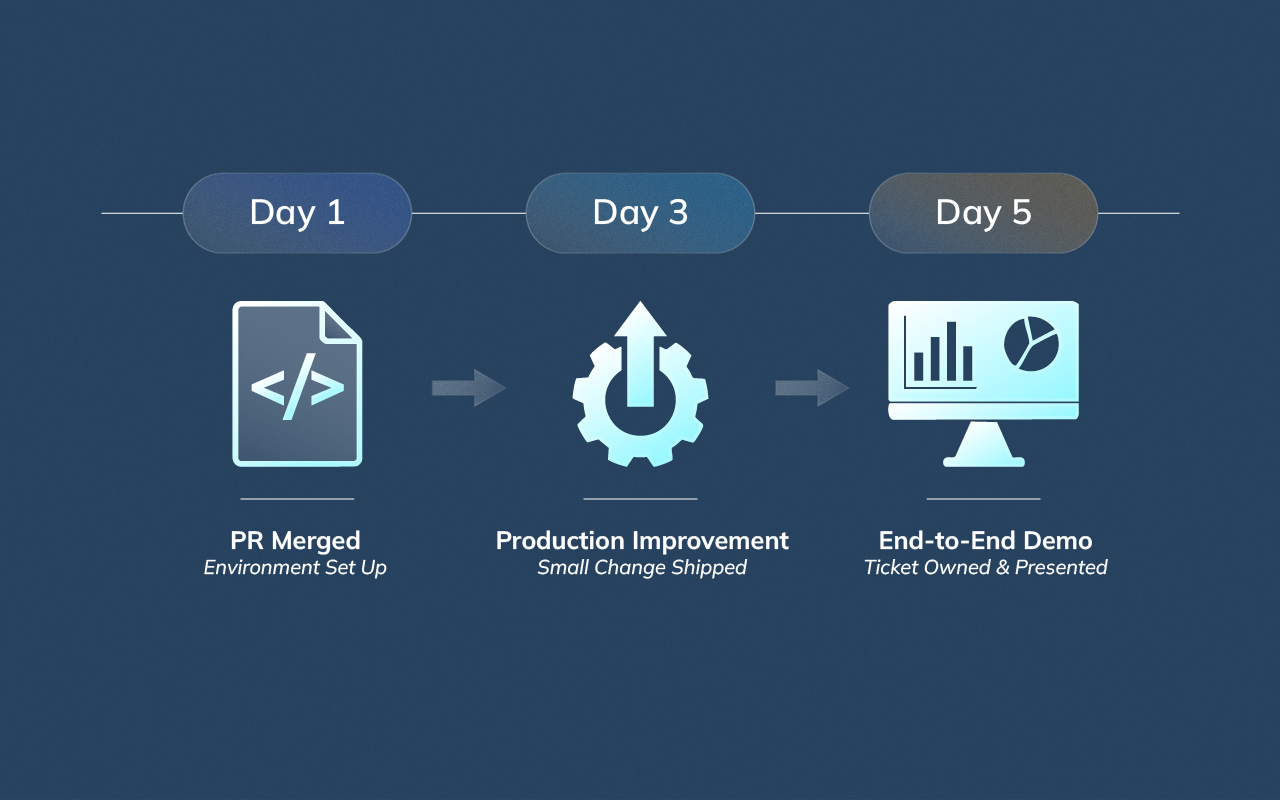
A strong remote developer onboarding process produces output immediately:
- Day 1: environment setup and first merged PR
- Days 2–3: small production improvement shipped
- Days 4–5: ticket owned end to end and demoed
Early delivery establishes standards faster than documentation alone.
Time zone management for remote teams
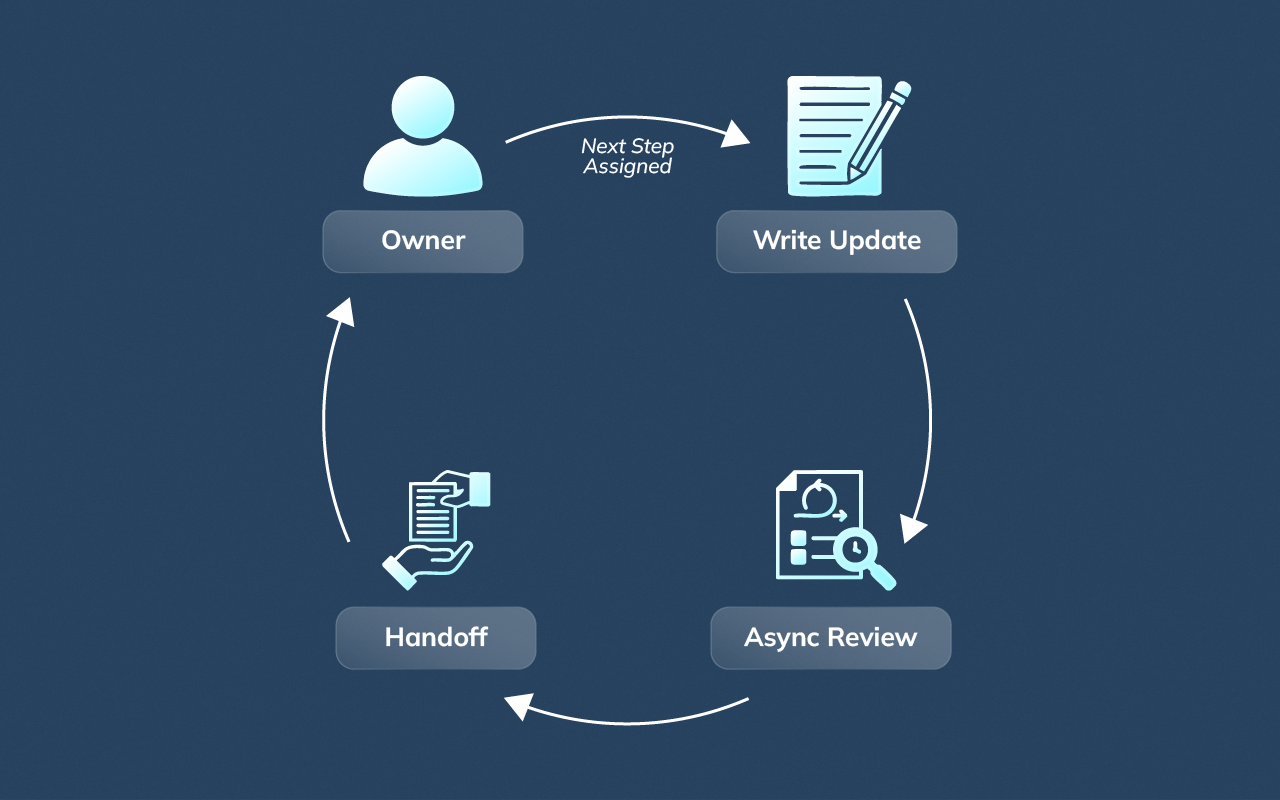
Time zones are rarely the real problem. Handoffs are.
Effective time zone management for remote teams relies on:
- one owner per workstream
- small, reviewable units of work
- decisions captured in writing
- meetings used only to unblock, not to coordinate basics
Communication tools for remote developers only work with rules
Tools support alignment only when expectations are explicit.
Common communication tools for remote developers include Slack, Jira, GitHub, and Notion, but drift is prevented by defining:
- where decisions live
- how progress updates are shared
- what “done” actually means for your team
Compliance when hiring remote developers protects continuity
Post-hire drift also happens when legal structure is unclear.
If you are hiring international developers legally, you must address:
- remote developer contracts and classification
- IP ownership and confidentiality
- local labor rules and tax exposure
Ignoring compliance when hiring remote developers creates instability that eventually affects team confidence and retention.
Cost of hiring remote software developers includes drift
The real cost of hiring remote software developers includes:
- rework caused by unclear standards
- management time spent correcting misalignment
- delayed releases caused by ownership gaps
Preventing drift is often the highest ROI decision you can make.
Hire Overseas Insight: How We Prevent Post-Hire Drift in Remote Software Teams
From working with hundreds of remote engineering hires, we have seen the same pattern repeat: post-hire drift does not come from weak developers. It comes from unclear structure after the hire.
Teams that drift usually share a few traits. Ownership is vague. Success is implied instead of defined. Communication norms vary by manager or time zone. Individually, developers perform. Systemically, the team slows.
At Hire Overseas, our approach is built to eliminate those gaps before a developer ever joins.
How We Design Against Drift
- We hire into ownership, not capacity
Every remote software developer we place is mapped to a clear responsibility area. Product surfaces, services, or infrastructure all have a named owner. This removes the “everyone contributes, no one owns” problem that quietly erodes velocity. - We screen for execution habits, not just skill
Technical ability is table stakes. We vet how candidates communicate progress, escalate blockers, document decisions, and operate asynchronously. These behaviors are the strongest predictors of long-term performance in distributed teams. - We align expectations before onboarding starts
Before day one, we help teams define what “done” means, how updates are shared, where decisions live, and which hours actually matter. This prevents the early misalignment that typically shows up in weeks two and three. - We onboard for output, not observation
Our recommended remote developer onboarding process is designed to produce shipped work in the first week. Early delivery sets standards faster than any policy document. - We match legal structure to real working relationships
Misaligned contracts and classification create instability that eventually reaches the team. We ensure IP ownership, compliance, and engagement models reflect how the developer actually operates.
The Consistent Outcome
Teams built this way stay aligned without added management layers. Founders step back instead of stepping in. Delivery stays predictable as the team grows.
Preventing post-hire drift is not about tighter oversight. It is about designing the system correctly from the start.
Preventing Drift Is the Real Work of Remote Hiring
Hiring remote software developers is no longer the challenge. Keeping them aligned after the hire is.
Post-hire drift is not caused by geography or talent quality. It happens when ownership, execution standards, and expectations are left implicit. When that occurs, velocity slows, quality erodes, and founders step back into day-to-day management.
Teams that avoid drift design for alignment early. They hire into ownership, evaluate execution habits, onboard for output, and match legal structure to how the team actually works. The result is consistent delivery without added oversight.
At Hire Overseas, this is how we help companies build remote software development teams that stay aligned long after the hire.
If you want to hire a remote team of software developers without post-hire drift, the next step is a focused conversation.
Book a demo with Hire Overseas and learn how we help companies build remote engineering teams that stay aligned, accountable, and productive over the long term.
