


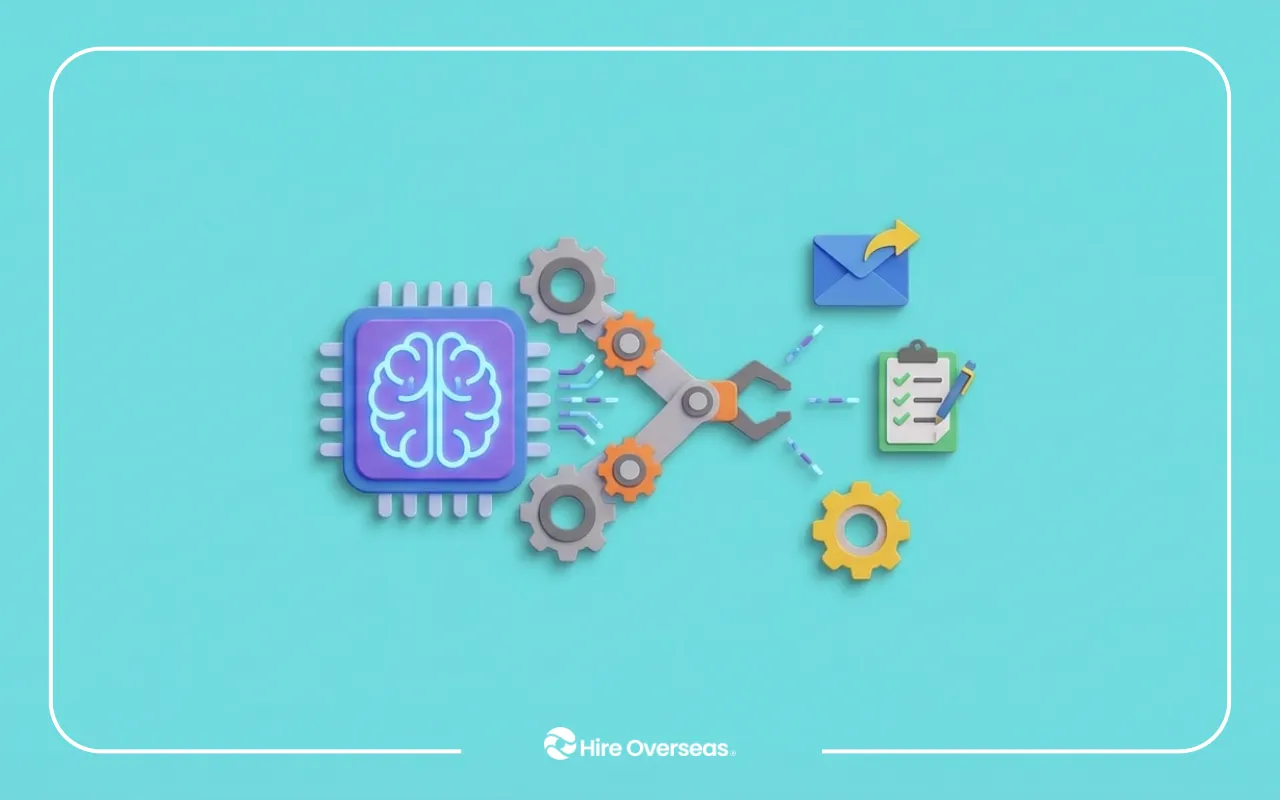
AI tools can generate insights, summaries, and recommendations. But most businesses still rely on people to take action after those outputs.
This is where an OpenClaw developer becomes essential.
They build the systems that turn AI decisions into real actions across tools, workflows, and operations. Instead of stopping at suggestions, AI becomes part of execution.
For companies moving beyond AI experimentation, this role defines whether automation actually delivers results.
What Is an OpenClaw Developer?
An OpenClaw developer is a specialist who builds AI-powered execution systems using OpenClaw. Their role is to connect AI outputs to real business actions through workflows, integrations, and automation logic.
Instead of stopping at insights or recommendations, they design systems where AI completes tasks across tools, databases, and business processes.
They operate within what is often called the:
- AI execution layer
- AI workflow execution
- AI automation infrastructure
- agent execution framework
- structured workflow automation
- decision-to-action systems
- AI action layer
In simple terms, they make AI operational by turning decisions into actions.
What does an OpenClaw developer do?
An OpenClaw developer designs systems where AI can move from input to execution without manual intervention.
They build workflows where AI can:
- interpret inputs such as messages, forms, or data events
- retrieve relevant context from CRMs, databases, or knowledge sources
- make structured decisions based on defined logic
- trigger actions across systems such as updating records or sending notifications
- escalate to humans when confidence is low or exceptions occur
- log and track outcomes for visibility and performance
This transforms AI from a passive tool into an active system that drives real operations.
What does an OpenClaw developer actually do?
Day-to-day work focuses on execution, system design, and reliability rather than model development.
A typical OpenClaw developer may:
- map how a workflow currently runs across tools and identify gaps
- integrate APIs so systems can communicate automatically
- design automation logic that defines triggers, conditions, and actions
- create rules that determine when AI should act or escalate
- troubleshoot failures when workflows break in real scenarios
- refine workflows to improve speed, accuracy, and consistency
They spend more time ensuring workflows run smoothly in production than building AI models themselves.
OpenClaw developer responsibilities
Key OpenClaw developer responsibilities focus on building systems that are reliable, scalable, and aligned with real business processes.
Workflow design
Structuring how tasks move from input to execution across multiple steps.
This includes defining triggers, decision points, action paths, and handoffs between systems. A well-designed workflow ensures that processes run consistently without requiring manual coordination.
System integration
Connecting CRMs, ERPs, databases, SaaS tools, and internal platforms.
This involves managing APIs, authentication, and data flow so information moves seamlessly between systems without duplication or errors.
Action execution
Ensuring AI outputs trigger the correct next step in a process.
This means translating decisions into actions such as updating records, assigning tasks, sending messages, or initiating workflows across tools.
Error handling
Building fallback paths, retries, and escalation logic.
Real-world workflows often encounter incomplete data, system errors, or unexpected inputs. A strong OpenClaw developer designs systems that can recover automatically or route issues to the right person.
Monitoring and optimization
Improving workflow performance over time.
This includes tracking execution logs, identifying bottlenecks, reducing failure rates, and continuously refining how workflows operate as business needs evolve.
If you're weighing whether an OpenClaw developer is worth the investment, this breakdown of the concrete benefits of hiring an OpenClaw developer covers the productivity gains teams typically see within the first 90 days of integration.
When Do You Need an OpenClaw Developer? Insights from Hire Overseas Experts
Most founders do not wake up thinking they need an OpenClaw developer.
They realize it after trying to use AI in real operations.
At Hire Overseas, we see a consistent pattern. Companies start with AI tools, get early wins, but then hit a ceiling. The problem is not the AI. It is everything that happens after the AI gives an answer.
This is where the need for an OpenClaw developer becomes clear.
The moment AI stops being useful
AI feels powerful at first.
It can generate responses, analyze data, and suggest next steps. But over time, teams notice something:
Nothing actually moves forward unless someone does it.
- Leads are scored, but not assigned
- Tasks are suggested, but not created
- Insights are generated, but not executed
- Workflows still depend on manual follow-through
This is the exact point where most businesses stall.
From what we see across clients, this is the first real signal that you need an OpenClaw developer.
When your team becomes the workflow engine
Another clear sign is when your team is constantly acting as the bridge between systems.
Instead of systems talking to each other, people are:
- copying data between tools
- triggering next steps manually
- following up to keep processes moving
- checking if tasks were completed
At this stage, your operations are not system-driven. They are people-driven.
This is not scalable.
An OpenClaw developer replaces this manual coordination with structured workflow automation, where systems handle execution automatically.
When automation exists but does not hold in production
Many companies already attempt automation before hiring a specialist.
They build workflows internally or use tools like Zapier, Make, or scripts. These often work in simple cases, but break under real conditions.
We typically see:
- workflows fail when data is incomplete
- integrations break when systems update
- edge cases require constant manual fixes
- teams lose trust in automation
This is where execution quality becomes the issue.
An OpenClaw developer does not just build automation. They build reliable AI workflow execution systems that can handle real-world variability.
When your business is scaling but operations are slowing down
Growth exposes operational gaps.
As volume increases, small inefficiencies become major bottlenecks:
- more leads to process
- more support requests to handle
- more internal coordination required
- more systems involved in each workflow
Without proper execution systems, teams spend more time managing work than doing meaningful work.
This is where we see founders realize they do not need more people.
They need better systems.
An OpenClaw developer helps shift operations from manual coordination to AI-driven execution, allowing teams to scale without increasing headcount.
The clearest signal: AI is present, but not operational
If there is one rule we consistently see at Hire Overseas, it is this:
If your AI requires humans to execute every outcome, you do not have an AI system. You have an AI assistant.
The moment you want AI to:
- trigger actions
- move workflows forward
- coordinate across tools
- operate inside your business processes
you are no longer in the experimentation phase.
You are in the execution phase.
And that is exactly when you need an OpenClaw developer.
For teams already sold on the role and ready to start vetting candidates, this guide to hiring an OpenClaw developer walks through the exact skill checks and contract structures that prevent mismatched hires.
Do You Need an OpenClaw Developer or an AI Engineer?
One of the most common questions we hear from founders is:
Should I hire an OpenClaw developer or an AI engineer?
At first, the roles sound similar. Both work with AI, both are technical, and both seem capable of building systems.
But in practice, they solve very different problems.
The real difference: intelligence vs. execution
The simplest way to understand it is this:
- An AI engineer focuses on how AI thinks
- An OpenClaw developer focuses on how AI acts
AI engineers work on:
- model development and fine-tuning
- improving accuracy and performance
- building ML pipelines and data systems
OpenClaw developers work on:
- connecting AI to business tools
- building automation workflows
- turning decisions into actions
- ensuring systems run reliably in production
Most businesses do not fail because their AI is not smart enough. They fail because nothing happens after the AI gives an answer.
When you need an AI engineer
You should hire an AI engineer if your core challenge is the intelligence layer.
This usually applies when:
- you are building your own models
- you need better prediction accuracy
- your use case depends on custom training
- your outputs are not good enough yet
In this case, improving the model itself is the priority.
When you need an OpenClaw developer
You should hire an OpenClaw developer if your AI already works but does not execute.
This is far more common.
At Hire Overseas, most clients come to us with:
- working AI tools
- useful outputs
- clear workflows
But they still rely on people to move work forward.
This is where an OpenClaw developer creates immediate impact.
They turn:
- insights into actions
- workflows into systems
- manual steps into automation
OpenClaw developer vs. AI engineer in real business scenarios
To make this clearer, here is how the difference shows up in practice:
Scenario 1: Lead qualification
- AI engineer improves how accurately leads are scored
- OpenClaw developer ensures leads are assigned, routed, and followed up automatically
Scenario 2: Customer support
- AI engineer improves response quality in customer support
- OpenClaw developer ensures tickets are created, categorized, escalated, and resolved through workflows
Scenario 3: Internal operations
- AI engineer improves classification or summarization
- OpenClaw developer ensures tasks are created, tracked, and completed across systems
In each case, one improves thinking. The other ensures execution.
Why most businesses need an OpenClaw developer first
From what we see at Hire Overseas, most companies are not limited by AI capability.
They are limited by:
- disconnected systems
- manual coordination
- lack of execution infrastructure
That is why hiring an OpenClaw developer often delivers faster ROI.
Instead of improving outputs slightly, they:
- eliminate manual work
- speed up workflows
- improve consistency
- connect tools into a working system
The key decision rule:
If you are unsure which role to hire, use this rule:
- If your AI is not good enough → hire an AI engineer
- If your AI is good but nothing happens → hire an OpenClaw developer
Most businesses today fall into the second category.
What Happens If You Try to Implement OpenClaw Without a Developer
OpenClaw is powerful, but it is not plug-and-play.
Many businesses try to implement it internally after seeing what it can do. They connect a few tools, build simple workflows, and get early results.
But once those workflows move into real operations, problems start to appear.
At Hire Overseas, we consistently see the same pattern.
Automation works in controlled scenarios, but breaks under real conditions.
Automation works at first, but fails in production
Initial workflows often perform well in testing.
But real business environments introduce:
- incomplete or inconsistent data
- unexpected inputs
- system delays or API failures
- edge cases across tools
Without proper workflow design and safeguards, automation becomes unreliable.
Instead of reducing work, it creates more of it.
Integrations become fragile and hard to maintain
OpenClaw relies on multiple system connections.
Without an experienced OpenClaw integration developer, these connections often:
- break when APIs change
- fail due to authentication issues
- stop syncing data correctly
- create silent errors that go unnoticed
Over time, this leads to workflows that cannot be trusted.
Teams start double-checking everything, which defeats the purpose of automation.
Workflows still depend on manual intervention
Many internal implementations still rely on people to:
- verify outputs
- trigger next steps
- fix errors
- monitor execution
This creates what we call “partial automation.”
It looks automated, but still depends heavily on human involvement.
An OpenClaw developer removes this dependency by building end-to-end execution systems, not just assisted workflows.
Hidden operational work increases
One of the biggest issues is not visible at first.
Automation creates hidden work.
Teams end up:
- maintaining broken workflows
- fixing failed executions
- handling exceptions manually
- managing disconnected systems
Instead of simplifying operations, the system becomes another layer to manage.
Security and control risks increase
OpenClaw can interact with systems, data, and workflows across your business.
Without proper setup, this can lead to:
- overly broad system access
- lack of permission controls
- unintended actions triggered by AI
- exposure of sensitive data
This becomes especially critical for businesses handling customer, financial, or internal operational data.
Automation becomes fragmented instead of scalable
Without a structured approach, companies often build:
- disconnected workflows
- duplicated logic across systems
- inconsistent automation rules
- processes that cannot scale
Instead of building AI automation infrastructure, they end up with scattered automations that are difficult to manage and expand.
The real issue: execution without structure
The core problem is not OpenClaw itself.
It is how it is implemented.
OpenClaw is designed for AI workflow execution, but without a specialist, most implementations stay at the surface level.
They automate small steps, but fail to build a system.
At Hire Overseas, this is usually the turning point.
Companies realize they do not just need automation.
They need structured, reliable execution.
And that requires an OpenClaw developer.
If you're still exploring what OpenClaw can actually automate before committing to a developer, this collection of OpenClaw use cases and examples shows five real-world workflows where AI-generated insights trigger actions without manual intervention.
Turn OpenClaw Into a Real Execution Advantage
Most companies think they need better AI.
What they actually need is better execution.
From what we see at Hire Overseas, the gap is never in ideas or outputs. It is in what happens next. Teams still move data, trigger steps, and follow up manually. That is where speed, consistency, and scale break down.
The companies that win with AI are not using more tools. They are building decision-to-action systems that run without constant oversight.
That shift does not come from software alone. It comes from the person designing how everything works together.
That is the role of a skilled OpenClaw developer.
At Hire Overseas, we connect businesses with developers who build execution systems that hold under real conditions, scale with your operations, and remove manual coordination.
If your AI still depends on people to get work done, you are not running an AI-powered operation yet.
Book a free consultation today to see what automation can actually do for your business.
