


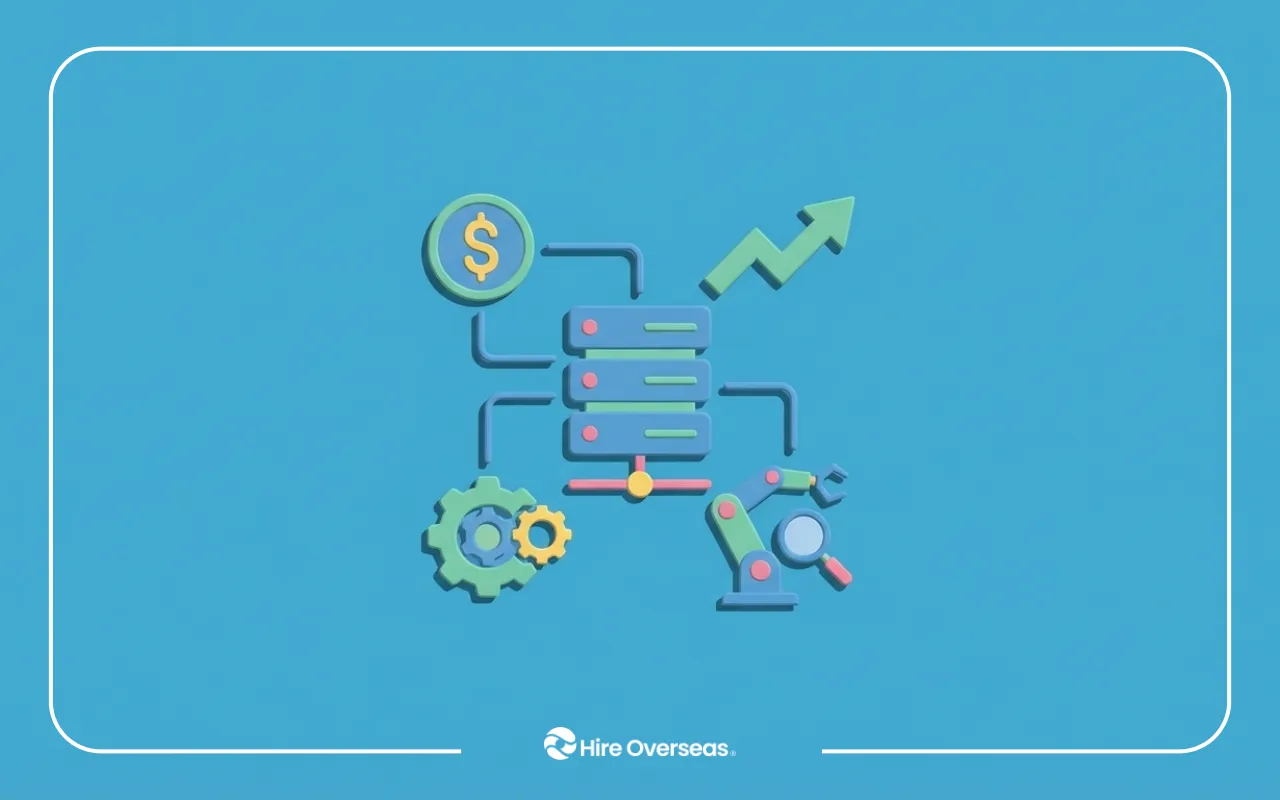
AI adoption has moved quickly over the past two years but most companies are still in the same stage. They experiment with tools, test workflows, and generate outputs. But turning AI into systems that execute real work remains a challenge.
At Hire Overseas, we are seeing this shift firsthand. More companies are moving beyond experimentation and asking: How do we turn AI into a reliable execution system inside our operations?
This is where the benefits of hiring OpenClaw developer become clear.
Based on what we are seeing across clients and what we project for startups adopting OpenClaw early, the real value is not just automation. It is operational transformation.
Strategic Benefits of Hiring OpenClaw Developer for Startups
At Hire Overseas, these are the benefits we consistently see among startups that invest early in OpenClaw developers, along with the outcomes we project for companies building automation-first operations from the start.
Turning AI Into a Real Execution Layer
The biggest OpenClaw developer value for businesses is shifting from AI assistance to execution.
Most AI tools today generate outputs such as summaries, recommendations, or drafts. But those outputs still rely on someone to take action, update systems, or move the workflow forward.
This creates a hidden gap between insight and execution.
OpenClaw developers remove that gap by building systems where AI does not just suggest the next step, but completes it.
They design agents that:
- execute workflows automatically across tools
- trigger actions across platforms based on real-time inputs
- update systems and records without manual input
- carry processes forward from start to finish
Instead of AI acting as a helper, it becomes an active operator inside the business.
For startups, this creates a fundamental shift.
They move from: generating outputs that require follow-through to running workflows automatically across systems.
This not only improves efficiency but ensures consistency in execution, which is critical when teams are small and resources are limited.
It creates a strong operational foundation early on, where systems handle execution and teams focus on growth and decision-making.
If you are moving from AI experiments to real operations, this OpenClaw implementation guide explains how businesses turn isolated workflows into production-ready execution systems.
Reducing Operational Overhead Without Increasing Headcount
Startups often reach a point where growth creates operational strain.
As more customers, leads, and internal processes increase, teams are forced to spend more time on coordination, updates, and repetitive tasks. Without automation, the default solution is to hire more people just to keep operations running.
This quickly increases costs without improving efficiency.
OpenClaw developers solve this by replacing manual coordination with automated execution.
They build systems that:
- handle repetitive workflows across tools
- eliminate manual operational tasks
- reduce the need for constant follow-ups and updates
- maintain consistent output without additional staff
Instead of scaling through headcount, startups scale through systems.
This is where the real advantage comes in.
Teams remain lean while output increases, and operational costs stay controlled as the business grows.
This leads to clear cost savings using OpenClaw automation and allows founders to allocate resources toward growth instead of operational overhead.
Creating System-Level Efficiency Across Tools
Most startups rely on multiple SaaS tools to run their operations.
CRM systems, marketing platforms, communication tools, and internal dashboards all play a role. But these tools often operate in isolation, which creates gaps between steps.
Teams end up acting as the bridge between systems.
This leads to:
- repeated data entry
- missed updates
- inconsistent workflows
- unnecessary back-and-forth between tools
OpenClaw developers solve this by designing connected systems instead of isolated automations.
They enable:
- automating cross platform workflows
- connecting automated business processes
- integrating business systems using OpenClaw
- creating unified automation across SaaS tools
Instead of workflows stopping at each tool, they continue seamlessly across systems.
This shifts operations from tool-based management to system-driven execution.
For startups, this means fewer errors, less manual coordination, and a more reliable operational structure from the start.
Increasing Execution Speed Across Operations
For startups, speed is one of the most important advantages.
But in practice, execution is often slowed down by small delays between steps. A task is completed in one system, then waits for someone to update another tool, send a message, or trigger the next action.
These delays add up across workflows.
OpenClaw developers remove this friction by automating the transitions between steps.
They build systems that:
- trigger actions instantly across tools
- minimize human intervention in processes
- eliminate waiting time between workflow steps
- ensure continuous execution from start to finish
This enables:
- accelerating workflow execution with AI
- faster response times across operations
- more consistent process completion
Instead of workflows pausing between actions, everything moves in real time.
For startups, this creates a major advantage.
Faster execution means quicker decision-making, faster customer response, and the ability to operate with the speed of a much larger team.
Improving Operational Scalability With Automation
Startups often build workflows that work at a small scale but break as the business grows.
As volume increases, manual processes become harder to manage. Tasks get delayed, errors increase, and teams spend more time fixing issues instead of moving forward.
This is where many startups hit operational bottlenecks.
OpenClaw developers solve this by designing systems that scale with the business.
They build workflows that:
- handle increasing volumes without additional effort
- maintain consistency across processes
- reduce dependency on manual coordination
- adapt as new tools or steps are introduced
This enables:
- improving operational scalability with automation
- consistent execution regardless of workload
- smoother growth without operational friction
Instead of rebuilding processes at every growth stage, startups rely on systems that expand with them.
This creates a more stable and predictable operational structure as the business scales.
Delivering Measurable ROI From AI Investments
Many startups invest in AI tools but struggle to connect them to real business outcomes.
They may see improvements in speed or output, but it is often unclear how those improvements translate into measurable value.
This is where OpenClaw developers create a clear advantage.
They tie automation directly to operational impact by replacing real work, not just assisting it.
This leads to:
- reduced manual workload across teams
- improved accuracy and consistency in execution
- faster turnaround times for key processes
Because these changes affect core operations, the impact becomes measurable.
Startups can track:
- time saved across workflows
- reduction in operational costs
- improvements in output and efficiency
This makes it easier to quantify the ROI of OpenClaw automation development and justify further investment.
Instead of AI being seen as an experiment, it becomes a performance driver tied directly to business growth.
Building Long-Term Automation Infrastructure Early
The biggest advantage for startups is not immediate efficiency. It is building the right foundation early.
Many companies wait until operations become complex before investing in automation. At that stage, systems are already fragmented and harder to fix.
OpenClaw developers help startups avoid this by designing automation as part of the core infrastructure from the beginning.
They build systems that:
- support new workflows as the business grows
- integrate easily with additional tools and platforms
- remain flexible as processes evolve
This creates:
- reusable automation systems
- faster expansion into new operational areas
- compounding efficiency over time
Instead of continuously rebuilding workflows, startups expand on an existing system that already works.
This is where the long-term business impact of OpenClaw automation becomes clear.
Companies that invest early do not just improve efficiency. They build a scalable operational engine that supports growth without increasing complexity.
What Happens When You Implement OpenClaw Without a Specialist
OpenClaw is powerful, but without the right implementation, it often fails to deliver consistent results.
At Hire Overseas, we have seen a common pattern. Companies try to build automation internally, get early wins, but run into issues once workflows become more complex or move into production.
Automation Works in Testing, But Breaks in Real Operations
Initial setups often work in controlled environments.
But in real operations, workflows face:
- unexpected inputs
- incomplete data
- edge cases across systems
Without proper design, automation becomes unreliable and requires constant manual fixes.
Integrations Become Fragile and Hard to Maintain
OpenClaw relies heavily on APIs and system connections.
Without a specialist:
- integrations break when systems update
- authentication issues stop workflows
- data fails to sync properly across tools
This creates silent failures that disrupt operations.
Workflows Still Depend on Human Intervention
Many internal implementations still require people to:
- check outputs
- fix errors
- push workflows forward
This defeats the purpose of automation.
Instead of eliminating work, it shifts it.
Security and Data Risks Increase
Poorly designed automation can create risks such as:
- excessive system access
- improper data handling
- lack of control over sensitive workflows
This becomes especially critical when automation touches customer data or financial systems.
Automation Becomes Fragmented Instead of Scalable
Without a structured approach, companies end up with:
- disconnected automations
- duplicated workflows
- inconsistent logic across systems
Instead of building a scalable system, automation becomes harder to manage over time.
If your automations are breaking in production, this guide to hiring an OpenClaw developer explains what to look for before fragile workflows create bigger operational problems
When to Hire OpenClaw Developer for Your Business
After understanding both the benefits and the risks, the next question becomes clear:
When is the right time to hire an OpenClaw developer?
From what we see at Hire Overseas, companies usually reach a point where internal efforts are no longer enough.
Your Workflows Span Multiple Systems
If your processes involve:
- CRM
- marketing tools
- internal dashboards
- communication platforms
and require constant coordination, it is a strong signal.
This is where automating cross platform workflows becomes necessary, and where a specialist adds immediate value.
Your Team Is Acting as the Workflow Engine
If your team is responsible for:
- moving data between tools
- triggering next steps manually
- following up on incomplete tasks
then your operations are still human-dependent.
This is one of the clearest indicators that you need an OpenClaw developer to transition into system-driven execution.
Your Automation Is Inconsistent or Breaking
Many companies reach a stage where:
- automations work sometimes but not reliably
- integrations fail without warning
- outputs require manual verification
This signals that your current setup is not production-ready.
A specialist is needed to build stable, scalable systems.
You Are Scaling But Operations Cannot Keep Up
Growth often exposes operational weaknesses.
If you are:
- handling more customers or data
- adding more tools to your stack
- experiencing delays in execution
then your systems are not scaling with your business.
This is where OpenClaw developers help enable improving operational scalability with automation.
You Need Measurable ROI From AI
If AI is already part of your business but:
- results are unclear
- impact is not measurable
- workflows still require manual effort
then you are still in the experimentation phase.
Hiring a specialist allows you to move into real execution and unlock the ROI of OpenClaw automation development.
The Right Time Is Before Complexity Becomes a Problem
One of the biggest insights we see at Hire Overseas is this:
- Companies that hire early build systems that scale.
- Companies that wait often have to rebuild their operations later.
If your workflows are becoming more complex, it is the right time to act.
The Right OpenClaw Developer Is the Real Advantage
The true benefits of hiring OpenClaw developer come down to one thing: who builds your system.
OpenClaw is powerful, but it does not create value on its own. The outcome depends on how well workflows are designed, how systems are connected, and how reliably everything runs in real operations.
From what we see at Hire Overseas, the difference between automation that works and automation that scales is the developer behind it.
A skilled OpenClaw developer does not just implement automation. They:
- design execution systems that run without constant oversight
- integrate tools into a unified workflow
- ensure reliability as your operations grow
This is what turns OpenClaw from a tool into a long-term operational advantage.
If you want OpenClaw to actually deliver results, it starts with hiring the right developer.
Book a call with Hire Overseas to connect with pre-vetted OpenClaw specialists who can build automation systems that scale with your business.