
Hiring International Contractors: When It Makes Sense and Where to Start

Hiring international contractors is often a turning point for startups. It usually happens when founders hit the limits of local hiring but are not ready for full-time global employees. Done right, it unlocks speed and expertise. Done wrong, it creates compliance risk and operational drag.
This guide is written for startups deciding when to hire international contractors, what roles make sense first, and how to start without overengineering or cutting corners.
Can a US Startup Actually Hire a Foreign Independent Contractor?
From a legal and operational standpoint, the answer is yes. A US startup can hire a foreign independent contractor without setting up a foreign entity, which is why this model is so common in early-stage companies.
It gives startups a way to access global talent quickly, try roles before turning them into full-time positions, and avoid locking in long-term employment costs too early.
That flexibility comes with responsibility. Even at an early stage, startups must ensure contractors are properly classified, covered by a compliant international contractor agreement, and paid with clean, well-documented records. Without that structure, the risk often appears later when the company starts to scale.
When Startups Should Consider Hiring International Contractors
Startups should consider hiring international contractors when full-time local hiring creates more risk than progress. This usually happens in a few clear situations.
When local talent is priced for scale but your company is still proving traction
If a full-time hire would significantly increase burn or shorten runway, hiring international contractors allows you to access the skills you need without locking in long-term payroll.
When the work has a clear outcome rather than an ongoing responsibility
Feature builds, product redesigns, infrastructure setup, marketing experiments, and short-term operational projects are easier to define, measure, and manage through international independent contractors.
When the role does not require constant real-time collaboration
If success is based on deliverables and timelines rather than daily meetings or fixed hours, asynchronous work makes hiring overseas contractors practical and efficient.
When speed matters more than organizational permanence
If delaying execution to find the perfect local hire would slow momentum, hiring foreign freelancers allows startups to move quickly while keeping future options open.
When product-market fit is not fully validated
At this stage, flexibility matters more than ownership. International independent contractors let startups scale effort up or down without creating long-term employment commitments that are hard to unwind.
Roles That Make Sense First for Startups
Not every role is contractor-friendly. Startups get the best results from hiring overseas contractors when the work is clearly scoped and output-driven.
Software Developers
Best for feature builds, integrations, bug backlogs, and defined sprints. These projects can be scoped in advance and reviewed against completed code and functionality, not time spent. This makes international independent contractors a strong fit for early engineering needs without adding long-term headcount.
Designers
Ideal for product UI, brand identity, pitch decks, and marketing assets. Design work is naturally milestone-based, which allows startups to hire foreign freelancers for specific outcomes without embedding them into daily decision-making.
Marketing Specialists
Works well for campaign launches, SEO foundations, paid acquisition tests, and content systems. When success is tied to deliverables and performance metrics, hiring overseas contractors keeps marketing execution flexible and focused.
Finance, Operations, and Data Contractors
Best for setup and cleanup work such as bookkeeping cleanup, financial models, reporting systems, data migrations, and process documentation. These roles benefit from expertise but do not require long-term supervision.
These roles succeed as international contractor engagements because accountability is tied to deliverables rather than daily oversight. That separation is essential for maintaining proper contractor classification while still moving the business forward.
[blog-cta_component]
Contractor vs Employee: Understanding the Difference Early
Startups often blur the line between contractors and employees because they want people who feel integrated without the cost or commitment of full-time hires. That confusion creates risk.
- A foreign independent contractor is hired for outcomes, not ongoing control. Contractors manage how and when they work, use their own tools, and are paid per project or milestone. They invoice for their work and handle their own taxes and local obligations.
- Employees are different. They are documented through payroll, subject to tax withholding, benefits, labor protections, and formal HR processes. You control their schedule and responsibilities, but you also carry long-term compliance and employment obligations.
Problems start when startups manage contractors like employees by tracking hours, approving time off, or embedding them fully into internal workflows.
This is where partners like Hire Overseas help. As a specialized talent vetting partner, Hire Overseas connects startups with international contractors who operate seamlessly like local employees while remaining properly classified and cost-effective. The result is execution without sacrificing compliance or flexibility.
Read more: How to hire employees from overseas (and when contractors are no longer enough)
How to Start Hiring International Contractors: A Hire Overseas Insider Approach
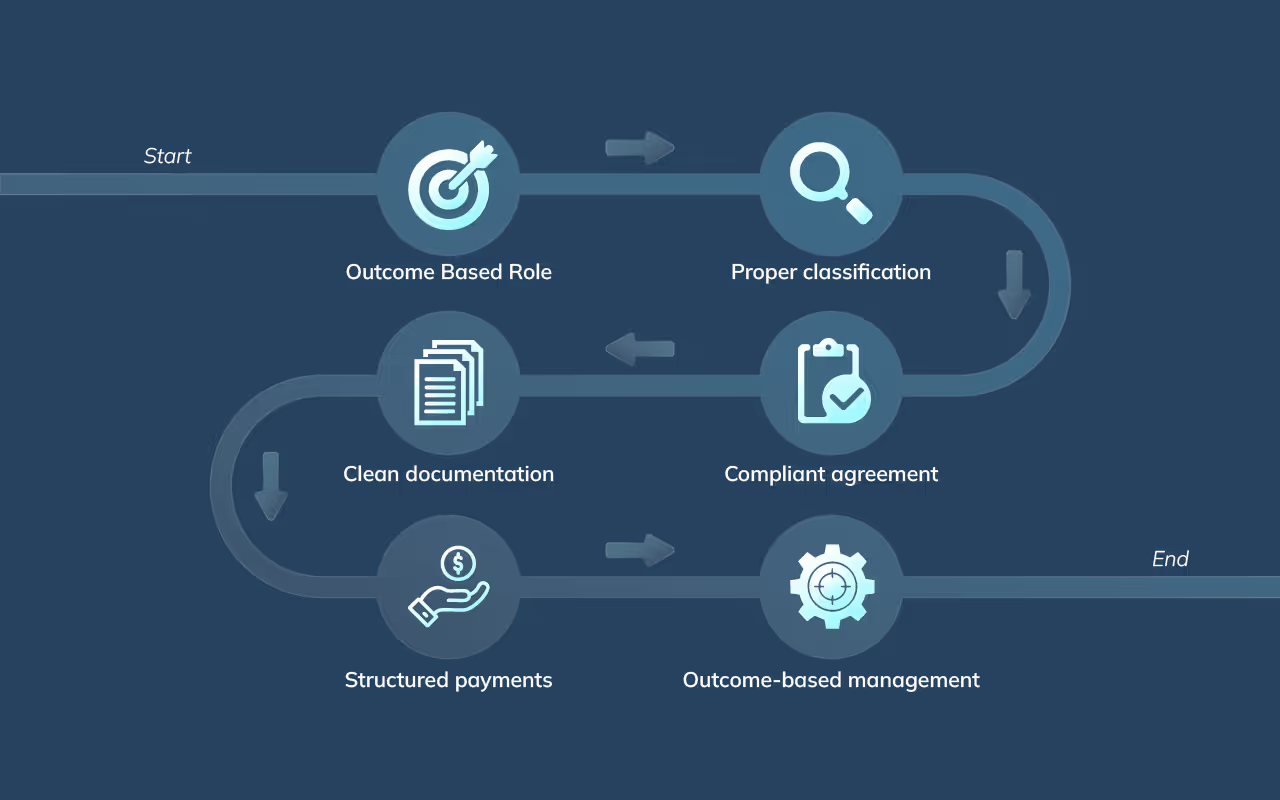
From working with startups at different stages, one pattern is clear. The companies that succeed with hiring international contractors do not overengineer the process, but they also do not wing it. They follow a simple setup that protects flexibility while avoiding future cleanup.
Step 1: Start With Outcome-Based Roles
At Hire Overseas, we see the best results when startups hire for outcomes, not availability. The role should be tied to clear deliverables such as features shipped, designs completed, or systems set up. If the role requires fixed hours or constant oversight, it is usually not a contractor fit.
Good examples include:
- Software development for defined features, integrations, or short sprints
- Product or brand design tied to specific milestones
- Marketing work such as SEO setup, paid campaign launches, or content systems
- Finance, operations, or data projects like bookkeeping cleanup, reporting setup, or system migrations
If success can be described as a finished output instead of ongoing responsibility, the role is contractor-ready.
Step 2: Get Classification Right From Day One
International independent contractors should control how and when work is done and operate independently. Setting these expectations early prevents the relationship from drifting into employee territory as collaboration increases.
Set expectations such as:
- No fixed working hours or required daily availability
- Work reviewed by milestones, not time tracked
- Asynchronous communication where possible
- Limited access to internal systems, only what is required for delivery
These practices keep collaboration effective without drifting into employee control.
Step 3: Use a Compliant International Contractor Agreement
One of the most common issues we see is startups using domestic templates for global contractors. A proper international independent contractor agreement defines status, scope, payments, IP ownership, confidentiality, and governing law before work begins.
At minimum, it should include:
- Explicit independent contractor status
- A scope of work defined by deliverables
- Payment terms and currency
- Intellectual property ownership
- Confidentiality and data protection
- Governing law and dispute resolution
Avoid US-only templates that ignore cross-border realities.
Step 4: Keep Documentation Simple and Clean
Collect the required tax forms, identity details, and invoices upfront. Clean documentation is what protects startups later during audits, due diligence, or fundraising, without adding unnecessary processes early on.
Collect:
- A signed international contractor agreement
- The appropriate W-8 form
- Basic identity or business details
- Invoices for all work completed
This keeps accounting, audits, and fundraising clean without slowing execution.
Step 5: Set Up Payments That Reinforce Contractor Status
Pay per milestone or project, require invoices, and use consistent payment methods. This structure supports proper classification and keeps accounting straightforward.
When startups partner with Hire Overseas, this process is handled end to end. We manage contractor payments, documentation, and ongoing administration so founders do not have to coordinate transfers, track invoices, or worry about inconsistent payment practices as the team grows.
Step 6: Manage Results, Not Time
Evaluate work based on agreed outcomes and timelines rather than day-to-day activity. Avoid managing schedules, approving time off, or assigning open-ended internal responsibilities. This keeps contractors productive while preserving the independence that makes the model work.
When you partner with Hire Overseas, our internal management and operations teams support this structure. We help maintain clear scopes, track deliverables, and manage operational details so contractors stay aligned with outcomes while founders stay focused on building the business.
Paying International Contractors: What Startups Need to Get Right

Once you start working with international contractors, payments and tax documentation become the main compliance touchpoints. Getting these basics right early keeps your books clean and prevents problems during audits, fundraising, or expansion.
How Paying International Contractors Works
Paying international contractors is not the same as running payroll. Contractors invoice you for completed work, and you pay based on agreed milestones or projects.
Best practices include:
- Require invoices for every payment
- Pay per project or milestone, not hourly
- Use consistent payment methods
- Track currency, fees, and payment dates
These practices reinforce independent contractor status and simplify accounting as volume grows.
When startups partner with Hire Overseas, contractor payments are handled end to end. This removes the need to manage transfers, reconcile invoices, or worry about inconsistent payment practices across countries.
Tax Forms: W-8, Not 1099
One of the most common questions startups ask is whether they need to issue tax forms for foreign contractors.
Do I Issue a 1099 to a Foreign Person?
No. You do not issue a 1099 to a foreign person for services performed outside the United States.
Instead, you should collect the appropriate W-8 form:
- W-8BEN for individual foreign contractors
- W-8BEN-E for foreign entities
The W-8 form documents that the contractor is not a US taxpayer and supports your tax reporting position.
What Documentation You Should Keep on File
To stay compliant without overengineering, startups should maintain a simple, complete record for each contractor:
- Signed international independent contractor agreement
- Completed W-8 form
- Invoices for all work performed
- Proof of payment
This documentation protects you during tax reviews, investor due diligence, and future audits.
Why This Matters More Than It Seems
Payment and tax mistakes rarely cause problems immediately. They surface later when startups raise capital, expand internationally, or formalize operations.
Clean payments, correct tax forms, and consistent documentation ensure your international contractor model scales without friction.
With Hire Overseas, these processes are built into the engagement. Startups get compliant payments and documentation by default, without adding internal finance complexity or slowing down execution.
Where DIY Hiring Breaks Down and When Platforms Make Sense

Hiring international contractors directly often feels simple at first. A few contracts, a few payments, and informal processes can work in the early days. The problem is that this approach does not scale, and the friction usually appears right when the company needs to move faster.
Where Startups Get Stuck With DIY Hiring
As teams grow and contractors become more embedded, startups commonly run into issues such as:
- Uncertainty around proper contractor classification as roles expand
- Outdated agreements that no longer reflect how the work is actually done
- Increasing complexity in managing payments across countries and currencies
- Gaps in coverage when contractors leave unexpectedly
- Difficulty explaining contractor structures and compliance during investor diligence
These issues are rarely obvious at the start, but they compound over time and create operational drag.
When DIY Hiring Still Works
DIY hiring can be effective when:
- The role is short-term or project-based
- Risk exposure is limited
- You can manage contracts, payments, and documentation manually
For early experiments or one-off needs, this approach can be sufficient.
When Platforms Become the Better Option
Platforms make more sense when:
- Contractors are long-term or critical to execution
- You are hiring across multiple roles or countries
- Investor scrutiny and compliance expectations increase
- Operational overhead starts pulling focus from growth
At this stage, the challenge is not finding talent. It is maintaining structure, continuity, and compliance while scaling.
The difference between DIY and platform hiring is not talent quality. It is operational leverage. Platforms absorb the complexity that would otherwise slow startups down just when momentum matters most.
Scale Globally Without Creating Future Risk
Hiring international contractors is not a shortcut. For startups, it is a strategic decision about how to move fast without creating problems that surface later.
When done right, international contractors give startups access to global talent, preserve runway, and keep teams flexible while the business is still evolving. When done poorly, the same model leads to misclassification risk, messy payments, and operational friction that slows growth at the worst possible time.
The difference comes down to structure. Clear roles, proper classification, compliant agreements, and clean payments allow startups to scale contractor relationships with confidence. You do not need heavy systems, only intentional setup.
Let Hire Overseas help turn this intention into a repeatable, scalable model. By combining vetted international talent with built-in operational support, we help startups get the execution of a local team without the cost, rigidity, or compliance burden.
If you want to scale faster while unlocking access to the top 1% of global talent, without compliance risk or operational drag, book a demo with Hire Overseas and see how a structured contractor model works in practice.
Frequently Asked Questions About Hiring International Contractors
Do international contractors need to be registered as a business?
Not always. Some international contractors operate as individuals, while others work through registered companies. What matters is that their status is clearly defined in the contractor agreement and supported by proper documentation such as a completed W-8 form.
How long can a startup work with the same international contractor?
There is no fixed time limit. However, long-term engagements should remain outcome-based and independent in structure. If a contractor’s role starts to resemble an employee with ongoing responsibilities and direct control, startups should reassess the engagement model.
Can international contractors work exclusively for one startup?
Yes, exclusivity is possible, but it must be handled carefully. Contractors should still maintain control over how they work, avoid fixed schedules, and operate under outcome-based agreements to preserve proper classification.
What currencies can international contractors be paid in?
International contractors can be paid in USD or their local currency. The key is consistency and clarity in the agreement and invoices. Currency choice does not affect classification as long as payments follow contractor best practices.
Are international contractors allowed access to internal systems?
Yes, but access should be limited to what is necessary for delivery. Granting broad access to internal tools or sensitive systems should be intentional and documented to avoid blurring the line between contractor and employee.
Can international contractors sign IP and confidentiality agreements?
Yes. A compliant international contractor agreement should explicitly assign intellectual property to the startup and include confidentiality and data protection clauses that apply across borders.
Do investors care if startups use international contractors?
Yes, especially during due diligence. Investors typically look for clean documentation, proper classification, and consistent payment practices. Well-structured contractor relationships are seen as a positive sign of operational discipline.
What happens if an international contractor stops working unexpectedly?
This is a common risk with direct hiring. Without backup coverage, startups may face delivery gaps. Partnering with a platform like Hire Overseas reduces this risk by providing continuity, replacements, and operational support when needed.


Unlock Global Talent with Ease
Hire Overseas streamlines your hiring process from start to finish, connecting you with top global talent.
Unlock Global Talent with Ease
Hire Overseas streamlines your hiring process from start to finish, connecting you with top global talent.
