



Startups move fast, operate lean, and depend heavily on clear communication. When hiring offshore contractors, virtual assistants, or remote specialists, English proficiency becomes a core success factor. Yet most early-stage companies still rely on resumes, generic interviews, or assumptions based on geography. These methods create blind spots and lead to misalignment, rework, and stalled operations.
A structured and modern assessment framework gives startups a reliable way to evaluate the English communication skills before making a hire, without slowing down the pace of the business. Below is a practical, startup-ready approach that focuses on real-world communication, not just fluency tests.
Step 1: Source Talent From High-Signal Channels Known for Strong English Communicators
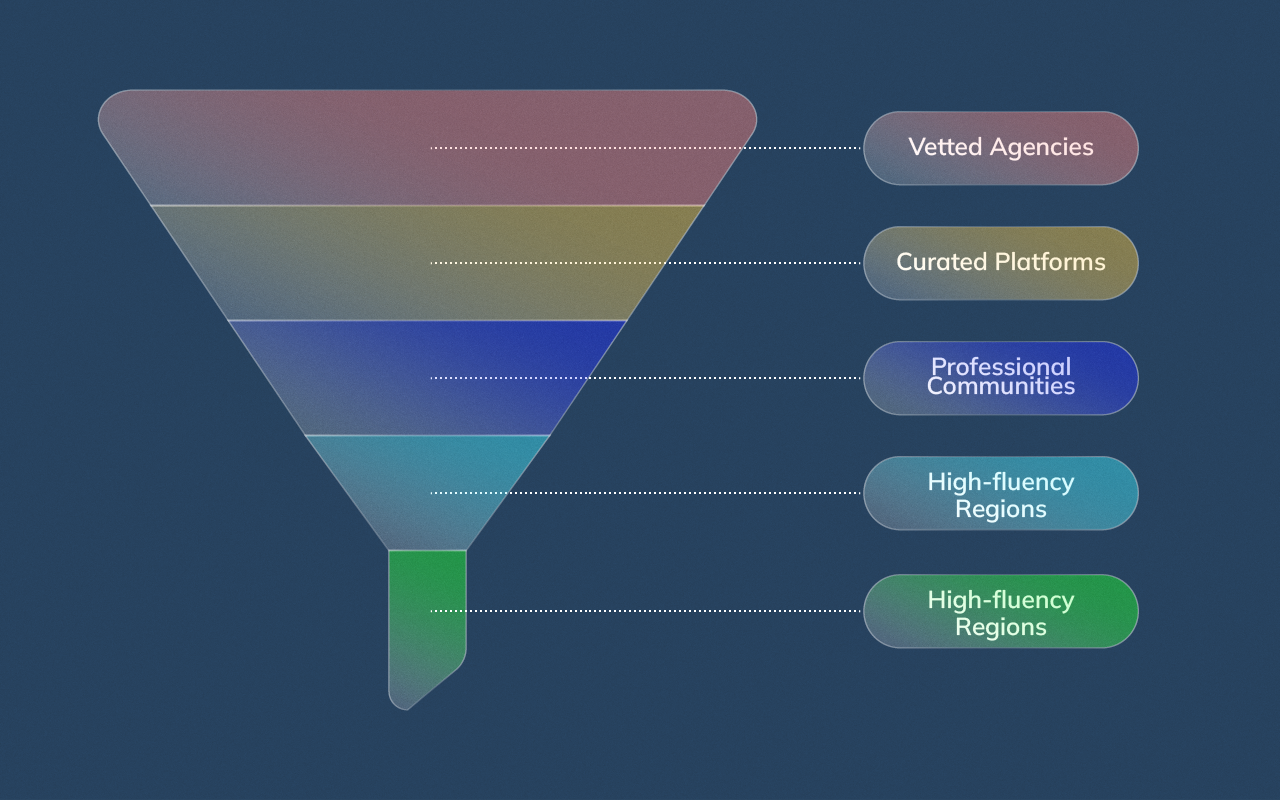
Before assessing candidates, startups must start with the right talent pools. Where you source offshore talent dramatically affects the communication quality you encounter. Instead of casting a wide net, focus on channels and regions that consistently produce candidates with strong English skills, remote-work discipline, and experience with international clients.
a. Work With Vetted Remote-Talent Agencies That Pre-Assess Communication
Agencies like Hire Overseas, SupportShepherd, Remotivate, and Wing Assistant filter applicants through:
- spoken English evaluation
- written clarity checks
- communication discipline scoring
- remote professionalism screening
This immediately eliminates the majority of applicants who struggle with English, saving founders hours of screening time and reducing hiring mistakes.
Hire Overseas Pro Tip: Use vetted agencies when hiring communication-heavy roles like virtual assistants, operations support, customer service, and project coordinators. These roles require real-time clarity and proactive communication.
b. Use Platforms With Built-In Communication Filtering
Unlike broad marketplaces, certain platforms enforce strict application criteria and include communication assessments in their process. These platforms naturally attract applicants already accustomed to Western expectations.
Examples:
- TopTal: live communication interviews and strict vetting
- Dynamite Jobs: a hands-on screening team and remote-first candidate pool
- We Work Remotely (curated category): experienced global professionals
- RemoteOK (verified listings): signals credibility and communication readiness
- These channels provide higher communication reliability than generic freelance platforms.
c. Tap Into Professional Communities That Attract English-Proficient Remote Talent
Some communities naturally gather candidates who already work with US/EU teams and understand global communication standards.
High-signal communities include:
- OnlineJobs.ph (premium-tier applicants): many with BPO or client-facing backgrounds
- Platzi and Torre (Latin America): tech-forward talent with strong English training
- LinkedIn communities across Eastern Europe: developers and operators experienced with US/EU firms
- BPO alumni groups on LinkedIn and Facebook: professionals trained in business English and structured communication
These communities self-select for candidates with stronger communication habits.
d. Prioritize Regions With Strong English Fluency Pipelines
Certain regions consistently produce offshore talent with strong English communication due to education systems, BPO ecosystems, and exposure to global clients.
- Philippines: exceptional spoken English, accent neutrality, strong comprehension, and BPO english training programs
- Latin America (Colombia, Argentina, Mexico, Costa Rica) – solid fluency plus ideal time-zone alignment for US teams.
- Sri Lanka – high literacy, strong service culture, and reliable spoken clarity.
- Nigeria – English as an official language, strong articulation, and growing remote-talent presence.
- South Africa – highly proficient English and strong suitability for client-facing roles.
- Poland, Romania, Serbia – clear written English and strong technical communication for operations and dev roles.
These regions offer not just talent, but communication infrastructure built over decades of outsourcing demand.
Why Sourcing Matters for English Assessments
You reduce 70–80% of communication challenges before you ever evaluate a candidate by choosing the right channels. Strong sourcing environments mean:
- fewer low-quality applicants
- less need for extended testing
- faster hiring cycles
- more predictable communication results
This sets the foundation for the next steps in your assessment framework.
Read more here to know more about the regions that consistently produce the strongest remote talent.
Step 2: Use Resume Screening to Identify Communication Signals (Not Grammar Accuracy)
Once you have sourced candidates from high-signal channels, the next step is filtering resumes for communication indicators. A resume cannot prove fluency, but it can reveal whether a candidate is likely to communicate clearly in a startup environment.
a. Look for Clarity, Structure, and Logic
Strong communicators tend to write resumes that are easy to scan and logically organized. Look for:
- concise bullet points
- clearly defined responsibilities
- measurable achievements
- structured formatting
- logical flow between sections
These signals reflect a candidate’s ability to organize thoughts — a core requirement for remote communication.
b. Prioritize Experience With International Clients or Remote Teams
If a candidate has worked with US, UK, EU, or Australian clients, they’ve likely developed strong English communication skills through real-world exposure.
Look for indications such as:
- “Handled client communication…”
- “Managed reporting for US team…”
- “Collaborated with international stakeholders…”
These experiences matter more than English test scores.
c. Identify Roles That Traditionally Require Strong English
Experience in the following areas often correlates with stronger communication:
- BPO/call center roles
- customer support
- client-facing virtual assistant roles
- project coordination
- technical documentation
- sales or lead qualification
These jobs require clear communication as part of daily responsibilities.
d. Avoid Overvaluing Perfect Grammar
Many offshore candidates receive help writing resumes or use AI tools. Perfect English on paper doesn’t guarantee spoken clarity.
Focus instead on structure, clarity, and relevance.
Hire Overseas Pro Tip: Resumes that show concise storytelling outperform resumes with flawless grammar. A candidate who can explain their work simply and clearly will communicate better in a startup environment than someone who writes complex, polished paragraphs.
Step 3: Implement a Quick “Communication Evidence Filter” Before Interviews
Before scheduling any interviews, startups should validate communication through a simple, low-friction request. This eliminates unqualified candidates early and saves hours.
a. Request a 30–45 Second Video Introduction
Ask candidates to briefly cover:
- who they are
- what role they’re applying for
- a recent project or responsibility
This gives you immediate insight into:
- spoken clarity
- accent intelligibility
- confidence
- ability to articulate ideas
- real-time thinking speed
It’s the fastest way to eliminate candidates who sound great on paper but cannot communicate verbally.
b. Keep the Prompt Simple and Unscripted
Overly complex prompts encourage candidates to memorize answers. You want spontaneous communication.
c. Evaluate Presence and Professionalism
Communication is more than language. Assess:
- tone
- pacing
- politeness
- engagement level
- ability to stay concise
You’re evaluating how they would appear in internal calls or client-facing interactions.
Hire Overseas Pro Tip: If the introduction sounds overly rehearsed, ask for a second spontaneous video with a practical prompt like: “Explain a task you completed last week and what the outcome was.”
This filters out memorized responses and reveals real communication skills.
Step 4: Use Structured Pre-Recorded Video Interviews as Your Primary Screening Tool
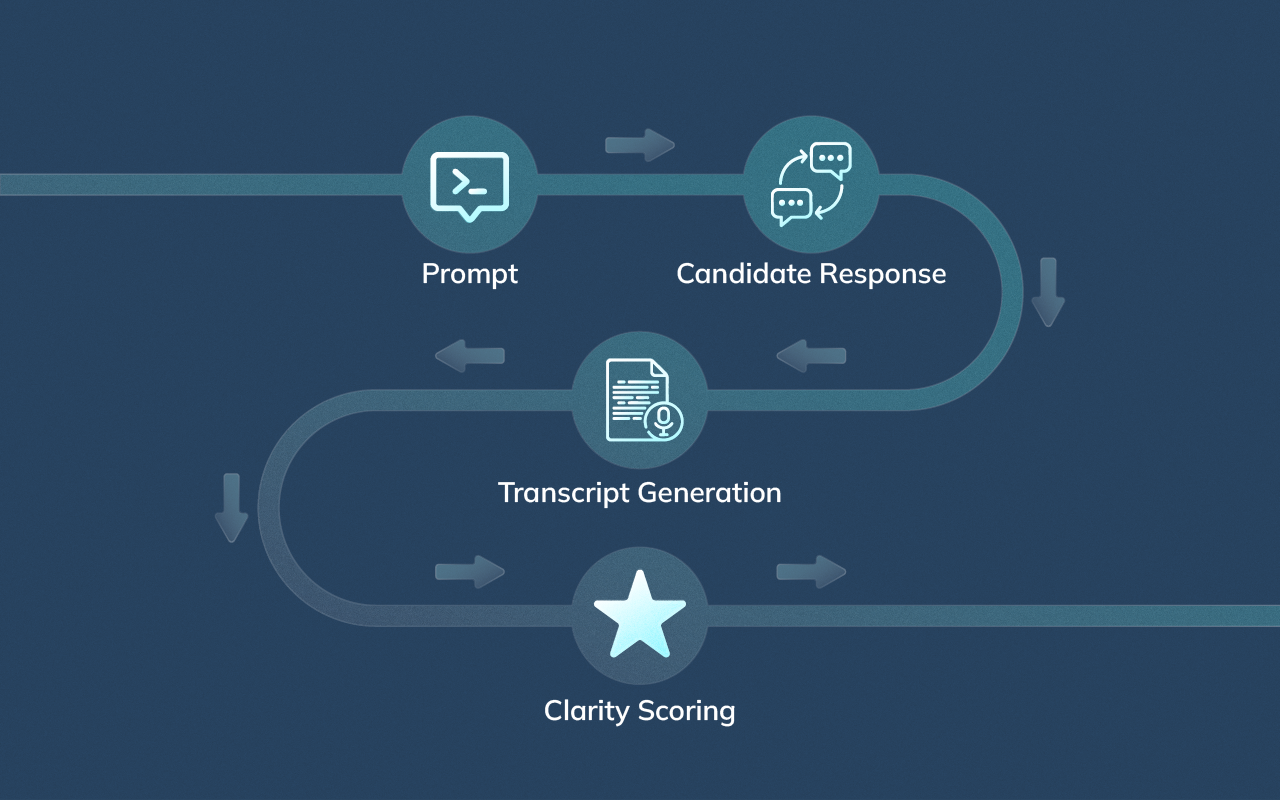
Once candidates pass the initial communication filter, move them into structured pre-recorded interviews. This is the most efficient method for startups hiring offshore talent.
a. Why Pre-Recorded Interviews Work Better Than Live Calls
Pre-recorded screening removes:
- scheduling friction across time zones
- long, repetitive interviews
- founder interruptions during the day
- It also allows standardized evaluation across all candidates.
b. Include 3–5 Startup-Specific Prompts
Ask questions that test how well candidates communicate in real work situations:
- “Summarize unclear instructions into next steps.”
- “Explain a process to a non-expert.”
- “Describe how you’d communicate a delay to a client.”
- “Walk me through how you clarify ambiguous instructions.”
You’ll see their ability to think, structure ideas, and communicate clearly — all without a live call.
c. Use Transcripts for Deeper Evaluation
Platforms that auto-generate transcripts allow you to assess grammar patterns, vocabulary, and coherence without multiple review cycles.
Hire Overseas Pro Tip: Include one “unexpected” question like:
“What is something you recently learned that improved how you work?”
This forces authentic, unscripted communication and reveals thinking style + clarity.
Step 5: Evaluate Communication Through Real Startup Scenarios
Formal tests don’t reflect startup workflows. Scenario-based evaluations show whether a candidate can communicate in chaotic, fast-moving environments.
a. Present Candidates With Realistic Challenges
Examples include:
- unclear client requests
- instructions that contradict
- task updates requiring prioritization
- writing a brief explanation for a teammate
- The goal is to mimic real communication friction they will encounter.
b. Look for Thought Process, Not Just Fluency
Founders should pay attention to whether candidates:
- break information into steps
- seek clarification
- identify missing details
- explain decisions logically
Good communication is structured thinking — not perfect grammar.
c. Evaluate How They Ask Questions
If your scenario is intentionally vague and the candidate asks thoughtful clarifying questions, it’s a strong sign they can operate autonomously.
Hire Overseas Pro Tip: Give candidates a short Loom/async video with an intentionally messy explanation, then ask them to extract next steps. This tests comprehension and summarization — two essential remote skills.
Step 6: Add a Written Communication Test for Async Collaboration
Startups rely heavily on async communication. Written clarity determines whether work moves smoothly or becomes a bottleneck.
a. Provide a Short, Realistic Writing Task
Examples include:
- rewriting unclear instructions
- creating a short SOP
- summarizing a brief into deliverables
drafting a client update
b. Assess Structure and Clarity Over Grammar
Look for:
- logical sequencing
- clarity in details
- tone and professionalism
- ability to simplify complexity
c. Evaluate Adaptability
Ask for both:
- a concise version
- a detailed version
Great remote workers adapt their communication based on context.
Hire Overseas Pro Tip: Give them a deliberately messy paragraph pulled from a real Slack thread or founder note. Ask them to turn it into a clear, actionable update. This reveals true comprehension speed.
Hire Overseas Insight: Use Region-Specific Communication Intelligence to Match Roles With the Right Talent Pools
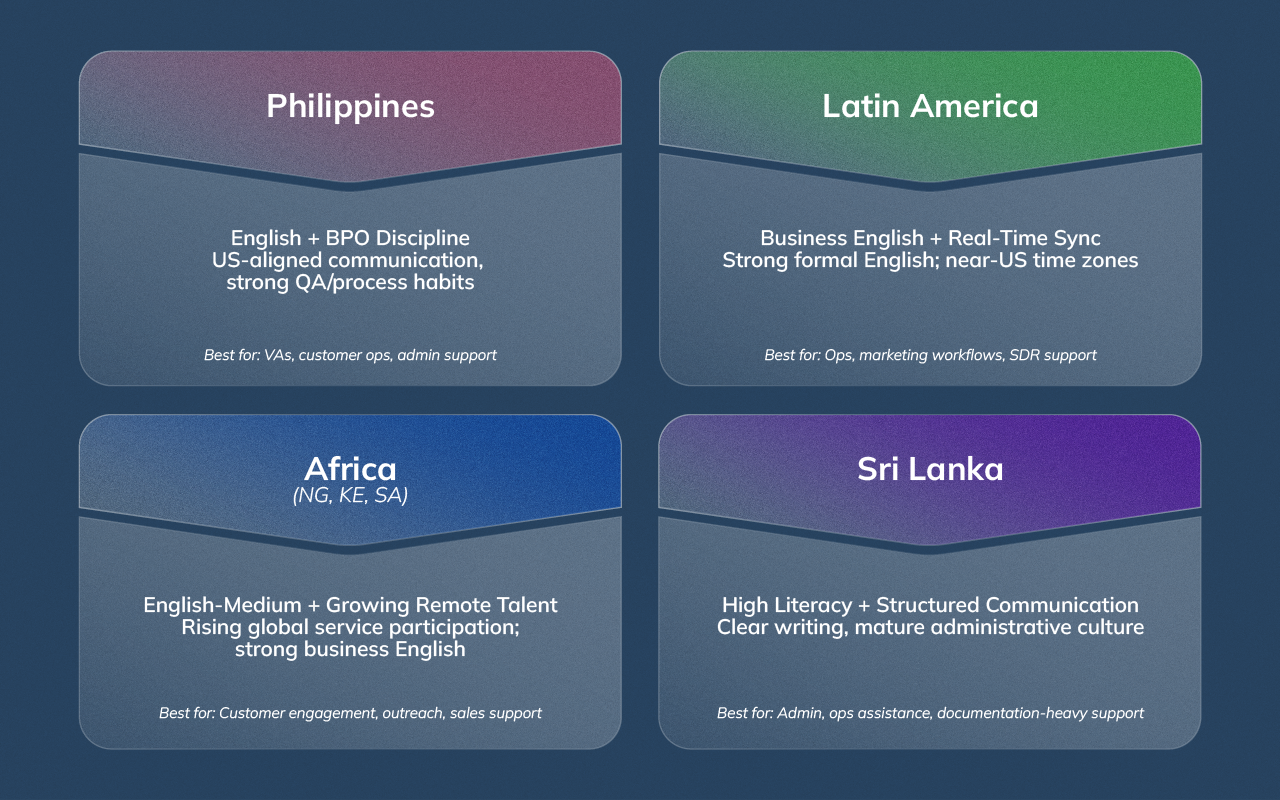
This is a step founders only access when partnering with Hire Overseas, where regional communication data and pattern recognition guide you to the best talent pools for each role.
While communication ability varies by individual, not geography, thousands of hiring cycles have revealed consistent regional strengths. Most startups never see these patterns because they hire too few people across too few regions to detect them. Hire Overseas applies this communication intelligence to avoid mismatches long before interviews begin.
Here’s the insider breakdown:
Philippines — English-Integrated Education + Mature BPO Communication Training
The Philippines has one of the most established global outsourcing pipelines, supported by:
- English as a primary instructional and business language
- a long-standing BPO industry with standardized communication training
- strong familiarity with US communication norms due to decades of outsourcing partnerships
- workforce exposure to structured client communication, QA scripts, and process documentation
Best-fit roles: virtual assistants, customer operations, coordination roles, administrative support.
Learn more: Why the Philippines remains the top global hub for English-proficient remote talent.
Latin America —Business English + Real-Time Workflow Alignment
Regions such as Colombia, Argentina, Mexico, and Costa Rica offer communication advantages shaped by:
- widespread formal English education in universities and professional programs
- increasing participation in remote-work markets serving US clients
- high adoption of business English certifications and workplace communication training
- near-aligned time zones enabling real-time collaboration and reduced clarification delays
Best-fit roles: operations, marketing workflows, SDR support, project coordination.
Africa (Nigeria, Kenya, South Africa) — English-Medium Education + Growing Remote Workforce
African regions bring communication strengths influenced by:
- English as an official or primary medium of instruction in Nigeria and Kenya
- high participation in global online education platforms and remote-work training
- increasing integration into international service roles
- South Africa’s long-established corporate English environment and strong business communication standards
Best-fit roles: customer engagement, outreach, sales support, communication-based operations.
Sri Lanka — High Literacy Rates + Service-Oriented Communication Frameworks
Sri Lanka offers a strong foundation for clear communication, shaped by:
- English as a widely taught and used business language
- high literacy and strong academic emphasis on structured writing
- a service-driven professional culture with established administrative workflows
- growing adoption of remote and BPO communication standards
Best-fit roles: administration, operations assistance, virtual assistants, support roles requiring consistent documentation.
Why This Insight Matters
Startups often match roles to skills but overlook the communication patterns that define regional strengths. This is where Hire Overseas applies practical communication data, historical performance patterns, and sourcing intelligence to prevent mismatches early. The result is faster hiring, fewer communication breakdowns, and more predictable remote-team performance.
Curious how the Philippines compares to Latin America? Read more in this PH vs .LATAM VA comparison guide.
A Final Lesson for Founders: Great Communicators Can Come From Anywhere
While strategic sourcing across certain regions increases your odds of finding strong English communicators, founders should remember that exceptional talent exists globally. Every country has standout professionals who exceed expectations—often in places startups wouldn’t think to look. The real challenge is not geography, but visibility: knowing how to uncover, evaluate, and validate these candidates quickly.
This is why experienced talent partners like Hire Overseas matter. We understand both the regional communication patterns and the individual variations within them, helping founders access high-performing candidates they might otherwise miss.
Effective global hiring is about sourcing strategically—but staying open to talent everywhere.
If you're expanding your global hiring strategy, read more about this dedicated guide to hiring overseas.
Communication Is the Backbone of a Scalable Global Team
For startups, clear communication isn’t optional — it’s the difference between smooth execution and constant friction. When offshore hires understand instructions, ask the right questions, and communicate proactively, founders gain speed, clarity, and the freedom to focus on growth instead of managing confusion.
A structured English assessment framework—paired with strategic sourcing and regional communication intelligence—gives startups a predictable way to hire offshore talent that communicates at a high level. You reduce misalignment, shorten onboarding, and build a team that operates with confidence and independence.
This is where Hire Overseas gives startups a decisive advantage. We don’t just find talent; we deliver communication-ready professionals who integrate seamlessly into fast-moving teams.
If you want offshore talent that communicates clearly from day one, start by booking a free demo with us today.
FAQs About Assessing English Skills in Offshore Talent
What level of English should I expect for different offshore roles?
Not every role requires native-level fluency. A practical benchmark is:
- Executive assistants, project coordinators, client-facing roles: High spoken clarity, fast comprehension, strong written summaries.
- Operations, marketing support, SDR assistants: Strong reading comprehension, clear written updates, conversational spoken English.
- Technical and back-office roles: Strong written clarity, ability to document processes, decent spoken communication for meetings.
Define communication expectations based on the role’s interaction level—not perfection.
Can AI English tests replace human evaluation?
AI tools (e.g., IELTS-style automated tests, voice-analysis platforms) provide useful baseline data, but they cannot fully assess:
- contextual understanding
- startup-style ambiguity handling
- ability to ask clarifying questions
- communication under pressure
- adaptability to real workflows
AI assessments are helpful as a first filter, but should be paired with scenario-based evaluation or video screening.
How do I avoid bias when evaluating accents or communication styles?
Accent does not correlate with comprehension quality. To avoid bias:
- Focus on intelligibility, not accent neutrality.
- Evaluate clarity, structure, and thought process, not speed or style.
- Use standardized prompts for all candidates.
- Avoid forming impressions within the first 10 seconds—listen for the full response.
This ensures fair, data-driven hiring decisions.
How can non-technical founders evaluate English skills without overcomplicating the hiring process?
You don’t need complex assessments. Instead:
- Use short, async video prompts
- Ask candidates to summarize unclear instructions
- Evaluate written updates for structure
- Use real messages or SOPs from your startup as testing material
This creates a simple, low-friction evaluation process aligned with real-world communication.
Can strong English compensate for limited experience?
Clear communication can accelerate learning, but it cannot replace domain expertise. For roles requiring:
- technical precision
- complex workflows
- compliance
- specialized tools
…experience matters more. For roles focused on coordination, support, and execution, communication skills can often outweigh limited experience.
