



If you do not have an executive assistant, you are the executive assistant.
Most leaders wait until they feel overwhelmed before they start searching for support. By that time, inboxes are overflowing, decisions are delayed, and key projects are stuck in your head instead of moving through your team.
Learning how to hire a remote executive assistant is not just about offloading tasks. It is about upgrading the way you operate as a leader so you can think clearly, make better decisions, and execute faster.
This guide gives you a practical framework to find a remote executive assistant who is reliable, proactive, and capable of becoming a long-term strategic partner.
Remote Executive Assistant vs Virtual Assistant: Why the Difference Matters
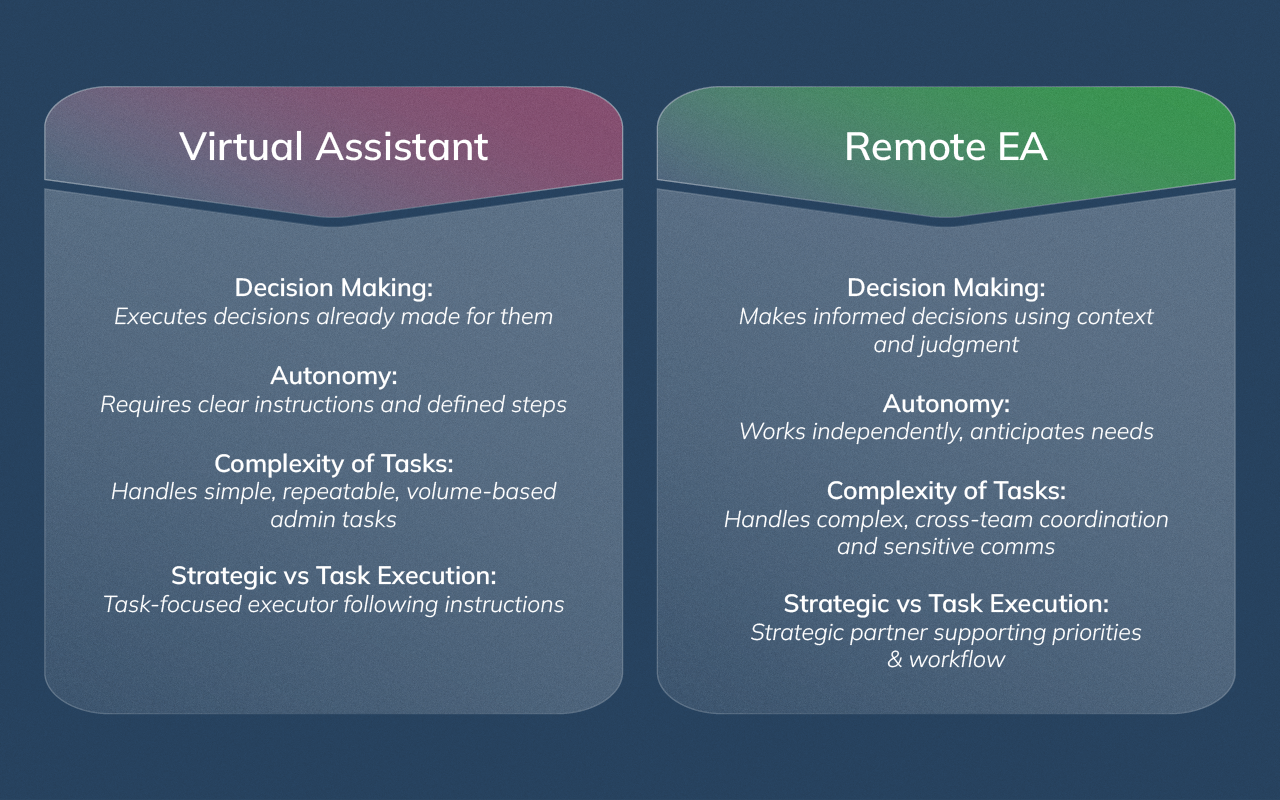
Before you begin hiring or try to find executive assistant services, you need clarity on the role you’re actually looking for. Many founders confuse a remote executive assistant (EA) with a general virtual assistant (VA), but they operate at very different levels.
A remote EA is a strategic partner. A VA is a task-focused executor.
What a Remote Executive Assistant Handles
A strong remote EA typically:
- Owns your calendar, inbox, and meeting flow
- Anticipates needs and solves problems proactively
- Coordinates across teams, clients, and stakeholders
- Manages sensitive information and high-level communication
- Supports priorities and decision-making, not just tasks
- They operate with judgment, context, and autonomy.
What a Virtual Assistant Handles
A general VA usually:
- Works on clearly defined, repeatable tasks
- Follows detailed instructions
- Focuses on execution rather than decision support
- They are valuable for volume-based admin but not for executive-level coordination.
Why It Matters
If you want to find a good executive assistant, choose someone who can think, prioritize, and communicate at your level—not just complete tasks. This distinction is the foundation of hiring the right remote EA who creates real leverage, not more work.
Step 1: Define Your Executive Operating System
Most leaders start with “I need help with email and scheduling.” That is too vague and leads to the wrong hire.
Instead, map your “executive operating system” across four buckets:
Time
- Calendar ownership
- Meeting preparation and follow-ups
- Protecting focus blocks
- Information
- Inbox triage and prioritization
- Summaries of long documents or threads
- Research and briefing notes
Execution
- Project coordination and task tracking
- Vendor, client, and team follow-up
- Light reporting and status updates
Life logistics (if you want blended support)
- Travel planning
- Reservations and scheduling
- Personal admin that protects your energy
Once this is defined, you have a clear filter for how to hire a remote executive assistant who fits your reality instead of a generic job description.
Step 2: Choose Your Hiring Model
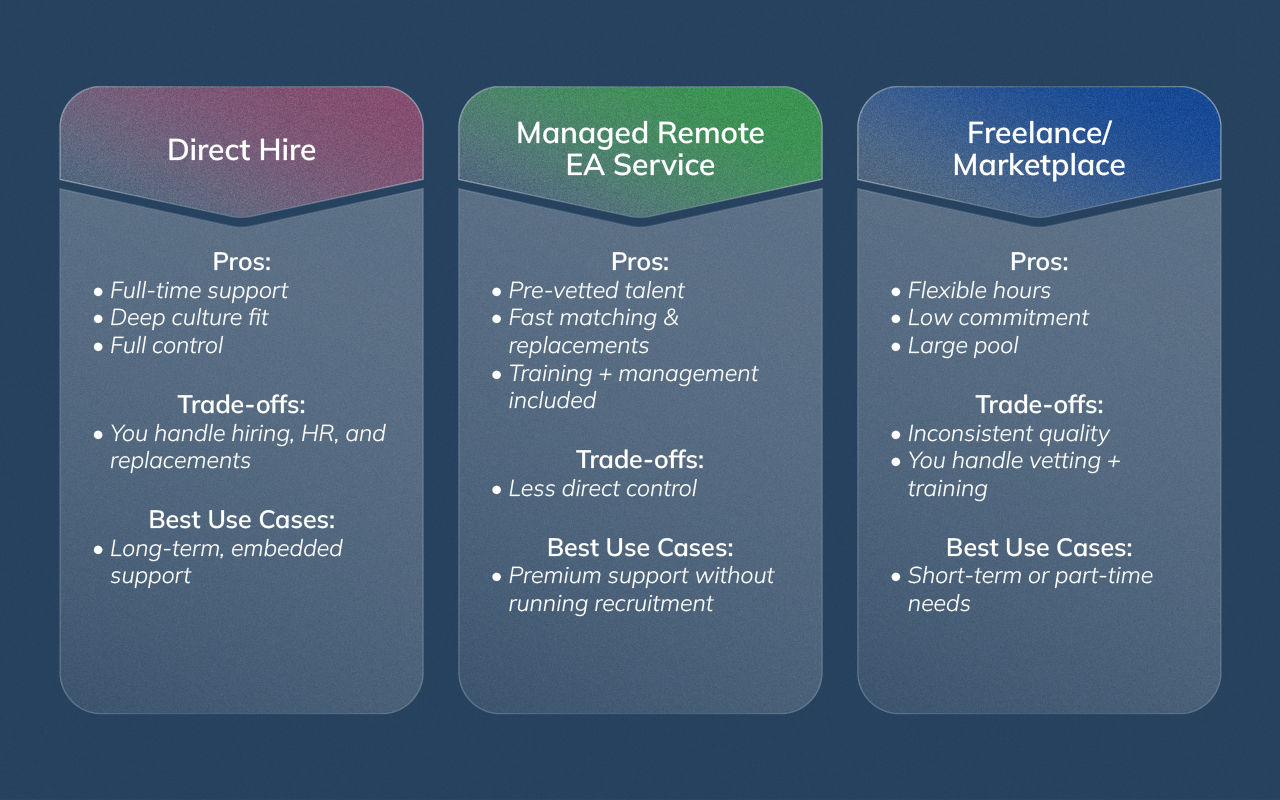
There are several ways to find an executive assistant. Each has trade-offs.
1. Direct hire (internal employee)
Best for leaders who want:
- Full-time, long-term support
- Deep integration into company culture
- Direct management and control
Trade-offs:
You handle sourcing, screening, HR, compliance, and replacement if it does not work out.
2. Managed remote EA service
Best for leaders who want:
Vetted, pre-screened executive assistants
Fast matching and replacement guarantees
Built-in training, management, and coverage
This is often the easiest way to find executive assistant services that feel premium but still flexible. Many founders prefer this route when they want to find a virtual executive assistant without running a full recruitment process themselves.
Services like Hire Overseas streamline this by handling the sourcing, vetting, and matching process, making it easier to connect with remote EAs who already meet executive-level standards.
3. Freelance and marketplaces
Useful when you:
- Need part-time or project-based help
- Have time to test multiple people
- Are comfortable with more variability
Trade-offs:
Quality is inconsistent. You are responsible for vetting, training, and retention.
Once you decide on a model, it becomes much easier to answer “where to find an executive assistant” who matches your budget, risk tolerance, and workload.
Step 3: Write a Role Profile, Not Just a Job Description
Most descriptions fail because they describe tasks, not outcomes.
Instead of only listing duties, define:
1. Primary success metrics
- Inbox response time
- Calendar accuracy and predictability
- Reduced time spent in admin per week
2. Decision boundaries
- What they can say “yes” or “no” to
- Which decisions they can make alone
- When they must escalate
3. Collaboration style
- Tools you use (Slack, Notion, ClickUp, HubSpot, etc.)
- Time zone expectations and overlap hours
- Communication cadence: daily recap, weekly planning, monthly reviews
This level of clarity helps you find a remote executive assistant who can operate with confidence instead of waiting for instructions.
Step 4: Where and How to Find an Executive Assistant
Once you know what you need, you can choose the best channel for how to find an executive assistant who fits that profile.
You can:
- Work with a specialized remote EA agency that pre-vets talent for experience, communication, and reliability.
- Use LinkedIn with targeted search terms like “remote executive assistant,” “virtual executive assistant,” or “chief of staff style EA.”
- Tap your network, especially other founders and operators who already use remote EAs.
If you want to know how to find a virtual executive assistant globally, look for partners that specialize in offshore, English-fluent executive support instead of general VA marketplaces. They usually have stronger screening around professionalism, English skills, and business context.
Read more: The top executive assistant staffing agencies and best global hiring regions to hire from.
Step 5: Build a Skills-First Interview Process
You cannot tell execution quality from a resume alone. To find a good executive assistant, test real skills in context.
Evaluate core skills
- Prioritization: Give them a list of 12 tasks with conflicts in time and importance. Ask how they would organize the day and what they would push or cancel.
Communication
Ask them to:
Draft replies to three emails: one urgent, one sensitive, one routine
Summarize a long email chain into a 5-line brief
- Autonomy and judgment: Present a scenario where you are unavailable, a client is pushing, and a teammate is late. Ask how they would handle it and what they would communicate to each party.
- Tool fluency: Have them walk you through tools they have used: calendar systems, CRMs, project tools, documentation platforms. Let them share their screen if possible and show you how they structure information.
You are not only checking if they can “do tasks.” You are testing if they can support you at the speed and ambiguity your role demands.
Step 6: Run a Paid Trial Before You Commit
A short, paid trial tells you more than another interview ever will.
During a 1–2 week test, give your remote EA:
- Real calendar control for part of your week
- Ownership of a sub-folder of your inbox
- A small project, like coordinating a customer call series or preparing a report
- Clear end-of-day updates and a weekly recap
In this period, watch for:
- How quickly they learn your preferences
- Whether they ask smart questions
- How they handle mistakes or unclear inputs
- Whether your mental load feels lighter after a few days
This is the most reliable way to find an executive assistant who not only looks good on paper but also works in practice.
Step 7: Set Up a Simple Operating Rhythm
Even the best hire fails without structure. When you hire a remote executive assistant, put a basic rhythm in place from day one:
Daily
- Priority check-in (10–15 minutes)
- End-of-day summary: what happened, what is pending, what needs your input
Weekly
- Planning call to review your goals, key meetings, and bottlenecks
- Review of what can be delegated next
Monthly
- Short performance review (what is working, what is not, what to change)
- New responsibilities to transfer from your plate
This rhythm turns your EA into a real partner instead of a task runner.
Common Mistakes to Avoid When Hiring a Remote Executive Assistant
Even experienced leaders fall into predictable traps when they begin learning how to hire a remote executive assistant. Avoiding these mistakes can save you months of frustration and dramatically increase your chances of finding someone who becomes a long-term partner rather than a short-term admin.
Mistake 1: Hiring for personality over performance
It’s easy to be impressed by someone who communicates well on a call, but surface-level chemistry can hide deeper skill gaps. Many failed hires happen because founders overvalue likability and undervalue capability.
How to avoid: Always run a structured skills test and a short paid trial. Execution reveals more than interviews ever will.
Mistake 2: Delegating everything at once
Founders often offload email, calendar, travel, follow-ups, plus internal coordination immediately—and the assistant becomes overwhelmed. Even great EAs need time to learn your preferences, communication style, and decision patterns.
How to avoid: Start with a small set of high-impact tasks that set the foundation. Expand responsibility once rhythm and trust are established.
Mistake 3: Giving vague expectations
Saying “take initiative” or “handle my calendar” without specifics leads to hesitation, misunderstandings, and repeated clarifications. Initiative requires clarity.
How to avoid: Define decision boundaries early. List what they can act on independently, where they should offer options, and what requires your approval.
Mistake 4: Ignoring time zones and responsiveness
Assuming availability without discussing it leads to misalignment, delayed responses, or missed priorities. Remote work only works with clear expectations.
How to avoid: Agree on overlap hours, response times, and escalation rules. A shared schedule prevents surprises and builds consistency.
Avoiding these mistakes positions you to find remote executive assistant support that integrates smoothly and enhances your daily workflow instead of complicating it.
Signs You Need a Remote Executive Assistant
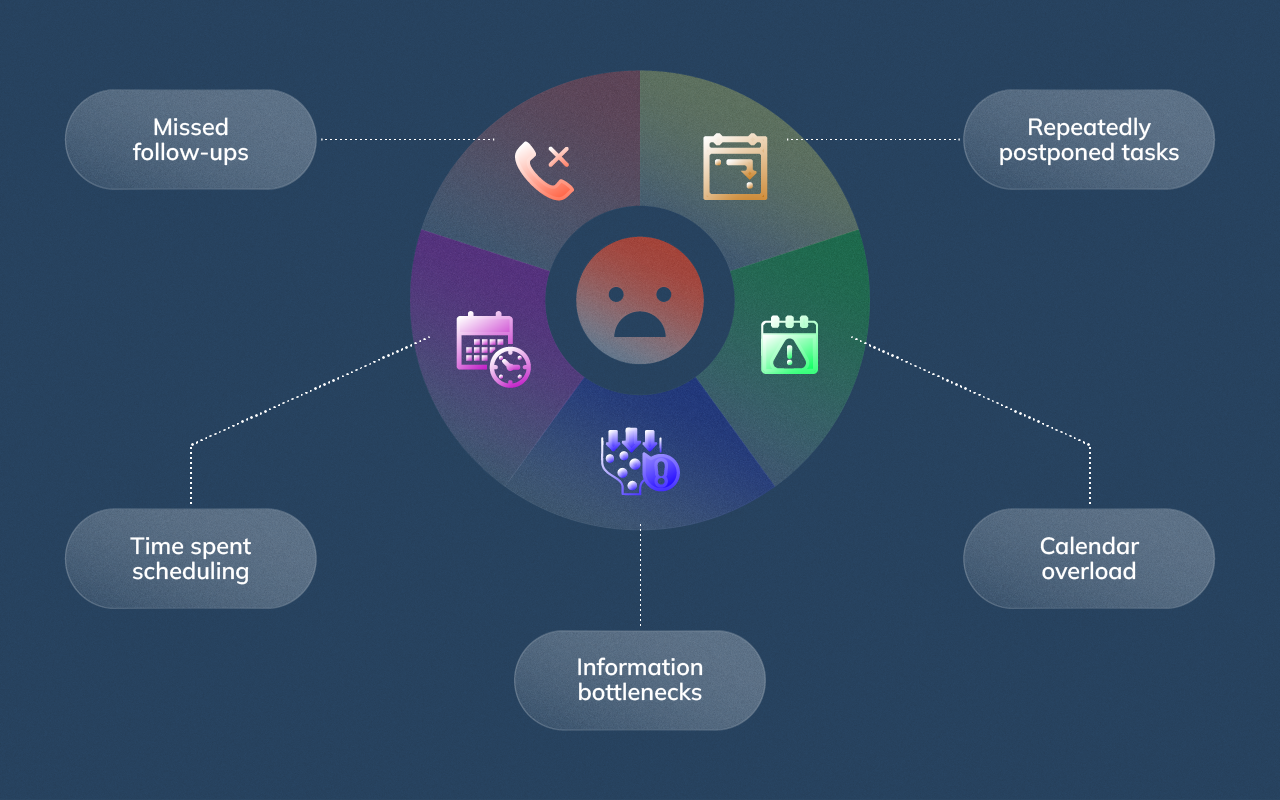
Most founders wait too long before bringing on an EA, usually because they believe they can “push through” the workload. But small inefficiencies stack into big operational costs. Here are the clearest signs it’s time to hire a remote executive assistant:
You spend more time scheduling than selling or strategizing
Your calendar becomes the bottleneck, not your capability. When scheduling takes priority over strategic work, an EA becomes essential.
You miss follow-ups with warm leads or key partners
Dropped follow-ups cost revenue, relationships, and momentum. A remote EA ensures communication never slips through the cracks.
Your team waits for your input because information is stuck in your inbox
If people cannot move without your response, your inbox is slowing the entire company—not just you.
You keep moving the same tasks from week to week
This is a sign you are overloaded and running on reactive energy rather than structure.
Your calendar feels like it belongs to everyone else except you
If your days are filled with meetings you didn’t want, tasks you shouldn’t own, or priorities that drain your energy, you’re operating without leverage.
If several of these signals describe your current reality, it’s time to stop patching your workflow with productivity hacks and start learning how to hire a remote executive assistant who can give you time, clarity, and strategic bandwidth back.
Hire Overseas Insight: How Founders Can Empower a High-Performing Remote Executive Assistant
Hiring a great remote executive assistant is only the first step. The real leverage comes from how well you set them up to operate at a high level. After placing and managing remote EAs for founders across fast-moving startups and global teams, Hire Overseas has identified the core systems that consistently separate successful EA partnerships from the ones that fall flat.
Give Them Clear Systems, Not Ambiguity
Share SOPs, templates, workflows, and examples up front. When expectations are documented, your EA can move quickly and make confident decisions without constant clarification.
Use Tools That Create Workflow Visibility
Platforms like Slack, Asana, Trello, and Notion keep priorities transparent and eliminate guesswork. Visibility turns remote work into seamless collaboration.
Establish a Simple Weekly Operating Rhythm
Short weekly check-ins, daily priorities, and structured updates give your EA direction while keeping you out of micromanagement mode. Consistency builds trust and momentum.
Align on Priorities and KPIs Early
Define what matters most—turnaround times, calendar accuracy, inbox hygiene, follow-ups, or project milestones. Priorities guide autonomy and ensure both sides measure success the same way.
Provide Feedback Early and Consistently
High-performing EAs refine their work fast when they have clear input. Feedback helps them learn your preferences, adapt quickly, and eventually anticipate your needs without asking.
A well-supported EA becomes more than an assistant—they become an operational extension of you, enabling you to think, decide, and execute at a higher level every day.
The No-Guesswork Approach to Hiring a Remote Executive Assistant
You can learn how to hire a remote executive assistant on your own and spend weeks screening resumes, testing candidates, and hoping you find the right fit—or you can partner with specialists who do this every day.
A dedicated remote EA service gives you clear advantages:
- Clear definition of your role and workload
- Access to vetted candidates across global talent markets
- Evaluation of English, communication style, and cultural fit
- Structured trials and guaranteed replacements
- Compliance, contracts, and data security handled for you
- But not all services operate at the same level. If you want executive-grade remote talent with professionalism, reliability, and judgment already built in, you need a partner who screens far beyond basic admin skills.
This is where Hire Overseas stands out.
We vet executive assistants for communication speed, decision-making, initiative, and global business competence—so you only meet candidates who can operate at your altitude. No guesswork. No gambling. Just a match built for long-term leverage.
A great remote executive assistant does more than manage your admin.
They create time. They protect your focus. They elevate how you operate as a founder.
If you're ready to experience world-class remote executive support, your next step is simple: Book a personalized consultation with us and get matched with a vetted remote EA who helps you work faster, think clearer, and scale with confidence.
FAQs About Hiring a Remote Executive Assistant
Can a remote executive assistant handle confidential or sensitive information?
Yes, provided proper safeguards are in place. Professional remote executive assistants regularly manage sensitive data such as contracts, inbox access, financial documents, and executive communications. Best practices include NDAs, access controls, password managers, and working with providers that enforce data security standards.
Is a remote executive assistant better than AI tools or productivity software?
AI tools improve efficiency, but they do not replace judgment, context, or decision-making. A remote executive assistant integrates tools, prioritizes work, manages ambiguity, and adapts in real time. Most high-performing founders use both—AI for speed and an EA for leverage.
What happens if my remote executive assistant isn’t a good fit?
This depends on your hiring model. Managed remote EA services typically offer replacement guarantees, ensuring continuity without forcing you to restart the entire hiring process. Direct hires or freelancers, on the other hand, usually require you to repeat sourcing, screening, and onboarding from scratch—creating added risk, lost time, and operational downtime.
Hire Overseas has a 14 day money back guarantee. If you’re unsatisfied with your remote executive assistant in the first 14 days, we give you your money back, and we can find you someone else. This ensures you’re not stuck with a poor fit and can move forward confidently until you have the right executive-level support for your team.
Can a remote executive assistant grow into a chief of staff–type role?
Yes. Many high-performing remote executive assistants evolve into expanded operational roles over time, supporting strategy, cross-team coordination, and execution oversight. This progression depends on capability, trust, and how clearly responsibilities are expanded.
Is hiring a remote executive assistant worth it at an early stage?
If your time is spent coordinating, scheduling, and reacting instead of building, selling, or leading—then yes. Many founders hire too late. A remote executive assistant often pays for themselves by freeing just a few high-value hours per week.
