
The State of Global Hiring: What Companies Were Doing in 2026 Beyond and What Comes Next

At Hire Overseas, we spent 2025 analyzing how US companies actually hired across borders, based on real hiring decisions, workforce structures, and long-term outcomes.
By early 2026, one thing became clear:
Global hiring is no longer an experiment, a pandemic adjustment, or a cost-cutting tactic.
It is now a core operating model for U.S. companies that want speed, stability, and access to global talent.
This 2026 report reflects:
- Real hiring execution data
- Workforce structure decisions
- Compliance shifts
- Leadership behavior changes
- Long-term outcomes across industries
Below is what actually changed — and what it means for U.S. decision-makers moving forward.
Key Findings for US Decision-Makers
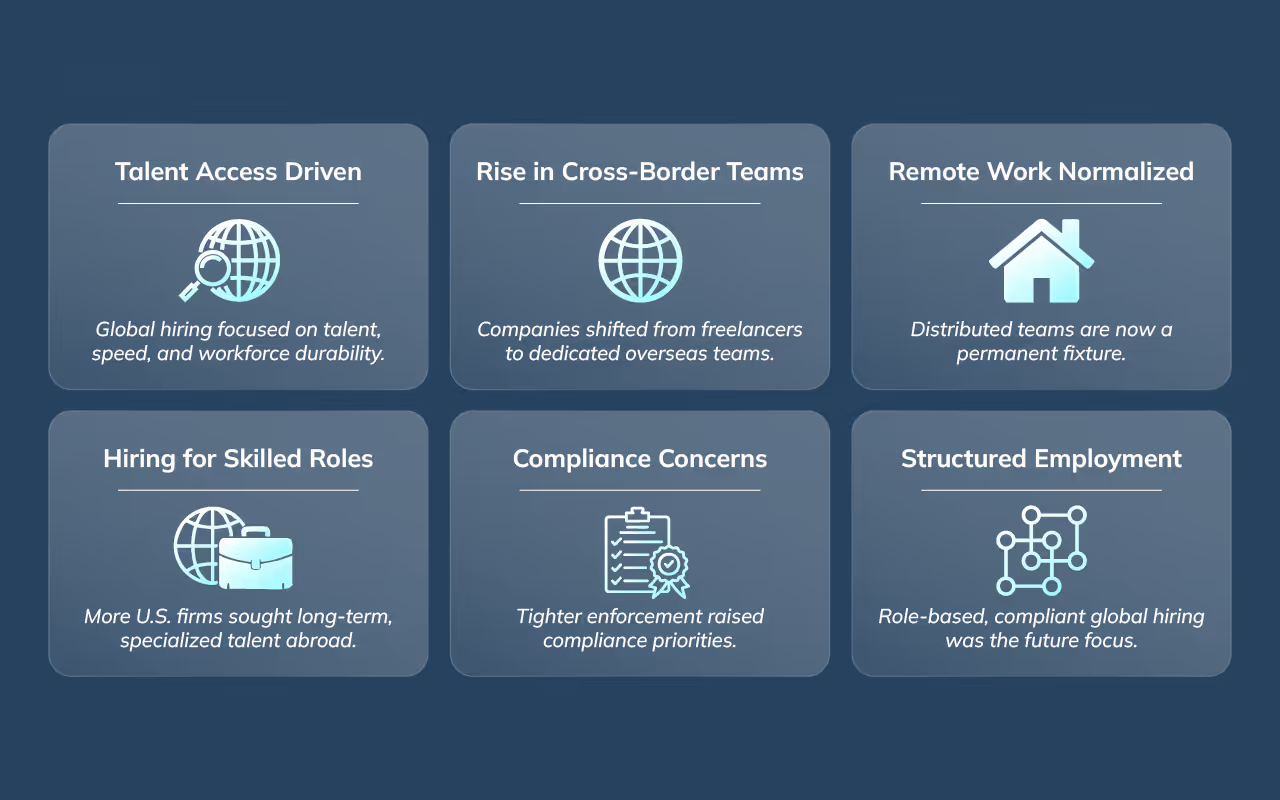
Based on our 2025 execution data and early 2026 hiring patterns, several themes are now dominant:
1. Global hiring is talent-driven, not cost-driven
U.S. companies are prioritizing:
- Speed to hire
- Access to scarce skills
- Workforce durability
- Retention and ownership
Cost efficiency still matters — but it is no longer the primary driver.
2. Dedicated overseas teams replaced freelance-heavy models
Many companies intentionally reduced contractor dependency and built:
- Long-term remote employees
- Structured overseas departments
- Clear reporting lines
The shift is toward stability and accountability.
3. Remote teams are permanent infrastructure
Distributed teams are no longer labeled “remote.” They are simply “teams.”
Geography is becoming irrelevant. Performance is what matters.
4. Compliance became a strategic filter
Worker classification, payroll compliance, and international labor enforcement tightened globally in 2025.
In 2026, compliant hiring models are a competitive advantage — not just legal protection.
5. Overseas hiring expanded into core functions
U.S. companies are hiring internationally for:
- Engineering
- AI implementation
- Operations leadership
- Customer success
- Revenue support
- Marketing strategy
Global talent is now embedded in core execution, not just support roles.
The Workforce Reality Behind Global Hiring
The structural workforce conditions that drove 2025 hiring decisions are still in place — and intensifying.
- The global workforce exceeds 3.5 billion people
- Asia represents over 55% of total labor supply
- U.S. labor force growth remains slow due to demographics
- Emerging markets continue adding working-age populations
- Cross-border remote employment participation remains elevated post-2020
For U.S. businesses, this reinforces a simple reality:
Access to talent is global.
Limiting hiring to domestic geography is optional — not required.
Global Workforce Reality in 2026
How Global Hiring Has Matured Since 2020

One of the clearest insights from 2025 was that while remote work adoption stabilized, global hiring did not reverse.
Research from Stanford’s Work From Home studies showed that remote work levels settled into steady, long-term patterns across countries rather than disappearing, confirming that distributed work had become a durable part of the global labor market. McKinsey’s research on hybrid and remote work echoed this finding, showing that companies adjusted how work was structured without returning to fully centralized models.
This aligned closely with what we observed operationally. Companies did not abandon global hiring. They refined it.
Now, remote work adoption is stabilized. Global hiring did not decline.
Instead, companies refined their approach.
What changed:
Companies moved away from:
- Short-term freelance stacking
- Geography experimentation
- Informal contractor setups
And toward:
- Structured overseas employment
- Dedicated distributed teams
- Role-based geographic specialization
- Early-stage global hiring integration
Beyond 2026, global hiring is no longer reactive. It is designed intentionally from day one.
Where U.S. Companies Are Hiring in 2026
When Hire Overseas analyzed where global hiring actually concentrated in 2025, one pattern was consistent. Companies were not spreading hires evenly across the world. They were doubling down on markets that delivered reliability.
Southeast Asia
Countries such as the Philippines and Vietnam continued to attract U.S. companies because they combined:
- Business-level English proficiency
- Established outsourcing and shared-services ecosystems
- Competitive but stable labor markets
Latin America
Mexico, Colombia, and Brazil saw rising demand due to:
- Time zone alignment with the U.S.
- Expanding professional and technical talent pools
- Improved remote work infrastructure
Eastern Europe
Poland, Romania, and Ukraine remained strong options for:
- Engineering and technical roles
- Multinational business experience
- Mature professional services sectors
Africa (Emerging Markets)
Kenya and Nigeria gained attention as emerging markets, particularly for:
- Customer support roles
- Entry-level professional positions
In 2025, most companies hiring remote workers reduced geographic experimentation and focused hiring where early success had already been proven.
The Roles Driving Global Hiring in 2026

Data from LinkedIn, Indeed Hiring Lab, and Lightcast closely matched what we observed in execution. Beyond 2026, US companies were hiring globally across both skilled and operational roles, reflecting growing confidence in managing distributed teams and a need to access talent faster than domestic markets allowed.
Technology and Engineering
These roles led global hiring due to persistent talent shortages and the ability to standardize work across locations.
Operations and Administrative Support
Operational roles continued to scale globally as companies sought reliability, process ownership, and day-to-day execution support.
Customer Support and Sales
Global hiring expanded into customer-facing and revenue-support roles as companies prioritized coverage, responsiveness, and lifecycle support.
- Customer success agents
- Sales development representatives
Marketing and Creative
Creative and marketing roles moved globally as workflows became more collaborative and performance could be measured by output rather than location.
This represented a clear shift away from viewing overseas talent as “support-only.” In 2026, global hires increasingly filled core business functions, directly contributing to product development, revenue generation, and operational scale.
[blog-cta_component
Hire Overseas Insights: What We Saw Inside Global Hiring Operations in 2025

During 2025, Hire Overseas worked directly with U.S. companies as they built, replaced, and scaled overseas teams. This put us inside hiring decisions as they happened, not after the fact.
From that vantage point, several operational trends consistently shaped which global teams scaled smoothly and which ones stalled.
A Shift From Tactical Hiring to Long-Term Global Team Design
Companies increasingly moved away from hiring overseas to solve short-term gaps. Instead, they began designing global teams as durable parts of their operating model.
We saw companies plan overseas headcount with multi-year horizons, define ownership early, and integrate global roles into core workflows rather than treating them as temporary extensions. This shift improved stability, knowledge retention, and execution quality.
By 2026 and beyond, global hiring was no longer framed as “extra capacity.” It was built as infrastructure.
Reduced Dependence on Freelancers for Core Functions
One of the clearest operational shifts we observed was the deliberate move away from freelancers in core roles.
Freelancers delivered flexibility, but companies experienced repeated friction as scale increased:
- Business context had to be re-explained
- Availability fluctuated
- Accountability was limited to tasks, not outcomes
As a result, many companies replaced freelancers with dedicated overseas team members who retained context and improved systems over time. This transition marked a broader move toward long-term employment models.
Global Hiring Expanded Beyond Support-Only Roles
Another consistent trend was the expansion of overseas hiring into skilled, business-critical functions.
U.S. companies increasingly hired globally for engineering, operations, customer success, revenue support, and technical roles. Overseas talent was no longer positioned as auxiliary support but as a core contributor to business outcomes.
This reflected growing confidence in global hiring execution and management capability.
Compliance and Worker Classification Became Strategic Filters
Compliance shifted from a downstream legal concern to an upfront decision factor.
As enforcement increased, companies began evaluating:
- Contractor vs. employee classification
- Country-specific employment requirements
- Long-term legal exposure
Earlier compliance planning allowed teams to move faster overall by avoiding reclassification, rehiring, and legal remediation later. Structured employment models increasingly replaced informal arrangements.
Hiring Concentrated in Proven Talent Markets
Rather than expanding globally without focus, companies concentrated hiring in regions with predictable performance.
We saw U.S. companies double down on markets where early hires succeeded, building depth instead of breadth. This reduced onboarding friction, improved management efficiency, and supported faster scaling.
Geographic discipline became a competitive advantage.
Management Structure Emerged as the Hidden Success Factor
One trend that rarely appears in reports was the role of management timing.
Global teams performed best when companies:
- Assigned managers earlier
- Clarified reporting lines from day one
- Set explicit performance expectations
Teams that delayed management layers often blamed geography for performance issues that were actually structural. Companies that treated global teams like in-house teams saw faster stabilization and higher retention.
Why These Trends Matter
These trends were not theoretical. They were operational signals observed repeatedly throughout 2026 and beyond.
They reinforced a core lesson from Hire Overseas’ perspective:
Global hiring succeeds when it is designed as a long-term operating system, not a staffing shortcut.
What's the State of Global Hiring Signals About the Future

Based on execution trends, several forward shifts are now visible.
1. Global hiring starts earlier in the company lifecycle
Startups are building overseas teams at foundation stage — not post-Series B.
2. Geography will become role-specific
Instead of asking:
“Where is labor cheapest?”
Companies ask:
“Where does this role perform best long term?”
3. Compliance will separate scalable companies from fragile ones
Structured employment models will outperform contractor-heavy systems.
4. Overseas teams will fully dissolve the “local vs global” divide
Teams will be measured entirely on output, ownership, and impact.
What This Means for U.S. Leaders in 2026
The biggest shift is not geographic. It is leadership-driven. Global hiring is now an organizational design decision.
U.S. leaders must:
- Define ownership early
- Clarify escalation paths
- Invest in documentation
- Create structured onboarding
- Standardize performance metrics
- Design communication rhythms intentionally
Global hiring raises the leadership bar.
But when executed correctly, it multiplies capacity.
The State of Global Hiring 2026. The Competitive Advantage is Execution
Beyond 2026, global hiring works. The question is not if it works.
The question is how well you execute it.
The companies winning are the ones that:
- Design clear global roles
- Hire from proven talent markets
- Prioritize compliance
- Build management structure early
- Replace fragile freelance setups with durable teams
The next phase of global hiring will not be defined by access to talent.
It will be defined by:
- Structure
- Stability
- Leadership maturity
- AI integration readiness
Build a Smarter Overseas Team in 2026
If you are planning to:
- Hire overseas for the first time
- Replace inconsistent freelancers
- Build a compliant remote team
- Scale AI-supported operations
- Strengthen operational capacity
Hire Overseas can help you design a structured global hiring strategy aligned with U.S. compliance and long-term growth.
Book a strategy call to build a stable, scalable overseas team that performs like core infrastructure — not outsourced support.
FAQs About The State of Global Hiring
Why is global hiring still growing in 2026?
Because U.S. companies are solving talent access constraints, not remote work preferences. Global hiring reduces time-to-hire, expands skill access, and increases workforce durability.
Is global hiring only for large enterprises?
No. Startups and mid-sized businesses now hire overseas earlier to gain execution leverage and reduce dependency on constrained domestic labor markets.
Does global hiring mean lower costs?
Not necessarily. While cost efficiency remains a factor, the primary drivers in 2026 are performance, reliability, retention, and speed.
What roles are most commonly hired overseas?
Technology, AI implementation, operations, customer support, revenue roles, and marketing are leading categories.
How important is compliance in global hiring?
Critical. Worker classification, payroll alignment, and local employment laws directly impact scalability and risk exposure.
What is the biggest mistake U.S. companies make when hiring overseas?
Treating global hiring as a staffing shortcut instead of a long-term operating model.




Unlock Global Talent with Ease
Hire Overseas streamlines your hiring process from start to finish, connecting you with top global talent.
Unlock Global Talent with Ease
Hire Overseas streamlines your hiring process from start to finish, connecting you with top global talent.
