


Most founders don’t struggle because they have *no* support.
They struggle because they hired the wrong kind of support.
When the role is a mismatch, small things pile up fast: decisions slow down, your calendar gets noisy, and you still end up doing work you thought you had delegated. But when the role fits your real bottleneck, day-to-day operations become lighter and leadership gets sharper.
This guide breaks down the difference between an executive assistant and a virtual assistant so you can choose the right support layer for your stage.
Why This Comparison Matters for Founders and CEOs
This is not just a role comparison—it’s a decision about how your time and leadership capacity get protected.
For founders, this isn’t a title debate. It’s a leverage decision. The real question is: Do you need someone to run recurring tasks, or someone to protect executive focus and support high-level decision flow?
When you choose the right role, work gets easier and faster. Choose the wrong one, and everything feels harder than it should.
Common signs of mismatch include:
- You hired support, but still handle follow-ups yourself
- Your day is full, but strategic priorities keep slipping
- Team communication depends too much on you
- You’re paying for help, but still feel overloaded
That usually means the role is handling tasks, but not reducing the leadership pressure that’s actually slowing the business down.
What Is an Executive Assistant?
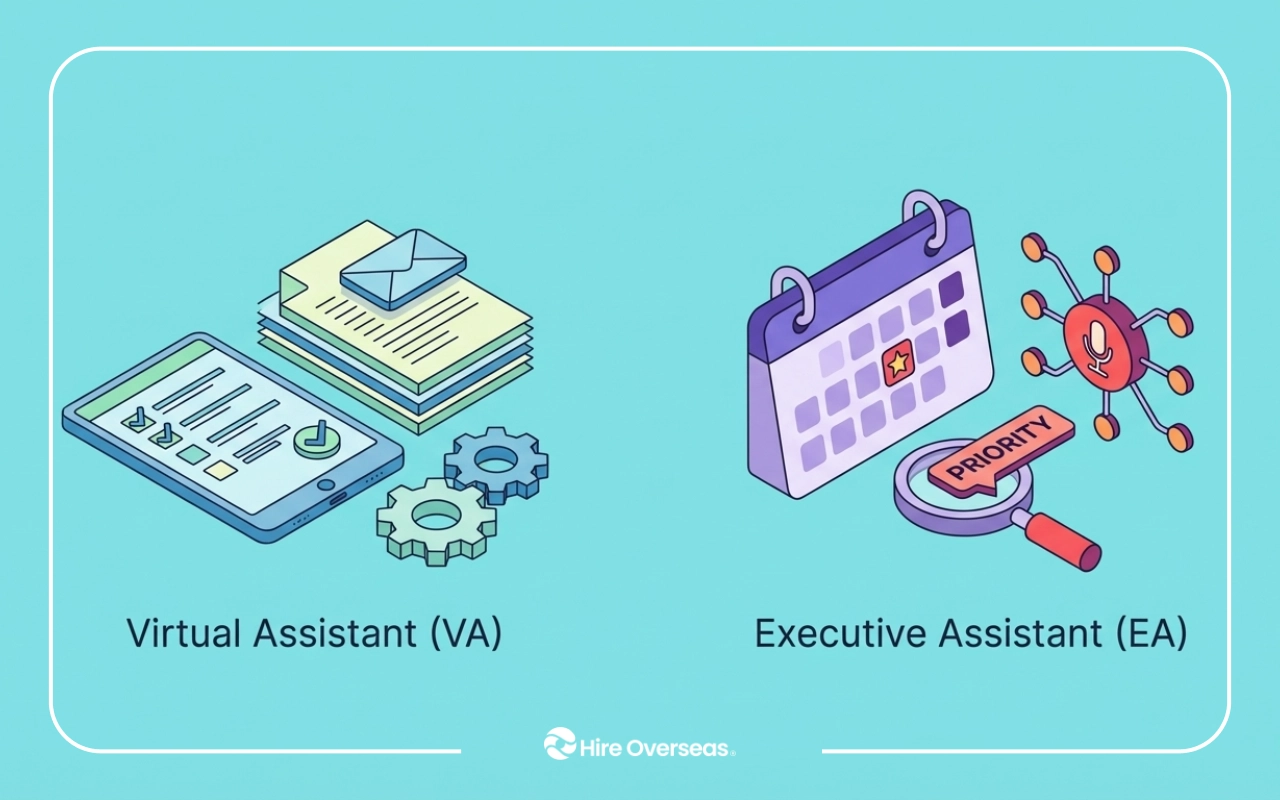
An Executive Assistant (EA) supports leadership at a strategic level.
This role is less about task volume and more about decision quality, focus, and coordination around the founder or executive team.
Typical EA responsibilities include:
- Managing a high-stakes calendar and inbox
- Prioritizing what needs leadership attention now vs. later
- Coordinating across teams and stakeholders
- Preparing agendas, briefs, and follow-through
- Handling sensitive communication and confidential workflows
In short, an EA helps leadership operate with less friction and better control.
What Is a Virtual Assistant?
A Virtual Assistant (VA) is a remote professional focused on operational and administrative execution.
This role works best when you already know what needs to be done and need consistent help getting it done.
Typical VA responsibilities include:
- Scheduling and meeting coordination
- Inbox cleanup and routine follow-ups
- CRM updates and admin documenta
Experienced executive assistants in the U.S. commonly earn $35–$60 per hour, reflecting their strategic proximity to leadership decisions.
By contrast, many businesses hiring remote support pay $3–$10 per hour for Filipino virtual assistants, with full-time salaries often ranging $400–$1,200 per month depending on experience.
This is why the decision between executive assistant vs. virtual assistant should be based on business complexity—not title preference.
If cost is driving your EA vs VA decision, this virtual assistant cost analysis breaks down hourly and monthly pricing bands by experience level so you can set a realistic budget before interviewing candidates.
Virtual Assistant vs. In-House Assistant: Additional Founder Considerations
Beyond role scope and cost, this comparison affects how support performs inside your company’s day-to-day operating environment.
Coverage model and business hours design
In-house assistants usually follow one local schedule.
Virtual support can be designed for staggered or extended coverage across time zones.
This matters when your team, clients, or vendors operate across regions.
Business continuity and single-point-of-failure risk
In-house support can create concentration risk if key workflows depend on one person in one location.
Virtual models often allow easier backup coverage and handoff design when documented properly.
Documentation maturity and process resilience
Remote support tends to expose weak documentation quickly.
That pressure can be useful: teams that standardize SOPs, handoffs, and response rules usually become more resilient overall.
Tooling and communication discipline
Virtual support depends on clear systems: task tracking, async updates, written briefs, and communication SLAs.
If your team is weak in operational tooling, performance may lag until those systems are tightened.
Security and access architecture
Remote collaboration requires structured access controls, permission tiers, and audit-friendly workflows.
Founders should evaluate whether their current stack supports secure delegation before scaling assistant support.
Culture and management load
In-house support may feel easier culturally because interactions are visible and immediate.
Virtual support requires stronger manager habits: clearer expectations, better written feedback, and outcome-based oversight.
Scalability of support design
In-house models often scale linearly by headcount.
Virtual support can be modular (part-time, specialized, or layered), which can better match uneven growth patterns.
These factors help founders evaluate not just who does the work, but how reliably the support model performs as the company becomes more complex.
If you’re still deciding whether your bottleneck is founder coordination or task backlog, this virtual assistant vs. in-house assistant breakdown compares coverage, management load, and continuity risk so you can choose a support model that won’t break at the next growth stage
How to Choose the Right Role for Your Stage
The right hire is the one that removes your current bottleneck, not the one with the better title.
At this stage, most founders are dealing with one of two constraints:
1) too much repeatable operational work, or
2) too much leadership coordination and decision traffic.
Use that as your filter.
Choose a Virtual Assistant if your bottleneck is execution capacity
A Virtual Assistant is usually the right fit when your business already knows what needs to happen, but doesn’t have enough consistent bandwidth to execute it.
You likely need a VA if:
- Your workload is mostly repeatable admin/process work
- You already have SOPs and need reliable follow-through
- You want cost-efficient support that can scale with workload changes
- Your bottleneck is output volume, not executive coordination
- Tasks are falling behind because no one owns recurring execution end-to-end
What success looks like with a VA:
- Cleaner inboxes and calendars
- Fewer dropped follow-ups
- Better task completion rhythm
- More predictable operational throughput week to week
If your team already has SOPs and you need execution capacity fast, this hire virtual assistant in the Philippines guide covers screening criteria, onboarding sequence, and common failure points in the first 30 days.
Choose an Executive Assistant if your bottleneck is leadership leverage
An Executive Assistant is usually the better fit when execution is happening, but leadership effectiveness is breaking down due to fragmentation.
You likely need an EA if:
- Your schedule is constantly fragmented
- Strategic work keeps getting pushed back
- Team and stakeholder communication is becoming complex
- You need trusted support for confidential, high-context workflows
- Prioritization depends too heavily on you, creating decision bottlenecks
What success looks like with an EA:
- Stronger control over leadership time
- Better priority sequencing across teams
- Faster decision follow-through
- Less executive context-switching and coordination drag
A practical growth path for many companies
Many companies use both roles over time—but in sequence.
A common pattern:
- Start with VA support to stabilize recurring execution
- Add EA support once leadership coordination becomes the limiting factor
- Redefine role boundaries as the company grows, so support layers don’t overlap or conflict
The key is not “VA vs EA forever.”
It’s matching support depth to business complexity at each stage.
If leadership bandwidth is the real constraint, this how to hire a remote executive assistant playbook shows how to evaluate discretion, prioritization judgment, and communication maturity before you make a high-trust hire.
Hire Overseas Expert Insight: How We Advise Clients to Choose
At Hire Overseas, we don’t begin with titles—we begin with operating friction.
In client discovery calls, we usually map four things first:
- Where founder time is currently going (strategic vs administrative)
- Whether execution gaps come from missing capacity or weak process design
- How mature the SOP layer is today
- Whether the role requires judgment/discretion or process reliability
Our practical advisory lens focuses on implementation risk, not just role selection.
Once the direction is clear, we help founders de-risk execution by defining:
Decision rights: what the role can own vs. what still requires founder input
Handoff design: how tasks move across teams without creating follow-up debt
Success metrics: what “working” looks like in the first 30–60 days
Scope boundaries: where the role starts and stops to prevent role creep
This prevents two expensive mistakes:
- Hiring the right title but with unclear ownership
- Adding support without reducing founder dependency in practice
Real-Life Scenarios: What This Looks Like in Practice
Here’s how this decision usually shows up in real companies: where the bottleneck appeared, what was hired, and why it worked.
Scenario 1: The founder became the default dispatcher
Everything ran through the founder—approvals, follow-ups, calendar decisions, internal alignment. Team quality was fine, but speed dropped because coordination depended on one person.
What we changed: Brought in an Executive Assistant to manage priority flow, meeting architecture, and stakeholder follow-through.
Result: Faster decisions, fewer executive interruptions, and better control over leadership time.
Scenario 2: Strategy was clear, execution was inconsistent
Leadership knew what to do, but recurring tasks kept slipping: CRM hygiene, scheduling, reporting prep, and routine follow-ups.
What we changed: Started with a Virtual Assistant, scoped around repeatable workflows with clear SOPs and weekly accountability.
Result: Cleaner operational rhythm, fewer dropped tasks, and immediate capacity gains without overbuilding headcount.
Scenario 3: The first hire was too senior for the actual bottleneck
The company hired an EA first, but most pain was still the task-volume backlog. Strategic support was underused while admin gaps stayed unresolved.
What we changed: Re-leveled the support model—VA first for execution stability, then expanded into EA support once coordination complexity justified it.
Result: Better role-fit, stronger ROI, and less role confusion across the team.
Scenario 4: Leadership looked busy but strategic work kept slipping
Executives were in constant meetings, but cross-functional priorities moved slowly and decisions lacked clean follow-through.
What we changed: Added EA-led priority sequencing, briefing discipline, and ownership tracking across stakeholders.
Result: Less context switching, tighter execution around leadership decisions, and improved strategic throughput.
Scenario 5: Distributed team, single-timezone support model
The team was remote, but support coverage was fixed to one local schedule. Handoffs stalled, response times lagged, and small delays compounded daily.
What we changed: Shifted to virtual support with timezone-aware coverage and clearer async handoff rules.
Result: Faster turnaround, smoother coordination across regions, and fewer avoidable operational delays.
Don’t Hire by Title, Hire by What’s Slowing Growth
Most founders don’t need “more help.” They need the right layer of help for the constraint they’re facing now.
If execution is breaking, adding strategic support won’t fix it.
If leadership is the bottleneck, adding more task support won’t unlock growth.
This is where most hiring mistakes happen: companies hire for relief, not for leverage design.
A good support model should do three things:
- Remove the current bottleneck
- Improve operating rhythm (not just reduce workload)
- Stay scalable as complexity increases
That’s why this decision matters. The right hire changes how the business runs. The wrong one keeps founders in the loop for work they should no longer be carrying.
If you want a clear recommendation based on your stage, workflows, and leadership load, book a structured advisory call with Hire Overseas today.
Related Video: How to Manage Overseas Teams & Contractors
If you’re choosing between EA and VA support, this video adds a systems-level view on structuring roles, ownership, and execution as you scale.
In this breakdown, we explain:
- Role clarity for overseas support
- How to match support type to bottlenecks
- Why SOPs and boundaries drive ROI
- How to avoid role drift
